
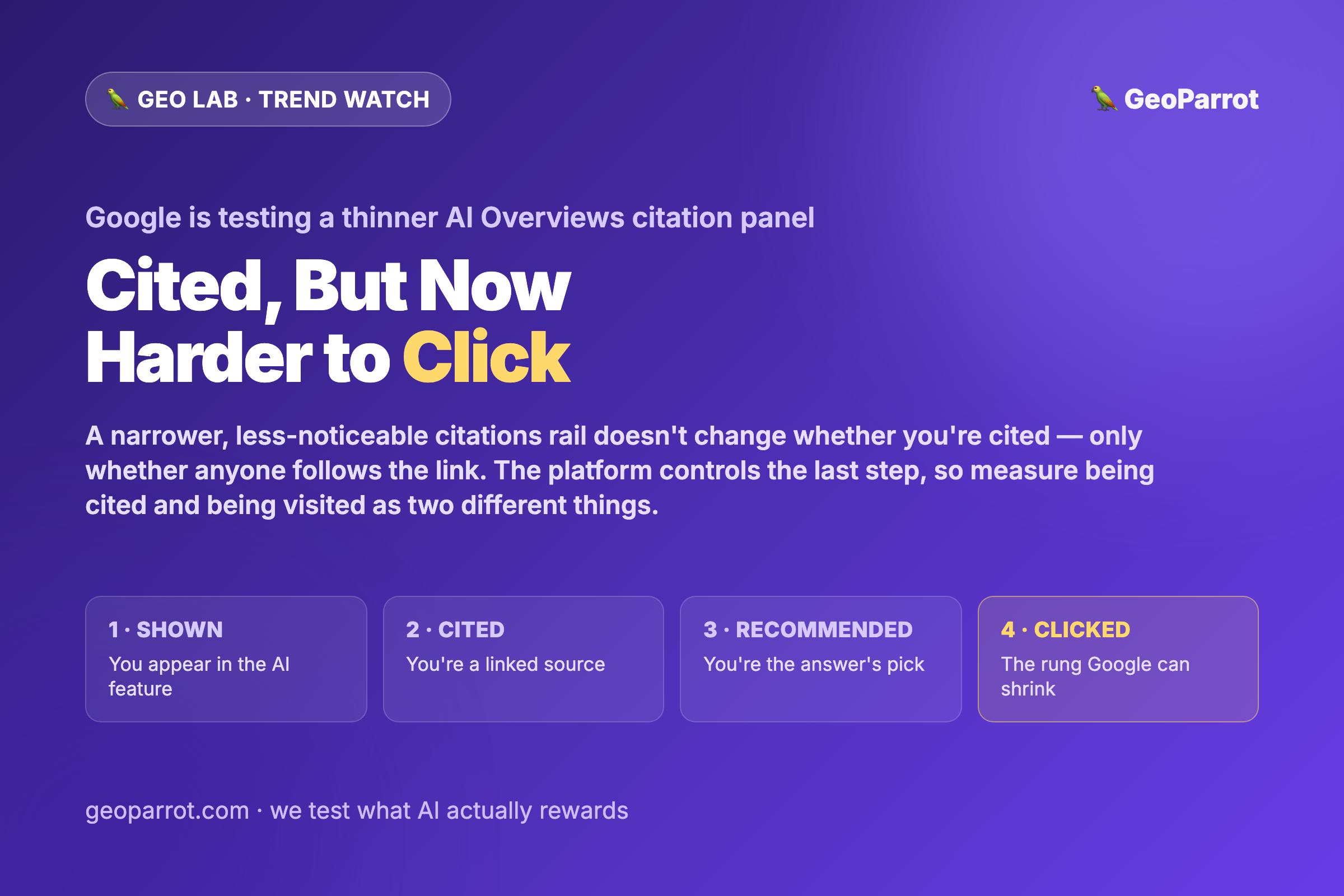
Quick answer: Google is testing a thinner, less-noticeable citations panel on the right side of AI Overviews on desktop — the rail of source links that sits beside the AI answer. It was spotted on September 8 and is not a confirmed rollout. If it does ship, the practical effect is blunt: being cited will send even fewer clicks than it already does. That doesn’t change what you write; it sharpens the one discipline we keep hammering in the GEO Lab — track citation and traffic as two separate things, because a link you can’t see is a citation that doesn’t convert. Watch this test; don’t rebuild your strategy around a screenshot.
Trend watch — published September 12, 2026. This is a fact-check post: the shrinking citation panel was reported this week and resurfaced in the September 11 search recap, so we pulled the primary source, checked what was actually observed, and asked what it means for practitioners — before anyone turns a UI test into a strategy.
What exactly is Google testing?
On desktop, a Google AI Overview shows the generated answer with a panel of source links off to the right — the citations rail. This week, SEO practitioner Khushal Bherwani posted side-by-side screenshots showing that rail rendered noticeably narrower in some searches, and Search Engine Roundtable’s Barry Schwartz confirmed he could reproduce it. Schwartz’s own read was direct: the panel is “noticeably thinner and may be less noticeable to searchers, maybe leading to fewer clicks.” He also questioned the optics for publishers — “I am not sure if making links and citations [smaller] is a good strategy to make the publishing world love you, Google.”
Two caveats belong right up front, because they decide how you should react. First, Google has not confirmed this — it’s a test observation from replicated screenshots, not an announced change, and Google runs and kills UI experiments constantly. Second, it’s been seen on desktop AI Overviews only, on some queries. So the honest framing is: a live experiment that trims citation real estate, consistent with a direction Google has been moving all year — not a shipped feature you can measure yet.
Why does a narrower panel matter so much?
Because it targets the exact spot where a citation turns into a visit. Getting cited in an AI answer is already a weak traffic guarantee — the answer often satisfies the user in place. The citations panel is the one piece of that interface still designed to pull people out to sources. Shrink it, make it easier to overlook, and you reduce the click-through on the citations you worked to earn, without changing whether you were cited at all. That’s the uncomfortable part: your visibility metric (“we’re in the sources”) can hold steady while your traffic from it quietly falls. It’s the same zero-click pressure we tracked when People Also Ask went almost entirely to AI Overviews and when AI Overviews began expanding toward AI Mode by default — now reaching the link rail itself.
Cited, then clicked — a new rung on the visibility ladder
Our experiments this year kept splitting apart things the industry treats as one. Being on the list is not being the pick: self-ranking listicles get cited but rarely recommended. Being cited is not being recommended: our consensus-pick work showed the brand an engine actually endorses is a separate signal from the ones it links. This test adds the next rung. Picture the ladder as:
| Rung | What it means | Who controls it |
|---|---|---|
| Shown | Your page appears in an AI feature (an impression) | The engine’s retrieval |
| Cited | You’re one of the linked sources for the answer | The engine’s citation logic |
| Recommended | You’re the answer’s actual pick, not just a source | The engine’s synthesis |
| Clicked | The user leaves the answer and visits you | The interface — which the engine can shrink |
The thinner-panel test is Google adjusting the last rung by design. You can climb every rung below it and still lose the click, because whether the link is prominent or nearly invisible is a layout decision made by the platform, not by your content. That is exactly why counting citations as if they were traffic is a trap.
What actually breaks is measurement (again)
If the panel shrinks and clicks fall, the danger is misreading your own dashboards. Google’s Search Console Generative AI report shows impressions in AI features but no click data — so a healthy impression count can sit right on top of collapsing click-through and you’d never see the gap there. That’s why you pair it with your own GA4 tracking for AI referrals, watching the actual visits, not just the appearances. And it’s a reminder about the “AI traffic converts better” story: we found the reported multiples run from -13% to 23x, largely because AI referral volume is tiny and the rate sits on a small denominator. A thinner citation rail makes that denominator smaller still — so a great-looking conversion rate can coexist with shrinking conversion counts. Measure both, and never let a citation-share number stand in for traffic.
Does “fewer clicks” mean citations stop being worth it?
No — and this is the part worth slowing down on. If the click gets rarer, the value of being cited migrates upstream, from the visit to the influence. Being the source an answer is built on still shapes how the engine frames the topic, and repeated presence in answers feeds the brand-recognition signals that actually move AI recommendations — recall that brand mentions correlate with AI citations far more strongly than backlinks. So the response to a shrinking panel is not “abandon citations.” It’s to stop valuing a citation purely as a click, and start valuing it as a durable presence in the answer that compounds into being the recommended pick over time. The click is the part Google can trim; the influence you’ve built into the synthesized answer is not.
Is this a reason to change tactics across every engine?
No — same scope discipline as always. This is a Google desktop AI Overviews layout test. ChatGPT, Perplexity, and Copilot don’t render a right-side citations rail; they surface sources inline or in their own formats, with entirely different click affordances. So even if Google ships a thinner panel tomorrow, it tells you nothing about how any other assistant links out — our cross-engine data keeps showing the citation sets barely overlap, and there is no universal GEO strategy. Build answer-first content that earns citations wherever it travels, then verify each engine on its own terms. Reacting to one platform’s UI experiment as if it were a law of AI search is exactly the mistake this blog exists to prevent.
The practitioner takeaway
- Don’t panic — it’s a test. Google hasn’t confirmed it, it’s desktop-only, and experiments get reversed. Log it as a signal to watch, not a change to plan around.
- Split citation from traffic in your reporting. Track AI-feature impressions (Search Console) and AI referrals (GA4) as separate lines. A stable citation count with falling clicks is the pattern this test could create — you only catch it if the two aren’t merged.
- Stop pricing a citation as a guaranteed click. Value it as presence in the answer that compounds into recommendation and brand recall. That value survives a shrinking panel; the click may not.
- Keep writing answer-first. Nothing about a layout test changes what earns the citation in the first place — a direct, self-contained, quotable answer is still the job.
- Don’t build a “citation panel” strategy. It’s a Google interface element. Optimize to be quotable everywhere and verify per engine, because no other assistant shares this UI.
Bottom line: A thinner AI Overviews citation panel would be a small pixel change with an outsized lesson. It’s still just a test, on one engine, on one device — so the right reaction is to watch, not to reorganize. But it makes concrete the rule the whole practice of AI SEO keeps circling: the platform controls whether your citation is a visible door or a hidden one, so you must measure being cited and being visited as two different outcomes, and build for the kind of presence that pays off even when the door gets smaller. The panel might shrink; the discipline shouldn’t.
Frequently asked questions
What is Google changing about AI Overviews citations?
Google is testing a narrower, less-noticeable design for the citations panel — the rail of source links on the right side of AI Overviews on desktop. It was spotted in September 2026 via replicated screenshots and reported by Search Engine Roundtable. Google has not officially confirmed it, so it is currently a test observation rather than an announced rollout.
Will a thinner citation panel reduce my traffic?
Potentially, if it ships. A less-noticeable panel can lower click-through on the sources an AI Overview cites, even though it doesn’t change whether you were cited. That means your visibility (appearing as a source) can stay flat while clicks from it decline — which is why you should track AI-feature impressions and AI referral clicks as separate metrics rather than assuming a citation equals a visit.
If citations send fewer clicks, is GEO still worth it?
Yes, but the value shifts upstream. Being the source an answer is built on shapes how the engine frames a topic and builds the brand-recognition signals that drive AI recommendations over time — and brand mentions correlate with AI citations far more strongly than backlinks. Value a citation as durable presence in the answer, not only as an immediate click, and it holds up even if the link rail shrinks.
Is this happening on ChatGPT and Perplexity too?
No. This is a Google desktop AI Overviews layout test. ChatGPT, Perplexity, and Copilot don’t use a right-side citations rail — they show sources inline or in their own formats with different click behavior. Cross-engine studies consistently find the platforms cite almost entirely different sources, so a Google UI change tells you nothing about how other assistants link out. Optimize to be quotable everywhere and verify each engine separately.
Should I change my content because of this test?
Change your measurement and expectations, not your writing. Keep producing direct, answer-first content with clear question headings and clean structure, because that is what earns citations in the first place. Then report citation presence and referral traffic separately, price a citation as compounding presence rather than a guaranteed click, and treat this as a test to monitor rather than a rollout to restructure around.
Leave a Reply