
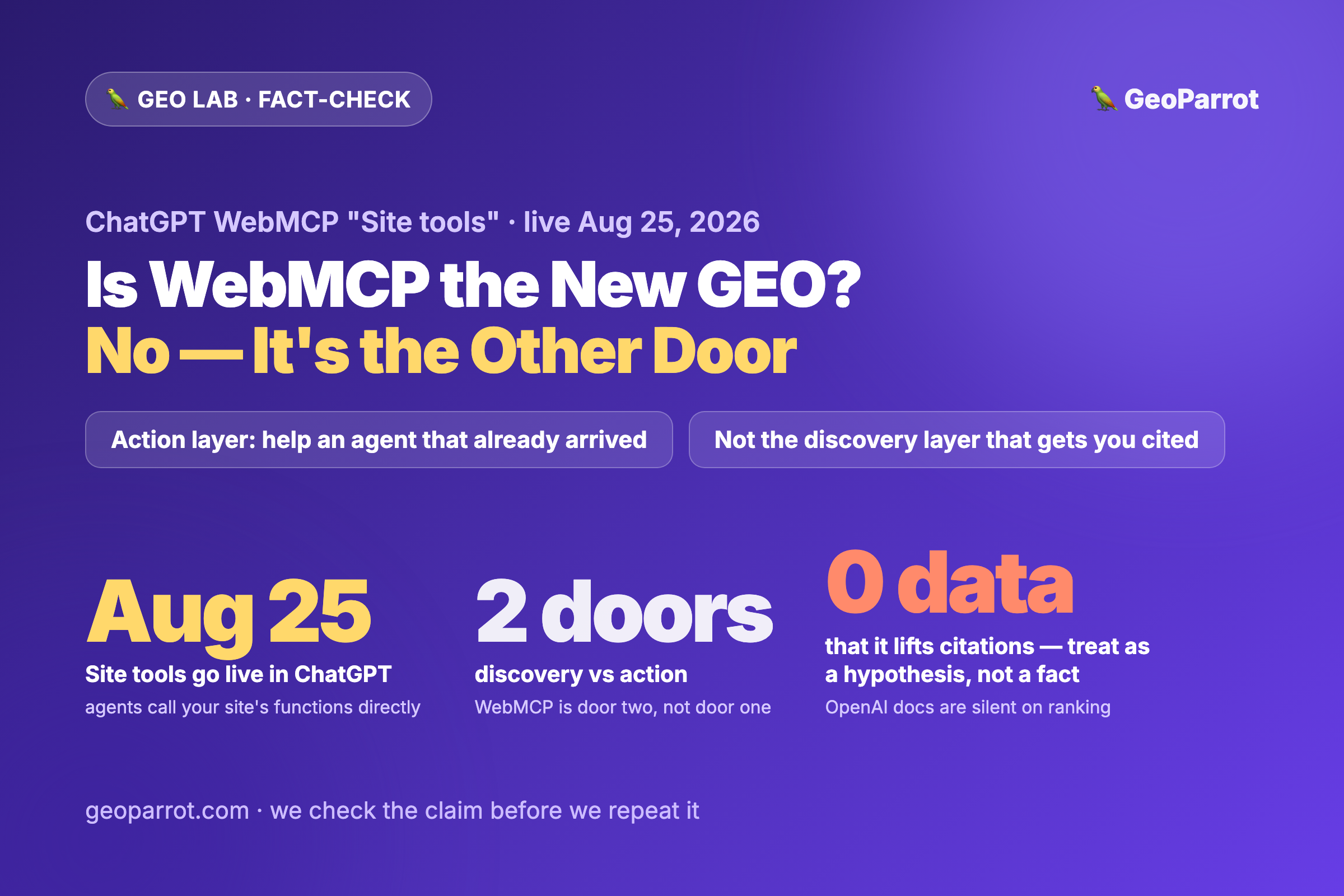
Quick answer: On August 25, 2026, OpenAI added WebMCP “Site tools” to ChatGPT’s built-in desktop browser. Instead of an agent guessing its way through your page by reading the DOM and simulating clicks, a WebMCP-enabled site declares its own callable functions — search this catalog, add to cart, filter this dashboard — and ChatGPT (or Codex) calls them directly on the live page, in your signed-in session. It’s real, and it’s a genuine shift in how agents act on the web. But it is not the new SEO in the way the takes claim. WebMCP is the action layer: it helps an agent that already landed on your site finish a task. It does nothing to get you found or cited in the answer in the first place — that’s still the citation layer, and it’s still upstream of everything. Don’t drop your GEO work to chase a tool interface.
Trend watch — published August 31, 2026. This is a fact-check post: we report what OpenAI actually shipped, separate it from the hype, flag what’s still an untested hypothesis, and connect it to the first-party thesis we keep testing in the GEO Lab.
What did OpenAI actually ship on August 25?
WebMCP (Web Model Context Protocol) is a proposed W3C browser standard — co-developed by Google and Microsoft engineers, first shown at Google I/O in May 2026 — that adds a browser API letting a website expose its features to AI agents as structured, callable tools. OpenAI’s implementation is branded Site tools. When ChatGPT’s desktop browser visits a page that registers tools, it can discover and invoke them to complete a task: searching documents, editing files, exploring a dashboard, comparing travel options, updating a shopping cart. You and the agent work the same live page and signed-in session, and every tool call goes through a safety review first — higher-stakes actions like purchases or permission changes still ask for your confirmation.
A few specifics worth pinning down, because the coverage blurs them. Site tools currently require GPT-5.6 Sol or Terra (Luna has it disabled) and the latest desktop app, and aren’t available in Enterprise or Edu workspaces. On the site side, only a subset of the WebMCP API is supported so far — the declarative HTML-form path isn’t live yet, and tools inside iframes aren’t discovered. Adoption is real but early: millions of Shopify storefronts are already WebMCP-enabled, with Expedia, Instacart, and Target among the companies experimenting. OpenAI also launched a 10-day WebMCP Challenge (Aug 25–Sep 3) with cash prizes to push developers to expose tools. So this isn’t vaporware — but it also isn’t finished.
Isn’t this just “SEO for agents”?
This is the framing to resist. There are two different doors into the agentic web, and WebMCP is only one of them. Door one is discovery and citation: does an engine retrieve your content, trust it, and surface it in the answer? That’s the entire subject of GEO — the citation layer, and the thing that decides whether an agent ever arrives at your site at all. Door two is action: once an agent is on your page with a task, can it operate your site reliably instead of fumbling through the UI? WebMCP is door two.
Those doors don’t substitute for each other. A perfectly WebMCP-instrumented store that never gets cited when someone asks ChatGPT “best running shoes for flat feet” is invisible for the same reason a beautiful, uncrawlable page is — the agent’s path to you runs through retrieval, not through your tool schema. It’s the same dependency chain we’ve flagged before: retrieval access is upstream of citation, and citation is upstream of any on-site action (the point underneath how AI search actually decides what to cite and what “AI SEO” really means). WebMCP makes the last step smoother. It doesn’t create the first one. If it’s the two-door web, WebMCP is the second door — the counterpart to the crawler-access door we covered in the Cloudflare AI-crawler default change.
Where we pump the brakes
Two claims are running ahead of the evidence. First, “WebMCP is a ranking/citation signal” — that being tool-enabled makes an engine more likely to route to or cite you. OpenAI’s own documentation is silent on how Site tools affect rankings, citations, or discoverability, and there’s no first-party data showing a preference. Treat “WebMCP will get you cited” as a hypothesis to test in your own logs, not a settled fact — the same causation discipline we apply to every trend here. It’s plausible engines eventually favor sites agents can act on; it’s not demonstrated.
Second, “the agentic web is here, universally.” Right now Site tools live in one engine’s desktop browser, on specific models, on a subset of the spec. The standard itself is mid-rollout: Chrome is running an origin trial, with Firefox support committed for Q3 2026 and Safari expected Q4. That fragmentation is the recurring GEO lesson, not an exception to it — what an agent can do on your site depends entirely on which engine, which browser, and which model the user is on, which is exactly why there’s no universal GEO strategy. Build for the surface your customers actually use, verify it there, and don’t assume it generalizes.
Who should implement WebMCP now — and who shouldn’t
Pilot it now if you’re transactional. If your value is in doing — an ecommerce catalog and cart, a booking or travel flow, a SaaS dashboard, docs with real search — WebMCP directly attacks the failure mode where an agent misreads your UI and abandons the task. Fewer failed carts, fewer wrong filters, more completed jobs. Shopify, Expedia, Instacart, and Target are early for a reason: for them, agent task-completion is conversion.
Don’t reprioritize around it if you’re a content site. If you’re a publisher, blog, or lead-gen site whose goal is to be cited, WebMCP gives you almost nothing today — there’s no cart to operate, no dashboard to drive. Your leverage is still answer-first passages, first-party data, and being the source an engine trusts. Spending this quarter registering tools instead of earning citations would be optimizing the wrong door.
What should you actually do this week?
- Classify yourself: action site or citation site. Be honest about where your value lands. That single call decides whether WebMCP is a Q3 priority or a “watch and revisit” item.
- If transactional, scope one high-value flow. Pick your single most important agent task — cart, search, booking — and expose just that as a tool. Don’t boil the ocean; the spec is a subset today anyway, and iframes and the declarative form path aren’t supported yet.
- Keep the citation layer as your main job. WebMCP is additive, not a replacement. Keep publishing answer-first, first-party content — that’s what puts you in the answer that sends the agent to your tools in the first place.
- Instrument, don’t assume. If you enable Site tools, log which agents invoke them and watch whether it moves anything in your citation or referral data. Feed reality back in — don’t infer impact from the changelog.
- Decide per engine. Site tools are ChatGPT-desktop-only right now; Chrome, Firefox, and Safari are on different timelines. Match your build to where your users actually are, using the same engine-by-engine logic as our per-engine GEO checklist.
Bottom line: WebMCP Site tools are a real and useful upgrade to how agents act on the web — and a genuine reason for transactional sites to pilot now. But they are not the new GEO. They optimize the last step of a journey the citation layer still controls. Instrument the action door if it fits your business; keep earning your way through the discovery door regardless. In AI search, getting found comes first — a tool nobody’s routed to is a tool nobody uses.
Frequently asked questions
What are ChatGPT Site tools and WebMCP?
WebMCP (Web Model Context Protocol) is a proposed W3C browser standard that lets a website expose its features to AI agents as structured, callable tools. Site tools are OpenAI’s implementation, added to ChatGPT’s desktop browser on August 25, 2026. Instead of the agent guessing through your UI by reading the page and clicking, it calls your declared functions directly on the live page in your signed-in session, with a safety review on each call and confirmation required for high-stakes actions.
Does WebMCP help me get cited in AI answers?
There’s no evidence that it does. WebMCP is an action interface — it helps an agent operate a site it has already reached — not a discovery or citation channel. OpenAI’s documentation doesn’t say Site tools affect rankings, citations, or discoverability. Getting found and cited is still governed by the retrieval-and-citation layer, so treat “WebMCP boosts citations” as an unverified hypothesis, not a fact.
Should my website implement WebMCP now?
It depends on your business. If you’re transactional — ecommerce, booking, a SaaS dashboard, searchable docs — piloting one high-value flow is worth it, because it reduces the agent failures that cost you conversions. If you’re a content, publisher, or lead-gen site whose goal is to be cited, WebMCP gives you little today; keep investing in answer-first, first-party content instead. Classify yourself before you build.
Which browsers and models support WebMCP?
ChatGPT Site tools currently require GPT-5.6 Sol or Terra in the latest ChatGPT desktop app, and aren’t available in Enterprise or Edu workspaces. The underlying standard is mid-rollout: Chrome is running an origin trial, Firefox support is committed for Q3 2026, and Safari is expected in Q4. Only a subset of the WebMCP API is supported so far — the declarative HTML-form path and tools inside iframes aren’t live yet.
Does WebMCP replace SEO or GEO?
No. Think of two doors into the agentic web: discovery/citation (getting found and surfaced in the answer) and action (letting an agent operate your site once it arrives). GEO is about the first door; WebMCP is the second. They’re complementary, not substitutes — a WebMCP-enabled site that never gets cited is still invisible. Keep earning citations as your primary work and treat Site tools as an additive layer for transactional flows.
Leave a Reply