
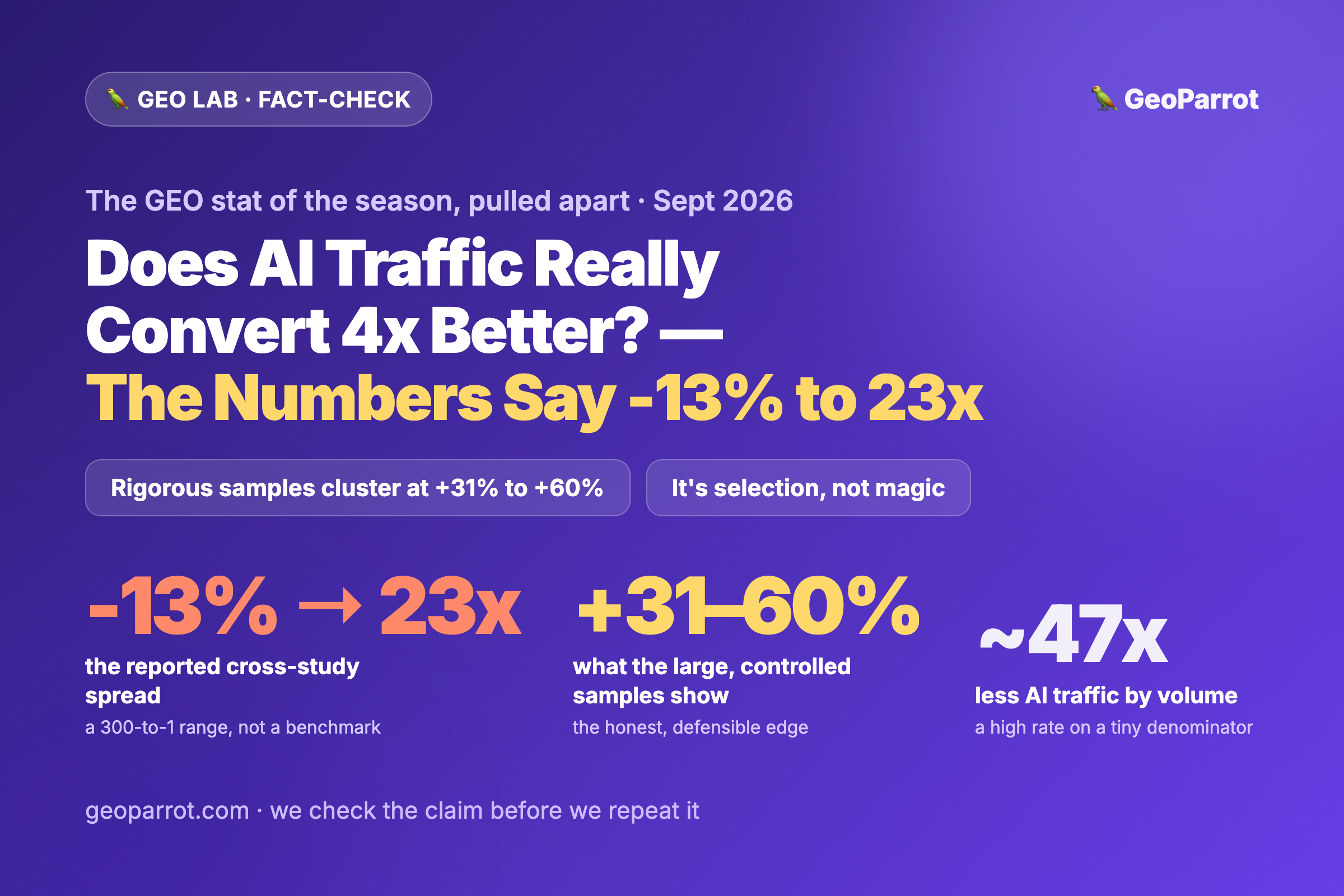
Quick answer: Directionally, yes — for lead-gen and sign-ups, visitors who arrive from AI answers tend to convert at a higher rate than average organic search. But the “4x” you keep seeing is a talking point, not a law. Across the studies circulating this month, the reported advantage runs from ChatGPT converting 13% worse than organic to 23x better — a 300-to-1 spread. The biggest multipliers come from single-client, tiny-denominator, or non-branded-baseline cases; the large, properly-controlled samples cluster around +31% to +60%. And the mechanism is selection, not magic: AI pre-qualifies visitors upstream, so you get far fewer of them (one study found Google sent ~47x more traffic) and, in e-commerce, often at a lower order value. Trust the direction, distrust the multiplier, and measure your own with a real baseline.
Trend watch — published September 9, 2026. This is a fact-check post: the “AI traffic converts 4x better” stat is everywhere in GEO decks right now, so we pulled the studies behind it, lined up the numbers, and separated what the data supports from what the headline claims — in the spirit of the GEO Lab.
Where did the “AI converts 4x better” claim come from?
The anchor is a widely-cited Semrush analysis from mid-2025 that looked at 500+ high-value topics and reported AI-referred visitors converting roughly 4.4x higher than traditional organic search. That single number — clean, memorable, from a trusted brand — became the season’s headline. It’s since been echoed and amplified: a 2026 B2B benchmark (Opollo, 312 tech firms) put AI-referred conversion at 14.2% vs 2.8% for Google organic (~5x), and a separate 12-million-visit analysis reportedly landed in the same zone.
So far, so consistent. The problem starts when you keep reading.
Why do the numbers range from -13% to 23x?
Line the studies up and the “4x” dissolves into a cloud. Here’s the actual spread reported across 2025–2026:
| Source (as reported) | Setup | AI vs organic conversion |
|---|---|---|
| Ahrefs (B2B SaaS, single case) | 0.5% of sessions → 12.1% of sign-ups | ~23x |
| Microsoft Clarity (1,200+ sites) | LLM sign-ups 1.66% vs organic 0.15% | ~11x |
| Seer Interactive (single client) | ChatGPT 15.9% vs organic 1.76% | ~9x |
| Opollo / RankScience (B2B) | 14.2% vs 2.8% | ~5x |
| Semrush (500+ topics) | cross-industry average | ~4.4x |
| Adobe Analytics (July 2026) | AI shoppers vs non-AI | ~+60% |
| Visibility Labs (94 e-commerce brands, full-year) | ChatGPT 1.81% vs non-branded organic 1.39% | +31% |
| Kaiser & Schulze (peer-reviewed, e-commerce) | controlled study | ChatGPT underperforms |
| 973-site study ($20B revenue, 164M txns) | 50k ChatGPT transactions modeled | ~-13% (below organic) |
That’s not a benchmark — it’s a Rorschach test. The pattern behind the chaos is legible, though. The giant multipliers (23x, 11x, 9x) are single-client or single-vertical cases with a tiny denominator: when AI is 0.5% of your sessions, a handful of high-intent sign-ups produces a spectacular ratio that won’t survive scale. The large, controlled samples land far lower — the 94-brand full-year study says +31%, Adobe says ~+60% — and at least two rigorous e-commerce studies find ChatGPT converting at or below organic. The honest takeaway: the direction is real for sign-up/lead funnels, the magnitude is wildly overstated, and for transactional e-commerce it may not hold at all.
What actually drives the higher conversion rate?
Not brand love, and not some AI-referral quality bonus. It’s selection. The AI answer does the top-of-funnel filtering — comparing options, summarizing, ruling things out — before anyone clicks. So the visitor who does arrive has usually finished the research phase. You’re seeing a pre-qualified slice, the same way a referral from a “best X for Y” comparison page outperforms a cold homepage visit. Two consequences follow that the headline never mentions:
- It’s a rate on a tiny denominator. One analysis found Google still sent ~190 visitors for every 1 from ChatGPT, with organic ~47x larger in raw volume. A 5x conversion rate on 1/47th the traffic is not 5x the customers — do the arithmetic before you reallocate budget.
- In e-commerce, higher rate ≠ higher revenue. The same data set that showed a conversion edge also reported ChatGPT traffic carrying ~14% lower average order value. High-intent researchers convert; they also comparison-shop harder.
What’s the biggest measurement trap here?
Two, actually, and they push in opposite directions. First, baseline gaming: several of the flattering studies compare AI traffic against non-branded organic — a deliberately weak benchmark. Compare AI to your branded organic (people who searched your name, also high-intent) and the gap shrinks fast. Second, dark traffic: the ChatGPT iOS app often arrives with no referrer and gets bucketed as “direct,” so AI’s real numbers are partly hidden and partly misattributed. When a stat can be inflated by baseline choice and distorted by attribution, treat any precise multiplier as a hypothesis, not a fact. This is the same discipline we apply to every vendor number — the reason we built the GA4 method for tracking AI traffic around your own first-party data instead of borrowed benchmarks.
Does converting well mean your GEO is working?
No — and this is the part GEO decks quietly skip. Conversion rate measures what the AI-referred visitor does after they reach you. It says nothing about the step that GEO actually governs: whether the AI cites and links to you in the first place. You can have a stellar AI conversion rate and near-zero AI visibility, because the rate is calculated only on the trickle who made it through. Getting picked is the hard, upstream problem — and it doesn’t generalize, because as our cross-engine study found, citation sets barely overlap across engines and there is no universal GEO strategy to game. A conversion multiplier is a reason to want AI visibility; it is not evidence that you have it. Don’t let a good downstream number stand in for the citation work you haven’t done — that’s the flip side of the vanity metrics we’ve flagged before.
So is the conversion story a reason to invest in GEO?
Yes, but for the honest reason, not the inflated one. If AI-referred visitors convert even +30–60% better — the range the solid studies actually support — then each citation you earn is worth more than an equivalent organic click, which strengthens the ROI case we laid out in is GEO worth it. That’s a real tailwind. Just build the model on the defensible number, against a branded-organic baseline, on your own data — not on a 23x screenshot from someone else’s SaaS dashboard.
- Kill the borrowed multiplier. Measure AI-referred conversion on your own site, in your own analytics, before you quote any number. If you can’t segment it yet, start with the GA4 setup.
- Use the right baseline. Compare AI traffic to branded organic, not non-branded. Report volume alongside rate — a great rate on 1% of sessions is a small business.
- Match the metric to your model. Sign-ups/lead-gen: the conversion edge is real, lean in. Transactional e-commerce: check AOV too; the edge may vanish.
- Don’t confuse it with visibility. Conversion quality is downstream. Whether you get cited is upstream and engine-specific — run the per-engine checklist for that.
- Invest where it compounds. Earned reputation and answer-first content are what get you cited in the first place — the only way to turn a high conversion rate into real customers.
Bottom line: “AI traffic converts 4x better” is half-true in the most misleading way. The direction is right for lead-gen; the multiplier is a fog of single-client anecdotes and cherry-picked baselines that ranges from -13% to 23x, with the rigorous studies clustering at +31–60%. And even the honest number is downstream of the question GEO actually answers — whether you get cited at all. Take the conversion tailwind as a reason to pursue AI visibility, measure it on your own data, and never mistake a good rate on a tiny denominator for a growth strategy. We check the claim before we repeat it — and here the honest claim is “a real but modest edge for the right funnel, wildly oversold, and no substitute for getting cited.”
Frequently asked questions
Does AI search traffic really convert better than Google organic?
For lead-gen and sign-up funnels, yes — most studies find AI-referred visitors convert at a higher rate. But the size of the advantage is wildly inconsistent across studies, ranging from ChatGPT converting about 13% worse to 23x better. The large, controlled samples cluster around +31% to +60%, not the 4x–23x figures that dominate headlines. For transactional e-commerce, at least two rigorous studies find AI traffic converting at or below organic.
Why is the “4x better” statistic misleading?
Because it collapses a huge range into one number. The biggest multipliers come from single-client cases with tiny denominators, or from comparing AI traffic against non-branded organic (a weak baseline). It’s also a rate, not a volume: AI may send 40–190x fewer visitors, so a higher conversion rate does not mean more customers. In e-commerce, AI traffic can also carry a lower average order value.
Why does AI traffic convert at a higher rate at all?
Selection, not a quality bonus. The AI answer does the research and comparison at the top of the funnel, so the person who actually clicks through has usually already decided. You’re seeing a pre-qualified slice of demand — which is why the rate is high but the traffic volume is low.
Does a high AI conversion rate mean my GEO is working?
No. Conversion rate measures what happens after a visitor reaches you; GEO governs whether the AI cites and links to you in the first place. You can have a great conversion rate on a trickle of AI traffic while your actual AI visibility is near zero. Getting cited is the upstream problem, and it’s engine-specific — a good downstream number is not evidence you’ve solved it.
How should I measure AI conversion for my own site?
Segment AI-referred sessions in your own analytics (watch for ChatGPT app traffic landing as “direct”), compare them against your branded organic conversion rate rather than non-branded, and always report volume next to rate. Then match the metric to your model: a conversion edge means more for sign-up funnels than for e-commerce, where you should also check average order value.
Leave a Reply