
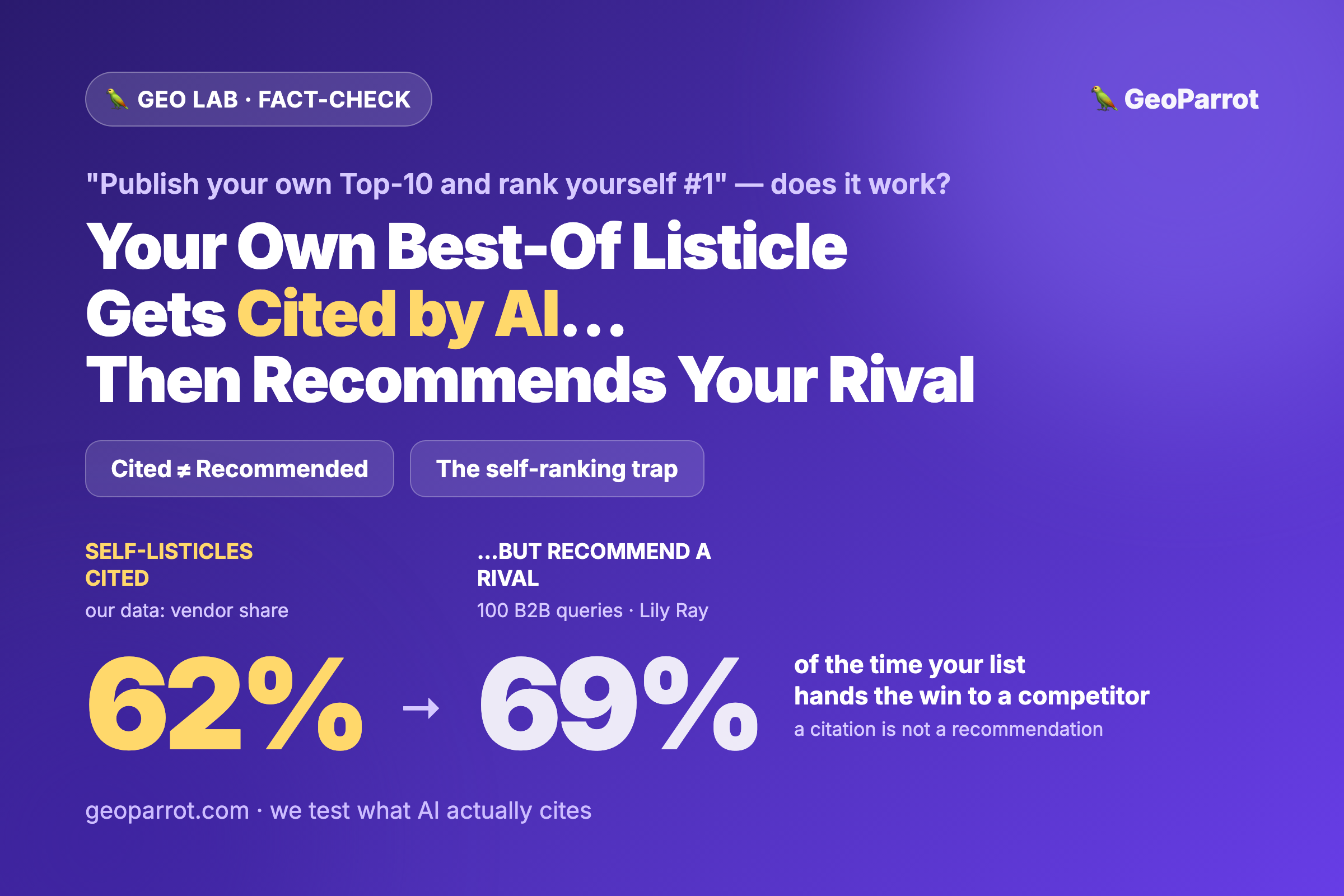
Quick answer: Yes — publishing your own “best-of” listicle really does get you cited by AI engines. Our first-party data is blunt about it: vendor-owned sites earn 59.5% of all citations on buyer-intent queries, and 62% of those vendor citations come from the vendor’s own best-of listicle content, not their homepage. So the popular advice isn’t wrong about citations. It’s wrong about what a citation buys you. A new analysis of 100 B2B “best software” queries found that when Google’s AI Overview cited a brand’s own self-promotional listicle, it recommended a competitor from that same list 69% of the time (224 of 323 citations). Google also began quietly suppressing the organic visibility of self-promotional-listicle-heavy sites in January 2026. The lesson for GEO: a citation is not a recommendation, and self-ranking is a lever that can quietly hand the win to your rivals.
This is Monday’s fact-check, and it opens a new week-long question in the GEO Lab: can you self-rank your way into AI recommendations by publishing your own listicle — or does self-ranking only earn a hollow citation while the recommendation goes elsewhere? We’ll spend the week taking the self-published listicle apart.
What is the “publish your own listicle” advice, exactly?
Open almost any 2026 GEO guide and you’ll find some version of this play: for every commercial keyword, publish a “Top 10 [category]” page — and, naturally, rank yourself at the top. The rationale is data-backed and, on its face, sound:
- Industry roundups report that ~74% of AI citations come from structured “Top N” listicle content, and that listicle pages earn 3–5× more AI citations than long-form tutorials.
- Our own experiments agree on the format: 66% of the citations we measured were ranked best-of listicles. Engines love an extractable ranked list.
- So the reasoning goes: build the ranked list yourself, put your product at #1, and collect the citations.
The first two bullets are true. It’s the leap to the third — therefore self-rank — that the 2026 data quietly demolishes.
Do self-published listicles actually get cited? (Yes.)
Let’s give the advice its due first, because this is where most skeptics get it wrong. Self-published, self-serving listicles do get cited. We can see it directly in our first-party corpus. In our domain-anatomy experiment — three AI engines across 12 buyer-intent questions, every citation classified — vendor-owned sites weren’t a footnote. They dominated:
| What we measured (exp4 corpus) | Result |
|---|---|
| Vendor-owned sites’ share of all citations | 59.5% (182 of 306) |
| Of vendor citations, share that are the vendor’s own best-of / listicle content | 61.6% |
| Of vendor citations, share that are the homepage | just 13% |
| Corpus-wide share that are listicle or comparison pages | 66.2% |
Read that middle row again: when a vendor got cited, it was usually not for its homepage or product page — it was for a listicle it published itself. So the “publish your own best-of” crowd is right that the tactic earns citations. Companies are clearly doing it, and the engines are clearly ingesting it. If your only goal were the citation, you could stop reading here. But the citation was never the goal.
But does a citation equal a recommendation? (No — 69% of the time it’s your competitor.)
Here’s the finding that reframes the entire tactic. SEO researcher Lily Ray analyzed 100 B2B “best [category] software” queries in Google’s AI Overviews across three dates (April 15, May 15, June 8, 2026). Of the 80 queries that triggered an AI Overview, self-promotional listicles were cited 323 times — and in 224 of those cases (69%), Google cited a brand’s own page but did not recommend that brand. Instead, the AI Overview pulled a competitor out of the brand’s own list and recommended them.
Sit with the mechanics of that. You publish “The 10 Best CRMs (2026)” with your CRM at #1. Google’s AI Overview reads it, cites you as the source — and then tells the user one of the nine competitors you listed is the better pick. You supplied the citation. Your competitor got the recommendation, and the click. As Ray puts it, a citation is not a recommendation: your content can appear in the answer while helping rivals capture the visibility that actually converts.
This is the missing half of our own data. We measured that self-published listicles get cited (59.5% vendor share). What our citation-share numbers can’t see is whether those citations became recommendations — and Ray’s query-level analysis suggests, for self-serving lists specifically, they often don’t. That gap between “cited” and “recommended” is the whole ballgame, and it’s exactly what we’ll test this week.
Isn’t Google suppressing self-promotional listicles anyway?
Yes — this is the second edge of the trap. Around January 20, 2026, Google appears to have begun reducing the organic visibility of sites that publish large volumes of self-promotional listicles, with the effect accelerating during the May 2026 core update. Ray’s earlier research documented some SaaS and B2B brands losing 30–50% of their visibility. So the self-ranking factory doesn’t just fail to convert — at scale it can actively drag down the rest of your site.
Note the nuance: this targets sites with lots of thin, self-serving “we’re #1” pages — especially AI-generated ones with artificial date-refreshing or reciprocal listing networks. One genuinely useful, honest comparison page is a different animal from a hundred templated “best-of” posts that all crown the same product. But the direction of the algorithm is clear, and it rhymes with Google’s own May 2026 guidance that manufactured mentions and gaming tactics “aren’t as helpful as they might seem.”
So should you publish your own best-of listicle at all?
The honest answer is “it depends on what you publish” — and that nuance is exactly what makes it a good week-long question rather than a one-line rule. Three shifts if you’ve been reading “listicles get cited” as marching orders:
- Separate the citation from the recommendation. Getting cited is cheap; getting recommended is the prize. A self-serving list where you crown yourself is optimized for the cheap half and, per Ray’s data, actively feeds the expensive half to competitors you list.
- An honest comparison can still win. The engine trusts a ranked list because it looks even-handed. A genuinely balanced comparison — where you might not be #1 — is more likely to be both cited and taken at face value than a transparent puff piece. Counterintuitively, listing competitors fairly is the price of being credible enough to be recommended.
- Get onto third-party listicles too. The lists engines trust most for buyer queries are still the independent ones — the TechRadar / PCMag / category-directory roundups from our concentration data. Earning a spot on those carries recommendation weight your own page can’t manufacture. Even our own best-GEO-tools list is written to be a useful reference first — because a list nobody trusts is a list nobody’s recommendation survives.
That’s the thread we pull all week: does self-ranking work, or does it only buy a hollow citation? Tuesday we pre-register the method for testing self-published vs. third-party listicles — measuring not just whether a listicle gets cited, but whether the brand behind it actually gets recommended. Thursday we publish the results; Friday, the verdict and a self-ranking playbook.
FAQ
Do self-published “best-of” listicles get cited by AI engines?
Yes. In our first-party data, vendor-owned sites earned 59.5% of all citations on buyer-intent queries, and 62% of those were the vendor’s own best-of / listicle content rather than its homepage. Publishing a ranked list clearly earns citations — the open question is whether the citation converts to a recommendation.
What’s the difference between being cited and being recommended?
A citation means the AI engine used your page as a source. A recommendation means it told the user to choose you. Lily Ray’s 100-query study found that for self-serving listicles, Google cited the brand’s own page but recommended a competitor 69% of the time. The citation is visibility; the recommendation is the conversion — and they come apart.
Will publishing best-of listicles hurt my Google rankings?
At volume, it can. Google began reducing the organic visibility of sites heavy with self-promotional listicles around January 20, 2026, accelerating in the May core update — with some B2B brands reportedly losing 30–50% of visibility. A single honest comparison page is lower-risk than a factory of templated “we’re #1” pages.
Should I list my competitors on my own comparison page?
Counterintuitively, an even-handed list that includes competitors fairly tends to be more credible — and a credible list is more likely to be trusted as a recommendation, not just scraped as a citation. A transparent puff piece gets the citation and feeds the recommendation to whoever you ranked #2.
How did you measure the 59.5% vendor share?
We classified every citation from three AI engines across 12 buyer-intent questions (306 domain-level citations, 219 distinct domains) by site type and page format. The full method and data are published. It’s a small hand-run sample by design — treat it as “the pattern is strong,” not a decimal-precise census.
Sources
- Search Engine Land — Google AI Overviews cite self-serving listicles, but recommend competitors 69% of the time (Lily Ray, 100 B2B queries; the 224/323 and organic-suppression findings)
- GEO Lab — AI Engines Don’t Choose Domains — They Choose Listicles (this post’s first-party vendor / listicle data)
- GEO Lab — Do a Handful of Domains Control AI Citations? The Verdict — Plus a Per-Format Playbook (the 66% listicle finding)
- GEO Lab — Do 15 Domains Control 68% of AI Citations? Our Data Says 23% (the third-party listicle domains engines actually choose)
- GEO Lab — Does AI Search Use Backlinks? What Actually Drives Citations (Google’s “still SEO” guidance)
Leave a Reply