
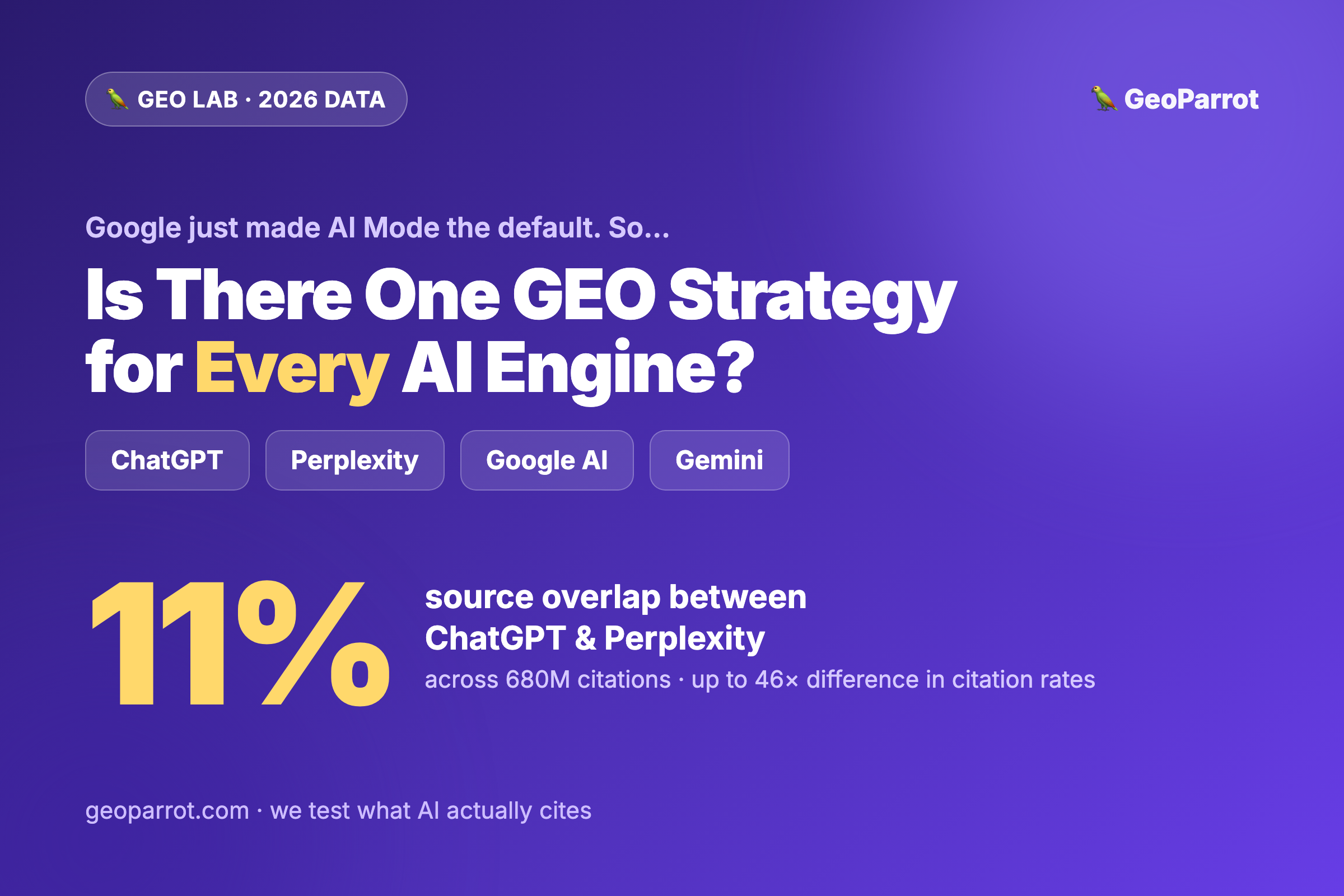
Quick answer: No. There is no single GEO strategy that wins across ChatGPT, Perplexity, Google AI Mode, and Gemini at the same time. A 2026 analysis of 680 million AI citations found that ChatGPT and Perplexity share only 11% of the same source domains, and brand citation rates differ by up to 46× between engines. Each engine picks sources differently — so the winning play is a shared citable foundation plus per-engine tuning, not one-size-fits-all.
This week Google made AI Mode the default search experience for over a billion users at I/O 2026, and AI Overviews now reach 2.5 billion people a month. The obvious reaction from marketers: “Great — I’ll optimize for Google’s AI and be done.” Tempting. Also wrong.
Because the moment you look across engines, the data falls apart on you. So we did what we always do at GEO Lab: checked the claim against real numbers — both the industry’s and our own.
What changed this month (and why it raised the question)
- Google I/O 2026: AI Mode became the default for 1B+ users; AI Overviews serve ~2.5B monthly users. Zero-click searches are now 58.5% of US Google searches.
- The “no universal strategy” study: Averi analyzed 680M AI citations in early 2026 and found only 11% domain overlap between ChatGPT and Perplexity, with brand citation rates varying up to 46× across engines.
- Source mix is wildly different: Reddit is ~46.7% of Perplexity’s top citations — but just 0.1% on Google Gemini.
Put together: the engine that just became most people’s default (Google AI Mode) sources answers very differently from the engine marketers obsess over (ChatGPT) and the one that cites most generously (Perplexity). Optimizing for one does not carry over to the others.
Why do AI engines cite different sources?
It isn’t random. Each engine has a different retrieval backbone, and that backbone decides who gets quoted:
| Engine | How it sources answers | Who tends to win |
|---|---|---|
| Perplexity | Live web retrieval, leans on community & experience-based content | Reddit, forums, hands-on reviews |
| Google AI Mode / AIO | Google’s own index + ranking & E-E-A-T signals | Established, well-ranked sites; almost no Reddit |
| ChatGPT Search | Conservative citation; cites a brand only ~0.59% of the time | High-agreement, frequently-corroborated sources |
| Gemini | Google ecosystem signals; very low Reddit reliance (0.1%) | Authoritative publishers, structured pages |
The common thread researchers keep finding: AI systems gain confidence to cite you when multiple independent sources agree about who you are — your site, Reddit, YouTube, review sites like G2, industry press, all saying the same thing. But which of those sources each engine trusts is where they diverge.
We saw the same thing — at small scale
Before the big studies landed, we ran our own test at GEO Lab: we asked 3 AI engines the same 12 questions and looked at which sources they cited. The pattern matched the 680M-citation study almost exactly:
- Only ~3% of cited sources were common across all engines.
- About 84% of citations were unique to a single engine.
- Reddit was the one source that showed up broadly — confirming its outsized role in AI answers.
One small experiment is an anecdote. A small experiment that lands on the same conclusion as a 680-million-citation analysis is a signal worth acting on.
So what do you actually do?
You don’t pick one engine. You build in two layers:
- The shared foundation (do this once): clear answer-first content, consistent entity/brand wording everywhere, verifiable original data, FAQ + structured headings, and corroboration across third-party sites. This is what every engine rewards. (Start with answer-first writing and what actually drives citations.)
- Per-engine tuning (do this where it pays): Reddit + community presence for Perplexity; depth + ranking strength for Google AI Mode; high corroboration for ChatGPT.
Coming this week at GEO Lab: we’re re-running our cross-engine citation test — this time including ChatGPT and post-AI-Mode Google — to measure exactly how much overlap there is now. We’ll publish the method tomorrow and the raw results later this week. If “there’s no universal strategy” is true, we want to show you how different the engines really are, with our own numbers.
FAQ
Is there a single GEO strategy that works for all AI engines?
No. 2026 data shows AI engines share only ~11% of cited domains and differ up to 46× in citation rates. Build one shared citable foundation, then tune per engine.
Which AI engine should I prioritize?
Start with where your buyers actually are. Google AI Mode now reaches the largest audience by default, but Perplexity cites far more sources (better odds of getting in). For most B2B, ChatGPT + Google + Perplexity is the core three.
Why does Reddit get cited so much?
It offers authentic, experience-based answers, which engines like Perplexity are tuned to surface (46.7% of its top citations). Google’s engines barely use it (0.1% on Gemini).
Does optimizing for Google AI Mode help me in ChatGPT?
Only partially. The shared foundation (clarity, corroboration, data) carries over; the source preferences do not.
Sources
- Averi — ChatGPT vs. Perplexity vs. Google AI Mode: B2B SaaS Citation Benchmarks (2026), 680M citations
- Google I/O 2026 AI search updates (AI Mode default, AI Overviews 2.5B MAU)
- GEO Lab — We Asked 3 AI Engines the Same 12 Questions (our data)
Leave a Reply