
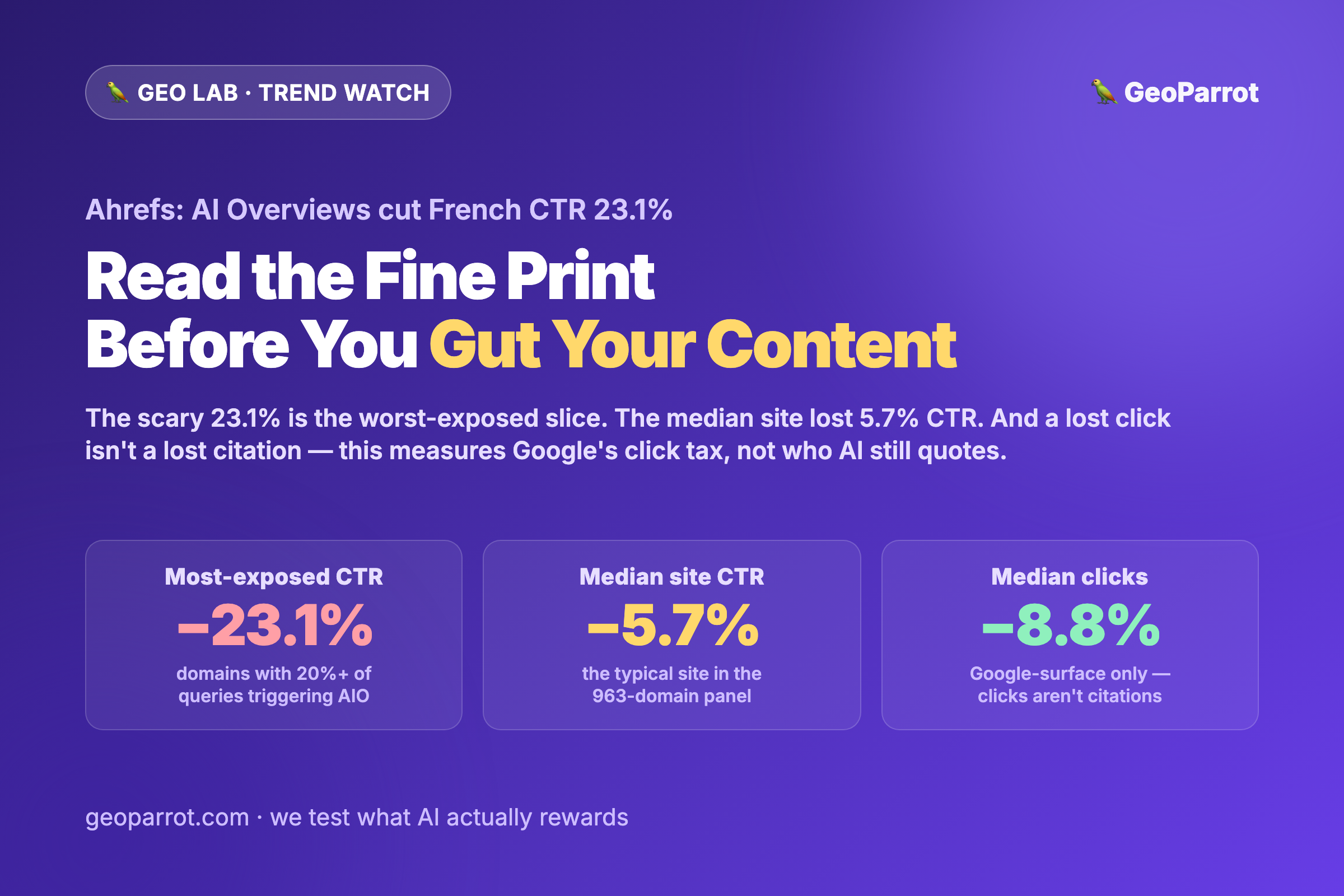
Quick answer: Ahrefs’ new study of 963 French domains found that AI Overviews cut click-through rate by 23.1% — but that figure is only for the most exposed sites, the ones where more than 20% of their queries trigger an AI Overview. Across the full panel the median CTR drop was −5.7% and median clicks fell −8.8%. So the headline number isn’t your number unless you’re in the exposed tail. And the point the SEO coverage keeps missing: a CTR drop measures the click tax on Google’s surface — it does not tell you whether you’re still the cited source in that AI Overview, and it says nothing at all about ChatGPT or Perplexity, which run their own retrieval. Clicks aren’t citations. Read the fine print before you tear down content that AI is still quoting.
Trend watch — published September 21, 2026. Ahrefs published “AI Overviews Cut CTR by 23.1% in France” on September 16, and it circulated through the SEO community this week (Search Engine Roundtable’s September 17 recap). The 23.1% is already getting screenshotted out of context, so we did what the GEO Lab does: read the actual methodology, separate the headline from the median, and ask the question the click-panic skips — is a lost click even the same event as a lost citation?
What did the Ahrefs France study actually find?
France got AI Overviews on July 22, 2026, which made it a clean natural experiment. Ahrefs (Juliette Begue and Xibeijia Guan, reviewed by Ryan Law) tracked 963 domains in Google Search Console — the sites earning the most clicks in France — for 28 days before the rollout and 9 days after. The widely-quoted headline: for the domains most exposed to AI Overviews, CTR fell 23.1%. But “most exposed” is a specific, narrow group — sites where more than 20% of their queries surfaced an AI Overview, and 82.2% of that group lost CTR.
Zoom out to the whole panel and the picture is calmer. The median site lost 5.7% of its CTR and 8.8% of its clicks. The distribution has a real tail — 48% of sites lost more than 10% of daily clicks, 19% lost more than 30%, and 5% lost more than half — but half the panel was in single digits. French (.fr) domains were hit harder than the panel as a whole (−12.3% clicks at the median vs −8.8%), and the health sector had both the highest AI Overview rate (22.2%) and a steep CTR drop (−20.4%). Crucially, Ahrefs itself flags the limit out loud: “A slope is not a prediction. Some heavily exposed sites are doing fine, and some barely exposed ones are falling apart for reasons that have nothing to do with AI.”
Is your site going to lose 23.1% of its CTR?
Almost certainly not, unless you’re already in the heavily-exposed tail. The 23.1% is a conditional, worst-case number — it describes what happened to the sites where AI Overviews show up on a fifth or more of their queries, not the typical site in the panel. Treating it as “the” impact of AI Overviews is the same mistake we flagged when the deck-favorite stat this season was “AI traffic converts 4x better” — a real study anchored a headline that then got detached from its denominator. A conditional figure quoted as a universal one is how a −5.7% median becomes a −23% panic.
This is also why a blended, third-party “impact” number should never trigger a content teardown on its own. It’s the same logic that makes a blended “AI share of voice” score the wrong metric: your exposure depends on your specific query mix, your vertical, and whether the queries you rank for are the informational ones AI Overviews loves. A recipe site and a B2B SaaS docs page are not living in the same distribution. The only exposure number that matters for a decision is your own.
Does a CTR drop mean you lost the AI citation?
No — and this is the distinction the whole “AI Overviews killed my traffic” genre blurs. CTR measures whether someone clicked through to you. Citation measures whether the AI Overview used you as a source. Those come apart constantly: an AI Overview can quote your page, satisfy the searcher inside the answer, and send zero clicks — you kept the citation and lost the click. That’s not you disappearing from AI search; that’s you winning the visibility and losing the click tax, which is a different problem with a different fix.
We’ve been pulling on this same thread from the platform side: Google has been testing a thinner citation panel that shrinks the click affordance without touching whether you’re cited, and it’s now answering nearly all People Also Ask questions with AI Overviews — both of which quietly cut clicks on pages that are still being used as sources. A CTR study can’t see any of that. It sees the click count fall and has no idea whether it’s because you were dropped as a source or because you were cited so well the user never needed to leave. Read the click number as a click number, not a citation verdict.
Why doesn’t this study tell you anything about ChatGPT or Perplexity?
Because it’s measured entirely inside Google Search Console — it’s a Google-surface story, full stop. ChatGPT, Perplexity, Gemini and the rest don’t generate their answers over Google’s index, and they don’t appear in your GSC clicks at all. In our own cross-engine test, the four major engines shared only 2 of 395 cited domains, with ~85% unique to a single engine — which is exactly why there is no universal GEO strategy. A CTR collapse on Google’s AI Overviews is genuinely bad news for your Google clicks, but it’s not evidence about your Perplexity citations or your ChatGPT presence, which are sourced independently and could be moving the opposite direction the same week.
So the honest read of the France data is narrow and specific: on Google’s surface, in France, in the first 9 days, exposed sites took a real click hit. That’s a legitimate, counted, first-party finding — the checkable kind of number, the sort we argued survives when the inferred metrics don’t. But its scope is exactly as wide as its instrument, and the instrument is Google clicks. Don’t let a Google-clicks study set your whole multi-engine GEO strategy.
How should you measure AI Overviews’ impact on your own site?
Stop reading the panel median and read your own dashboards, on the right instruments. Your CTR and click loss are already sitting in Search Console’s Performance report — pull your own before/after around the AI Overview rollout in your market, segmented to the query clusters where AI Overviews actually appear, instead of importing someone else’s 963-site median. Then separate the click question from the citation question: Google’s Search Console Generative AI report gives you impressions on Google’s AI surfaces (no clicks, Google-only), and your own GA4 setup for AI-referred traffic captures the sessions that actually arrive from ChatGPT, Perplexity and the rest. If your clicks are down but your AI-surface impressions are flat or up, you’re being cited more and clicked less — which calls for a content strategy change, not a content teardown.
One guardrail while you read those reports: don’t over-interpret Google’s AI “position,” because Google itself clarified that every link in an AI Overview shares the block’s position, not an individual rank. And act per engine, not on a blended fear number — the moves that keep you cited on ChatGPT aren’t the moves that recover a Google click, as the per-engine GEO checklist lays out.
The practitioner takeaway
- The 23.1% isn’t your number. It’s the worst-exposed slice (20%+ of queries triggering an AI Overview). The median site lost 5.7% CTR and 8.8% of clicks — pull your own exposure before you react.
- Clicks aren’t citations. A CTR drop can mean you were cited so well the user didn’t click, not that you were dropped as a source. Measure the two separately.
- This is a Google-surface, single-market, 9-day finding. It says nothing about your ChatGPT or Perplexity citations, which are sourced independently (~85% of cited domains are unique to one engine).
- Read your own GSC, not the panel median. Segment to the query clusters where AI Overviews appear, and pair click data with the GSC Generative AI report and GA4 AI-referred traffic.
- Don’t gut content over a click drop. If impressions hold while clicks fall, you’re winning visibility and losing the click tax — a pricing-and-positioning problem, not a “rewrite everything” problem.
Bottom line: The Ahrefs France study is solid, first-party, counted data — and its real message is more measured than the number making the rounds. Exposed sites took a genuine click hit, but the median site lost single digits, the finding is Google-only and market-specific, and a lost click is not a lost citation. Before you react, pull your own before/after, separate clicks from citations, and remember that the engines that never touched Google’s index never saw this event at all.
Frequently asked questions
Did AI Overviews really cut CTR by 23.1%?
Yes, but only for the most exposed sites. Ahrefs’ September 2026 study of 963 French domains found a 23.1% CTR drop specifically for domains where more than 20% of queries triggered an AI Overview. Across the full panel, the median site lost 5.7% of its CTR and 8.8% of its clicks — so the headline number describes the exposed tail, not the typical site.
Does losing CTR to AI Overviews mean I lost the citation?
Not necessarily. CTR measures whether someone clicked through; citation measures whether the AI Overview used your page as a source. An AI Overview can cite you, answer the searcher inside the panel, and send no click — you keep the citation and lose the click. A CTR drop alone can’t tell you which happened, so measure clicks and citations on separate instruments.
Does this study apply to ChatGPT and Perplexity?
No. The Ahrefs study is measured entirely in Google Search Console, so it only covers Google’s AI Overviews. ChatGPT, Perplexity and Gemini generate answers from their own retrieval, not Google’s index, and don’t appear in GSC clicks. In cross-engine testing, ~85% of cited domains are unique to a single engine, so a Google CTR drop is not evidence about your citations on other AI platforms.
How do I measure AI Overviews’ impact on my own site?
Use your own Search Console Performance report for before/after clicks and CTR around the AI Overview rollout in your market, segmented to the queries where AI Overviews actually appear. Then separate the citation question using the GSC Generative AI report (AI-surface impressions, Google-only) and a GA4 setup for AI-referred traffic (sessions from ChatGPT, Perplexity and others). Your own exposure and citation data beat any panel median.
Should I rewrite my content because AI Overviews are cutting clicks?
Not reflexively. If your AI-surface impressions are steady while clicks fall, you’re still being cited and just losing clicks to zero-click answers — that’s a positioning and monetization problem, not a reason to gut pages that AI is still quoting. Reserve content overhauls for cases where your impressions and citations are genuinely dropping, not where a third-party median made the sky look like it’s falling.
Leave a Reply