
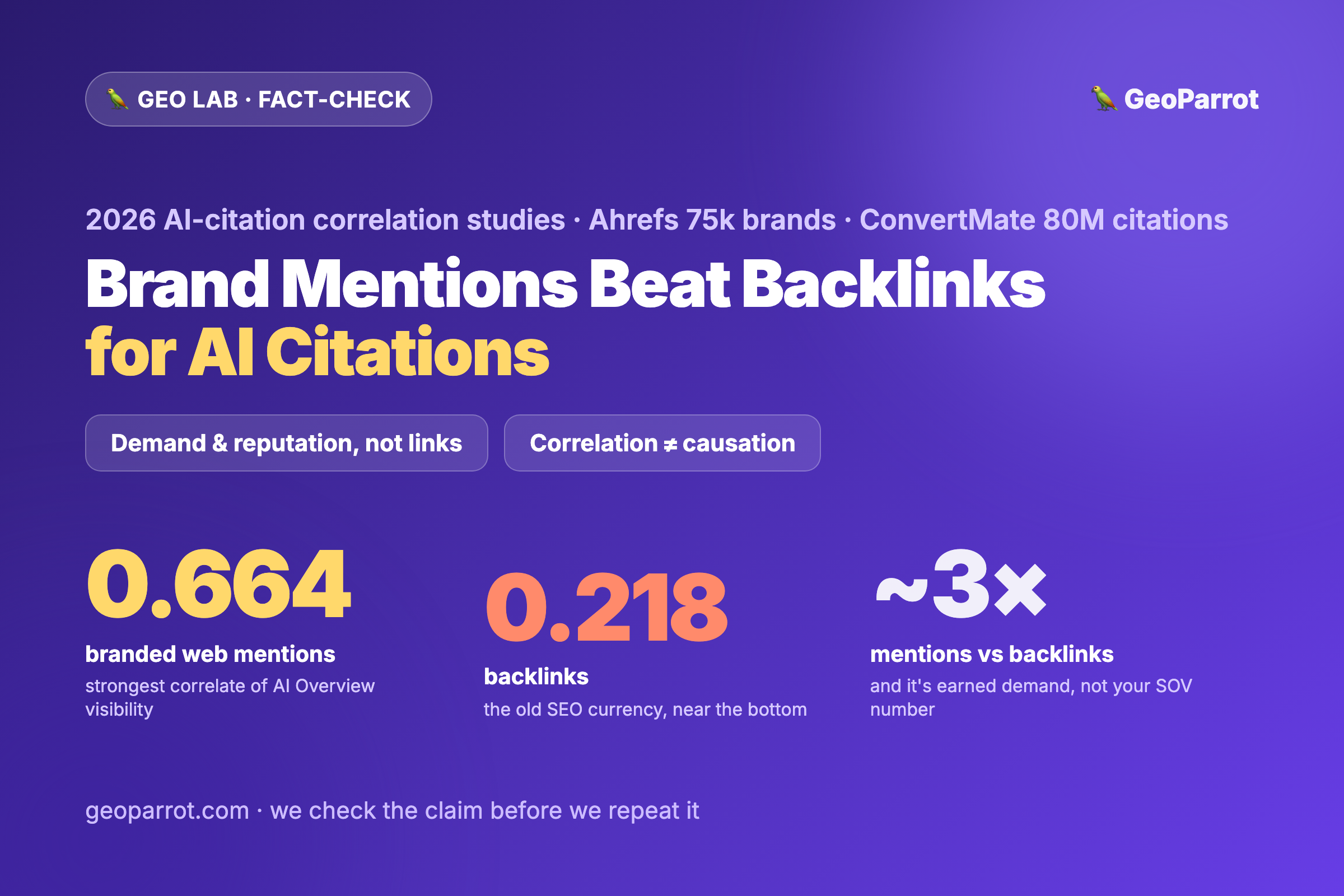
Quick answer: A wave of 2026 studies converges on one uncomfortable finding for classic SEO: the strongest measurable correlate of getting cited in AI answers is brand demand — mentions, branded search, earned media — not backlinks. Ahrefs, studying 75,000 brands, found branded web mentions correlate r=0.664 with AI Overview visibility versus just 0.218 for backlinks — roughly 3× stronger. ConvertMate’s separate 80-million-citation analysis found branded search volume the single strongest variable in its model (r≈0.334). Two caveats stop this from being a magic bullet: these are correlations, not proof of causation, and “brand mentions” means real earned demand — not the share-of-voice number on your GEO dashboard. The takeaway isn’t “buy mentions.” It’s that the lever behind AI citations is reputation, and reputation is slow, earned, and can’t be link-farmed.
Trend watch — published September 3, 2026. This is a fact-check post: we take a finding that’s spreading fast across GEO circles this week, check it against the primary studies, flag where the hype outruns the evidence, and connect it to the first-party experiments we’ve been running in the GEO Lab.
What do the 2026 studies actually say?
Three independent datasets, three different methods, one direction. Ahrefs analyzed 75,000 brands against Google AI Overview visibility and ranked the correlates: branded web mentions 0.664, branded anchor text 0.527, branded search volume 0.392, Domain Rating 0.326 — and plain backlinks a distant 0.218. ConvertMate, looking at roughly 80 million citations, found branded search volume the single strongest variable in its model (r≈0.334), again ahead of link metrics. And a run of PR-industry reports in 2026 keep landing on the same phrase: earned media is the strongest single GEO signal, and citation share that active earned-media programs captured “paid media spend alone could not buy.”
The through-line: the currency that dominated a decade of SEO — links — is near the bottom of the AI-citation correlation table. The signals at the top are all proxies for one thing: how much the world already talks about and searches for your brand. That’s a very different game than link acquisition.
Didn’t the GEO Lab already find this?
Yes — which is the honest reason we’re flagging it rather than just amplifying it. Our own experiments kept pointing at the same lever from a different angle. When we reverse-engineered how brands become the AI “consensus pick”, the countable signals — listing breadth, review counts, star ratings — turned out to be floors, not levers; the thing that separated the picked brand from the runners-up was category narrative reputation, not link or listing math. Our killer counter-example was a product that was the AI’s #1 pick despite thin listings and few reviews. These new correlation studies are the large-n version of that finding: demand and reputation predict citations; counting artifacts don’t. It also lines up with our earlier read that AI search doesn’t lean on backlinks the way classic SEO does.
Where does the hype outrun the data?
Trap 1: correlation is not causation. A 0.664 correlation is strong for social-science data, but it is not a recipe. Brand demand is almost certainly a confound — it travels with having a real product, genuine PR, category leadership, and a decade of word-of-mouth. “Manufacture 10,000 mentions and citations will follow” does not follow from these numbers. The studies show what cited brands look like, not what makes an uncited brand cited. Treat mention-building as a bet with good odds, not a lever with a guaranteed payout — the same causation discipline we apply to every trend here.
Trap 2: “brand mentions” is not your dashboard’s share-of-voice. The signal the studies reward is earned — third parties talking about you, real people searching your name. That is the opposite of the vanity metric we warned about when we argued share-of-voice is the wrong way to measure AI visibility. Counting how often you say your own name, or a GEO tool’s aggregate “mention share,” is not the thing correlating at 0.664. Self-published mentions are cheap and the engines discount them; earned demand is expensive and that’s exactly why it predicts citations.
Trap 3: one number, many engines. “Brand demand” is the closest thing to a cross-engine constant, but the surfaces still diverge. In our own cross-engine citation study, ChatGPT, Perplexity, Gemini and Google AI Mode shared almost no citation domains — external 2026 audits put ChatGPT–Perplexity domain overlap at only ~11%. So build brand demand as the durable foundation, but verify per surface: there is still no universal GEO strategy.
What should you do this week?
- Rebalance the budget you’d have spent on links. If backlinks correlate at 0.218 and earned mentions at 0.664, a dollar of digital PR / earned media plausibly does more for AI citation than a dollar of link-building. Shift accordingly — don’t abandon links, but stop treating them as the main lever.
- Track branded search and earned mentions as leading indicators. Watch your branded query volume and third-party mention count over time. These are the inputs the studies reward; they move before citations do.
- Stop reporting self-mention share-of-voice as progress. It’s a vanity number. Measure earned mentions (who cited you unprompted) and actual citations in answers, not how loud you are about yourself.
- Earn the category narrative, don’t just chase listings. Be the brand people reach for as shorthand for the category. That reputation — not review counts or DR — is what our experiments and these studies both flag as the differentiator.
- Instrument per engine, and prove it in your own logs. Correlation across a dataset isn’t proof for your brand. Watch whether rising mentions actually move your citations on the engines your customers use — then let reality, not the changelog, set the strategy.
Bottom line: the 2026 data retires a comforting old belief — that AI citation is just SEO with links renamed. The strongest measurable pull toward being cited is brand demand, and demand is earned, slow, and un-farmable. That’s harder than buying links. It’s also a moat: the reputation that gets you cited is exactly the thing competitors can’t replicate on a Q4 budget.
Frequently asked questions
Do backlinks still matter for AI search citations?
They matter less than they did for classic SEO. In Ahrefs’ 75,000-brand study, backlinks correlated with AI Overview visibility at r=0.218 — the weakest of the signals measured, and roughly a third as strong as branded web mentions at 0.664. Links still help pages get discovered and crawled, so don’t drop them entirely, but they are no longer the dominant lever for getting cited in AI answers.
What is the strongest predictor of getting cited in AI answers?
Across the 2026 studies, brand-demand signals top the table: branded web mentions (r=0.664 in Ahrefs’ data), branded search volume (the single strongest variable in ConvertMate’s 80-million-citation analysis), and earned media. In plain terms, how much the world already talks about and searches for your brand predicts citations better than any technical on-page or link metric.
Does this mean I should buy or manufacture brand mentions?
No. These are correlations, not proof of causation, and the signal that correlates is earned demand — third parties citing you and real people searching your name. Manufactured or self-published mentions are cheap, and engines discount them; they are not the thing correlating at 0.664. Counting your own mention volume (share-of-voice) is a vanity metric, not the lever. Invest in genuine PR, product, and category reputation instead.
Does the same brand strategy work across ChatGPT, Perplexity, and Google?
Brand demand is the closest thing to a cross-engine constant, but the specific sources each engine cites diverge sharply — external 2026 audits put ChatGPT–Perplexity citation-domain overlap at only about 11%, and our own cross-engine study found the engines share almost no citation domains. Build brand demand as the durable foundation, then verify and optimize per engine rather than assuming one playbook generalizes.
Leave a Reply