
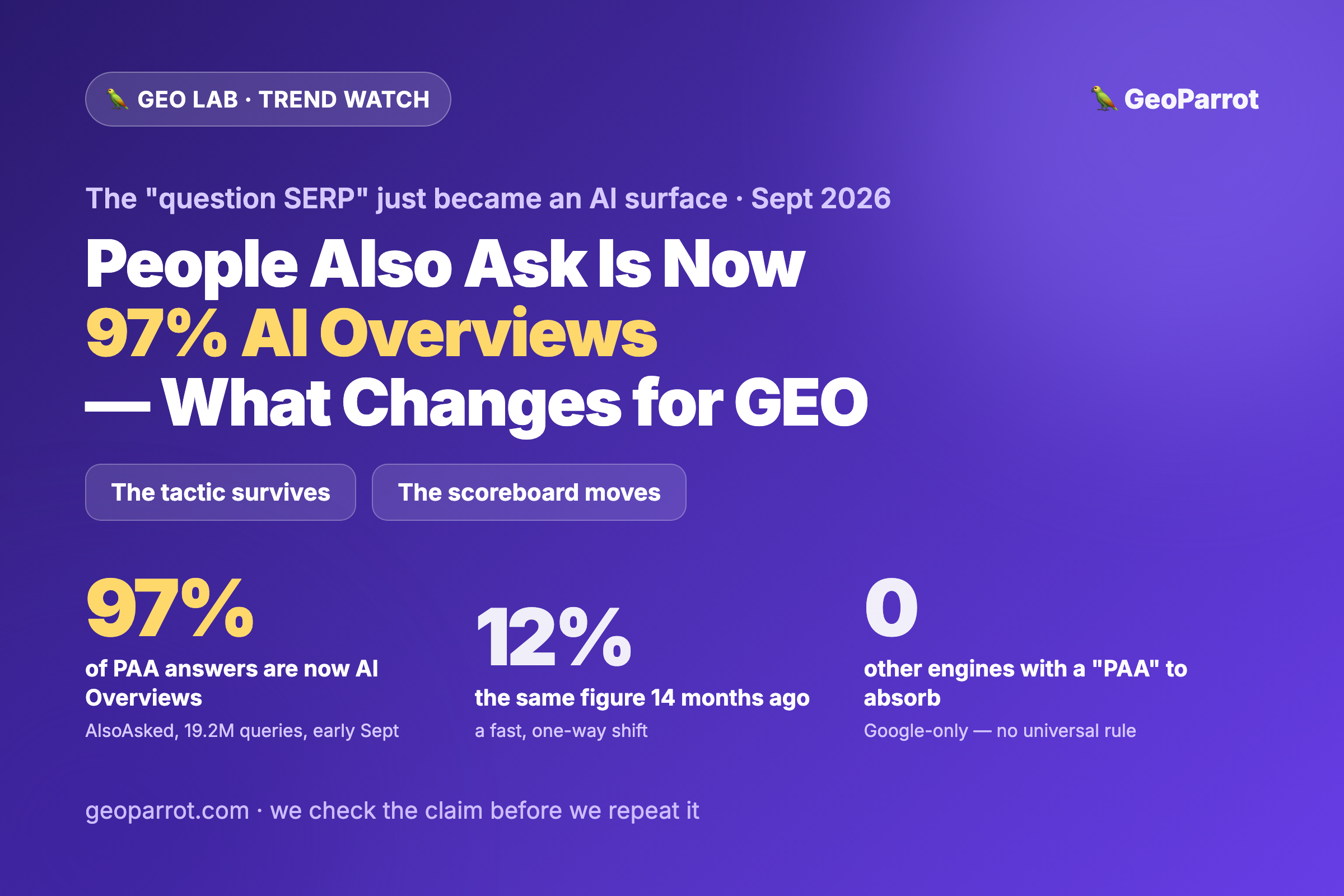
Quick answer: New tracking data shows roughly 97% of People Also Ask (PAA) results are now AI Overviews — up from about 12% fourteen months ago. The question-intent real estate that SEOs spent years optimizing FAQ content to win has effectively been absorbed into AI answers. What this changes is smaller than the headline suggests: the work is the same (answer-first, genuinely question-shaped content with clean structure), but the payoff moved from winning a clickable SERP slot to being a cited source inside an AI answer — often a zero-click one. And because PAA is a Google-only feature, this is one engine reshuffling its own UI, not a universal GEO rule. Adjust how you measure, not what you write.
Trend watch — published September 10, 2026. This is a fact-check post: Search Engine Roundtable reported the PAA-to-AI-Overviews shift on September 9, so we pulled the underlying data, checked the claim, and asked what it actually means for practitioners — in the spirit of the GEO Lab.
What exactly changed with People Also Ask?
People Also Ask is the expandable list of related questions Google has shown in its results for years. Historically each one opened to a featured-snippet-style answer pulled from a ranking page, with a link — a reliable long-tail target that rewarded well-structured FAQ content. Two independent trackers now say that format has been almost entirely converted to AI. AlsoAsked, sampling 19.2 million English-language queries, found 97% of PAA answers in the first week of September 2026 were AI Overviews, up from 86% in August. A second tool, Allintitle, reported the figure hit 100% in August. For context, the same measurement sat at roughly 12% just fourteen months earlier. Whichever number you take, the direction is unambiguous: the “question SERP” is now an AI surface.
| When | Share of PAA answers that are AI Overviews | Source (as reported) |
|---|---|---|
| ~14 months ago | ~12% | AlsoAsked |
| August 2026 | 86% | AlsoAsked (19.2M queries) |
| August 2026 | 100% | Allintitle |
| First week of September 2026 | 97% | AlsoAsked (19.2M queries) |
One caveat first, because it matters for how you react: these are third-party measurements, not a Google-confirmed metric, and “an AI Overview now answers this PAA query” is not the same as “your page is the source it cites.” Treat the 97% as a strong, consistent signal of where Google is headed — not as a precise law to reallocate your budget around.
Why does this matter more than a normal SERP tweak?
Because PAA was the bridge. It took a question, gave a short answer, and — crucially — handed off a click to the page behind that answer. That made it the cleanest proof that “optimize for the question, earn the visit” still worked. When AI Overviews absorb the box, the question-intent query now resolves inside the AI answer. The user frequently gets what they need without a click, and your reward for winning the question is no longer a guaranteed visit — it’s a citation, which may or may not send traffic. This is the same zero-click pressure we covered when AI Overviews began expanding toward AI Mode by default, now reaching one of the last SERP features that reliably rewarded FAQ content with clicks.
So do I change what I write?
Mostly no — and this is the part that gets lost in the panic. The behavior that used to win a PAA slot is the same behavior that gets a passage quoted in an AI Overview: a direct, self-contained answer in the first sentence, a clear question as the heading, and clean structure a machine can lift without guessing. That is exactly the answer-first writing and schema markup we have argued for all along, and it is the core of showing up in AI Overviews. The tactic survives the transition intact. What changes is the scoreboard: you are no longer optimizing to own a clickable SERP feature — you are optimizing to be the cited, quoted source inside the answer, and to earn the trickle of clicks that the “dig deeper” links still pass through.
What actually breaks is measurement
If PAA slots used to be part of how you judged question content, that signal is gone — you cannot track appearances and clicks on a box that no longer behaves like a box. The replacement scoreboard is newer and thinner. On the Google side, lean on the Search Console Generative AI performance report, which shows impressions in AI features but no click data — so it tells you that you appeared, not whether it paid off. On your side, watch your own referral logs with a GA4 setup for AI traffic, remembering that a citation that satisfies the user never shows up as a session at all. The honest read: a chunk of the value you used to be able to see has moved into a zero-click space you can only partially instrument. Plan for visibility you can prove and conversions you may never attribute cleanly.
Is this a reason to build a “PAA strategy” for every engine?
No — and here is the scope discipline we keep insisting on. People Also Ask is a Google-specific SERP feature. ChatGPT, Perplexity, and Copilot have no PAA box to absorb; they answer questions through entirely different retrieval and citation mechanics. So this is one engine reshuffling its own interface, not a new law of AI search. It fits a clear Google direction — the company is simultaneously testing paginated, skippable follow-up responses in AI Mode — but it does not tell you how to get quoted in any other assistant. As our cross-engine testing keeps showing, there is no universal GEO strategy: build answer-first content that travels, then verify per engine rather than chasing one platform’s feature change. This is also why “is SEO dead” keeps being the wrong question — the skill transfers, the surface moves.
The practitioner takeaway
- Don’t panic-reallocate. “97% of PAA shows an AI Overview” is not “97% of your question traffic is gone.” PAA clicks were never a traffic firehose, and an AIO appearing on a query does not mean you were the source it cited.
- Keep writing answer-first. The content that won PAA slots is the content that gets quoted in AI Overviews — lead with the answer, use the real question as the H2, keep it liftable.
- Swap your scoreboard. Stop counting PAA appearances; start tracking AI-feature impressions in Search Console and AI referrals in GA4, and accept that satisfied zero-click citations won’t fully show up.
- Don’t build a PAA strategy. It’s a Google feature. Optimize for being quotable everywhere, then check each engine on its own terms with the AI SEO fundamentals as your baseline.
- Treat the 97% as a signal, not a law. It’s strong third-party measurement of a real trend — useful for direction, not precise enough to be a KPI.
Bottom line: People Also Ask going ~97% AI Overviews is a milestone, but not a strategy reset. It confirms a trajectory we have been tracking all year — Google folding its own SERP features into AI answers — and it removes one of the last question-intent surfaces that reliably rewarded FAQ content with clicks. The right response is boring on purpose: keep writing the answer-first content that makes a passage quotable, change how you measure so you’re watching citations and impressions instead of a vanished box, and resist turning a single Google UI change into a cross-engine theory. The surface moved; the work didn’t.
Frequently asked questions
What percentage of People Also Ask results are now AI Overviews?
According to AlsoAsked, which sampled 19.2 million English-language queries, about 97% of People Also Ask answers in the first week of September 2026 were AI Overviews, up from 86% in August. A separate tool, Allintitle, reported the figure reached 100% in August. Fourteen months earlier the share was roughly 12%. These are third-party measurements rather than a figure Google has confirmed.
Does this mean my FAQ and question content is now worthless?
No. The answer-first, question-shaped content that won People Also Ask slots is exactly what gets quoted inside an AI Overview. The tactic still works; what changes is the reward. Instead of owning a clickable SERP feature, you are competing to be the cited source inside the AI answer, which often resolves the query without a click.
How do I measure success now that People Also Ask is an AI surface?
Shift from tracking SERP-feature appearances to tracking AI visibility. Use Google Search Console’s Generative AI performance report for impressions in AI features (note it has no click data), and segment AI-referred sessions in your own analytics. Accept that a citation that fully satisfies a user may never register as a visit, so plan for partial attribution.
Is this happening on ChatGPT and Perplexity too?
No. People Also Ask is a Google-specific SERP feature, so this change is Google absorbing one of its own interface elements. ChatGPT, Perplexity, and other assistants answer questions through different retrieval and citation systems and have no PAA box. It reflects Google’s direction, not a universal rule for AI search — optimize to be quotable everywhere and verify each engine separately.
Should I change my content strategy because of this?
Adjust measurement, not writing. Keep producing direct, answer-first content with clear question headings and clean structure, because that is what makes a passage citable. Then update your scoreboard to watch AI-feature impressions and referrals instead of People Also Ask slots, and avoid building a single-feature strategy around one platform’s UI change.
Leave a Reply