
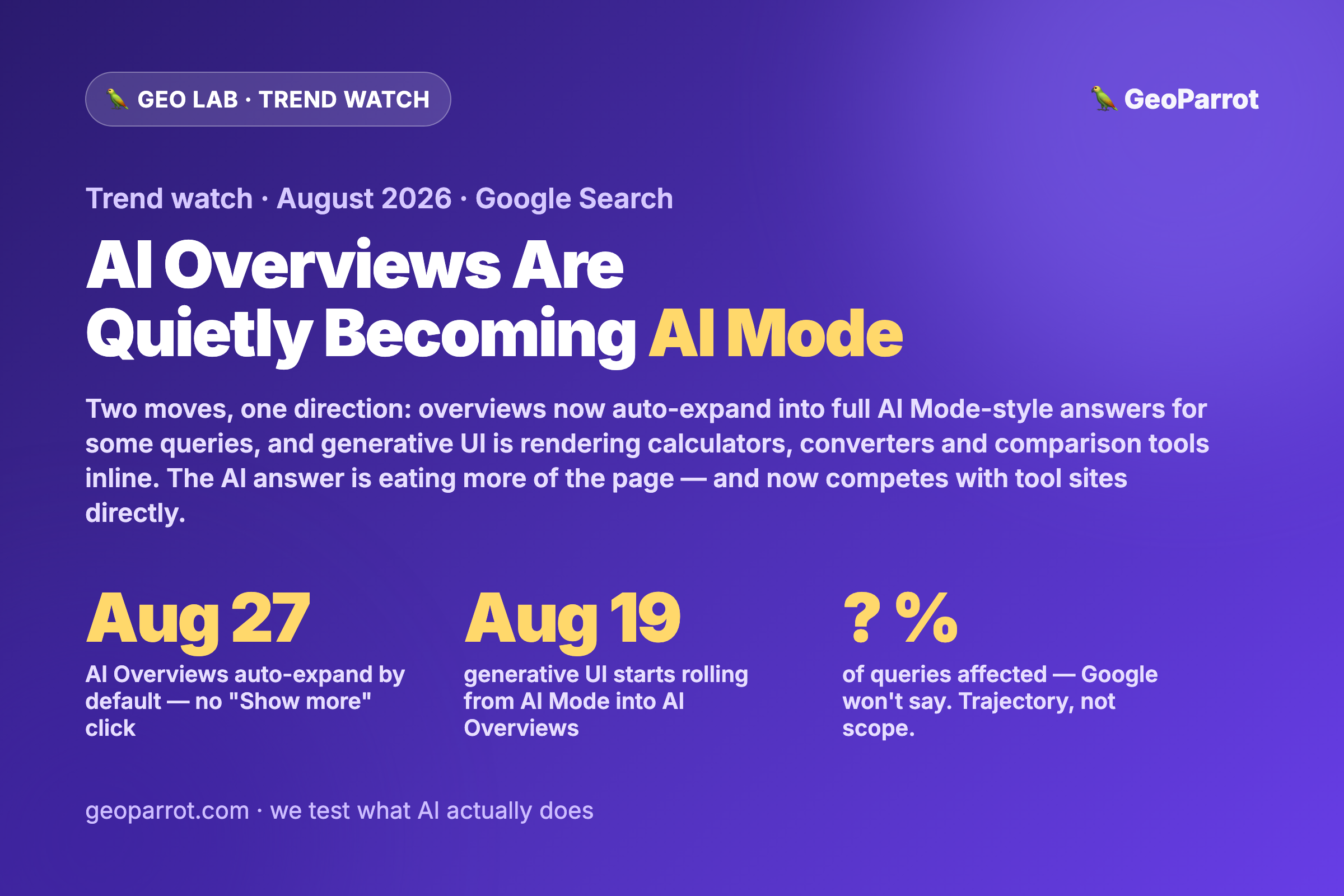
Quick answer: In late August 2026 Google made two moves that point the same way. On Aug 27, it began auto-expanding AI Overviews into a full, AI Mode-style answer for “some queries” — loading the whole response plus an “Ask anything” box by default, with no “Show more” click, pushing the blue links further down the page. Separately, since Aug 19 it has been rolling generative UI — on-the-fly calculators, converters, comparison tools, and interactive visuals — out of AI Mode and into AI Overviews, “the larger of the two surfaces.” Together they mean the AI answer is eating more of the page, on more queries, and now competes directly with tool and calculator sites. What it does not mean: that AI Mode is “the default” everywhere. Google won’t say what share of queries this touches — so treat the trajectory as real and the scope as unmeasured.
Trend watch — published August 29, 2026. This is a fact-check post: we report what’s confirmed, flag what isn’t, and connect it to our own first-party experiments on how AI engines actually surface sources.
What exactly changed in AI Overviews?
Two things, close together, both confirmed by Google:
- Default expansion (Aug 27). SEO practitioner Chris Long spotted AI Overviews auto-expanding to their full state for certain queries — no “Show more” tap required — with the “Ask anything” follow-up box loaded by default. Google confirmed it: “For some queries, AI Overviews may dynamically expand for topics where our systems determine it’s most useful for people… users find Search more helpful and engage deeper in follow-up exploration.” If you’ve already started scrolling, the expansion cancels so you don’t lose your place.
- Generative UI moving in (Aug 19). The feature that “builds custom visual layouts, interactive tools, and simulations on the fly” — live in AI Mode since November 2025 — began appearing inside AI Overviews, with full availability expected “in the coming weeks.” Google’s own demos include an interactive pH scale you can query further (“plot citrus fruits on that same scale”) and mortgage calculators that let users compare loan terms without leaving the result.
Read together, this is the AI Overview quietly becoming AI Mode: a fuller answer, an interactive canvas, and a follow-up box — all before the first organic result.
Why does this matter more than the average AI Overviews headline?
Because it hits two different groups of sites at once. If you optimize for clicks, a default-expanded overview means the answer is more complete and the links start lower — the click you were fighting for is the one most at risk. If you built utility pages — a loan calculator, a unit converter, a “X vs Y” comparison — generative UI is aimed squarely at your traffic. Search Engine Journal put it plainly: “Sites built around calculators, converters, or comparison tools could see more direct overlap as it reaches AI Overviews.”
We’ll be honest about our own exposure here: part of GeoParrot’s distribution is a set of free interactive tools we built to earn traffic. Generative UI is the clearest signal yet that “rank a calculator page” is a shrinking play — the engine can now render the calculator itself. That doesn’t make tools worthless (they still earn links, embeds, and brand recall), but it does move the moat from “having the tool” to “being the cited source of the method the tool uses.”
Isn’t this just “AI Mode is the default now”?
This is where we pump the brakes. Google described default expansion as happening for “some queries… where our systems determine it’s most useful,” and declined to say what percentage of searches it affects or whether the rollout will widen. So “AI Mode is now the default search experience” is a direction of travel, not a measured fact. We’ve watched this failure mode all year in GEO: a screenshot of a dramatic new surface, plus a confident “everything has changed,” treated as settled before anyone has data on how common it actually is. Google itself frames the whole shift conservatively — its 2026 guidance says “optimizing for generative AI search is optimizing for the search experience, and thus still SEO.” Believe the trajectory; wait for the scope.
There’s a second reason not to overreact by rebuilding one “AI strategy.” Our cross-engine citation experiment found ~85% of cited domains were unique to a single engine — which is why we keep arguing there is no universal GEO strategy. A Google AI Overviews UI change tells you about Google. It tells you nothing about how ChatGPT or Perplexity assemble answers. Optimize per surface, or you optimize for an average that describes none of them.
What should you actually do about it?
- Stop reporting “AI Overviews impressions” as a win. A default-expanded overview can appear, cite you, and still send fewer clicks than a collapsed one did. Track cited-and-clicked, not cited — the gap is where this change hurts. (Why blended visibility numbers mislead: our share-of-voice critique.)
- If you own tool/calculator pages, move the moat upstream. Generative UI can reproduce the widget; it’s far harder for it to reproduce your authority on the method. Make the page the citable explanation of how the calculation works, why the inputs matter, and where the numbers come from — the part the engine still has to source from somewhere.
- Write the self-contained passage. A fuller AI answer rewards content the engine can lift as a clean, complete paragraph that answers the exact question. Buried, multi-scroll answers lose to structured ones — this is the same AI SEO fundamentals we keep landing on.
- Don’t torch your Google plan over one engine’s UI. Per-surface still wins. Keep separate playbooks for Google AI Overviews/AI Mode, ChatGPT, and Perplexity — see our per-engine GEO checklist.
- Measure the real scope yourself. Google won’t publish the query share. Sample your own top queries over the next few weeks and log how often the overview arrives pre-expanded. Your own data on your queries beats any industry headline about “most searches.”
Bottom line: the two changes are real and confirmed, and they point the same direction — the AI answer is claiming more of the page and now renders tools inline. The “AI Mode is the default” framing is running ahead of the evidence. GEO in late 2026 rewards teams that act on the confirmed shift while staying skeptical of the tidy headline about how universal it is.
Frequently asked questions
Is Google replacing AI Overviews with AI Mode?
Not outright — but the line is blurring. As of Aug 27, 2026, Google auto-expands AI Overviews into a full, AI Mode-style answer (with an “Ask anything” box) for “some queries,” and since Aug 19 it has been adding AI Mode’s generative UI to overviews. Google won’t say what share of searches this covers, so treat “AI Mode is the default” as a trajectory, not a confirmed state.
What is generative UI in Google Search?
It’s a capability that builds custom visual layouts, interactive tools, and simulations on the fly inside the AI answer — for example an interactive pH scale you can query further, or a mortgage calculator that compares loan terms. It launched in AI Mode in November 2025 and started rolling into AI Overviews around Aug 19, 2026, with full availability expected within weeks.
Will default-expanded AI Overviews hurt my organic traffic?
Likely yes for click-dependent pages, though Google published no CTR data. A pre-expanded overview delivers a more complete answer and pushes the first organic result lower, so the risk is fewer clicks even when you’re cited. Shift your success metric from “appeared in the overview” to “appeared and still earned the click,” and sample your own top queries to measure the real effect.
My site is built around a calculator or converter — what now?
Generative UI can render a comparable tool inside the result, so “rank the widget” is a weakening strategy. Move your moat upstream: make the page the citable authority on the method — how the calculation works, why inputs matter, and where the underlying numbers come from. The engine can copy a slider; it still has to source the explanation.
How is this different from the original AI Overviews launch?
The 2024–2025 launch put a collapsible summary above the links. The August 2026 changes remove the collapse (full answer by default for some queries) and add interactivity (generative UI tools and follow-up questions) directly in the overview. It’s less “a summary on top of Search” and more “AI Mode wearing an AI Overview’s clothes.”
Leave a Reply