
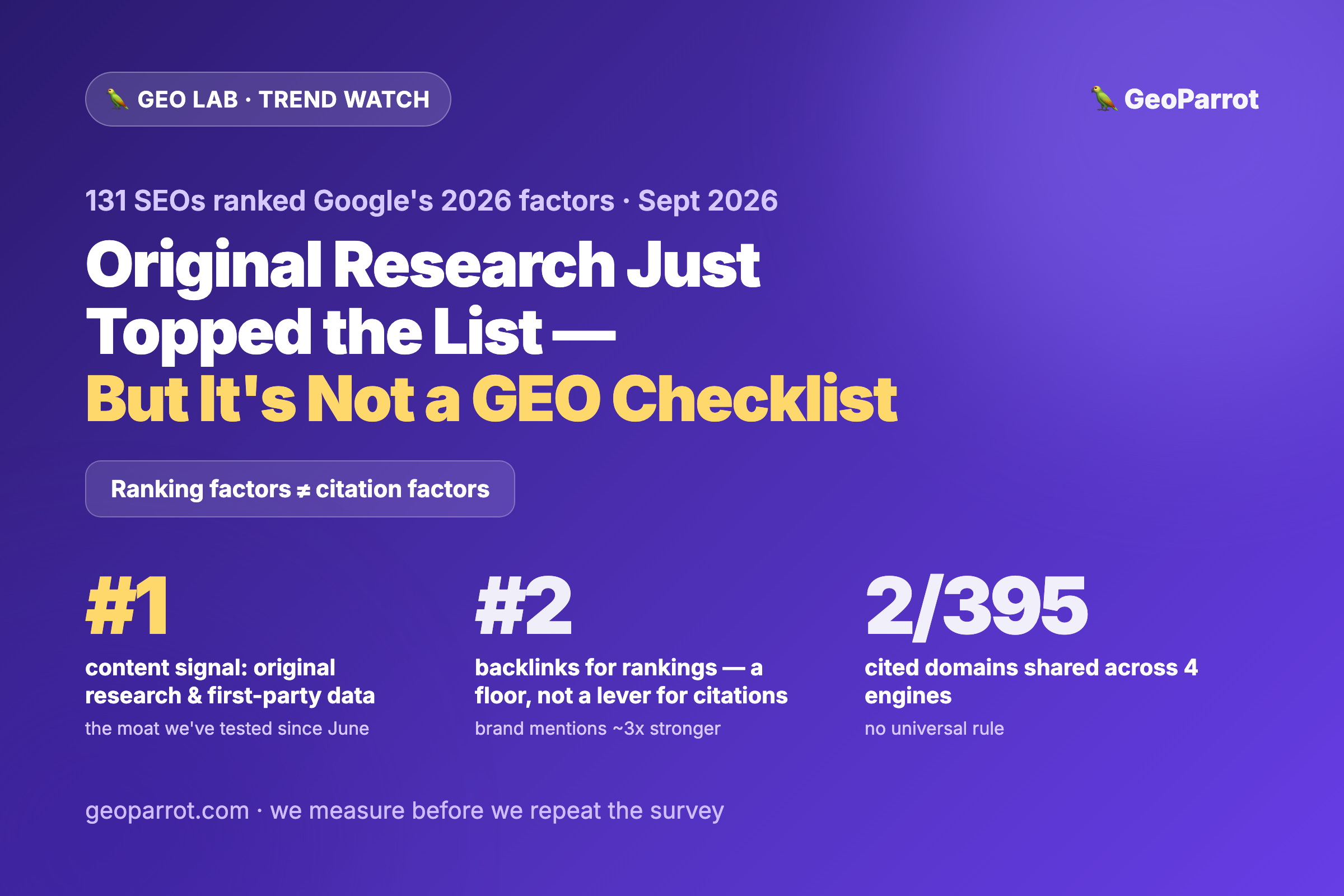
Quick answer: Zyppy’s 2026 Google Ranking Factors Expert Survey (131 practitioners, 13,665 ratings across 103 factors, published September 9) put relevance, backlinks, and content quality at the top — and within content quality, it crowned original research and first-party data as the highest-rated signal “in the age of AI.” That’s the exact thesis this lab has run on since June, so the convergence is real and worth celebrating. But two things keep it from being a GEO checklist: it’s an opinion survey about Google rankings, not measured data about AI citations, and it’s Google-only. Use it as a hypothesis list — then verify against your own citation logs, because the weights that rank a page (backlinks #2) are not the weights that get it cited by an AI answer (where our data and the large studies put backlinks near the floor).
Trend watch — published September 11, 2026. This is a fact-check post: Cyrus and Dawn Shepard released the 2026 survey on September 9 and it’s the definitive annual read on what SEOs believe moves Google. We pulled the findings, mapped them against what we’ve actually measured for AI citations, and drew the boundary — in the spirit of the GEO Lab.
What did the 2026 survey actually find?
The Zyppy survey asks experienced SEOs to score potential ranking factors on a seven-point scale, from +3 (strongly positive) to −3 (strongly negative), and aggregates the votes. This year’s cohort was 131 practitioners producing 13,665 ratings across 103 factors, and Zyppy says it updated the instrument to reflect AI search, Google’s API leak, and antitrust testimony. Here is the top of the list by the share of respondents naming each a top-three factor.
| Rank | Factor | % naming it top-3 |
|---|---|---|
| 1 | Relevance / search-intent match | 57.1% |
| 2 | Backlinks | 54.8% |
| 3 | Content quality | 47.6% |
| 4 | Authority & trust | 36.5% |
| 5 | Behavior / click signals | 29.4% |
| 6 | Brand signals | 27.0% |
| … | Meta description | rated dead last |
Two details matter more than the headline order. First, within content quality, “original research” and “first-party data” received some of the highest ratings of any sub-factor — the survey frames unique, non-commodity content as the way to stand out “in the age of AI.” Second, the panel split cleanly on AI-written content: human-reviewed AI that adds genuine value scored positive, while AI content published at scale with little added value scored negative. Meta description, meanwhile, landed at the bottom — most respondents said it has little or no direct ranking effect.
Where does this converge with what we’ve measured for AI citations?
More than we expected — and in the places that matter most. The survey’s top content signal, original research and first-party data, is the same moat we’ve argued for all year: AI answers preferentially quote passages carrying a statistic, a source, or a number you can only get by doing the work. That’s why our whole positioning is running experiments instead of restating opinions. When 131 SEOs independently vote unique data to the top of the content pile, that’s the mainstream consensus catching up to a bet we placed in June.
The rise of brand signals (27%) and authority/trust (36.5%) tracks our citation findings too. When we looked at the 2026 correlation studies, brand web mentions correlated with AI visibility roughly three times more strongly than backlinks — and one meta-analysis of 54 studies reached the same ordering. Reputation and demand, not link volume, is what shows up as the lever in both worlds. And the panel’s negative rating for scaled, low-value AI content lines up with Google’s own spam direction, which suppresses the same pages in AI answers because AI Overviews draw from the same index.
So why isn’t this a GEO checklist?
Because a ranking-factors list and an AI-citation list are not the same document, and copying one onto the other is the mistake we keep flagging. Three boundaries.
1. It’s an opinion survey, not measurement. Every number here is expert belief, aggregated — valuable, but it’s what practitioners think moves rankings, not a controlled test of what moves citations. Our lab exists precisely because the GEO market is full of confident claims and thin data. Treat the survey the way we treat any hypothesis: a ranked list of things worth testing, then check it against your own AI-referral logs. Belief and measurement disagree often enough that the gap is the whole game.
2. Backlinks rank #2 for pages — but they’re a floor, not a lever, for citations. This is the single most dangerous transfer error. Backlinks are the second-most-cited ranking factor in the survey, so the reflex is to pour GEO budget into links. But when we asked whether AI search actually uses backlinks, and when we compared Google rank position against who gets cited, links behaved like a qualifying threshold, not the thing that wins the quote. The large correlation studies agree: backlinks sit near the bottom of the AI-visibility ranking while brand mentions sit at the top. A page can rank on links and still never get cited.
3. It’s Google-only. The survey measures Google, and even Zyppy now carves out a separate “Google AI Ranking Factors” section — an admission that AI answers need their own factor set. But Google is one engine. Our cross-engine test found the four major assistants shared only 2 of 395 cited domains, with roughly 85% of sources unique to a single engine. A checklist tuned to Google’s rankings tells you almost nothing about how ChatGPT or Perplexity choose sources, which is why there is no universal GEO strategy.
What should you actually do with it?
- Read it as a hypothesis list, not a recipe. The survey ranks what experts believe about Google. Turn each high-rated factor into something you can verify in your own logs before you reallocate a dollar.
- Double down on original research and first-party data. This is the rare factor rated top by the panel and confirmed by citation data. It’s the most durable investment you can make for rankings and for getting quoted in AI answers at once.
- Don’t shift GEO budget to backlinks because they’re #2. For citations they’re a floor. Once you clear a credible link baseline, the marginal link buys ranking, not quotes — spend the next dollar on demand and reputation instead.
- Build category brand presence. Earned mentions and being the name people associate with the category is what shows up as the lever in both the survey’s brand-signal rise and our consensus-pick findings.
- Kill scaled thin content. The panel and Google’s spam updates agree: mass-produced AI filler is a liability in rankings and in AI answers.
- Verify per engine. Don’t assume a Google list transfers to ChatGPT, Perplexity, or Gemini. Use the AI SEO fundamentals as your baseline, then test each surface on its own terms.
Bottom line: The 2026 ranking-factors survey is genuinely useful, and its top content finding — original research and first-party data — is a public vote of confidence in the exact strategy we’ve been running experiments to prove. Celebrate the convergence, then respect the boundary: this is expert opinion about Google rankings, and the weights that rank a page are not the weights that earn it a citation. Backlinks that rank you sit near the citation floor; brand and original data that get you quoted sit near the top; and none of it automatically transfers to the next engine. Use the survey to generate hypotheses. Use your own data to decide what’s actually true.
Frequently asked questions
What is the 2026 Google Ranking Factors Expert Survey?
It’s an annual survey run by Cyrus and Dawn Shepard at Zyppy, published September 9, 2026, in which 131 SEO practitioners scored 103 potential ranking factors on a seven-point scale (+3 to −3), producing 13,665 ratings. This year Zyppy updated it to reflect AI search, Google’s API leak, and antitrust testimony. It reports what experienced SEOs believe drives Google rankings — aggregated opinion, not a controlled experiment.
What was the top content-quality signal in the survey?
Within content quality, original research and first-party data received some of the highest ratings of any sub-factor, framed as the way to stand out with unique, non-commodity content in the age of AI. That aligns with what we’ve measured for AI citations: passages carrying a statistic, source, or original number are the ones assistants tend to quote.
Do backlinks matter for AI citations the way they do for rankings?
Not the same way. Backlinks ranked as the #2 Google ranking factor in the survey, but our experiments and the 2026 correlation studies treat them as a floor rather than a lever for AI citations — brand web mentions correlated roughly three times more strongly with AI visibility than backlinks. A page can rank on links and still never get cited, so don’t reallocate GEO budget to link-building just because links rank highly for pages.
Can I use this survey as a GEO or AI-citation checklist?
Use it as a hypothesis list, not a checklist. It measures Google rankings, and even Zyppy separates out a distinct “Google AI Ranking Factors” section. Because our cross-engine testing found the major assistants shared only 2 of 395 cited domains, a Google-tuned list won’t tell you how ChatGPT or Perplexity pick sources. Verify each engine against your own citation and referral data.
What ranked lowest, and does it matter for GEO?
Meta description ranked dead last, with most respondents saying it has little or no direct ranking effect. The GEO read is the same: don’t over-invest in meta descriptions as a citation lever. They can still influence click-through from a search result, but they aren’t what makes a passage quotable inside an AI answer.
Leave a Reply