
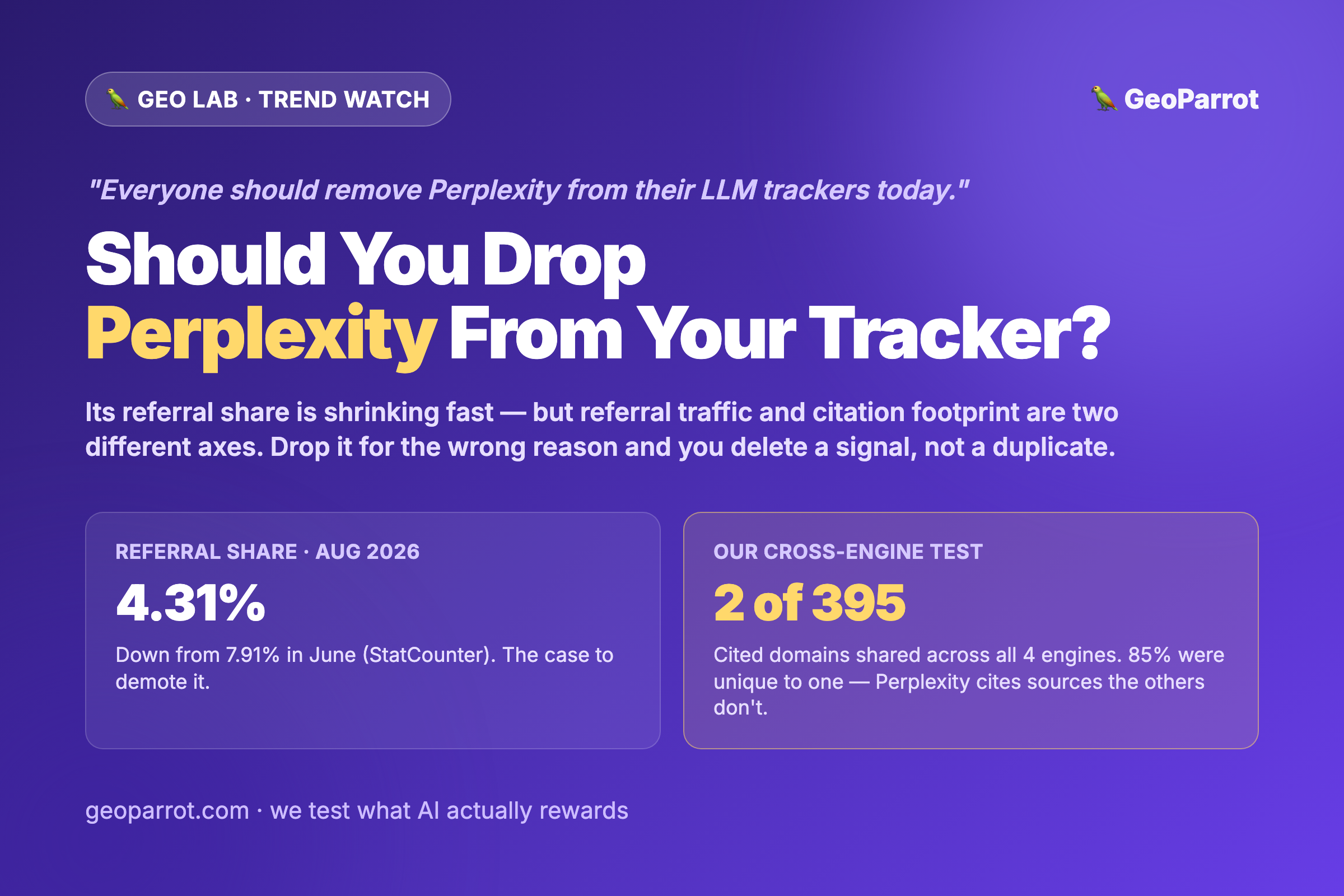
Quick answer: Don’t delete Perplexity from your AI tracker — demote its weight. The provocation making the rounds (“everyone should remove Perplexity from their LLM trackers today”) is right about one thing: Perplexity’s referral share fell from 7.91% in June to 4.31% in August 2026 while Gemini nearly tripled it, so treating all engines as equal in a blended visibility score is now distorting. But it conflates two different axes — referral traffic (how much a click an engine sends) and citation footprint (whether your content is being picked up at all). Our own cross-engine testing found the four major engines shared only 2 of 395 cited domains, with ~85% unique to a single engine. Perplexity cites sources the others don’t. Drop it and you lose a distinct diagnostic signal, not a redundant one. The disciplined move: weight engines by your traffic and conversion data, but keep a cheap presence check running everywhere.
Trend watch — published September 13, 2026. This is a fact-check post: a live debate broke out this week after Search Engine Journal (Sept 9) covered the “stop tracking Perplexity” argument. We pulled the underlying share data, checked the claim against our own cross-engine citation experiment, and asked what it actually means for how you measure — in the spirit of the GEO Lab.
What sparked the “drop Perplexity” debate?
The trigger was a blunt call to action. Ross Hudgens, CEO of Siege Media, declared: “Everyone should remove Perplexity from their LLM trackers today.” His reasoning is a market-share argument — Perplexity is shrinking, and giving it equal billing alongside ChatGPT, Gemini, Claude, and Google’s AI surfaces paints a distorted picture of where visibility actually matters. Writing in Search Engine Journal on September 9, Greg Jarboe pushed back with a more measured line: “Don’t remove Perplexity from your LLM tracker. Remove it from the position of equal weighting.” That gap — delete versus demote — is the whole debate, and it’s a measurement question, which is exactly the kind of thing this lab exists to referee.
What do the numbers actually say?
The share decline is real and steep. Here is the data being cited, as reported by the trackers behind the debate:
| Metric | Perplexity | For comparison | Source (as reported) |
|---|---|---|---|
| AI chatbot referral share, June 2026 | 7.91% | Gemini 7.94% (roughly tied) | StatCounter |
| AI chatbot referral share, August 2026 | 4.31% | Gemini 10.9% (nearly tripled the gap) | StatCounter |
| Share of worldwide web visits, May 2026 | 1.3% | ChatGPT 53.9% · Gemini 27.9% · Claude 9.2% | Similarweb |
So the “demote it” instinct has an honest basis: if you’re building a single blended “AI visibility” number and Perplexity carries the same weight as an engine sending 10–50× the traffic, your score is being dragged around by a tail. That is precisely the kind of distortion we warned about when we argued that a blended “AI Share of Voice” is the wrong metric — averaging unlike engines into one figure hides more than it reveals. On that narrow point, the critics are correct.
Why deleting it entirely is the wrong call
Here’s where the headline overshoots, and it comes down to a category error: referral traffic and citation footprint are not the same axis. A referral-share chart measures how many clicks an engine sends to websites. A visibility tracker measures whether your content is being cited — whether it shows up as a source in the answer at all. Those diverge, and they diverge more every month, because AI citations are increasingly zero-click. We’ve documented this repeatedly: Google is testing a thinner citation panel that shrinks clicks without changing who gets cited, and People Also Ask has been almost entirely absorbed into AI answers. An engine can be cited constantly and still send you very little referral traffic. Low referral share is therefore not evidence of low citation presence — it may just mean the engine resolves queries without passing a click.
The stronger reason sits in our own data. When we ran a cross-engine citation experiment across four AI engines, the overlap was almost nonexistent: of 395 unique cited domains, exactly 2 (0.5%) were shared by all four engines, and roughly 85% were cited by only one engine. Perplexity’s citation pool was largely its own. That means Perplexity is not a redundant proxy you can safely infer from ChatGPT or Gemini — it is a distinct citation surface that pulls from sources the others ignore. Delete it from your tracker and you don’t remove a duplicate reading; you go blind to a set of sources and competitors you can’t see anywhere else. This is the same lesson as there being no universal GEO strategy: engines behave differently enough that you have to check each one on its own terms.
Aren’t small engines just a waste of tracking budget?
Only if you track them the same way you track leaders — which you shouldn’t. The mistake isn’t tracking a 4% engine; it’s spending the same money and giving it the same decision-weight as a 50% engine. Those are separable. You can keep a cheap “presence check” on a tail engine — a handful of manual or low-frequency queries to confirm whether you’re cited and who’s beating you — while reserving expensive daily rank-style tracking for the platforms that actually move your traffic. And remember the variance: Perplexity over-indexes in some verticals (research-heavy, B2B, technical queries), so its average share understates its value for specific businesses. A blanket “drop it” rule ignores that your category may be one where it punches above its weight. The only way to know is to look at your data, not the market average — the dogfooding principle this lab runs on.
The real fix: separate your metrics by decision
The whole argument dissolves once you stop collapsing everything into one “visibility” number. Different metrics answer different questions, and each engine belongs in each view for a different reason:
- Referral traffic answers where should I prioritize distribution and effort? Here Perplexity gets a small weight, correctly, because it sends little traffic today.
- Citation presence answers is my content being picked up, and by whom? Here Perplexity stays fully in view, because it cites a distinct source set you can’t infer from other engines.
- Conversion value answers is this traffic worth anything? — a reminder that raw referral volume is a weak proxy, as we found when we asked whether AI search traffic really converts better. A small engine can still send disproportionately qualified visitors.
Measure those on their own axes and the “delete vs keep” fight evaporates: you weight by traffic where traffic is the question, and you keep full coverage where coverage is the question. For the how-to on wiring this up, our GA4 setup for AI traffic and per-engine GEO checklist cover the mechanics, and how to rank in Perplexity still matters for the verticals where it earns its slot.
The practitioner takeaway
- Demote, don’t delete. Stop giving Perplexity equal weight in any blended visibility score — that part of the criticism is fair. But keep it in your citation tracking.
- Don’t read referral share as citation share. Low traffic ≠ low citations. Zero-click answers mean an engine can cite you constantly and send almost no clicks.
- Check your verticals. Perplexity over-indexes in research and B2B niches. Your category may make it more valuable than its ~4% average suggests — look at your own logs.
- Match tracking cost to engine weight. Cheap presence checks for tail engines, expensive daily tracking for leaders. Tracking budget and decision-weight are separate dials.
- Watch the trend, not one month. A single share reading is noisy; the direction over quarters is the signal. Don’t restructure your stack around one data point.
Bottom line: The “remove Perplexity today” take is a good instinct wearing the wrong clothes. It correctly spots that equal-weighting a shrinking engine distorts a blended score — but it treats a tracker as if its only job were to reflect traffic. A tracker’s real job is to tell you whether you’re being cited and by whom, and on that axis Perplexity remains a distinct, non-redundant surface: our data says the engines barely share sources at all. So demote its weight, right-size its cost, and check whether your vertical is one of the ones where it still matters. Delete the equal weighting, not the signal.
Frequently asked questions
Should I remove Perplexity from my AI visibility tracker?
No — demote its weight instead of deleting it. It’s fair to stop giving Perplexity equal billing in a blended visibility score, since its referral share fell to about 4.31% in August 2026. But keep it in your citation tracking, because cross-engine data shows engines share almost no cited sources, so Perplexity surfaces sources and competitors you can’t see through ChatGPT or Gemini.
Why did Perplexity’s referral share drop in 2026?
According to StatCounter data cited in the debate, Perplexity’s share of AI chatbot referrals fell from 7.91% in June 2026 to 4.31% in August, while Gemini rose from 7.94% to 10.9% over the same period. The AI assistant market is concentrating around ChatGPT and Gemini, which pulled far ahead in both referral traffic and overall web visits.
Does low referral traffic mean low AI citations?
No. Referral traffic measures the clicks an engine sends; citation presence measures whether your content is used as a source at all. AI answers are increasingly zero-click, so an engine can cite you frequently while sending very little traffic. Treating a low referral share as proof of low citation footprint is a category error.
Isn’t tracking a 4% engine a waste of budget?
Only if you track it like a leader. Keep a cheap, low-frequency presence check on tail engines to confirm whether you’re cited and who’s beating you, and reserve expensive daily tracking for the platforms that drive your traffic. Tracking cost and decision-weight are separate dials — you can lower one without zeroing out the other.
Which AI engines should I prioritize tracking?
Weight by your own data, not the market average. For most sites that means ChatGPT and Gemini get the heaviest tracking, with Google AI Overviews close behind. But separate your metrics by decision: use referral traffic to prioritize effort, citation presence to see coverage, and conversion value to judge worth. Some verticals — research-heavy or B2B — should keep Perplexity higher than its average share implies.
Leave a Reply