
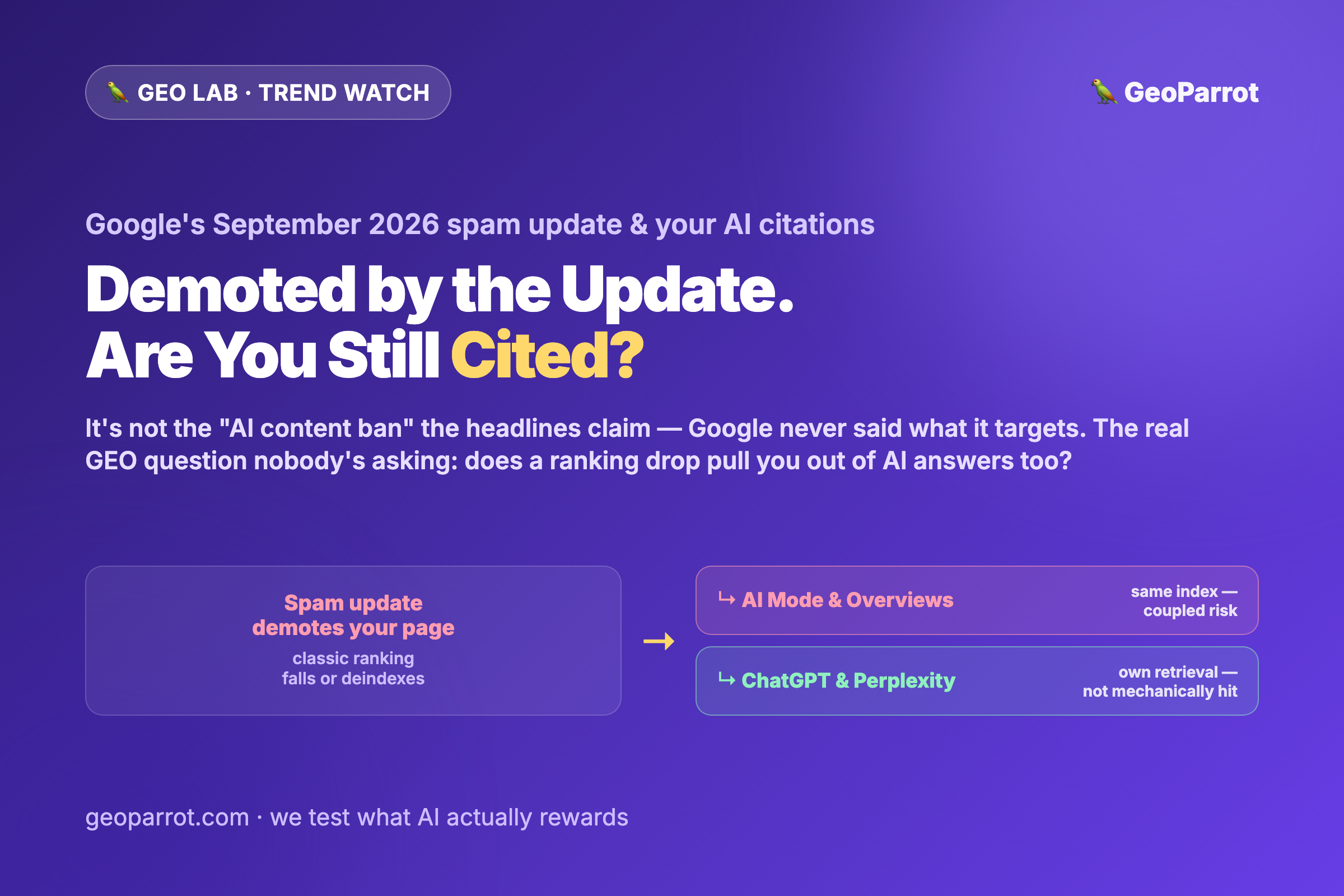
Quick answer: Google started the September 2026 spam update on September 24 (~9:15 a.m. PDT), applied globally and to all languages, with a rollout that may take up to two weeks — much longer than the ~2-day spam updates earlier this year. It’s the fourth spam update of 2026. The headlines calling it a “secret AI content detector” are outrunning the facts: Google has not said what this update targets, and has not confirmed AI-generated content is the focus. Google’s standing spam policies target scaled content abuse — bulk, low-value pages made to game rankings — “regardless of how the content is created.” The GEO question the SEO panic is skipping: if a demotion drops your rankings, does it also drop your AI citations? Our data says it depends on the engine — and the “publish in bulk to get cited” playbook just got riskier.
Trend watch — published September 29, 2026, five days into a two-week rollout. We’re reading it the way the GEO Lab reads any big SERP event: separate what Google confirmed from what the industry is inferring, then check the mechanism against what our own experiments already show.
Is the September 2026 spam update an “AI content” update?
No — or at least, Google never said so. The official announcement is deliberately spare: “Released the September 2026 spam update, which applies globally and to all languages. The rollout may take up to two weeks to complete.” That’s it. No target named, no mention of AI-generated content, no new “detector” announced. The “secret AI spam detector” framing making the rounds is an inference layered on top of that silence, not something Google stated. This is exactly where the GEO Lab habit of grading counted facts against inferred claims earns its keep: “global, all languages, up to two weeks, fourth update of 2026” is counted; “it’s an AI content ban” is inferred, and the two shouldn’t be quoted with the same confidence.
What we can say from Google’s published policies: the relevant rule is scaled content abuse — producing many pages primarily to manipulate rankings rather than help people — and it applies “regardless of how the content is created.” That means AI-assisted writing is not banned, and a hand-written content farm is not safe. The line isn’t human-versus-machine; it’s whether pages were mass-produced with no editorial value. Google’s spam systems, including the SpamBrain AI-based spam-prevention system, get periodically improved, and this update likely rides on those systems — but “SpamBrain improved” is not the same claim as “AI-written content is now penalized.” Grade the two differently.
Does a spam-update ranking drop also kill your AI citations?
This is the question the SEO coverage isn’t asking, and the answer is: it depends on the engine. Our experiments have consistently found that classic rank and AI citation are only loosely coupled. Across four major engines, they shared just 2 of 395 cited domains, with about 85% unique to a single engine, and our overlap work put the rank-to-citation relationship around a third — with Google AI Mode coupling most and ChatGPT least. Rank buys the ticket, not the seat: pages get cited without ranking, and rank without being cited.
Apply that to a spam-update demotion. Index-based surfaces — Google AI Overviews and AI Mode — draw from the same index that a spam update reshuffles, so a page that gets catastrophically demoted or deindexed can plausibly lose its eligibility to be cited there too. Independent-retrieval engines are different: ChatGPT and Perplexity run their own retrieval and don’t mechanically inherit a Google ranking change, so a Google demotion doesn’t automatically remove you from their answers. That’s the same split we flagged two weeks ago when unconfirmed ranking volatility had SEOs panicking — except this time the ranking event is confirmed, so the coupling risk on Google’s own surfaces is real rather than hypothetical.
One honest caveat: this is structural inference from our overlap data, not a before/after A/B test of this update. Normal position wobble is not the same as leaving the index. Only a page that falls out of Google’s index entirely puts its AI Mode and AI Overviews citations at real risk; a page that merely slides a few positions likely keeps them. Don’t read every dashboard dip during the rollout as a citation loss.
Why does this update raise the stakes for “GEO content farms”?
Because a lot of what’s been sold as “GEO” for the last year is the exact pattern this update targets. The pitch — publish extractable answer pages in bulk so an AI is more likely to quote you — produces thin, scaled content whether a human or a model writes it. That’s scaled content abuse by another name. And the downside is no longer just “those pages don’t rank.” If the tactic drags your whole domain into a demotion, then on index-based engines you can lose the rankings and the citations from that surface in one move. The shortcut to citations became a domain-level liability.
Our own experiments keep landing on the opposite of the volume playbook. Being on the list is not being the pick: self-ranking listicles rarely win the recommendation they list themselves in. Being cited is not being recommended: the consensus pick tracks category reputation, not page count. And in the aggregate, earned mentions beat owned pages for earning citations. None of that rewards mass production — which is precisely why a spam update aimed at scaled content should worry the “spray and get cited” crowd more than it worries anyone doing the slower, authority-first work.
How do you tell a citation loss from a ranking loss during the rollout?
Split the two metrics and watch them separately, on your own infrastructure. Google’s Generative AI performance report is impressions-only — no click data — so it won’t cleanly tell you whether an AI surface stopped citing you. The counted signal is first-party: track your GA4 AI-referred sessions alongside classic organic. If classic organic falls but AI-referred sessions hold, independent-retrieval engines are still carrying you and you should not panic-delete pages. If both fall together, you likely got demoted on the index-based surfaces too. Trust the numbers you can count on your side over the ones an interface implies.
And keep the scope tight: this is a Google event. There is no universal GEO move here — a Google spam update tells you nothing about whether Perplexity or ChatGPT still cite you on the same question, because they pull from largely different sources. Verify presence per engine instead of assuming Google’s behavior is everyone’s.
The practitioner takeaway
- Don’t gut content mid-rollout. The update may run up to two weeks. Wait for it to finish before diagnosing, or you’ll be reacting to a moving target.
- Don’t call it an “AI content ban.” Google didn’t. It targets scaled content abuse “regardless of how the content is created” — mass-produced thin pages, not the use of AI itself.
- Separate rankings from citations in your reporting. Watch classic organic (GSC) and AI-referred sessions (GA4) as two lines. Only both falling together points to a citation loss on Google’s surfaces.
- If citations held while rankings dropped, don’t panic-delete. Independent-retrieval engines are carrying you; deleting pages to “recover” can cost you citations you still have.
- Audit for scaled-content exposure, not “did I use AI.” The risk is bulk, low-value pages. If your GEO strategy is a page farm, that’s the liability to fix.
- Keep the scope on Google. Check Perplexity, ChatGPT and Gemini separately — a Google demotion doesn’t mechanically move them.
Bottom line: The September 2026 spam update is a real, confirmed, unusually long rollout — but it is not the “AI content ban” the headlines imply, because Google never said what it targets. The GEO story underneath is sharper than the SEO panic: a demotion can cost you citations on index-based engines (AI Mode, AI Overviews) while leaving independent-retrieval engines (ChatGPT, Perplexity) untouched, and the “publish in bulk to get cited” tactic is now a domain-level risk rather than a free lever. Measure rankings and citations as two separate lines, on your own analytics, per engine — and keep earning citations by being the most citable source, not the most prolific one.
Frequently asked questions
Is the September 2026 spam update targeting AI-generated content?
Google has not confirmed that. The official announcement only says the update “applies globally and to all languages” and “may take up to two weeks to complete,” with no target named. Google’s standing spam policies target scaled content abuse — bulk, low-value pages made to manipulate rankings — “regardless of how the content is created,” which means AI-assisted writing isn’t banned and human-written content farms aren’t safe. Treat “it’s an AI content update” as an unconfirmed inference, not a stated fact.
When did it start and how long will it take?
Google began rolling out the September 2026 spam update on September 24, 2026, at roughly 9:15 a.m. PDT, applied globally and to all languages. Google says it may take up to two weeks to complete — notably longer than the roughly two-day spam updates earlier in 2026. It is the fourth spam update of the year, following updates in March, June and August.
Will a spam-update demotion remove me from ChatGPT and Perplexity?
Not mechanically. ChatGPT and Perplexity run their own retrieval rather than reading off Google’s ranking, so a Google demotion doesn’t automatically strip your citations there. Google’s own AI surfaces — AI Overviews and AI Mode — draw from the same index a spam update reshuffles, so a catastrophic demotion or deindex can put those citations at risk. This is structural inference from our overlap data, not a before/after test of this specific update, so verify each engine on its own.
Does using AI to write content violate Google’s spam policies?
No. Google’s scaled content abuse policy explicitly applies “regardless of how the content is created,” meaning it doesn’t ban AI-assisted writing. What it targets is publishing pages in bulk with little editorial value primarily to game rankings. A carefully AI-assisted, genuinely useful page is not the target; a thousand thin auto-generated answer pages are — and so is the human-written equivalent.
How do I tell if my AI citations dropped versus my rankings?
Track two lines separately. Watch classic organic in Google Search Console against your GA4 AI-referred sessions. If classic organic falls while AI-referred sessions hold steady, independent-retrieval engines are still citing you — a ranking loss, not a citation loss. If both fall together, you were likely demoted on Google’s index-based AI surfaces too. GSC’s Generative AI report is impressions-only, so rely on first-party analytics for the click and session picture.
Leave a Reply