
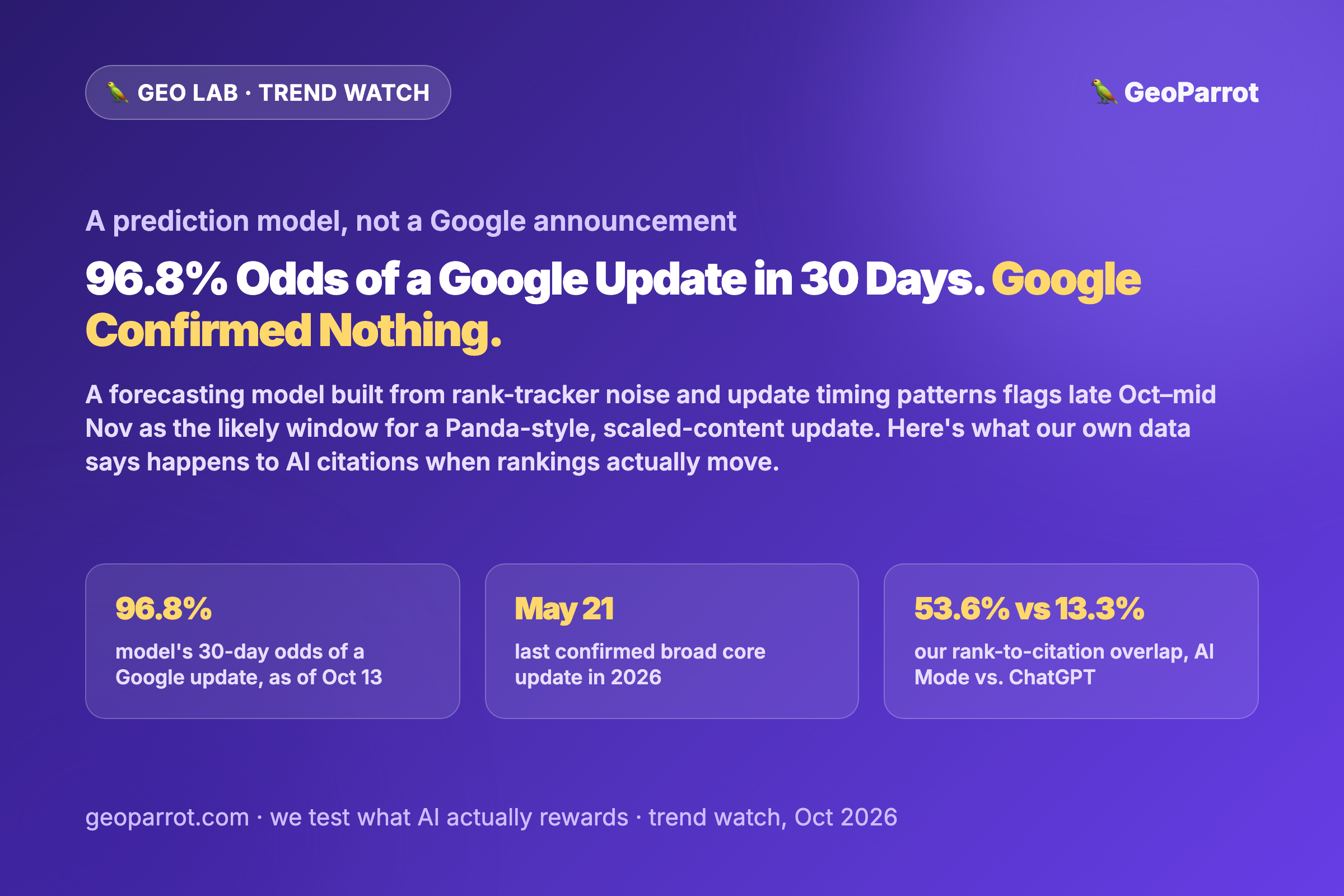
Quick answer: On October 13, 2026, SEO analyst Dan Taylor published a gradient-boosted decision tree model that puts 96.8% odds on a Google update landing within 30 days, and 90.9% odds within 90 days — with late October to mid-November flagged as the most likely window, timed to finish before the Thanksgiving/Black Friday retail period. The model doesn’t read Google’s internal signals; it blends macro timing (days since the last rollout, calendar seasonality, typical update intervals) with micro volatility (rank-tracker anomalies and update-chatter patterns on X, Reddit, and industry sites). Taylor’s own framing, and the reason trade press is calling this “Panda-style,” is that Google hasn’t run a broad core update since May 21, 2026, while quietly rewriting its content-quality guidance three times since: fact-checking AI content became “critical” on October 1, main-content quality got redefined around effort/originality/skill/accuracy on October 5, and Gary Illyes has said scaled content is now a bigger problem than link spam. None of that is a confirmation. Google’s Search Status Dashboard showed nothing as of this writing, even as rank-tracker forums reported live volatility — the same gap we’ve seen before every update this year.
Trend watch — published October 22, 2026, in the GEO Lab. This is the third time in three months we’ve picked up this exact thread: Google’s August spam update and September spam update both got covered here as “is this an AI-citation event, not just a ranking event,” and three weeks ago we ran an actual blind test on whether a confirmed ranking swing moves AI citations with it. We’re not predicting whether this specific forecast comes true — that’s not something we can test before it happens. What we can do is flag exactly what’s confirmed versus modeled, and hand over the one piece of real evidence we have about what happens to AI citations the next time Google rankings do move.
What is this prediction, exactly, and who made it?
Dan Taylor, founder of 10 Spurs and a Search Engine Journal contributor, built a gradient-boosted decision tree model that estimates the probability of a Google update landing in a given window. It isn’t built on anything Google discloses internally. It runs on two kinds of public signal: macro timing (how long it’s been since the last confirmed rollout, time of year, how often updates have historically clustered) and micro volatility (statistical anomalies in third-party rank trackers, plus how much “is this an update?” chatter is showing up on X, Reddit, and SEO news sites in real time). As of October 13, 2026, the model put the 30-day probability at 96.8% and the 90-day probability at 90.9%, with late October through mid-November called out as the most likely landing window — a stretch Google has historically favored because it leaves a three-to-four week buffer to finish rolling out before Thanksgiving and Black Friday traffic.
Worth sitting with for a second: a 96.8% model confidence is not the same claim as “Google is updating.” It’s a forecast about timing built from historical pattern-matching and current noise levels, and Taylor says so himself. We’re repeating that distinction up front because the headlines reporting on this model are not always as careful about it.
Why “Panda-style,” and why scaled AI content specifically?
The model itself doesn’t know what an update will target — that part is inference from Google’s own public statements, not the prediction. Three data points are doing the work here. First, Google hasn’t run a broad core update since May 21, 2026; August and September were narrower, named spam updates, not core updates. Second, Google rewrote its generative-AI content guidance on October 1 to call manual fact-checking “critical” — a story we covered in detail when it landed, because it explicitly extended that review to metadata, not just body copy. Third, on October 5, Google revised how its own quality raters evaluate main content, reframing it around four criteria — effort, originality, skill/talent, and accuracy — with mass-produced AI content cited as the example of “little to no effort.” Gary Illyes has separately said scaled content is becoming a bigger problem for Google than link spam. Stack those three together and you get a plausible, but still unconfirmed, read: Google has spent six weeks telegraphing a concern it hasn’t yet acted on with an algorithm change, and the prediction model is betting the gap closes soon.
Forecast versus confirmation: the same gap we’ve seen all year
As of this writing, Google’s own Search Status Dashboard shows no live or recently completed broad update, and Google has not named this forecast publicly in any form. That didn’t stop rank-tracking tools and SEO forums from reporting volatility consistent with something moving — the same pattern that preceded both confirmed updates we covered this year. It’s the gap between “the dashboard says no” and “forums say yes” that makes this genuinely hard to call in real time, not a reason to dismiss the forecast outright. Our own position, consistent with how we treated the August and September updates before Google confirmed either: track the volatility data, don’t publish a reaction piece as if the update is confirmed until Google’s own status page or Search Liaison account says so, and don’t let a 96.8% model score read as 100%.
If it lands, what actually happens to AI citations? Here’s our own data.
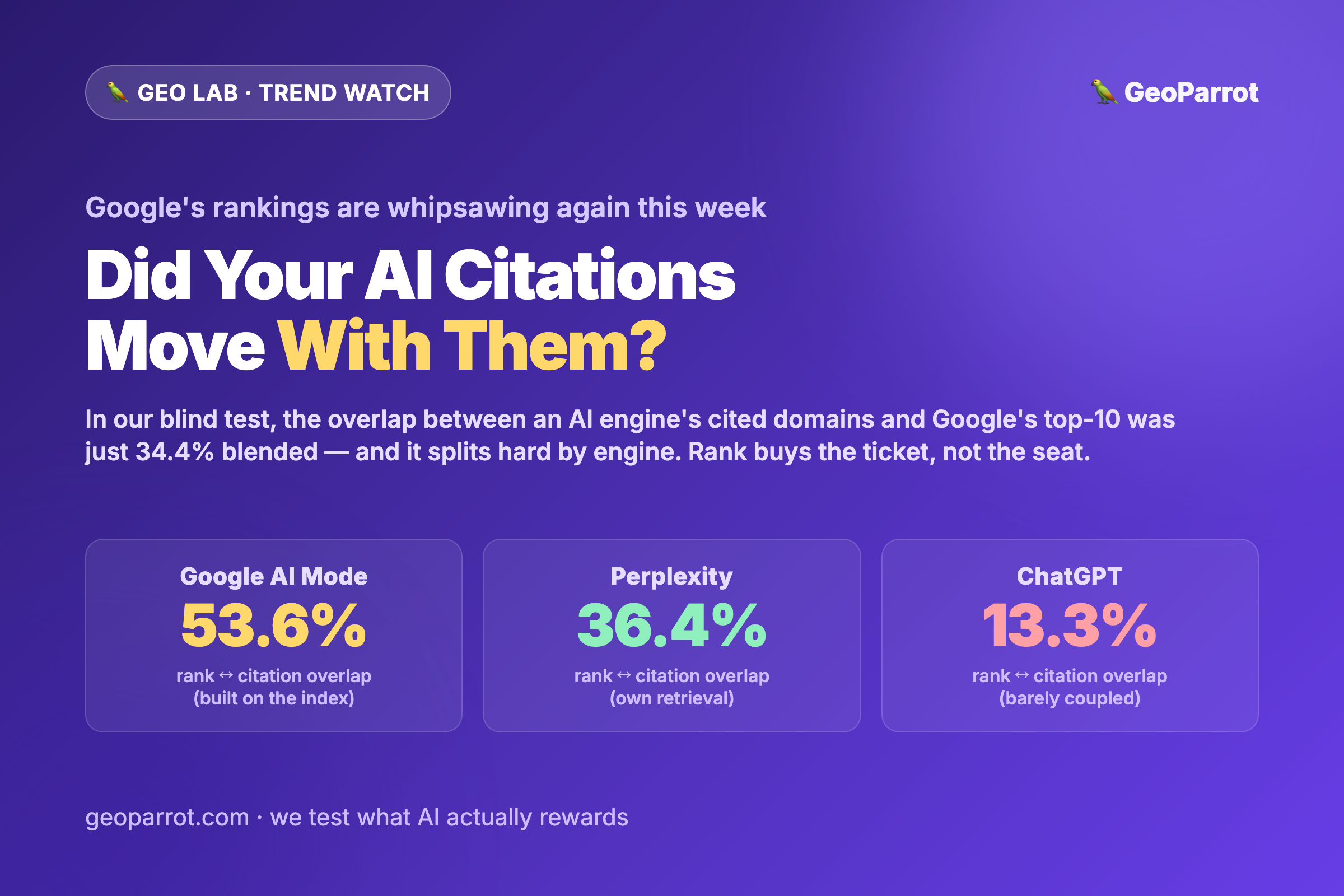
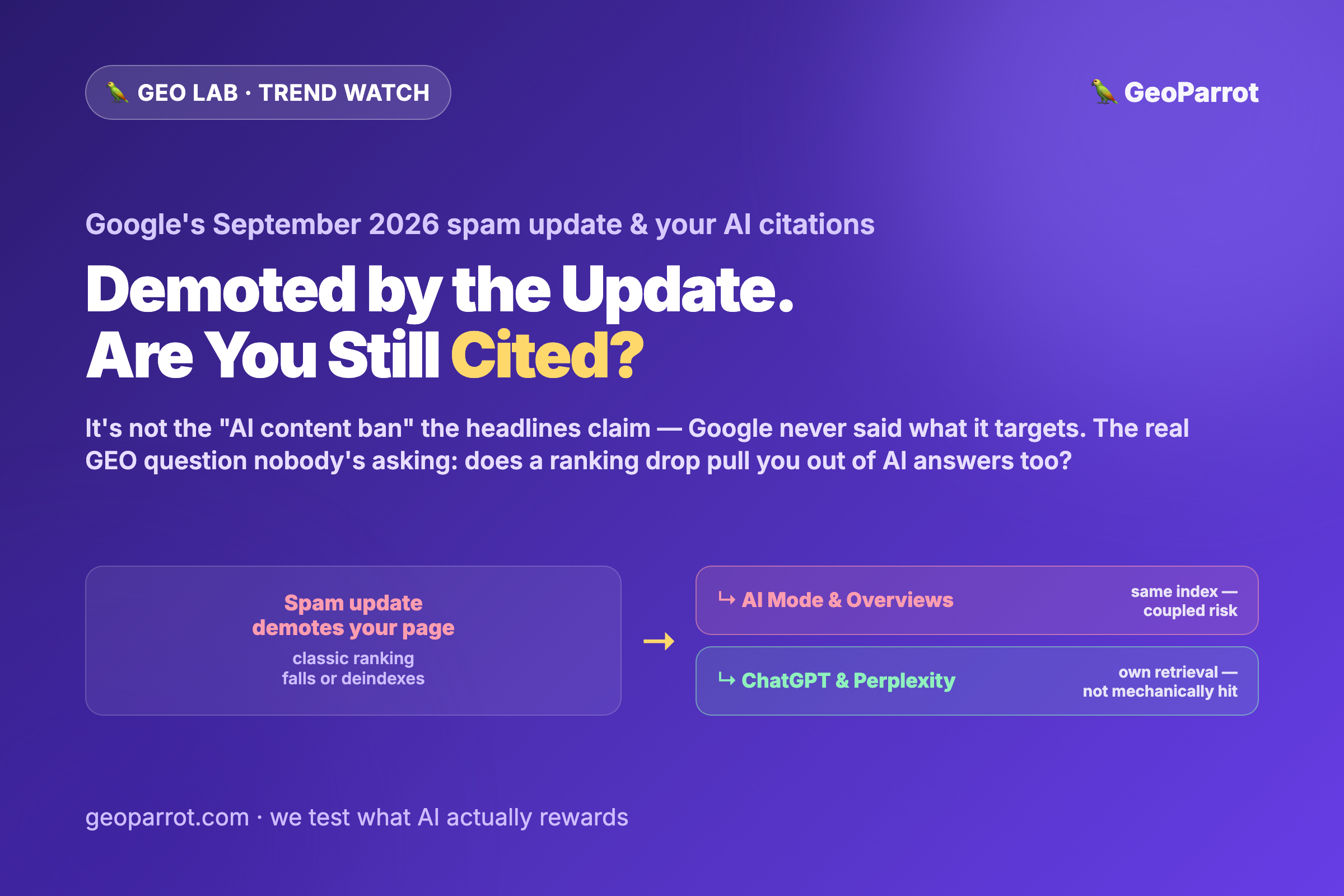
This is the part we can answer with something other than a forecast, because we’ve already measured it twice this year. Three weeks ago, during the ranking volatility around the unconfirmed early-September movement, we ran a direct test: when a page’s Google rank swung, did its presence in AI citations swing with it, on the same topics, in the same window? The overlap was weak and uneven across engines — 53.6% on Google AI Mode, only 13.3% on ChatGPT. Separately, our reads on the confirmed August and September spam updates concluded that index-based AI surfaces (AI Mode, AI Overviews) share meaningful risk with a ranking demotion because they draw from the same index, while ChatGPT and Perplexity run independent retrieval and don’t move mechanically when a Google rank drops.
| What we measured | When | Finding |
|---|---|---|
| Rank swing → AI citation overlap (same pages, same week) | Sept 2026 volatility, our blind test | 53.6% overlap on Google AI Mode; 13.3% on ChatGPT |
| Spam-update demotion → AI Mode/Overviews citation risk | August 2026 spam update | Coupled — shares the same index |
| Spam-update demotion → ChatGPT/Perplexity citation risk | September 2026 spam update | Not mechanically coupled — independent retrieval |
None of that tells you what a future, hypothetical, Panda-style update does — we’re not claiming it does, and a scaled-content update is a different mechanism than a spam action or ordinary ranking noise. What it does tell you is that the last two times Google’s index moved in a way we could measure, AI citation exposure moved with it unevenly and mostly weakly, split sharply by which engine is doing the retrieving. That’s the baseline to compare against if this forecast does land, not a guess.
What to actually do in the next 30 days
- Don’t treat the 96.8% figure as a Google announcement. It’s a third-party model’s confidence score about timing, built from public pattern-matching, not a leak or a disclosed signal. Watch Google’s own Search Status Dashboard and the Search Liaison account for actual confirmation before changing anything.
- If you run AI-assisted content at scale, close the gap Google already named. The October 1 and October 5 guidance changes are confirmed and live regardless of whether a ranking update follows them. Manually fact-check AI-drafted body copy and metadata (titles, meta descriptions, structured data, alt text), and be able to show effort and skill in a piece beyond “a model generated this.”
- Expect any citation impact to be engine-specific, not uniform. Based on what we’ve measured twice this year, a ranking hit is far more likely to touch AI Mode and AI Overviews (same index) than ChatGPT or Perplexity (independent retrieval). Don’t assume a Google Search Console drop means your ChatGPT visibility moved too, or vice versa.
- Keep your own before/after snapshot. If you want to know what actually happened to your pages rather than relying on anyone’s forecast or anyone’s case study, log your own rank positions and AI citation presence for your top pages now, before mid-November, so you have a real comparison point either way.
Frequently asked questions
Has Google confirmed a core update is coming in late October or November 2026?
No. The 96.8%-odds figure comes from an independent prediction model built by SEO analyst Dan Taylor, not from Google. As of this writing, Google’s Search Status Dashboard shows no confirmed broad core update, and no Google representative has named this forecast.
What is a “Panda-style” update?
Panda was a 2011 Google algorithm change aimed at thin, low-value, mass-produced content. The “Panda-style” label here is trade-press shorthand for a theorized update targeting scaled, low-effort AI content specifically — inferred from Google’s recent guidance rewrites, not from anything Google has said about this specific update’s scope.
If a ranking update lands, will my AI Overviews or ChatGPT citations drop too?
Based on our own prior measurements, that depends heavily on which engine. AI Mode and AI Overviews draw from Google’s own index, so a ranking demotion carries real citation risk there. ChatGPT and Perplexity run independent retrieval and historically haven’t moved in lockstep with a Google ranking change in what we’ve tested.
What should I do right now if I publish AI-assisted content?
Act on what’s already confirmed, not the forecast: Google’s October 1 and October 5, 2026 guidance changes require manual fact-checking of AI-generated content and metadata, and define quality around effort, originality, skill, and accuracy. Those apply whether or not this specific predicted update ever lands.

Leave a Reply