
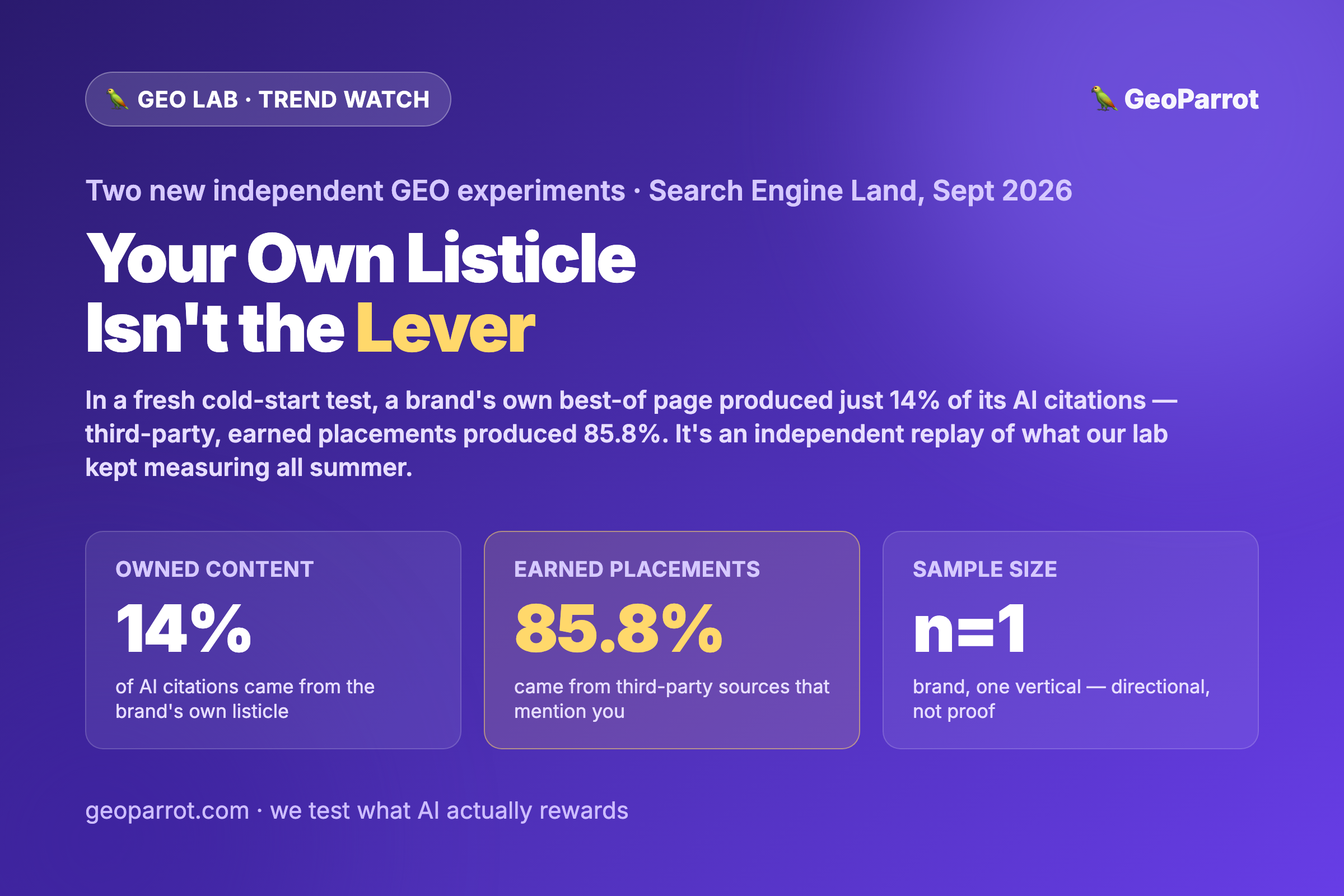
Quick answer: A practitioner named Zeeshan Yaseen published two structured GEO experiments in Search Engine Land on September 14, 2026, and the headline result is the one every content team hates: a brand’s own “best of” listicle generated only 14% of its AI citations, while 85.8% came from earned, third-party placements that mention the brand. His own page took 18 days to earn a first citation; third-party sources took 1–18 days. That is an independent, larger-scale replay of the self-ranking trap we measured all summer — being on your own list isn’t the same as being picked. But two experiments on one brand each aren’t proof, so the honest read is: strong corroboration of the “earned > owned” thesis, and a reason to treat the specific multipliers as directional, not causal.
Trend watch — published September 16, 2026. This is a fact-check post: we report what the two experiments found, line them up against our own GEO Lab results, and then apply the same skepticism to his data that we apply to ours — because “someone ran an experiment” is a reason to look closer, not a reason to stop questioning.
What did the two experiments actually find?
Yaseen ran two tests and logged citations by hand across AI engines. The first — a “consultant” account tracked over several months, peaking April 29 — followed 15 commercial-intent keywords across ChatGPT, Claude, Gemini, and Perplexity, logging 395 citation events (ChatGPT 148, Claude 96, Gemini 87, Perplexity 64) and surfacing the brand for 10–12 of the 15 keywords at a peak presence of 37.01%. The second was a 30-day “cold start” (May 30–June 28) for a brand-new SaaS site across six engines — ChatGPT, Claude, Gemini, Perplexity, Google AI Mode, and Grok — that logged 298 citation events from a zero baseline (Gemini 104, Google AI Mode 95, Claude 59, ChatGPT 32, Grok 4, Perplexity 4).
The findings that matter for GEO:
- Earned beats owned, decisively. Owned content produced 14% of mentions; earned third-party placements produced 85.8%. Listicles and PR “appeared to work as one system,” generating 72.4% of citations in the first test — a single Indeed SEO article drove 190 mentions, more than every other source combined.
- Comparative framing outperforms advocacy. Adding competitor names to the brand’s own listicle increased its citations 12.25-fold; removing recognized names from a page dropped visibility within days.
- Sources decay fast. Roughly half of the citation sources stopped appearing within 30 days — one-time publication wasn’t enough to hold a spot.
- Cited is not clicked. The most-cited source wasn’t the most-clicked: Indie Hackers drove the most citations (146) but flat referral traffic, while a lower-citation source, TechBullion, sent 64 sessions.
Why does this matter to us? It replays what our lab already found
We’ve spent the summer running the experiments that produce exactly these conclusions — which is why an independent operator landing in the same place is worth flagging. When two separate labs, using different brands, verticals, and methods, converge on the same shape, the underlying signal gets more believable. Here’s where his results line up with ours:
| Yaseen’s experiments (Sept 2026) | Our GEO Lab data |
|---|---|
| Owned listicle = 14% of citations; earned = 85.8% | exp5: a brand’s own “best of” listicle was cited just 8.3% of the time, and its own domain was the source behind a #1 recommendation only 4.2% of the time |
| Listicles + PR act as one system (72.4% of citations) | Large-n studies show brand mentions beat backlinks — web mentions correlate with AI citations at r=0.664 vs backlinks at 0.218 |
| Comparative content and competitor mentions drive citations, not advocacy | exp6: the lever is category-defining prose reputation, not self-promotion or vanity counts |
| Engine split flips: Gemini 104 vs ChatGPT 32 (cold start) after ChatGPT 148 led the consultant test | exp2: 85% of cited domains were unique to a single engine — there is no universal GEO strategy |
| Most-cited source ≠ most-clicked source | We keep separating being cited from being visited and converting — citation volume is not business value |
This is the “we saw it first” version of E-E-A-T that a small, new domain can actually earn: not louder opinions, but a documented track record of the same finding turning up in our data before it turned up in someone else’s. It also dovetails with the 2026 ranking-factors survey, where original research and first-party data topped the content list.
Does earned really beat owned — or is this correlation wearing a lab coat?
Here’s the discipline our positioning demands: we don’t get to cheer a result just because it agrees with us. So apply the same scrutiny to Yaseen’s numbers that we apply to our own. Three caveats keep this honest.
- n=1 per test, one vertical. Both experiments track a single brand in the SaaS/agency space, logged manually by one operator. That’s a case study, not a controlled trial. It’s strong directional evidence — especially because it matches independent data — but “85.8% earned” is this brand’s ratio, not a law of AI search. Your category, competitors, and starting authority can move it.
- The 12.25x is a single before/after. “Adding competitor mentions multiplied citations 12.25-fold” is one edit on one page observed over time — exactly the kind of change that can be confounded by indexing lag, concurrent PR, or the source-decay effect his own data documents. Treat it as a hypothesis worth testing on your own assets, not a dial you turn for a guaranteed 12x.
- “Owned took 18 days” may be crawl lag, not inferiority. A brand-new page needs to be discovered, indexed, and then judged before it can be cited. Some of owned content’s slow start is plumbing, not proof that your own pages are weak. The right conclusion isn’t “never publish your own listicle” — it’s that owned content is foundational support, not the primary lever.
None of that overturns the finding. It sharpens it: earned, third-party mentions look like the dominant citation driver across two independent datasets, but the exact multipliers are snapshots of specific pages and specific weeks. Believe the direction; verify the magnitude on your own site.
What’s genuinely new here — and it’s not “earn links”
The finding we hadn’t stressed enough is source decay: roughly half of the citation sources stopped appearing within 30 days. AI citation isn’t a monument you build once; it’s a position you have to keep re-earning as engines re-crawl, re-rank, and refresh what they consider current. That reframes GEO as maintenance, not a launch. It also connects to our consensus work — part of why a brand gets picked is how recently the relationships and mentions around it were reinforced, not just how many exist. If you earned ten great placements in March and did nothing since, expect a chunk of them to quietly fall out of the answer set.
The other quietly important one: the most-cited source drove flat traffic while a less-cited source converted. That’s the share-of-voice trap in miniature — counting citations is not the same as measuring outcomes. One low-volume Perplexity referral in his data turned into a paying customer, which is a useful reminder that a small denominator can still be the valuable one.
What should you actually do this week?
- Query your targets before you invest. Run your commercial keywords through the AI engines your buyers use and record which sources are already cited. That cited-source list is your outreach list — and it will look nothing like a traditional link-prospecting spreadsheet.
- Shift budget from owned to earned. Keep your own listicle as a foundation, but spend the real effort on getting mentioned in the third-party sources AI already pulls from. Earn your way in — that’s the door into AI answers, not a self-published “best of” with your name at the top.
- Write comparative, not self-promotional. Pages that name and position competitors get cited more than pages that only advocate for one brand. If you publish a listicle, make it a genuinely useful comparison, not a thinly veiled ad.
- Budget for maintenance. Because half of sources decay within 30 days, plan to refresh and re-earn placements on a schedule. Treat GEO like a garden, not a statue.
- Measure outcomes, per engine. Don’t stop at citation counts. Track AI-referred traffic and conversions in GA4, then apply the per-engine checklist — because a source that gets cited everywhere but converts nowhere is losing to one that barely gets cited and pays the bills.
Bottom line: Two independent experiments just put numbers on the thing our lab has been repeating all year — earned, third-party mentions do the heavy lifting for AI citations, and your own listicle is the floor, not the lever. The convergence is real and worth acting on. But the specific multipliers come from one brand in one vertical logged by hand, so use them as a compass, not a map: adopt the direction (earn placements, write comparatively, maintain them, measure outcomes), and verify the magnitude on your own site before you bet a budget on 12x. We check the claim before we repeat it — and here the checked version is a rare thing in GEO: someone else’s data agreeing with ours, with the caveats kept in.
Frequently asked questions
Do my own pages help me get cited by AI at all?
Yes, but as a foundation, not the primary driver. In the cold-start experiment, owned content produced about 14% of AI citations while earned third-party placements produced 85.8%, and the brand’s own listicle took 18 days to earn its first citation. Our own experiments found a brand’s self-published “best of” was cited only 8.3% of the time. Publish clear, well-structured pages so engines can understand and quote you — then spend the bulk of your effort earning mentions in the third-party sources AI actually pulls from.
Should I add competitors to my comparison pages?
The evidence leans yes. In these experiments, adding competitor names to a brand’s own listicle increased its citations more than twelve-fold, and comparative content consistently outperformed advocacy-only pages. AI engines favor content that positions options against each other because that’s what answers buyer-intent questions. Just remember this was a single before/after on one page, so test it on your own assets rather than assuming a fixed multiplier — and make the comparison genuinely useful, not a disguised sales pitch.
Why do my AI citations disappear over time?
Source decay. In the experiments, roughly half of the citation sources stopped appearing within 30 days. AI engines re-crawl and re-rank continuously and favor recently reinforced sources, so a placement that earned a citation in one month can fall out of the answer set the next if nothing keeps it fresh. Plan GEO as ongoing maintenance — refresh content and re-earn mentions on a schedule — rather than a one-time publish.
Does more citations mean more traffic?
Not necessarily. In the data, the most-cited source drove flat referral traffic while a less-cited source sent 64 sessions, and a single low-volume Perplexity referral became a paying customer. Being cited, being clicked, and converting are three different things. Track AI-referred traffic and downstream conversions in analytics instead of treating raw citation counts as the outcome — the source that gets cited most isn’t always the one that grows the business.
Is one person’s experiment enough to change my GEO strategy?
Use it as directional evidence, not proof. Each experiment tracked a single brand in one vertical, logged manually — that’s a case study, and its exact percentages won’t transfer cleanly to your site. What makes it credible is that it independently matches larger studies and our own multi-engine experiments on the core direction: earned mentions beat owned content, engine behavior varies widely, and citation volume isn’t business value. Adopt the direction, then verify the magnitudes on your own site before committing budget.
Leave a Reply