
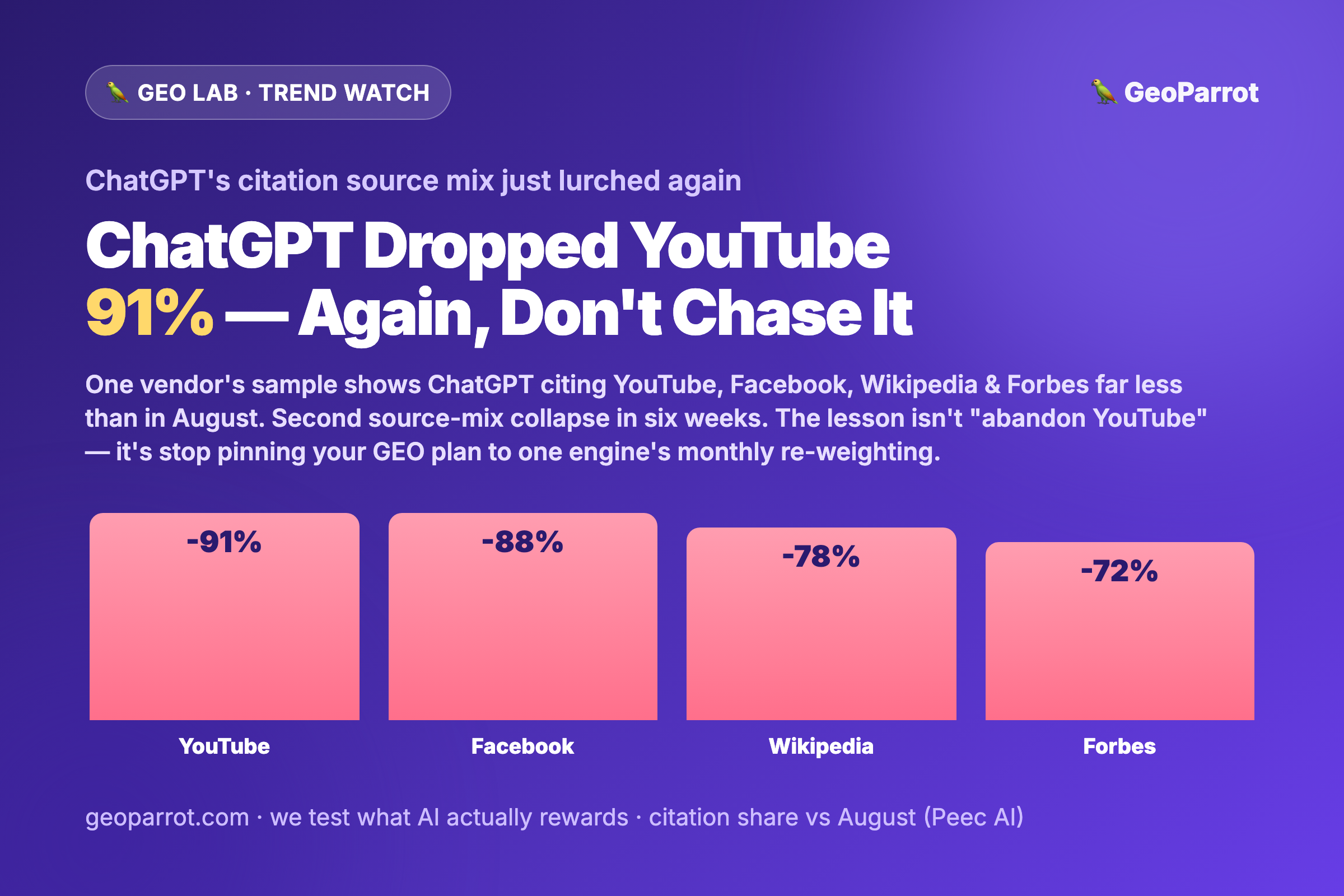
Quick answer: A GEO researcher at Peec AI, David Konitzny, published data on September 25, 2026 showing ChatGPT’s citation share for major domains collapsing versus August: YouTube -91%, Facebook -88.1%, Wikipedia -78.4%, Forbes -71.7%, drawn from “hundreds of thousands of branded and non-branded prompts.” Two honest caveats the headlines skip: (1) retrieved ≠ cited — Konitzny is explicit that these domains are still retrieved and used, they just surface as final visible citations far less often; and (2) it’s one vendor’s sample of one engine. This is the second ChatGPT source-mix collapse in six weeks (Reddit fell ~81-86% in August). The GEO takeaway isn’t “abandon YouTube.” It’s that a single engine re-weights its citation diet server-side, month to month — so a content plan pinned to “get cited where ChatGPT cites now” is renting a position that can be revoked overnight.
Trend watch — published September 30, 2026. We read this the way the GEO Lab reads any citation shakeup: separate what was counted from what’s being inferred, check whether the effect is one-engine or cross-engine, then ask what it changes for how you actually operate.
What exactly did the data show?
Konitzny’s numbers are share-of-citations figures: the proportion of the sources ChatGPT cites that come from a given domain, September versus August. YouTube -91%, Facebook -88.1%, Wikipedia -78.4%, Forbes -71.7%. He got ahead of the obvious objection — “isn’t that just dilution from a bigger citation pool?” — by re-indexing absolute citation volume against a July baseline and showing the decline holds there too. So this isn’t only a share effect; ChatGPT appears to be citing these domains materially less often in raw terms.
The single most important line in his post is one most re-shares dropped: “Retrieved ≠ Cited.” Nothing indicates YouTube, Facebook, Wikipedia, or Forbes have vanished from ChatGPT’s retrieval — they can still be fetched, considered, and used to shape an answer. What changed is how often they end up as a visible, attributed citation. That distinction is the whole ballgame for GEO, and we’ll come back to it.
Haven’t we seen this before? (Yes — and that’s the point)
Six weeks ago the story was Reddit: ChatGPT’s Reddit citations reportedly fell ~81-86% in mid-August, alongside drops for YouTube and TikTok. We covered it at the time and argued the “did Reddit get blocked” framing was outrunning the evidence — see our August fact-check. Now, a month later, a different set of domains lurches. Two data points don’t make a law, but the pattern is worth naming: ChatGPT periodically re-weights which sources it promotes into final citations, and when it does, the swings are large and land on whole categories of sites at once.
If source-mix volatility is a recurring feature rather than a one-off event, then the popular GEO move — “ChatGPT loves YouTube/Reddit right now, so go pile content there” — is chasing a target that moves faster than you can build. By the time a content program spun up around August’s winners ships, the citation weights have already turned over.
Is this a counted fact or an inferred one?
Both, in different layers — and it pays to keep them apart, the way we argued when we wrote about counted versus inferred GEO metrics. Konitzny’s methodology is unusually transparent for this genre (hundreds of thousands of prompts, a stated baseline, a share-vs-volume check), which puts it well above anecdotal “I asked ChatGPT five times” screenshots. But it is still an inferred number: a sample of prompts extrapolated to ChatGPT’s behavior at large. The population it represents can’t be fully enumerated by anyone outside OpenAI, and no one outside OpenAI can audit why the weights moved.
So quote it as what it is. “A vendor sample shows ChatGPT’s YouTube citation share down 91% month-over-month” is defensible. “YouTube is dead for AI citations” is not — that’s an inference stacked on a sample, generalized to every engine. Don’t let a clean, dramatic number tempt you into treating it like it came off your own analytics.
Does a ChatGPT drop mean your citations fell everywhere?
No — and this is where a single-engine headline does the most damage. Our own cross-engine experiment found the engines barely agree on which sources to cite: across 395 unique cited domains for the same buying-intent questions, only two showed up across all four engines, and ~85% were unique to a single engine (the full results are here). Independent third-party trackers report the same shape at scale — overlap on which sources fill citation slots sits well under 5% across millions of citations.
The mechanism explains why. ChatGPT and Perplexity run their own retrieval; Google’s AI Mode and AI Overviews draw on Google’s index. A re-weighting inside ChatGPT’s synthesis layer has no mechanical reason to move Perplexity’s or Google’s citations. That’s exactly why we keep repeating that there is no universal GEO strategy and that you should work from a per-engine checklist instead of one leaderboard. “YouTube lost 91% of ChatGPT citations” and “YouTube is a strong AI citation source” can both be true this week, on different engines.
Why “retrieved ≠ cited” is the part that actually matters
Because it tells you where the change happened — and therefore what you can and can’t do about it. If these domains are still being retrieved and used but shown as citations less often, the shift is in ChatGPT’s final selection and attribution step, not in whether it can find or crawl the content. You can’t schema-mark or robots-tweak your way out of a synthesis-layer preference change; those levers affect access, not the model’s choice of what to visibly credit. It’s the same lesson as our finding that being cited is not the same as ranking: presence in the answer is decided by the engine’s own selection logic, upstream of the tidy on-page checklist most GEO advice sells.
It also means a citation-share dashboard can look alarming while your actual influence is intact. If ChatGPT still retrieves and reasons over your page but attributes it less, you’ve lost visible credit, not relevance — a distinction a blended “AI share of voice” number will happily bury, which is one more reason we call that the wrong metric to optimize.
What should you actually do about it?
- Don’t rebuild your plan around one engine’s monthly winners. If the source mix swings this hard every few weeks, “chase whatever ChatGPT cites now” is a treadmill. Build for durable relevance, not this month’s weighting.
- Diversify across engines, deliberately. Because citation sets barely overlap, coverage on ChatGPT, Perplexity, Google AI surfaces, and Gemini is four jobs, not one. Prioritize per engine using a per-engine checklist.
- Measure with counted, first-party signals. Track real referrals with a GA4 AI-referral setup and watch your server logs for assistant crawlers — those are events on infrastructure you control, unlike a vendor’s share estimate. And make sure you’re not accidentally blocking the AI crawlers in robots.txt.
- Favor being the source over being a mention. Our experiments keep showing earned, primary-source status beats owned syndication. Original data and first-hand answers are harder for an engine to swap out when it re-weights aggregators.
- Treat vendor “citation share” as a weather report, not a compass. Useful for spotting that the wind changed; not something to steer a quarter by. Pair it with the counted signals above and the GSC generative-AI report for the Google surfaces.
The honest caveats
One vendor, one query panel, one engine, a roughly one-month window. Konitzny handled the share-versus-volume objection well, but we can’t audit his prompt set, and a single sample can’t rule out sampling artifacts or a temporary state that reverses next month — Reddit’s August drop was itself described as partly recovering afterward. The four domains falling together suggests a broad re-weighting event rather than four coincidences, but the cause is unconfirmed: it could be a retrieval-source change, a synthesis-prompt change, a quality filter, or a licensing/agreement shift. All of those are inferences right now. What’s solid is the shape of the lesson: single-engine citation mixes are volatile, they don’t move together across engines, and the durable play is to be genuinely citable everywhere rather than to sprint after last month’s favorite.
Frequently asked questions
Did ChatGPT really cut YouTube citations by 91%?
By one measure, yes. Peec AI researcher David Konitzny reported on September 25, 2026 that YouTube’s share of ChatGPT citations fell 91% versus August, with Facebook -88.1%, Wikipedia -78.4%, and Forbes -71.7%, based on hundreds of thousands of prompts. It’s a credible vendor sample, but still a sample of one engine — not a universal or audited figure.
Does “retrieved ≠ cited” mean my content is still being used?
Likely, yes. Konitzny stressed that these domains are still retrieved and can inform ChatGPT’s answers; what dropped is how often they appear as visible, attributed citations. The change is in the engine’s final selection step, not in whether it can access your page — so on-page and robots.txt fixes won’t reverse a synthesis-layer preference.
Should I stop publishing on YouTube for AI visibility?
No. This is one engine’s month-over-month shift, and engines barely share citation sources — only two domains overlapped across all four engines in our cross-engine test. YouTube can lose ChatGPT citation share while remaining useful for Google surfaces and for humans. Decide per engine and per goal, not off a single headline.
Is this the same thing as the August Reddit citation drop?
It’s a similar pattern, likely a separate wave. Reddit’s ChatGPT citations fell ~81-86% in August; this is a different set of domains in September. Together they suggest ChatGPT re-weights its citation mix periodically, which is the real reason not to build a GEO plan around whatever it’s citing this month.
GeoParrot is a GEO Lab: we run experiments to test what AI search engines actually reward, and we grade the industry’s claims against first-party data. See the running scoreboard at our 2026 GEO benchmark.
Leave a Reply