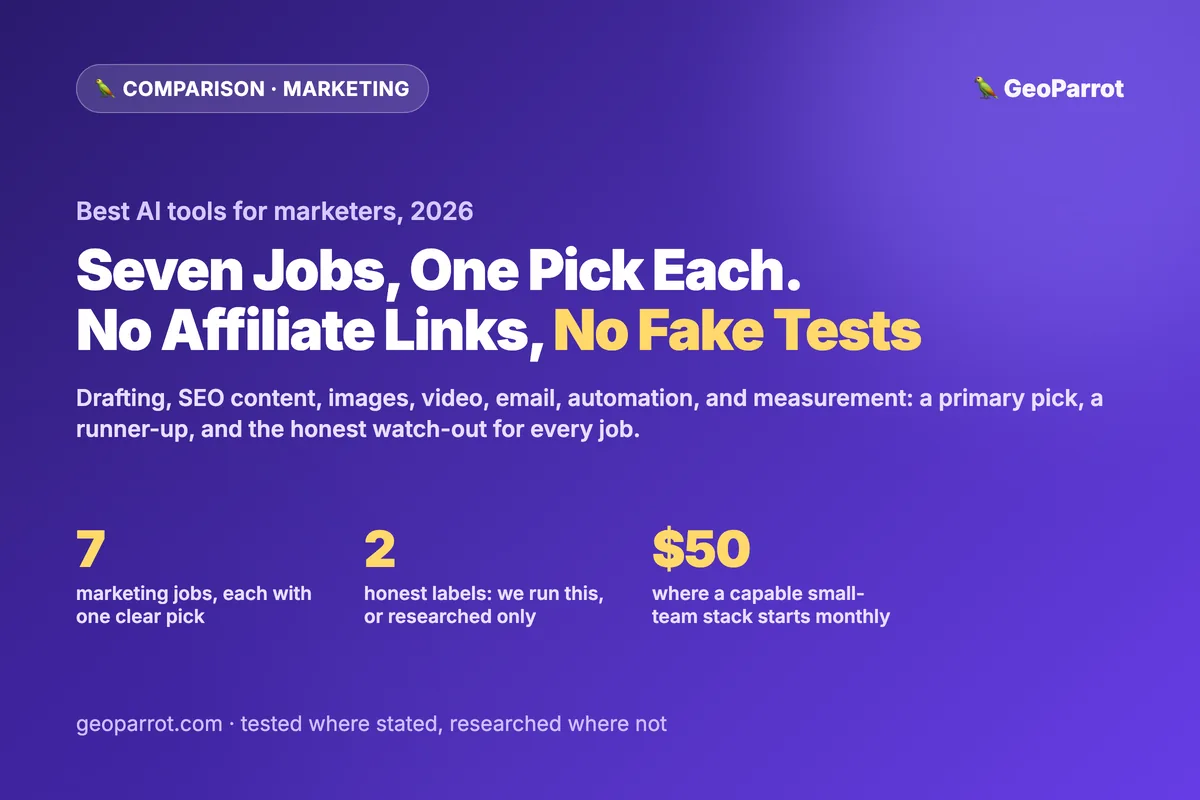
Quick answer: pick by job, not by listicle rank: a general assistant (ChatGPT or Claude) for drafting and research, Surfer or Clearscope if you produce SEO content at volume, Midjourney or Canva for static creative, Runway or Veo for short video, your ESP’s built-in AI for email, and n8n or Zapier to wire it together. Details, runners-up, and honest caveats below.
How this list was made: tools marked we run this are in production in our own AI-assisted publishing and ad operations. Everything else is marked researched: evaluated through documentation, trials, and published user reports, not months of production use. No affiliate links anywhere in this post. Prices are rough tiers as of late 2026; verify before buying. This is the opinionated companion to our category map of AI marketing tools.
1. Everyday drafting, research, and analysis
Pick: ChatGPT or Claude (we run both daily). This is the highest-leverage subscription in marketing: briefs, drafts, rewrites, spreadsheet formulas, campaign analysis, competitor teardown summaries. The two leaders trade places by task; Claude tends to hold long documents and nuanced editing better, ChatGPT bundles stronger image generation and a larger plugin-style ecosystem. Both have usable free tiers and paid tiers around $20 monthly.
Watch out: the failure mode is trusting unverified numbers in drafts. Our content workflow exists because assistants will state invented statistics with full confidence; budget a verification pass for anything factual.
2. SEO content at volume
Pick: Surfer SEO (researched), roughly $79 to $99 monthly. Its job is narrow and real: compare your draft against what currently ranks, surface term and structure gaps, and score coverage. Also consider: Clearscope (cleaner editor, enterprise pricing) and MarketMuse (topic-cluster planning). Skip if you publish a few posts monthly; a general assistant plus manual SERP review covers that scale without the subscription.
Watch out: optimization scores are correlation tools, not causation. Chasing a 90+ score produces keyword-dense sameness; use the gap analysis, ignore the leaderboard impulse.
3. Ad and social images
Pick: ChatGPT image generation for iteration volume, fal.ai for API-scale production (we run both). ChatGPT’s image model handles text rendering and instruction-following well enough for real ad drafts; fal.ai gives per-image API pricing when a pipeline generates dozens of variants. Also consider: Midjourney (researched) for the strongest pure aesthetics, Canva Magic Studio (researched) when the job is templated brand assets rather than generation from scratch.
Watch out: cost scales with iteration count, not output count. Our rule from production: generate one test image, approve the direction, then batch; never batch first.
4. Short-form video
Pick: Runway or Google Veo (researched; we run adjacent open models for a shorts pipeline). 2026 video models produce genuinely usable 5 to 15 second clips for ads and social. Kling competes hard on realistic motion. For talking-head and localization work, Synthesia and HeyGen own the avatar niche. Skip if you need brand-exact product shots across many scenes; consistency between generations is still the category’s weakest point.
Watch out: review time per clip is the hidden cost. Plan human review on every output; one uncanny frame in a paid placement costs more than the tool saved.
5. Email marketing
Pick: the AI already inside your ESP: Klaviyo AI for e-commerce, HubSpot’s Breeze for B2B (both researched; Breeze ships free with the CRM). Embedded AI that can read your actual segments, send times, and revenue events beats a smarter external model pasting into a blind editor. Skip standalone AI email writers; subject lines and body copy are exactly what your general assistant already does.
6. Automation and pipelines
Pick: n8n (we run it in production) for teams with any technical capacity: self-hostable, priced by execution rather than per task, and AI steps drop into any workflow. Also consider: Zapier (largest connector catalog, fastest start, cost grows fastest) and Make (visual middle ground). Agent-style scripting on top of an assistant API is what runs this site’s pipeline; it is the most capable and the most maintenance-heavy option.
Watch out: automations fail silently. Whatever you build, build the alerting the same week; we learned this from a pipeline that died quietly for two months behind a folder-permission change.
7. Measurement, including AI visibility
Pick: GA4 plus Search Console, configured properly, before any paid tool (we run this). Most AI measurement questions are configuration questions: channel groups for AI referrals, landing-page analysis for citations, honest bot filtering. Our free setup guides cover tracking ChatGPT traffic and the calculators on this site handle the ad-metric arithmetic. Also consider: AI-visibility trackers (Profound, SE Ranking’s AI module, and a fast-growing field) once you have confirmed AI engines matter for your category; they answer share-of-voice questions GA4 cannot.
The stack we would buy first on a small budget
Priority
Tool
Monthly cost (rough)
Replaces
1
One general assistant (ChatGPT or Claude)
$0 to $20
Copywriter hours, research time
2
Your ESP and ad platforms’ built-in AI
$0 incremental
Standalone copy and optimization tools
3
Canva free tier or ChatGPT images
$0 to $20
Basic design requests
4
n8n or Zapier starter
$0 to $30
Manual report pulls, repost chores
5
Category tool for your one proven bottleneck
$80+
Nothing yet; buy it when the bottleneck is measured
Frequently asked questions
Is ChatGPT or Claude better for marketing work?
Both are excellent; the differences are at the edges. In our daily use, Claude is stronger on long-document editing and tone control, ChatGPT on image generation and breadth of integrations. Run your three most common tasks through both free tiers for a week; the winner for your workflow will be obvious.
Are tools like Jasper worth it over ChatGPT?
For solo marketers, usually not; the model underneath is comparable and the price is higher. For teams with brand-voice enforcement, approval chains, and shared template needs, the workflow layer is the real product and can be worth it. Count the people who touch a draft; that number decides.
What should I automate first?
The recurring task with zero judgment: weekly report pulls, UTM link assembly, publishing mechanics, alert digests. Automating judgment tasks (angle selection, claim checking) first is how teams end up publishing errors at scale.
How much should a small team budget for AI tools?
A capable stack runs $50 to $150 monthly for one to three people using the priority table above. If your AI line item exceeds that before you have measured a single bottleneck, you are collecting subscriptions, not capability.
Do any of these tools improve AI search citations?
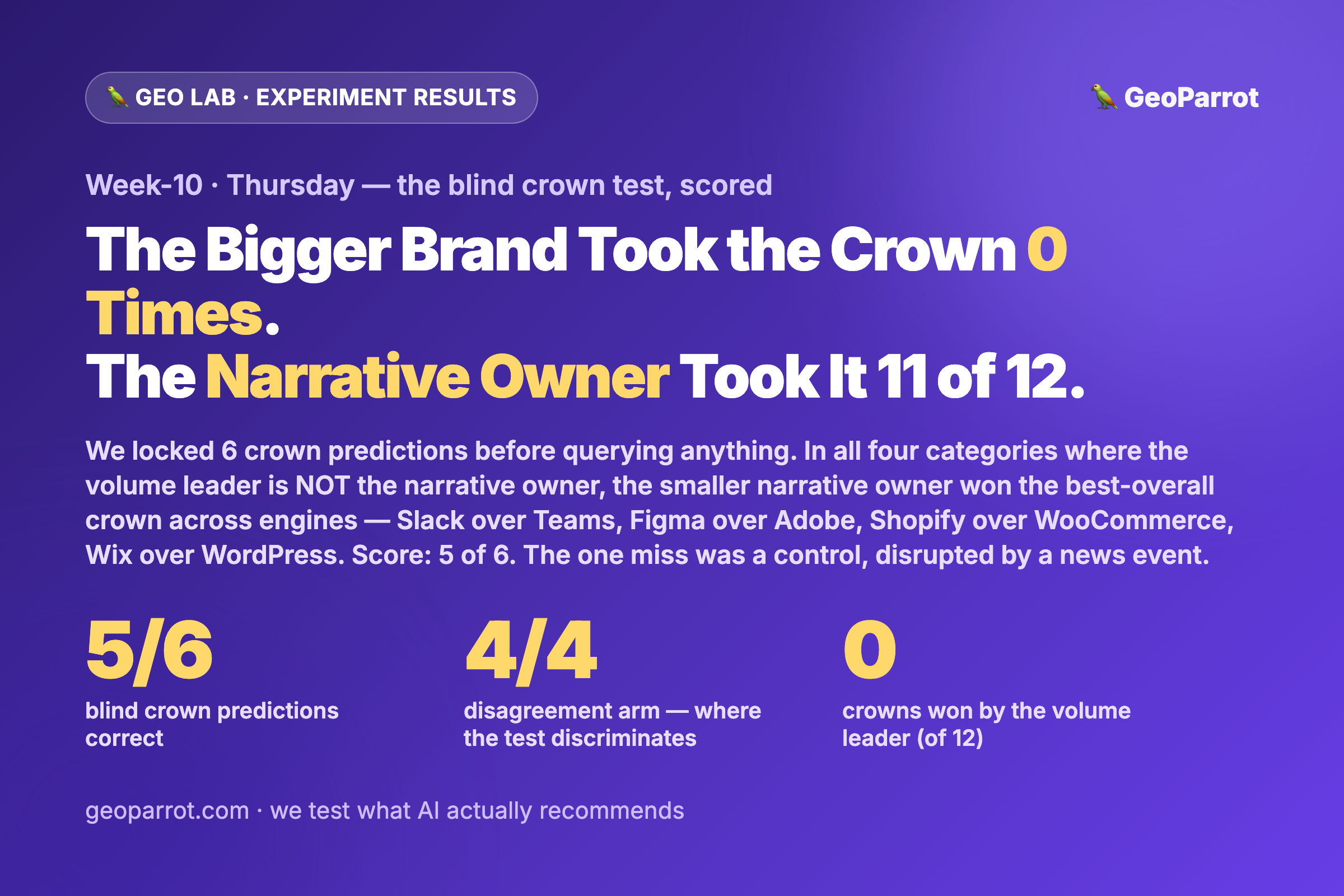
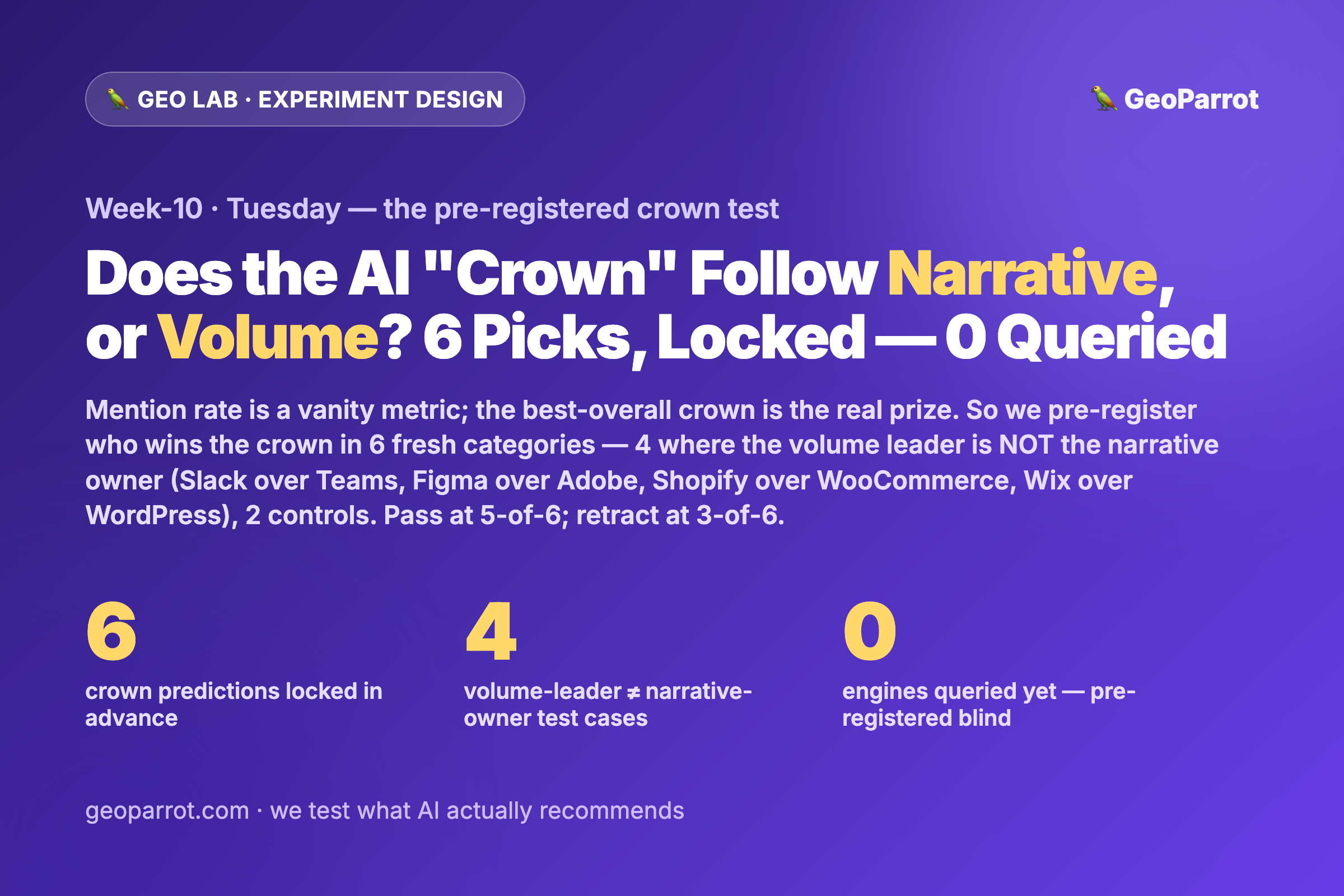
No subscription buys citations. Visibility trackers measure them, and content tools can improve the structural factors that correlate with them, but in our weekly citation experiments the drivers are content specificity, first-hand data, and site authority. Spend on evidence creation before spending on optimization software.


Leave a Reply