
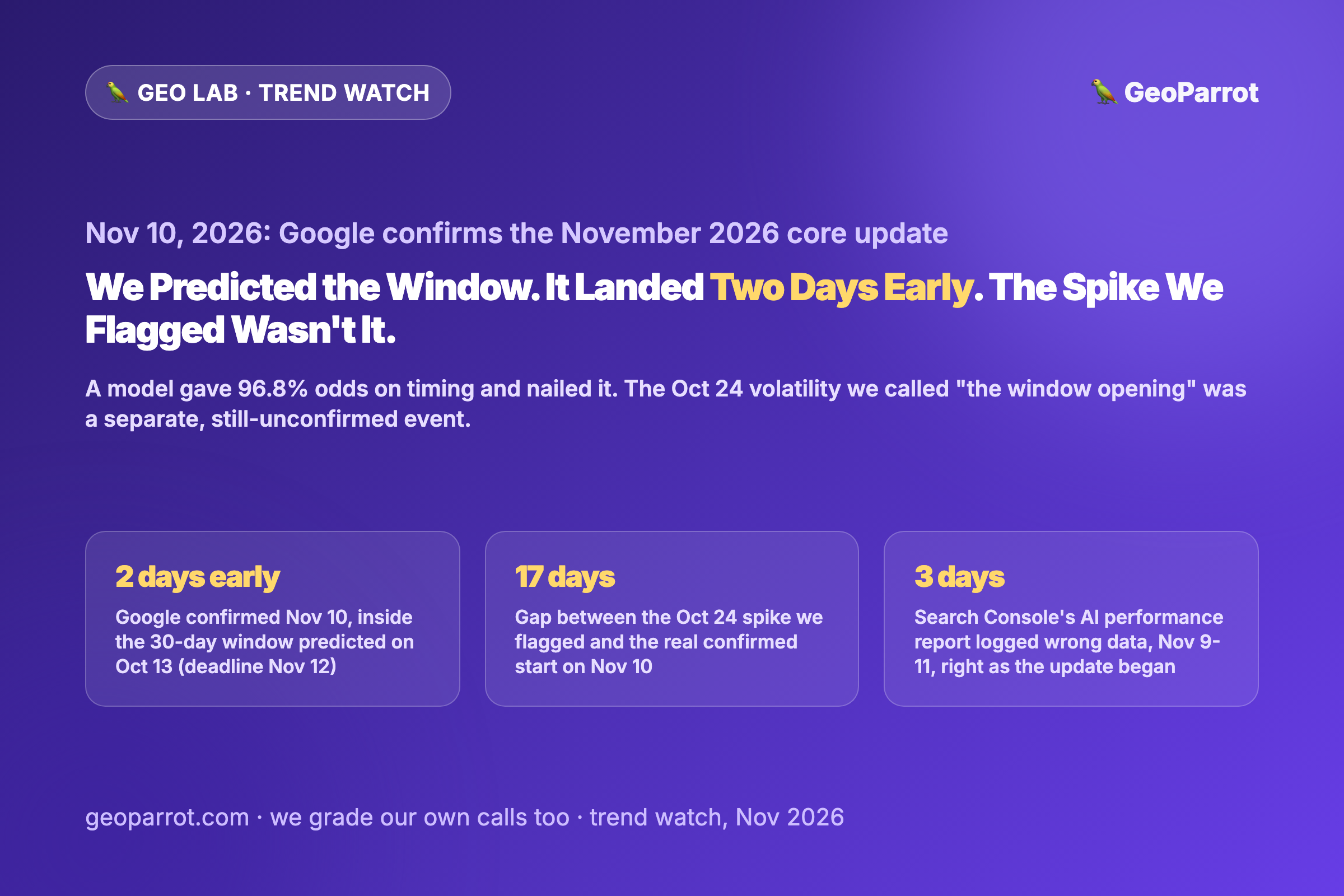
Quick answer: Google confirmed its November 2026 core update on its Search Status Dashboard at 10:06 a.m. Pacific on November 10, global, all languages, up to two weeks to finish. That lands two days inside the 30-day window a gradient-boosted prediction model gave 96.8% odds to on October 13, so the timing call held. But the October 24 rank-tracker spike we covered three weeks ago as “the predicted window opening” is a separate, still-unconfirmed event. Google’s dashboard lists only November 10 as the start, nothing from October 24. Google also named this a plain “core update,” not the Panda-style scaled-content action the prediction’s reasoning pointed toward. And right as the real update started, Google’s Search Console Generative AI performance report had a logging bug for November 9 through 11 that undercounted AI Overview and AI Mode impressions, the exact data you’d check to see what the update did to your AI citations.
Trend watch, published November 15, 2026, in the GEO Lab. This closes a loop we opened on October 22: a prediction model called the timing window, volatility inside that window looked like confirmation on October 27, and now we have an actual confirmed update to grade both calls against.
What did Google actually confirm on November 10?
Google’s own Search Status Dashboard logged an incident beginning November 10, 2026 at 10:06 a.m. Pacific, with the update released a minute later. The dashboard classifies it under Ranking and calls it a “core update,” global, covering all languages, with a rollout Google says “may take up to 2 weeks to complete,” putting the likely finish around November 24. It’s the third broad core update of 2026, after March and May, and the first in roughly five and a half months since May 21. Google’s stated purpose is the standard line: better surface relevant, satisfying content. No sector, content type, or system is named.
Did the October 13 prediction model get this right?
On timing, yes, closer than most forecasts get. SEO analyst Dan Taylor’s model gave 96.8% odds of a Google update landing within 30 days of October 13, a deadline of November 12. Google confirmed one on November 10, two days inside that window. On mechanism, the reasoning doesn’t hold up as cleanly. The theory, built from Google’s own October content-quality moves, pointed toward a Panda-style action targeting scaled AI content specifically. Google’s dashboard calls this a generic core update and names nothing. October’s quality-rater guidance, built around effort, originality, skill, and accuracy, lines up with the direction of that theory. Direction isn’t confirmation, though, and Google didn’t say this update enforces that guidance any more than March or May did.
Was the October 24 volatility spike actually this update?
No, and that’s worth correcting in our own coverage. On October 27 we wrote that the October 24 rank-tracker spike sat “squarely inside” the predicted window and left open whether it would later get cited as the update’s start. It won’t. Google’s dashboard lists only November 10 as the incident’s begin time, nothing from October 24. Search Engine Roundtable’s tracking treats October 16, 20 to 21, 24 to 25, and 27 as a separate run of unconfirmed turbulence that ended before the confirmed update began, with renewed movement around November 8 and 9, one to two days ahead of Google’s announcement. Three weeks of real volatility happened inside the predicted window and still wasn’t the update the model was pointing at, the gap between “consistent with a forecast” and “caused by the thing the forecast named.”
| Date | Event | Google confirmed? |
|---|---|---|
| Oct 13, 2026 | Prediction model: 96.8% odds of an update within 30 days (deadline Nov 12), theorized Panda-style, scaled-content target | No, a forecast |
| Oct 24-25, 2026 | Mozcast, Semrush, Wincher and others spike; GeoParrot covers it as the predicted window opening | No, still unconfirmed |
| Nov 8-9, 2026 | Renewed rank-tracker movement, one to two days before any announcement | No, pre-announcement noise |
| Nov 10, 2026, 10:06am PT | Google confirms the November 2026 core update on its Search Status Dashboard | Yes, confirmed |
| Nov 9-11, 2026 | Search Console Generative AI performance report logging bug undercounts AI Overview/AI Mode impressions | Yes, confirmed as a reporting bug only |
Why did Search Console break at exactly the wrong moment?
Google confirmed a separate logging bug in the Search Console Generative AI performance report, affecting data from November 9 through 11, the same 48 hours the core update started rolling out. The bug undercounted how often sites appeared in AI Overviews and AI Mode; Google says it’s a logging issue only, not a real change in AI-surface visibility. That’s the piece that connects to measurement, not just timing. If you checked whether the update moved your AI-citation exposure using Search Console numbers from that specific weekend, the number was wrong, not because your visibility changed but because the counter broke. That’s exactly the gap our counted-versus-inferred framework flags: a dip in a dashboard isn’t evidence of a dip in reality until you’ve ruled out the dashboard itself.
What should you actually do about this?
- Don’t backdate your own analysis to October 24. Google’s confirmed update started November 10. If you changed anything in response to the October spike, that wasn’t a response to this core update.
- Don’t assume this targets AI content specifically. Google named it a generic core update. The scaled-content theory is plausible background, not a confirmed mechanism, the same distinction we drew when the prediction model first ran it.
- Discard your Nov 9 to 11 Search Console AI performance data. Google confirmed that window is logged wrong. Compare before Nov 9 and after Nov 12 instead, once the bug’s resolved.
- Expect volatility through roughly November 24. Google says the rollout can run up to two weeks from November 10. Rankings moving on November 18 are still inside this same event, not a new one.
Frequently asked questions
Did Google confirm the November 2026 core update?
Yes. Google’s Search Status Dashboard logged it beginning November 10, 2026 at 10:06 a.m. Pacific, global, all languages, with a rollout Google says may take up to two weeks.
Was the October 24 ranking volatility the start of this update?
No. Google’s dashboard lists only November 10 as the incident’s start. The October 24 spike remains unconfirmed and is treated separately by Search Engine Roundtable’s tracking, which logs it as one of several unconfirmed turbulence windows in October that preceded the confirmed November update by more than two weeks.
Did the prediction model that called this update get it right?
On timing, yes. It gave 96.8% odds of an update landing within 30 days of October 13, a deadline of November 12, and Google confirmed one on November 10. On mechanism, Google’s own description is a generic “core update” with no named target, which doesn’t confirm the model’s Panda-style, scaled-AI-content theory even though Google’s October quality-rater changes point in a similar direction.
Can I trust my Search Console AI Overview data for this period?
Not for November 9 through 11. Google confirmed a logging bug that undercounted Generative AI performance report impressions during exactly those three days, the same window the core update started. Google says actual visibility wasn’t affected, only the reporting. Compare data from before November 9 and after the bug clears instead of using that window.
How long will the November 2026 core update keep affecting rankings?
Google says the rollout may take up to two weeks from November 10, putting a likely finish around November 24. Ranking movement anywhere in that stretch is plausibly still this same update, not a separate event.
GeoParrot is a GEO Lab: we run experiments to test what AI search engines actually reward, and we grade the industry’s claims, including our own prior calls, against what was actually confirmed. See the running scoreboard at our 2026 GEO benchmark. Related: the October content-guidance changes behind the scaled-content theory, and why a broken dashboard number isn’t evidence of a real change.


Leave a Reply