
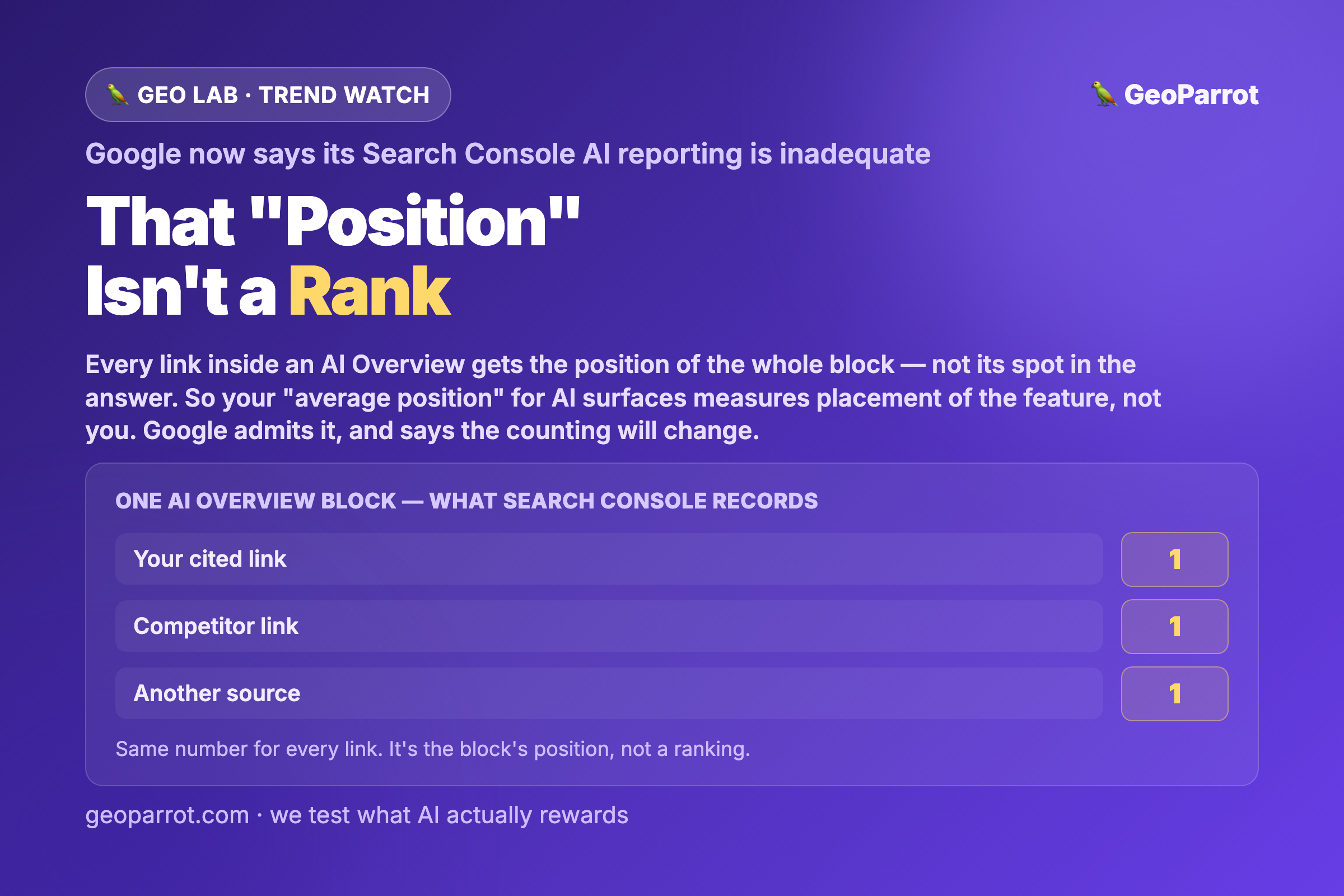
Quick answer: Google’s John Mueller confirmed this week that Search Console does not track where your link sits inside an AI Overview — every link in the block gets the position of the whole block, so your “average position” for AI surfaces is really the feature’s placement on the results page, not your rank within the answer. He called the old “position 1–10” model hard to map to modern results, said the current block-level approach is “pretty much it,” and added that the counting “will evolve over time” — with no timeline and no word on whether past data would be restated. The practical takeaway: stop treating an AI-surface “average position” as a rank you can move. Use it as a coarse presence flag, lean on impressions and your own analytics for direction, and don’t rebuild your reporting around a metric Google just told you is provisional.
Trend watch — published September 17, 2026. This is a fact-check post: the “position” question flared up in the SEO/GEO community this week (Search Engine Journal, Sept 13; Search Engine Roundtable recap, Sept 16) after Mueller’s Reddit comments. We pulled his exact wording, checked what the metric actually represents, and asked what it changes for how you measure AI visibility — in the spirit of the GEO Lab.
What did Google actually admit?
Two things, and it’s worth separating them. First, the current state: Mueller confirmed that Search Console assigns every link inside an AI Overview the position of the AI Overview block, the same way it treats other search features. In his words, “Position for these is hard to do in a way that makes it useful, so we’re currently tracking it like we do for many search features (as a block),” adding that “the old ‘position 1–10’ is hard to map” to today’s results pages, which have many ways for users to interact. Asked whether better position data was coming, he was blunt that this “is pretty much it” for now and that Google had tried to document it as clearly as possible.
Second, the direction: in the Sept 16 recap of his comments, Mueller signalled that position and impression tracking for Search, AI Mode, and AI Overviews “will evolve over time” as those surfaces themselves change. There was no timeline, no committed new metric, and no statement on whether historical numbers would be recalculated. In other words: Google is telling you the current AI-surface position number is a placeholder, and that the placeholder may be replaced later on terms it hasn’t defined yet.
Why does “position as a block” break your reporting?
Because it makes “average position” for AI surfaces measure the wrong thing. If every cited link in a given AI Overview inherits the block’s position, then two very different outcomes — being the first source the answer leans on, or being the fifth link nobody reads — record the same position value. Your “position” therefore moves when Google shifts the whole AI Overview higher or lower on the page, not when your standing inside the answer improves. It’s a measure of the feature’s placement, blended across links, not a rank you can optimize toward.
That has a concrete failure mode: you can “improve” your AI-surface average position without doing anything to your content — Google simply started showing the AI Overview earlier for your queries — and you can “lose” position while being cited more prominently, because the block slid down beneath more of the page. Any dashboard that charts AI-surface position as a KPI, or any report that says “we moved from position 4.2 to 3.1 in AI Overviews,” is reading motion in the feature’s layout as if it were motion in your ranking. Mueller just confirmed those are not the same thing.
Isn’t this the same gap you already wrote about?
It’s the next crack in the same wall — and worth being precise about the difference. When Google shipped its Generative AI performance report, we flagged that it gives impressions but no click data. This week’s admission is about the other core metric, position, and it’s arguably worse: impressions at least count a real event (“a link to your site was shown”), whereas the AI-surface position number is a block-level stand-in that doesn’t describe your placement at all. So the scoreboard now has two soft columns for AI surfaces — impressions that can’t tell you about clicks, and a position that isn’t a rank.
This lines up with a pattern we keep hitting. We found Google testing a thinner citation panel that shrinks clicks without changing who gets cited, and that People Also Ask has been almost entirely absorbed into AI answers, erasing a slot SEOs used to measure. Each change quietly removes a familiar number from the board. The honest read: the visibility ladder — shown → cited → recommended → clicked — is real, but Search Console mostly instruments the bottom rung (“shown”), and even that rung’s “position” label doesn’t mean what it means in classic search.
Does this mean position is useless for GEO?
No — it means you should downgrade what you ask of it. A block-level position is still a coarse presence signal: a much better number tells you the AI feature tends to sit near the top for your queries, and a much worse one tells you it’s buried. That’s directional context, not a rank to chase decimal points on. Treat it the way you’d treat a “we’re usually on page one” statement: useful framing, useless as a per-query optimization target. The mistake is precision — reporting AI-surface position to two decimals and drawing week-over-week trend lines as if you were moving it.
There’s also a scope discipline point. This is Google-only. ChatGPT, Perplexity, Copilot, and Gemini’s app don’t expose a “position” for your citations at all — they render sources inline with their own affordances, and there’s no Search Console equivalent to argue with. Our cross-engine testing found the four major engines shared only 2 of 395 cited domains, with ~85% unique to a single engine, which is why there is no universal GEO strategy: a Google metric quirk tells you nothing about how you’re cited elsewhere. Don’t let a debate about one engine’s dashboard become your whole measurement model.
What should you measure instead?
Move the weight off the soft columns and onto things that describe real outcomes. Two guardrails first: don’t build a blended “AI Share of Voice” vanity number on top of a position that isn’t a rank, and remember that being listed or cited isn’t the same as being the answer’s pick — the gap we documented in self-ranking listicles and reverse-engineering the consensus pick. With those in mind, the practical stack:
- Impressions and query coverage from the Generative AI report — for “am I showing up, and for which queries,” which the report does answer.
- Your own analytics for the click side Search Console won’t give you: our GA4 setup for AI traffic captures referred sessions and what they do next.
- Conversion value, not raw volume — a reminder from when we asked whether AI search traffic actually converts better; a small referral stream can still be your best one.
- Per-engine presence checks — because position is Google-only, run the lightweight coverage checks in our per-engine GEO checklist to see who’s cited where.
The practitioner takeaway
- Stop reporting AI-surface “position” as a rank. Every link in an AI Overview shares the block’s position — it’s the feature’s placement, not yours.
- Kill the decimal-point trend lines. A move from 4.2 to 3.1 in AI Overviews likely reflects where Google placed the block, not anything you changed.
- Treat it as a coarse presence flag. “Usually near the top” vs “usually buried” is the most you should read into it.
- Don’t rebuild reporting around a provisional metric. Google says the counting will evolve, with no timeline and no promise to restate history — build on impressions plus your own analytics.
- Keep it Google-scoped. Other engines have no position metric; check each one on its own terms.
Bottom line: Google didn’t break Search Console this week — it admitted, plainly, that the AI-surface “position” number was never a rank to begin with, and that it’s provisional on top of that. That’s clarifying, not alarming. The teams that quietly re-labeled their dashboards months ago — presence, not rank; impressions plus first-party analytics, not a single “visibility” score — don’t have to change anything. Everyone still charting AI Overview position to two decimals just got told, by the source, that they’re tracking the layout, not the win.
Frequently asked questions
What position does Search Console assign to links inside an AI Overview?
Every link inside an AI Overview receives the position of the AI Overview block itself, not its individual spot within the answer. John Mueller confirmed this in September 2026, explaining that Google tracks these “as a block” the way it does other search features, because mapping the old position 1–10 model onto modern AI results is hard to do usefully.
Does that make my AI Overviews “average position” a ranking?
No. Because every cited link shares the block’s position, your AI-surface average position reflects where Google placed the whole AI Overview on the results page — blended across links — rather than your standing inside the answer. It can change when Google moves the feature up or down without any change to your content, so it should be read as a coarse presence signal, not a rank to optimize.
Is Google going to fix AI position reporting?
Mueller said position and impression tracking “will evolve over time” as Search, AI Mode, and AI Overviews change, but gave no timeline, committed to no specific new metric, and did not say whether past data would be restated. Treat the current number as provisional and avoid rebuilding your reporting around it.
Where do AI Mode queries show up in Search Console?
According to Mueller, AI Mode queries appear in Search Console’s regular Performance report, not in the separate Generative AI report. The Generative AI report covers AI Overviews and AI Mode impressions on Google surfaces but does not include click data, which is why pairing it with your own analytics is necessary for a complete picture.
What should I measure for AI visibility instead of position?
Use impressions and query coverage from the Generative AI report for “am I showing up,” your own GA4 setup for the click and behavior data Search Console omits, and conversion value rather than raw referral volume to judge worth. Because position is Google-only, run lightweight per-engine presence checks to see where you’re cited across ChatGPT, Perplexity, and others, and avoid collapsing everything into one blended visibility score.
Leave a Reply