Evidence-first case study · sports brand SEO + GEO series, part 11 of 20
On’s flagship Cloudmonster 3 product page — a $190 bestseller — carries zero customer reviews anywhere: no aggregateRating in its ProductGroup schema, no star rating or review count in the rendered page, nothing, on every one of the three product pages we checked. At the same time, On runs the most deliberately-curated llms.txt in this entire series: a short brand brief pointing AI agents to a dedicated Technology Glossary published in both Markdown and JSON — except that JSON file isn’t actually the schema.org DefinedTermSet that the llms.txt itself claims it is. And from a Korea-based IP, on.com’s own homepage redirects you to its English-language Korea storefront by default, not its fully-Korean one. Despite all that, Google AI Mode cited on.com in 6 of 10 real queries this run.
Actual public homepage captured during this audit, November 7, 2026.
What is On trying to do — and why audit it eleventh?
This is part 11 of GeoParrot’s sports-brand series, running the same evidence-first method we used on Converse, New Balance and nine other major brands. On is a useful eleventh name because it’s the first brand in this series built almost entirely on a single word: the Swiss running-shoe company, founded in Zurich in 2010, trades under the one-syllable mark “On” — and its own domain reflects that literally. Typing on-running.com, the URL most people would instinctively guess for a brand commonly called “On Running,” gets you a permanent HTTP 301 redirect to the one-word domain on.com, which is what every URL in this audit actually resolves to. A one-word brand name is a genuinely different GEO problem than “Reebok” or “Skechers”: it’s much harder for an AI engine (or a search index) to disambiguate “on” from the million other things that word means.
Brand category Swiss performance running-shoe and apparel company, founded 2010, best known for its CloudTec cushioning technology and the Cloudmonster/Cloud shoe lines.
Primary user job Find the right Cloud-series running shoe for a specific use case (daily trainer, race day, trail), backed by clear technology explanations and sizing guidance.
SEO + GEO challenge A one-word brand name that collides with ordinary English usage, a flagship PDP with zero review signal of any kind, and a self-described llms.txt artifact whose own schema claim doesn’t match what it actually serves.
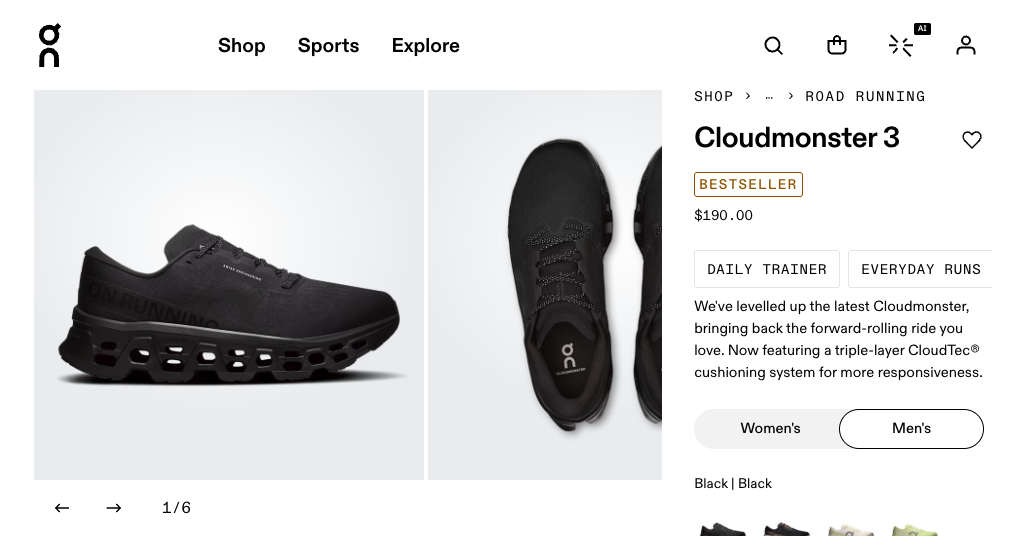
The product we tracked: Cloudmonster 3
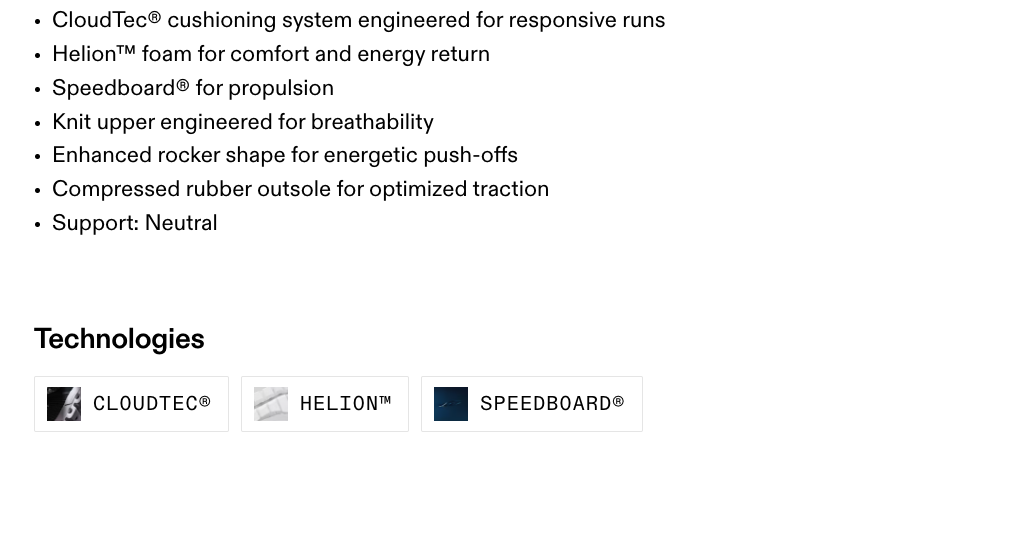
US product page: Black | Black, $190, marked Bestseller — no star rating or review count visible anywhere on the page.Scrolling past the fold surfaces a plain-language features list and a Technologies explainer (CloudTec, Helion, Speedboard) — the same proprietary-technology content that the site’s llms.txt separately exposes as a dedicated machine-readable glossary.
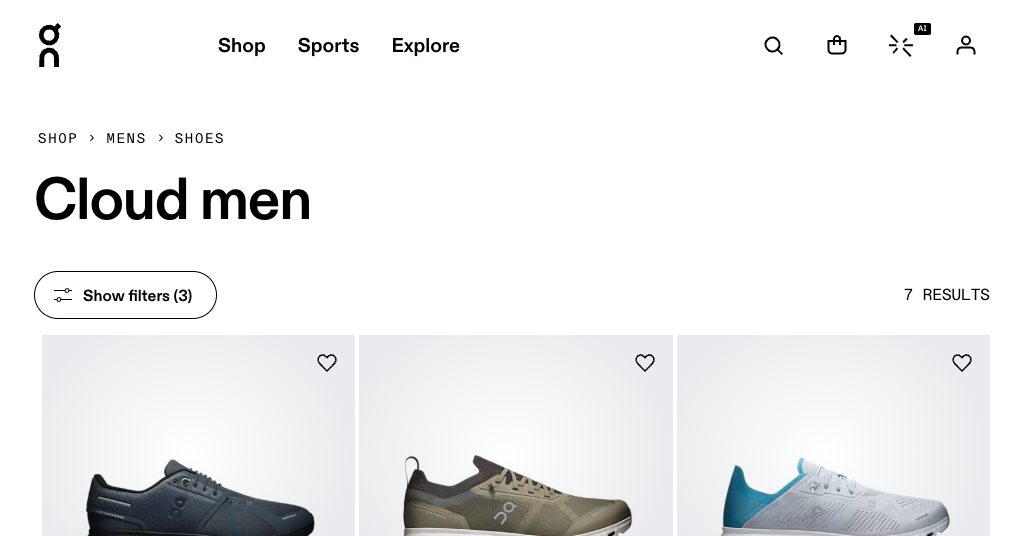
The category layer: “Cloud men” at 7 results — the narrowest single-category count we’ve seen in this series, reflecting On’s smaller, more curated catalogue versus the hundreds-of-SKU categories at Nike or Converse.
AI citation snapshot: 10 real queries, Google AI Mode
We sent 10 verbatim queries to Google AI Mode (udm=50) and checked both direct a[href] links and citation chip aria-labels, counting a citation only when the exact registrable domain is on.com — a stricter bar than most of this series, deliberately, because “on” is common enough as a word and a domain fragment that a loose substring match would produce false positives.
Query
on.com cited?
Who else showed up
best on running shoes for beginners
❌ No
doctorsofrunning.com, runrepeat.com — third-party review sites only
on cloudmonster 3 review
❌ No
runrepeat.com, theruntesters.com, meta-endurance.com, rtings.com — continuing this series’ pattern of “[brand] [product] review” queries rarely citing the brand’s own domain
a second on.com-family result labelled “www–on.com” (a double-hyphen variant we did not visit and cannot vouch for) alongside the genuine citation
are on running shoes true to size
❌ No
odsdesignerclothing.com, runrepeat.com, opumo.com, oncloudshoesco.com — note the last domain is not On’s own site either
on cloudmonster vs cloudsurfer
✅ Yes
reddit.com, alastairrunning.com — on.com’s own comparison content cited directly
best on running shoes for wide feet
✅ Yes
northernrunner.com, werunwild.com — on.com cited alongside two third-party retailers
who owns on running shoes
❌ No (strict count)
wikipedia.org, odsdesignerclothing.com — plus the legacy on-running.com domain, which 301-redirects to on.com but is a different registrable domain, so it doesn’t count under our strict rule even though a reader clicking it lands on the real site
on running vs nike running shoes
✅ Yes
nike.com, runrepeat.com, runtothefinish.com, poizon.com — both brands’ own domains cited in the same result, a direct comparison query actually working as intended
how to clean on running shoes
✅ Yes
odsdesignerclothing.com, runnersneed.com, underarmour.com — on.com’s own care guidance cited directly
Result: on.com cited in 6/10 queries (Nike 5/10, Adidas 4/10, Puma 5/10, Under Armour 8/10, New Balance 6/10, ASICS 7/10, Skechers 4/10, Lululemon 8/10, Reebok 7/10, Converse 7/10) — tied with New Balance, mid-pack. The two most useful findings here aren’t the raw count: first, both named-product-review queries failed to surface on.com, continuing a pattern that’s now held across nearly every brand in this series. Second, we observed a domain in the results (“www–on.com”) that is very plausibly not On’s own property — a double-hyphen variant of the brand domain, a pattern sometimes used by mirror or scraper sites. We did not visit it and aren’t making a security claim here, only flagging that an AI engine surfaced it next to the genuine domain without visibly distinguishing the two.
G-score audit: the 8-pillar hygiene checklist
We scored six representative On URLs with the same 8-pillar static-HTML checklist (JSON-LD present, FAQ content, visible date, author byline, concrete data points, table/list structure, 3+ subheadings, a 30–500 character early answer) used in our Week 17 quality-score experiment and on all ten prior brands. Unlike several recent brands in this series, On did not block our plain, non-browser HTTP requests anywhere — every page returned a real HTTP 200 to a bare urllib fetch. But two of the six pages we targeted (the shoe category page and the Help & support page) returned only a ~4.5KB client-side-rendering shell to that plain fetch, versus 590–770KB of fully server-rendered HTML on the homepage and product page — so those two were scored from a browser-rendered DOM instead, the only way to see their real content.
Page
Fetch method
G-score
Notable pillars
US homepage
Plain fetch (HTTP 200)
0.5
1 JSON-LD block; no FAQ, no author, no date
Cloudmonster 3 PDP (US)
Plain fetch (HTTP 200)
0.5
ProductGroup JSON-LD present; fails early-answer (first paragraph too short)
Men’s shoes category (US)
JS-rendered (plain fetch = 4.5KB shell)
0.5
1 JSON-LD block once rendered; a non-JS crawler would see almost nothing here
Help & support (US)
JS-rendered (plain fetch = 4.5KB shell)
0.375
0 JSON-LD blocks even after rendering
KR homepage (ko-kr)
Plain fetch (HTTP 200)
0.5
Same structure and score as US homepage
Cloudmonster 3 PDP (KR, ko-kr)
Plain fetch (HTTP 200)
0.375
Same ProductGroup schema as the US PDP, but missing the US page’s data-point pillar
Six-page average: 0.4583 (Nike: 0.4375, Puma: 0.354, Under Armour: 0.5208, New Balance: 0.5833, Adidas: 0.6458, ASICS: 0.4583, Reebok: 0.5417, Converse: 0.5208) — tied exactly with ASICS, on the lower half of this series. Notably, none of the six pages scored above 0.5: the ceiling here isn’t any single catastrophic gap, it’s that no page we checked has a date, an author byline, or an FAQ block of any kind.
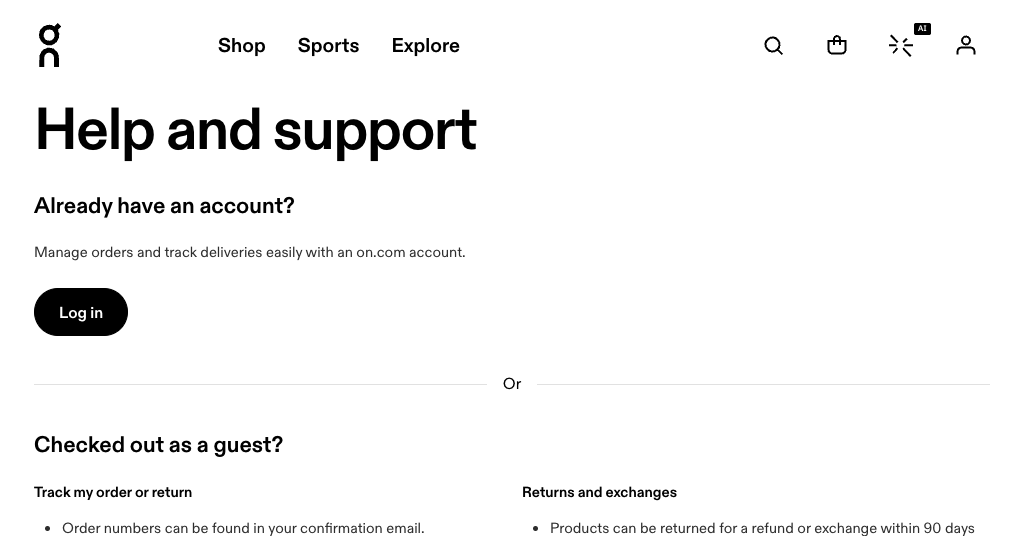
US Help & support page: visually complete and genuinely useful (login, guest order tracking, returns), but the lowest G-score in this audit (0.375) — it carries zero JSON-LD even after full rendering.
The review gap: zero, not hidden — genuinely absent
This is the clearest single finding of this audit. On’s Cloudmonster 3 ProductGroup schema — on both the US and Korea PDPs — contains a fully-structured hasVariant array with per-colorway Offer blocks (price, currency, availability, itemCondition), but no aggregateRating and no review field anywhere. We didn’t stop at schema: a full-text scan of the rendered page found no star rating, no review count, and no review text displayed anywhere on the page, and we spot-checked a second product (Cloudmonster 3 Hyper) with the same result. This isn’t a case of reviews existing but failing to make it into structured data, the pattern we’ve seen repeatedly elsewhere in this series — on.com’s PDP genuinely does not surface customer reviews for the products we checked.
What makes this worth a second look: On’s own front-end translation files, visible in the page’s embedded i18n payload, contain dozens of unused review-related UI strings — "Leave a review of {{name}}", reviewAverageStarRatingAriaLabel, use-product-reviews-compact-cloud — meaning a review *feature* exists somewhere in On’s codebase. It’s either not enabled on these products, not yet rolled out broadly, or gated behind an interaction we didn’t trigger. We can only report what we observed: the capability is present in the code, the data was not present on the page.
A genuinely curated llms.txt — that misdescribes its own file
robots.txt — A standard, short Disallow list (checkout, cart, orders, account, API, password, chat) applied to User-agent: * with no per-bot rules. No AI crawler (GPTBot, ClaudeBot, PerplexityBot, Google-Extended) is named anywhere, positive or negative — neutral, matching the majority pattern in this series.
llms.txt — genuinely curated, a first for this series — Most brands we’ve audited either had no llms.txt, a broken one, a raw link dump, or an auto-generated storefront-agent instructions file. On’s is short and clearly hand-written: a two-sentence brand description, then two sections pointing to a Technology Glossary (published in both .md and .json form) and the Shoe Finder / product catalogue. It reads like documentation written for an AI agent, not boilerplate.
…but the schema claim doesn’t match the file — The llms.txt describes technology-glossary.json as a “Schema.org DefinedTermSet representation.” We fetched it directly: its actual @type is CollectionPage, with a mainEntity of type ItemList containing 7 ListItem entries (CloudTec, CloudTec Phase, Helion, Helion HF, LightSpray, MissionGrip, Speedboard). Nowhere in the file does the type DefinedTermSet or DefinedTerm actually appear. The glossary itself is genuine and well-maintained (dateModified 2026-10-19, datePublished back to 2022-08-17) — it just isn’t the specific schema type its own documentation says it is.
sitemap.xml — The root path 302-redirects to a locale-specific sitemap index (/en-kr/sitemap.xml for a Korea-based request), which in turn lists five separate sitemap files: pages, product-listings, products, stories and collections. A real, structured, multi-file sitemap — not a flat dump.
No hreflang annotations — Despite three parallel locale paths sharing an identical URL structure (en-us, en-kr, ko-kr), neither the US nor the Korea PDP we inspected carries any hreflang link tag. Each page does have a correct self-referencing canonical tag, but nothing tells a crawler that the Korea and US pages are locale-alternates of each other.
Rendering is inconsistent by page type, not by locale — Home and product pages are fully server-rendered on both US and Korea domains (590–770KB of real HTML to a plain fetch). The shoe category page and the Help & support page, on both locales we spot-checked, return a bare ~4.5KB client-rendering shell instead. A non-JS AI crawler reading this site would see complete homepages and product pages, and nearly nothing on category or support pages.
One domain, one default locale that isn’t the local language
Requesting on.com/ from our Korea-based IP 302-redirected to /en-kr/ — an English-language storefront scoped to the Korea region (Korean won pricing, Naver Pay / Kakao Pay banners) — not to /ko-kr/, the fully Korean-language storefront that also exists and works perfectly when requested directly. We measured the difference directly: the ko-kr homepage contains roughly 31,000 Hangul characters; the en-kr homepage this same IP was sent to by default contains 22 (stray characters in currency labels). A Korean-speaking visitor arriving at on.com without already knowing to edit the URL to /ko-kr/ lands on an English page by default.
/en-kr/ — the default landing page for a Korea-based request: Korea-region pricing and payment methods, English copy./ko-kr/ — the fully Korean-language storefront, not reached by default, only by manually requesting this path.
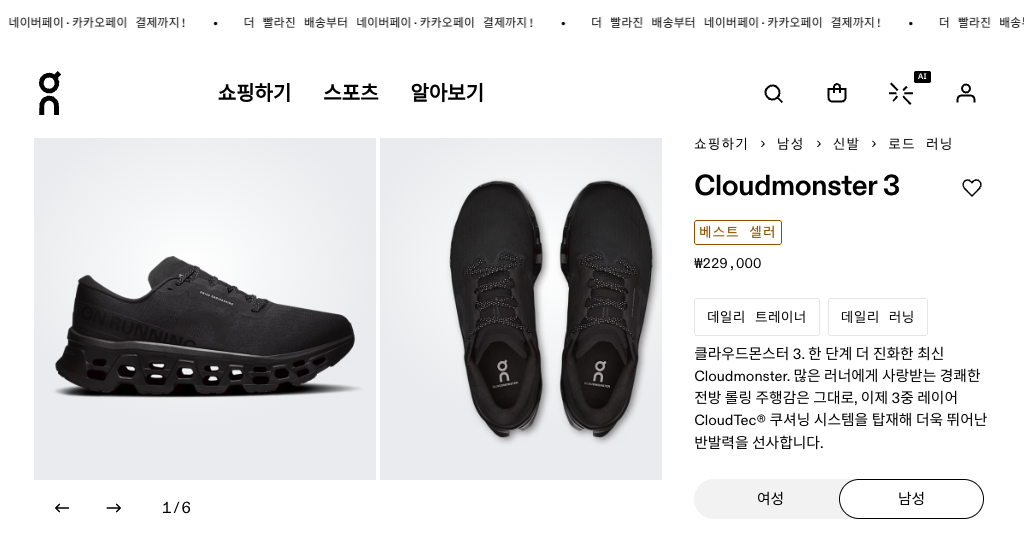
Korea Cloudmonster 3 PDP (ko-kr, same SKU 3MG1005 as the US page we tracked): 229,000원, marked 베스트 셀러 (Bestseller) — roughly 15-20% less than the US $190 price at prevailing exchange rates, not adjusted for Korean VAT.
Korea operations are disclosed on the ko-kr site’s company-information footer as 온 코리아 유한회사 (On Korea LLC, a “yuhan-hoesa” limited-liability company), representative Rebecca YiChia Cai, business registration 886-87-02816, based in Yangcheon-gu, Seoul. This reads as On’s own Korean subsidiary rather than an external licensee — the same pattern we found at Converse (Nike’s own Korean entity), different from Reebok (LF Corporation) or New Balance (E-Land) earlier in this series.
What works / What to verify
WHAT WORKS
A genuinely hand-curated llms.txt pointing to a real, multi-year-maintained Technology Glossary in two machine-readable formats, a structured five-file sitemap, complete ProductGroup/Offer schema on both locale PDPs, and no plain-HTTP blocking anywhere in this audit.
WHAT TO VERIFY
Whether the review feature visible in On’s own front-end code is intentionally disabled or simply unpopulated on the products we checked, whether the llms.txt’s “DefinedTermSet” claim is a stale description that needs updating, whether the Korea-region default-to-English-locale behavior is deliberate, and what “www–on.com” actually is.
Target query check — reported honestly, not inflated
We have not re-measured “on running seo” or “on running geo audit” query volume this session. Per the pattern already confirmed across ten earlier subjects in this series on October 20, 2026 (Keyword Planner, US) — the large majority showed no measurable search volume at all for “[brand] SEO/GEO audit” phrasing — we’re not claiming this title drives ranking-based traffic, and a one-word brand name like “On” makes keyword-level ranking claims even harder to make honestly than for the rest of this series. The distribution case for this series rests on internal links, our own index, and readers already following the GEO Lab arc, not on search demand for “[brand] SEO audit” as a query.
Frequently asked questions
Does On’s flagship Cloudmonster 3 product page have any customer reviews at all?
No, based on what we observed: neither the US nor the Korea product page carries an aggregateRating or review field in its ProductGroup schema, and a full-text scan of both rendered pages found no star rating, review count, or review text displayed anywhere. We spot-checked a second product (Cloudmonster 3 Hyper) with the same result. The site’s own translation files do contain unused review-related UI strings, so a review feature exists in the codebase — it simply wasn’t populated with data on any product we checked.
Why does on.com send a Korea-based visitor to an English-language page by default instead of the Korean one?
We can only report what we observed, not the underlying logic: requesting on.com’s root path from a Korea-based IP returns a 302 redirect to /en-kr/, an English-language storefront scoped to the Korea region (won pricing, local payment methods). The fully Korean-language /ko-kr/ storefront exists, works correctly, and contains roughly 1,400x more Hangul text — but it’s only reached by manually editing the URL, not by the default geo-routing.
Is On’s technology-glossary.json actually the schema.org DefinedTermSet that its own llms.txt claims it is?
No, based on what we fetched: the llms.txt describes this file as a ‘Schema.org DefinedTermSet representation,’ but the JSON it links to has @type CollectionPage with a mainEntity of type ItemList — neither DefinedTermSet nor DefinedTerm appears anywhere in the document. The underlying glossary content (7 technology entries, actively maintained since 2022) is genuine; the specific schema-type claim in the documentation doesn’t match what’s actually served.
Does a 6/10 AI citation rate mean On’s GEO setup is working despite the missing reviews?
Not reliably — this audit is itself a data point against that conclusion, consistent with ten prior brands. Our Week 17 experiment found hygiene/structure score was not a dependable predictor of AI citation, and here On lands at a mid-pack 6/10 citation rate while tying ASICS for one of the lower G-scores in the series (0.4583) and carrying zero review signal on its highest-traffic product page. Our 10-query snapshot measures the domain family, not individual URL citation, so we can’t confirm which specific On page — if any — drove the 6 successful citations.
Audit evidence, scope and limits
Inspected: November 7, 2026, public logged-out access from a Korea-based IP (real browser session used for screenshots and citation testing; plain HTTP fetches used urllib with a standard desktop user agent). Screens: US homepage, Men’s Cloud category (7 results), the Cloudmonster 3 product page (top and scrolled), US help and support, en-kr homepage, ko-kr homepage, and the ko-kr Cloudmonster 3 product page — plus robots.txt, llms.txt, technology-glossary.json/.md, sitemap.xml checks, a 10-query Google AI Mode citation snapshot, and an 8-pillar G-score scored on six pages (plain-fetched for home/PDP on both locales, browser-rendered for category and support after plain fetch returned only a CSR shell).
Not measured: rankings, Search Console performance, analytics, conversion, signed-in/member flows, ChatGPT citations (not attempted, given the composer failures flagged on earlier audits in this series), ownership verification of the “www–on.com” domain observed in one citation result, or the complete product/locale catalogue beyond the one shoe line and six-to-eight URLs sampled here. This is a public-signal snapshot, not a performance claim or a full-catalogue crawl.
This is part 11 of a daily series. Every day, GeoParrot runs this same evidence-first method — real screenshots, a 10-query AI citation snapshot, an 8-pillar G-score audit, and an honest target-query check — against one more major sports and athletic-wear brand. Next: Hoka.








Leave a Reply