
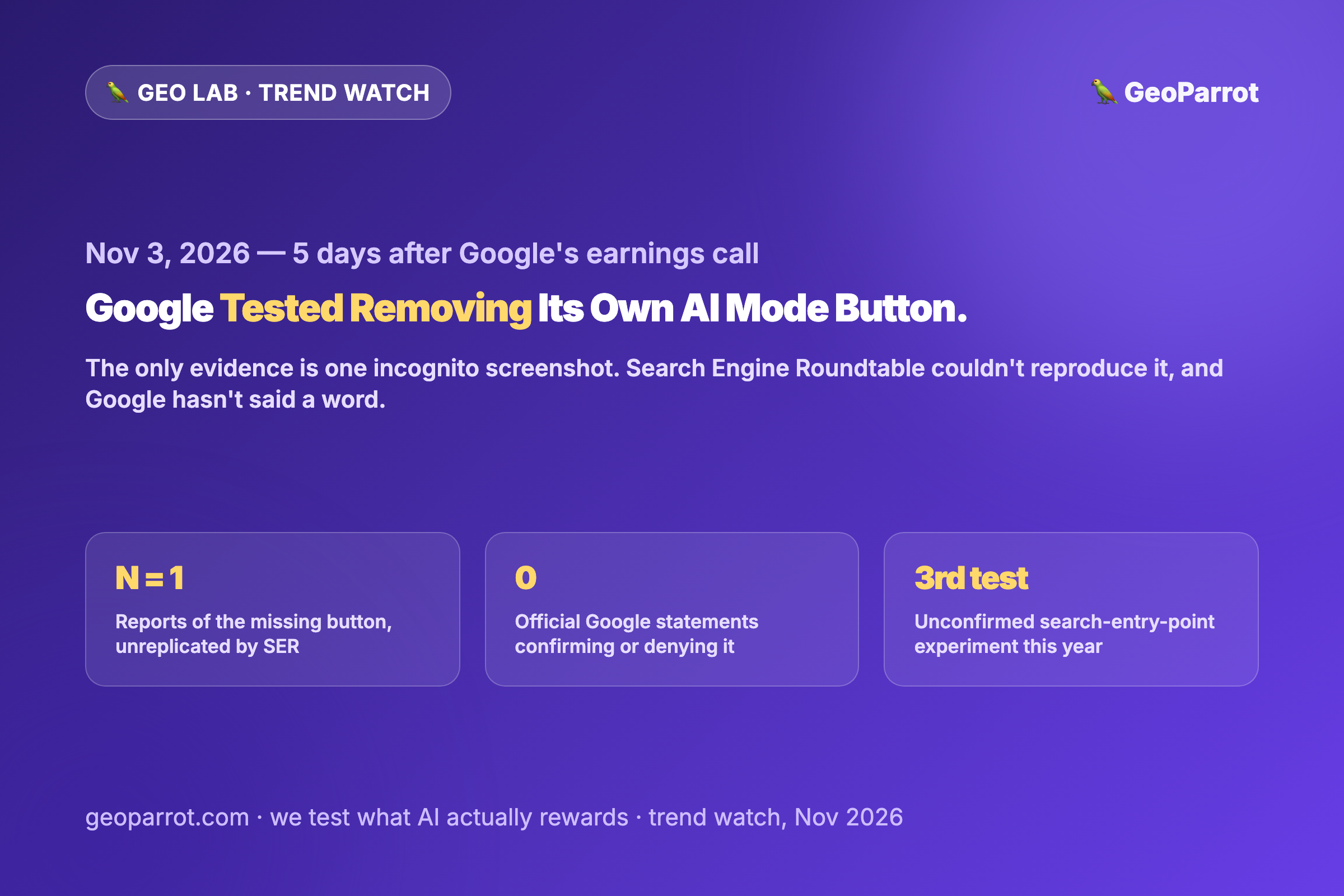
Quick answer: On November 3, 2026, X user Len Raleigh reported that the AI Mode button had disappeared from Google Search in an incognito Chrome session, calling it “just a test — I still have AI Mode on other machines and on other sessions.” Barry Schwartz at Search Engine Roundtable covered it the same day but said plainly: “I cannot replicate this.” Google has not confirmed, denied, or commented on the test. The report landed five days after Alphabet’s October 28 earnings call, where Chief Business Officer Philipp Schindler said AI Mode’s query growth hurt the quarter “because of the lower monetization we were seeing in AI Mode” — a comment we covered in detail two days before this report surfaced. The timing invites a story: Google is quietly pulling back AI Mode because it doesn’t pay. The evidence supports a narrower one: one person’s browser, once, unreproduced.
Trend watch — published November 6, 2026, in the GEO Lab. We just finished writing about what Alphabet’s earnings call actually said about AI Mode, as opposed to what the coverage said it said. Four days later, a different story about AI Mode is getting the same treatment — so we’re applying the same standard twice in one week.
What did Len Raleigh actually see, and did anyone confirm it?
Raleigh posted a screenshot on X showing a Google Search results page with no AI Mode tab next to the standard search tabs, taken in an incognito Chrome window. His own framing was careful: he called it a test, not a rollout, and noted the button was still present on his other machines and other (non-incognito) sessions — meaning he wasn’t reporting a personal account change, but a session-specific absence. Search Engine Roundtable picked it up on November 3 and tried to reproduce it. Barry Schwartz’s verdict: “I cannot replicate this, but it doesn’t surprise me that Google would test removing the AI Mode bar for a tiny subset of searchers.” That sentence does two things at once — it treats the report as plausible given how Google runs search UI experiments, and it states outright that the outlet best positioned to verify an SEO-industry claim quickly couldn’t. No other outlet we found reproduced it independently either; the syndicated coverage (BusinessToday, PCQuest, NewsBytes, and others) all traces back to the same single screenshot and the same SER writeup.
Does the earnings-call timing actually connect to this?
Only as a coincidence worth noting, not as a mechanism. On October 28, Schindler told Alphabet’s investors that AI Mode’s query growth weighed on the quarter because those queries “currently monetize at a lower rate than classic Search” — a comment that, paired with Alphabet’s roughly 10-12% single-day stock drop the next day, got widely read as “AI Mode caused Google’s worst day ever,” a reading the transcript itself doesn’t fully support (Schindler named foreign exchange as the larger driver first). Five days later, one person spots the AI Mode button missing in one browser session. The sequence is suggestive — a company under earnings pressure on a specific feature, then a sighting of that exact feature’s entry point disappearing — but suggestive is not the same as caused-by. Google runs thousands of simultaneous UI experiments on tiny user slices for reasons that have nothing to do with any single week’s investor call, and a true monetization-driven product decision would show up as a confirmed, broad change communicated through official channels, not a single incognito screenshot nobody else can reproduce five days later.
Is this actually the first time Google has touched the AI Mode button’s placement?
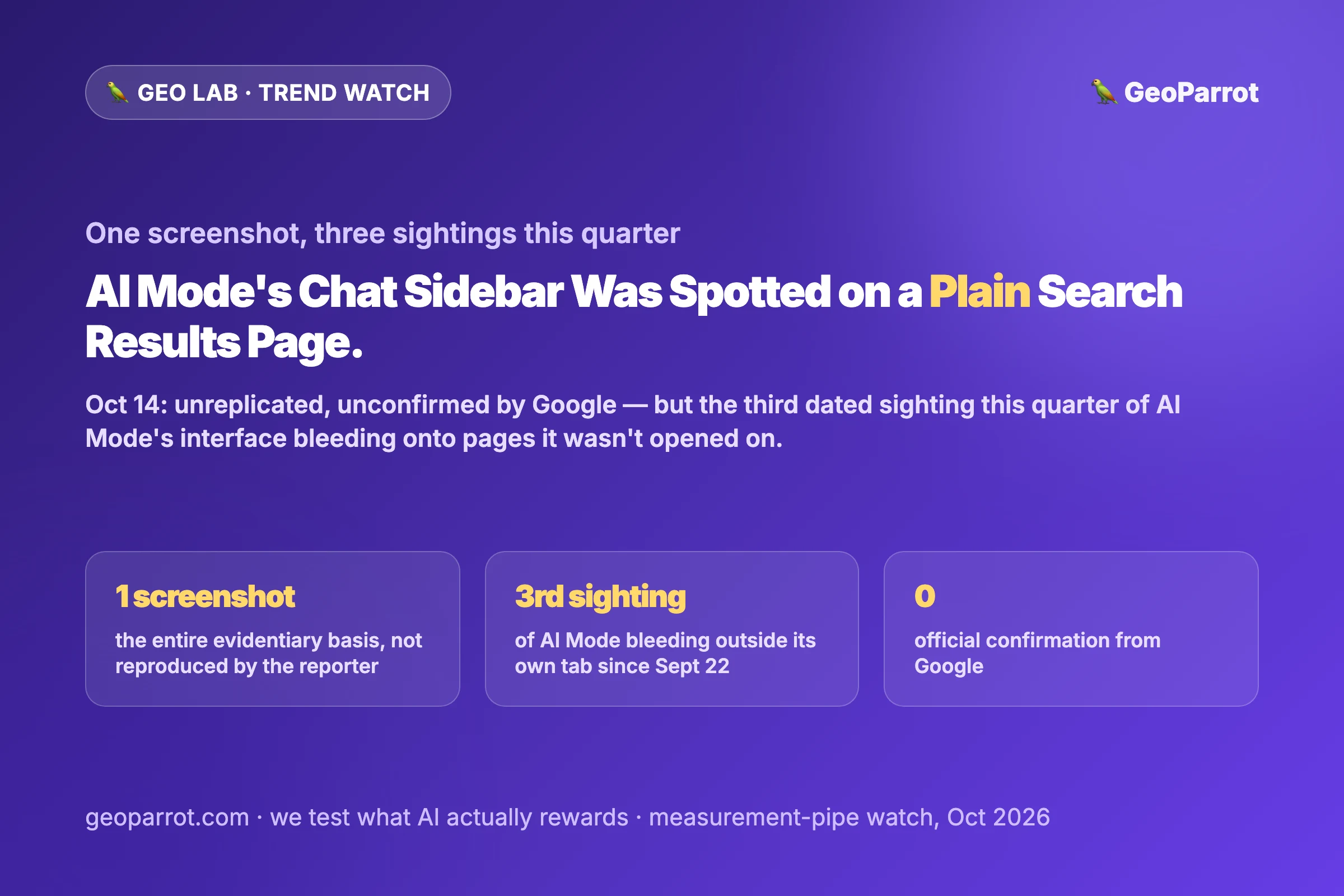
No, and the history argues for caution rather than alarm. Google moved the AI Mode icon into the app’s search bar back in May 2025 to make it permanently visible — a change that made AI Mode more prominent, not less. In August 2026, Search Engine Watch caught a separate, also-unconfirmed A/B test on signed-out desktop visitors that replaced the classic Search button entirely with three AI-first shortcuts (“Ask about files,” “Brainstorm,” “Create images”); Google never confirmed the scope of that test or whether it would ship. Lined up, that’s three distinct, small-sample, individually unconfirmed search-entry-point experiments in eighteen months — one adding AI Mode prominence, one replacing classic Search with AI shortcuts, and now one reportedly removing the AI Mode button for a sliver of users. Reading any single instance as a directional signal about Google’s confidence in AI Mode requires ignoring that it has already tested the opposite move, and the orthogonal move, in the same window.
This has the same shape as a pattern we’ve already named
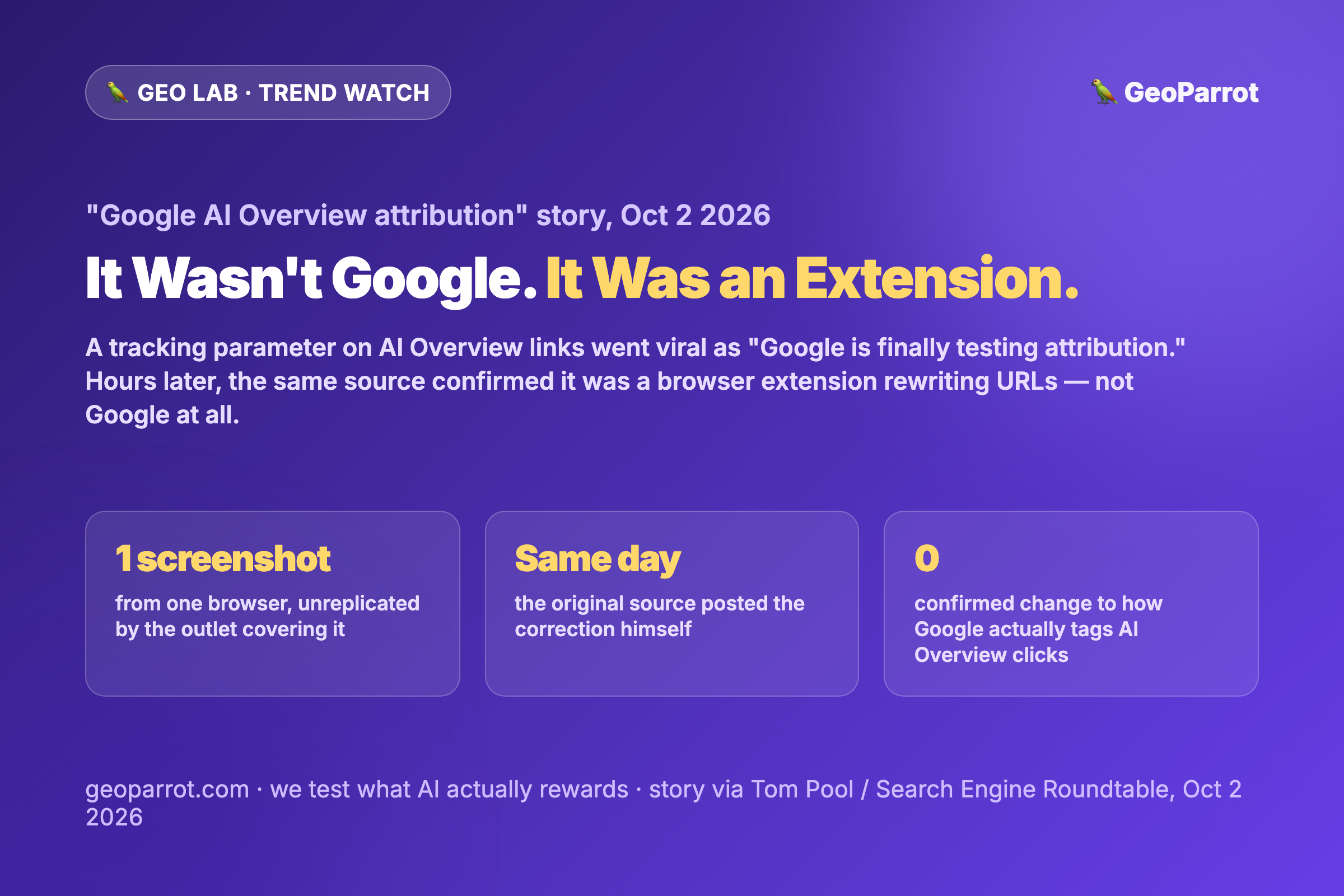
We spent most of October cataloguing incidents where a single, short-window anomaly got reported as a real shift in Google’s AI behavior, when the actual cause was a label, a tag, or a reporting-pipeline gap unrelated to AI Overviews or AI Mode themselves. Those were measurement artifacts; this one is closer to a sampling artifact — one user, one browser mode, one unreplicated screenshot — but the underlying failure is identical: a data point moves, coverage treats it as confirmation of a trend, and nobody checks whether the sample size supports the claim first. The fix is also identical: treat N=1 the way you’d treat a single tracker dip, as a prompt to verify, not a conclusion to repeat. Our counted-vs-inferred framework applies as cleanly to UI sightings as to citation metrics — “one person saw it once” is inferred, not counted, and deserves exactly that much confidence.
What to actually do before reacting to this
- Don’t change AI Mode strategy off an unreplicated UI sighting. A single incognito screenshot that even the reporting outlet couldn’t reproduce is not evidence of a rollout, a policy change, or Google’s confidence level in AI Mode — it’s evidence that Google runs small-sample tests, which was already known.
- Separate “Google said” from “coverage concluded” on the earnings call, too. Schindler’s actual quote was about monetization rate on existing AI Mode queries, not about any plan to reduce AI Mode’s visibility or query share — the two claims get merged in headlines more often than the transcript supports.
- Check your own analytics, not a stranger’s screenshot. If you want to know whether AI Mode’s prominence or query share is actually shifting in a way that matters to your traffic, your own Search Console and referrer data over weeks will tell you faster and more reliably than any single viral report.
- Wait for corroboration or an official statement before citing this as a trend in client reporting. One unreplicated sighting plus one earnings-call quote from five days earlier is two separate, individually weak data points — not one strong one, even when they’re easy to narrate together.
Frequently asked questions
Has Google confirmed it is removing the AI Mode button?
No. Google has not commented on the report at all. The only source is a single X post from Len Raleigh on November 3, 2026, showing the button missing in one incognito Chrome session, and Search Engine Roundtable’s Barry Schwartz said he could not reproduce it himself.
Is this connected to Alphabet’s October 28 earnings call comments on AI Mode?
Only by timing, not by confirmed cause. Philipp Schindler said AI Mode’s query growth hurt Q3 results because those queries currently monetize at a lower rate than classic Search. That’s a statement about revenue mix, not an announced plan to reduce AI Mode’s visibility, and nothing published since connects the two directly.
Has Google tested changes to the AI Mode button before?
Yes, at least twice in the opposite direction. In May 2025, Google moved the AI Mode icon into the search bar to make it more prominent. In August 2026, it ran a separate, also-unconfirmed test replacing the classic Search button with AI-first shortcuts for some signed-out visitors. Both were small-sample, individually unconfirmed experiments, same as this one.
Should SEOs or marketers change their AI Mode strategy based on this report?
Not based on this report alone. One unreplicated sighting doesn’t establish a rollout, a policy shift, or reduced investment in AI Mode. Monitor your own Search Console and referrer data for real shifts in AI Mode-driven traffic, and treat single-source UI sightings as a prompt to watch, not a signal to act on.
What’s the broader pattern this fits into?
It’s the same failure mode we’ve logged repeatedly this quarter in AI-visibility reporting: a single, short-window, low-sample data point gets treated as confirmation of a trend before anyone checks whether it replicates. The specific mechanism differs each time — a missing HTML label, a broken UTM tag, now a single screenshot — but the fix is the same: verify before you repeat it.


Leave a Reply