
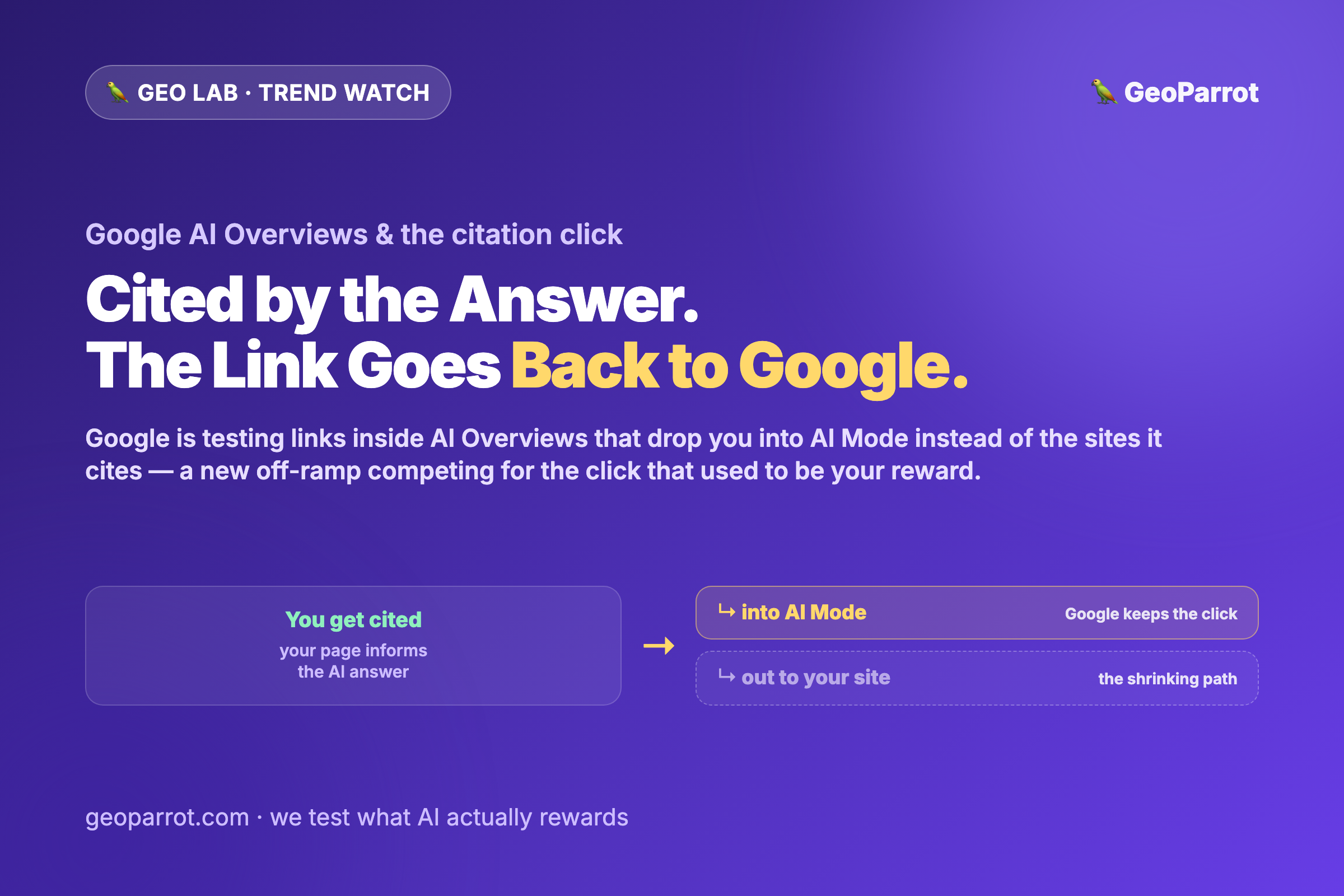
Quick answer: On September 22, Barry Schwartz reported a test spotted by Gagan Ghotra: Google is placing normal-looking anchor links at the bottom of AI Overviews that don’t take you to a webpage — they drop you into AI Mode with a follow-up question. It’s unconfirmed, seen on a single query, and could disappear tomorrow, so it’s a direction, not a data point. But the direction is the story: these are additional links that compete for the click inside the same block where your citation lives, and they route attention back into Google’s own AI surface instead of out to the sites Google cited. For GEO it deepens a gap we’ve been measuring all year — being cited keeps decoupling from getting a click. The citation is still the prize; the click was never the guarantee.
Trend watch — published September 23, 2026. This is an unconfirmed test seen by one person on one query. We’re not calling it a rollout or a ranking signal. We’re reading it the way the GEO Lab reads any shiny SERP change: separate what’s confirmed from what’s speculation, then check the mechanism against what our own experiments already show.
What exactly did Google change in AI Overviews?
According to Ghotra’s post, “in AI Overviews answers Google is now testing showing anchor links which instead of taking to a webpage takes to AI Mode.” Schwartz described them as normal-looking links that “appear at the bottom of the AI Overview and prompt follow-up questions that take you into AI Mode.” So these aren’t the inline citation chips that point to your page — they’re a new class of link, styled like a web link, that a user could reasonably assume goes to a source but instead loads a Google AI Mode session with a suggested follow-up.
Two honest caveats before anyone rebuilds anything. First, it’s a test — Google hasn’t confirmed it, it was caught on one query, and Google kills tests constantly. Second, it doesn’t (yet) replace your citation link; it sits alongside it as an extra off-ramp. Overstating this as “your citation now points to Google” would be exactly the kind of headline-chasing we avoid. What’s real is narrower and still worth your attention: Google is experimenting with putting more of its own links into the answer box.
Why does a link that goes to AI Mode matter for GEO?
Because the entire GEO business case rests on an unstated chain: you get cited, the citation earns a click, the click becomes traffic. Every link Google adds that points back into Google — rather than out to a source — weakens the middle link of that chain. The answer box stops being a launchpad out to publishers and becomes a launchpad deeper into Google’s own surfaces. You can still be the source that informed the answer; you’re just one more competing affordance away from the click that used to be your reward.
This isn’t a one-off. It lands on top of a run of same-direction changes we’ve tracked over the last two weeks: Google testing a thinner, less prominent citation panel (cited, but harder to click), an Ahrefs study showing AI Overviews cutting click-through for exposed queries, and the near-total absorption of People Also Ask into AI Overviews. In the same September 22 recap where this AI Mode link test appeared, Google was also testing a Discover “Dive deeper” feature that shows AI-generated topic overviews instead of publisher articles. The common thread is self-preferencing inside the answer: keep the user’s next action inside Google. This test is the version of that trend aimed squarely at the citation link.
Isn’t this just the “AI Mode is the default” story again?
Related, but distinct — and the distinction is the point. The broader push to make AI Mode the default surface is about the results page: auto-expanding overviews, a prompt box shown by default, an AI-organized layout. This test is smaller and sharper: it’s about the links inside the answer itself changing where a click goes. That’s why it’s worth a separate note rather than a footnote — it’s the first sign of Google competing for the citation click at the link level, not just at the layout level. If you filed the “AI Mode default” trend away as background, file this one under “the click economy is being renegotiated inside the answer box.”
What do our experiments already say about the citation-to-click gap?
That the click was never the thing to price your GEO strategy on. Our overlap work found that classic rank and AI citation only loosely track each other — pages get cited without ranking and vice versa — so citation was already an independent currency from ranked-and-clicked traffic. And the volume that does click through is small and easy to misread: the reported “AI traffic converts better” numbers run from -13% to 23x mostly because the click counts are tiny denominators. A test that quietly siphons some of those clicks into AI Mode doesn’t break a healthy channel — it shrinks a channel that was already thin, while leaving the citation (the presence in the answer, the brand recall, the framing of the recommendation) fully intact. The takeaway isn’t “GEO is dying.” It’s “value your citations as presence, not as guaranteed traffic,” which is what the data has said all along.
How do you even measure this, and does it change other engines?
Carefully, and on your own infrastructure. Google’s Generative AI performance report is impressions-only — it has no click data, so if AI Mode links start eating your citation clicks, that report will keep looking healthy while your actual click-through quietly erodes. The signal that would catch it is first-party: watch your GA4 AI-referred sessions against your impression trend. Flat or rising impressions with falling AI-referred clicks is the fingerprint of “cited, but the click went to Google.” That’s the counted-vs-inferred rule in practice — trust the numbers you can count on your side, not the ones an interface implies.
And keep the scope tight: this is Google-only. ChatGPT, Perplexity and Gemini render their citation links their own way and pull from largely different sources — in our cross-engine test the four major engines shared just 2 of 395 cited domains, with about 85% unique to a single engine. There’s no universal GEO move here; a Google link-behavior change tells you nothing about whether Perplexity sends the click through on the same question. Verify click-through per engine instead of assuming Google’s behavior is everyone’s.
The practitioner takeaway
- Don’t rebuild for a one-query test. This is unconfirmed and could vanish. Note the direction; don’t reorganize your strategy around it.
- Price citations as presence, not clicks. The value that survives — brand recall, being the framing of the answer, shaping the recommendation — doesn’t need a click. Report it that way.
- Watch clicks first-party. GSC’s AI report has no click data. Pair impressions with GA4 AI-referred sessions; flat impressions plus falling clicks is your early-warning fingerprint.
- Separate “cited” from “clicked” in your reporting. They were always two metrics. Any answer-box change that keeps the click inside Google makes conflating them more expensive.
- Keep the scope on Google. This is a Google AI Overviews test. Verify link-through behavior on ChatGPT, Perplexity and Gemini separately.
- Optimize the asset, not the affordance. You can’t control whether Google routes a click to AI Mode. You can control whether your page is the one worth citing — so keep earning the citation.
Bottom line: A single-query test of links that go to AI Mode instead of a website is a small thing on its own. What it signals isn’t: Google is starting to compete for the citation click inside the answer box, adding its own off-ramps to a surface that used to point out to sources. That doesn’t kill the value of being cited — our data says the click was never the guaranteed prize anyway. It just makes the old habit of pricing GEO in clicks look more fragile than ever. Value the presence, measure the clicks on your own infrastructure, and check every engine on its own.
Frequently asked questions
What is Google testing with AI Overview links?
Google is testing normal-looking anchor links at the bottom of AI Overviews that, instead of taking you to an external webpage, load Google’s AI Mode with a suggested follow-up question. It was reported by Barry Schwartz on September 22, 2026, based on a test spotted by Gagan Ghotra on a single query. Google has not confirmed it, so treat it as an early, unconfirmed test rather than a rollout.
Do these links replace the citation links to my website?
No — based on what’s been reported, they’re additional links that appear at the bottom of the AI Overview alongside the existing inline citations, not a replacement for them. The concern isn’t that your citation link disappears; it’s that Google is adding its own competing links into the same answer block, giving users another way to stay inside Google instead of clicking out to a source.
Should this change my GEO strategy?
Not the underlying work. It’s a reminder to price the value of an AI citation as presence — brand recall, being the framing of the answer — rather than as a guaranteed click and a guaranteed session. Keep earning citations by being the most citable source on a question, and measure any click-through impact using first-party analytics rather than assuming the citation converts to traffic.
How would I detect if AI Mode links are costing me clicks?
Google Search Console’s Generative AI performance report shows impressions but no click data, so it won’t show it directly. Compare your AI-feature impressions in GSC against your GA4 AI-referred sessions over time. If impressions stay flat or rise while AI-referred clicks fall, that’s a fingerprint consistent with the answer box keeping clicks inside Google rather than sending them to you.
Does this affect ChatGPT and Perplexity too?
No. This is a Google AI Overviews test. ChatGPT, Perplexity and Gemini render citation links their own way and pull from largely different source sets — in our cross-engine test the four major engines shared only 2 of 395 cited domains, with about 85% unique to a single engine. Google changing where its links point tells you nothing about how other engines handle click-through, so verify each engine separately.
Leave a Reply