
Quick answer: On September 20, Barry Schwartz reported that Google’s opt-in Web Guide has a bug — the “Classic search” button that’s supposed to take you back to the normal results page doesn’t; you click it and land right back in the AI-organized layout. The bug will probably get fixed. The mechanism it exposes won’t go away: Web Guide runs on query fan-out, where a custom Gemini model breaks your one query into several related sub-queries, searches them in parallel, and groups the results into labeled clusters. For GEO that’s the whole game — you’re no longer competing for ten slots on one query, you’re competing across a handful of invisible sub-queries, and a narrow, specialized page can earn a cluster spot it could never win in a flat top-10. It also means the query you optimized for isn’t necessarily the query you got cited on.
Trend watch — published September 22, 2026. Web Guide isn’t new (Google launched it as a Search Labs opt-in in July 2025 and has been testing it in the main “All” tab since late 2025), but this week it made the rounds for the wrong reason: the escape hatch back to classic results quietly broke. We did what the GEO Lab does with a shiny SERP story — skip the bug and read the machine underneath it, then check it against what our own experiments already show about who gets cited.
What broke in Google’s Web Guide this week?
Web Guide is Google’s AI-organized results page — think “a mix of its AI search interface and web search interface in one.” Instead of ten blue links, it clusters pages under AI-generated topic headings. On September 20, Search Engine Roundtable’s Barry Schwartz reported that when you click the “Classic search” link that’s meant to drop you back to the standard results, it doesn’t — it just reloads the same Web Guide view (he also spotted Web Guide text rendering below the knowledge panel where it shouldn’t). It looks like a bug, and Google will likely patch it. We’re not treating a display glitch as a strategy signal.
But the reason it’s worth two minutes: the escape hatch failing is a small, accidental version of the direction of travel. AI-organized results keep getting more prominent and more default-ish, and the layout you’d get “stuck” in is powered by a retrieval mechanism most content teams still optimize against instead of for. That mechanism is query fan-out.
What is query fan-out, and why does it matter for GEO?
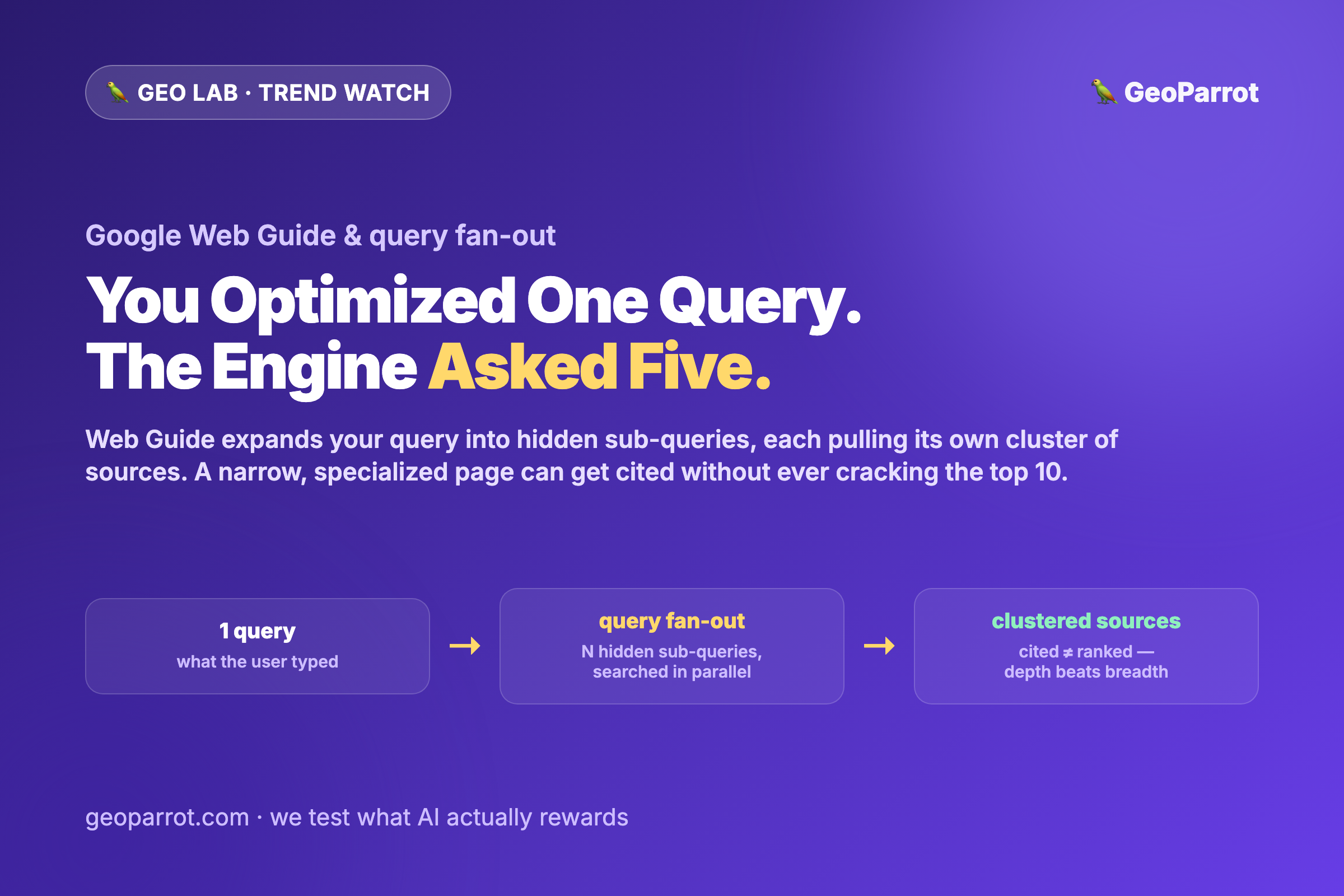
Query fan-out is the step where the AI takes your single query and quietly expands it into several related sub-queries before it fetches anything. Search “best hiking trails in Colorado” and the model spins off angles like “beginner hiking trails Colorado” and “scenic hikes near Denver,” runs them concurrently across Google’s index, deduplicates the results, and organizes them into clusters — comprehensive guides here, beginner content there, community threads in their own group — each with a descriptive heading. The same technique already sits under AI Mode and AI Overviews; Web Guide just makes it the visible layout of the whole results page.
Here’s the GEO consequence nobody’s stating plainly: fan-out multiplies and fragments the surface you’re competing on. In a flat SERP you fight for ~10 slots on one query. Under fan-out you’re being matched against a set of sub-queries you never see, each with its own little pool of eligible sources. That’s not a cosmetic change — it changes which of your pages is eligible, and for which intent.
Does query fan-out change which of your pages gets cited?
Yes — and mostly in a direction that rewards depth over breadth. Ahrefs’ teardown of Web Guide put it bluntly: “a specialized page covering one niche angle could earn its place in a curated block, even if it wouldn’t crack the top 10 in a flat SERP.” Read that again through a GEO lens. It’s a SERP-level restatement of the finding we keep hitting: being cited is not the same as ranking. Our own overlap data shows classic rank and AI citation only loosely track each other — rank buys the ticket, not the seat, and there’s a real population of pages that get cited without ranking. Fan-out is a big part of the machinery behind that signature: a narrow page that nails one sub-query can land in a cluster while the head-term winner sits somewhere else entirely.
There’s a second twist that lands right on top of an experiment we’re running now. If Google is silently rephrasing your query into sub-queries, then the wording of the retrieval prompt — not the wording you targeted — is deciding your source pool. That’s exactly the question our current lab arc is testing: does query phrasing change which sources AI cites? We pre-registered that experiment this week. Web Guide is the production-scale version of the same effect — the engine is doing the rephrasing for the user, and doing it invisibly. If phrasing moves citations (our bet is that it moves the trigger more than the final selection), fan-out is where that leverage gets applied thousands of times a second.
Why does this make AI citations even harder to measure?
Because the sub-queries are invisible. You can see the query a user typed; you cannot see the fan-out expansions that actually pulled your page in. So even when you show up in a cluster, you don’t know which angle earned it — which makes “optimize for the query” a guess about a query you’ll never observe. It also breaks the tidy idea of a “position”: your slot in an AI-organized cluster is a block placement, not a rank, which is the same caveat Google itself made when it clarified that every link in an AI surface shares the block’s position rather than an individual rank. Chasing a decimal-point “Web Guide rank” would be optimizing a number that doesn’t describe your page.
This is the counted-vs-inferred line again: the honest, checkable signals are the ones on your infrastructure. Your closest observable proxy for likely fan-out angles is what Google already publishes about a query — the People Also Ask and related-question expansions are a decent free map of the sub-intents an engine is likely to spin off. But treat that as a hypothesis generator, not a scoreboard, and keep your reporting on the metrics you can actually count rather than infer.
Should Web Guide change your ChatGPT and Perplexity strategy?
No — and this is the scope discipline that keeps GEO teams from over-fitting. Web Guide is a Google-only, US-first, still-opt-in Labs experiment that could graduate or get retired. ChatGPT, Perplexity, Gemini and the rest run their own fan-out and their own retrieval, and they land on almost entirely different sources: in our cross-engine test the four major engines shared just 2 of 395 cited domains, with ~85% unique to a single engine. That’s the whole reason there is no universal GEO strategy. Winning a Web Guide cluster tells you nothing reliable about whether you’re the source Perplexity reaches for on the same question. Optimize the underlying asset — deep, self-contained, narrow-angle pages — and then verify presence per engine instead of assuming one win travels.
The practitioner takeaway
- Ignore the bug, respect the mechanism. The broken “Classic search” button is a glitch; query fan-out is the durable thing to plan around.
- Write for one sub-question, deeply. Fan-out surfaces specialized narrow-angle pages that can’t crack a flat top-10 — the opposite of thin, catch-all pages. Depth on a specific angle is now an eligibility lever.
- Make your headings do the sorting. Fan-out clusters and labels by topic. Descriptive, self-contained H2s help the model file your page under the right sub-intent.
- Map the likely sub-queries. Use People Also Ask and related searches as a free proxy for the angles an engine will fan out to — as hypotheses, not KPIs.
- Stop chasing a “position.” A cluster slot is a block placement, not a rank. Measure counted first-party signals — GA4 AI-referred sessions and your own GSC — not an inferred decimal.
- Don’t rebuild for Web Guide alone. It’s Google-only, US-first, and still a Labs experiment. Optimize the asset; verify per engine.
Bottom line: A stuck escape button is a footnote. The story worth your attention is that Google keeps pushing an AI-organized layout whose engine, query fan-out, silently rewrites the query behind every result — and that quietly favors deep, specialized pages over head-term breadth, on a query you’ll never get to see. That’s not a new law of GEO; it’s the old one, cited ≠ ranked, wired into the default SERP. Write for the narrow angle, keep your measurement on the numbers you can count, and check every engine separately.
Frequently asked questions
What is Google Web Guide?
Web Guide is Google’s experimental AI-organized search results page, launched as a Search Labs opt-in in July 2025. Instead of ten blue links, a custom Gemini model groups web pages into clusters under AI-generated topic headings. It originally appeared in the “Web” tab and has since been tested in the main “All” tab for some users in the US.
What is query fan-out?
Query fan-out is when an AI takes your single search query and expands it into several related sub-queries, searches them in parallel across the index, then deduplicates and clusters the results. Web Guide, AI Mode, and AI Overviews all use it. For GEO it matters because you end up being matched against sub-queries you never see, not just the literal query the user typed.
Does query fan-out mean I need to rank in the top 10 to get cited?
No. Because fan-out builds a source pool per sub-query, a specialized page that answers one narrow angle well can earn a cluster spot even if it wouldn’t crack the flat top-10 for the head term. This is the same “cited, not ranked” pattern we see in our overlap data — classic rank and AI citation only loosely track each other.
How do I optimize for query fan-out?
Write deep, self-contained pages that fully answer one specific sub-question rather than thin pages that skim a broad topic, and use descriptive headings so the model can file your content under the right sub-intent. Use People Also Ask and related searches as a proxy for the sub-queries an engine is likely to generate, and treat those as hypotheses to cover — not as guaranteed placements.
Is Web Guide the same across ChatGPT and Perplexity?
No. Web Guide is Google-only. ChatGPT, Perplexity and Gemini run their own fan-out and retrieval and cite largely different sources — in our cross-engine test the four major engines shared only 2 of 395 cited domains, with about 85% unique to a single engine. A Web Guide win doesn’t transfer to other engines, so verify your presence on each one separately.
Leave a Reply