
Quick answer: Generative Engine Optimization (GEO) is the practice of structuring your content, entities, and reputation so that AI search engines — ChatGPT, Perplexity, Gemini, Copilot, Claude, and Google’s AI Overviews — quote and cite you in their generated answers. Where SEO competes for a link in a list of ten, GEO competes to be the source the AI repeats out loud. This guide covers what GEO is, how citation actually works (with first-party experiment data), a step-by-step 2026 playbook, per-engine tactics, and how to measure it.
Last reviewed: August 2026. We update this cornerstone guide as our GEO Lab experiments produce new evidence.
What is Generative Engine Optimization (GEO)?
Generative Engine Optimization is the discipline of making your content easy for large language models to retrieve, trust, and cite. When an AI answer names a source, that brand captures the visibility — and the sliver of click-through that’s left after the model has already answered the question. GEO optimizes for being that named source, not for a blue-link ranking underneath it.
The term was popularized by a 2023 research paper (“GEO: Generative Engine Optimization”) and has since split into a small family of near-synonyms — LLMO (LLM Optimization), AEO (Answer Engine Optimization), and “AI SEO.” They describe overlapping work. We untangle the labels in LLM SEO / LLMO explained, but the practical point is simple: the unit of victory has moved from a ranked link to a cited sentence.
Why does GEO matter right now?
AI search increasingly answers questions directly, so fewer users scroll a list of ten links. Google’s AI Overviews now sit above the classic results for a large share of informational queries, and tools like ChatGPT Search and Perplexity are built answer-first by default. If your brand isn’t inside the generated answer, you’re invisible to a fast-growing slice of search demand — even when you rank on page one of the old blue links.
The counterintuitive part: this is an opportunity for smaller sites. Because AI answers synthesize from whichever sources are clearest and most credible on a specific question, a focused site with genuine expertise can get cited alongside — or instead of — a much larger incumbent. Our own experiments repeatedly show that citation is decided per-question, not by raw domain size. See Does AI search level the playing field? and the incumbency-moat verdict.
GEO vs. AEO vs. SEO vs. LLMO: what’s the difference?
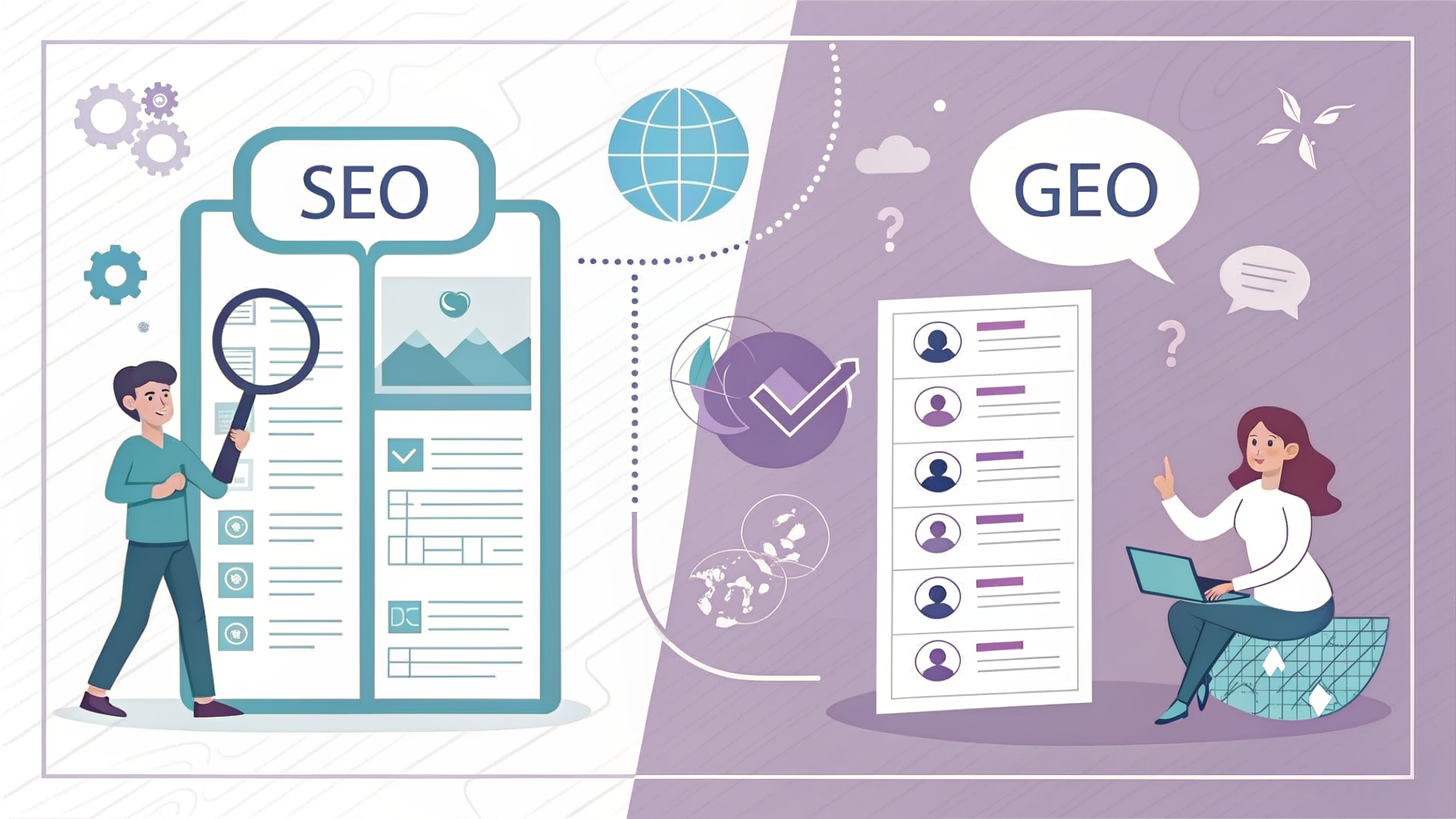
| Approach | Goal | Wins when… | Primary metric |
|---|---|---|---|
| SEO | Rank a page in a list of results | Users click through a results page | Rankings, organic clicks |
| AEO | Become the direct answer (snippets, voice, “People also ask”, AI Overviews) | One concise answer is surfaced | Answer/snippet capture |
| GEO | Get cited inside a generated AI answer | An LLM synthesizes and attributes sources | Citations / share of voice |
| LLMO | Same intent as GEO — a synonym used by some vendors | (interchangeable with GEO) | Citations / mentions |
They overlap — strong SEO foundations still help AI crawlers find and trust you — but GEO rewards a different content shape: clear, self-contained, citation-worthy passages a model can lift and attribute with confidence. For a deeper breakdown, read GEO vs. SEO vs. AEO: which should you focus on? and the complete AEO guide.
How do AI engines decide what to cite?
No engine publishes its exact recipe, but consistent patterns appear across retrieval-augmented systems. AI answers tend to favor sources that are:
- Structurally clean — clear headings, short answer-first paragraphs, and lists are easy to chunk and retrieve.
- Self-contained — a passage that answers the question without the rest of the page is far more “liftable.”
- Specific and verifiable — concrete numbers, dates, definitions, and named entities signal reliability.
- Authoritative — first-hand experience, clear authorship, and external corroboration build trust.
- Fresh — recently updated content wins in fast-moving topics.
- Corroborated across the web — models lean on sources that other credible pages (and communities like Reddit) already reference.
What our GEO Lab experiments actually found
Most GEO advice is asserted, not tested. GeoParrot runs a public GEO Lab where we pre-register hypotheses, query real engines, and publish the results — hits and misses. A few findings that should shape your strategy:
- There is no universal citation list. Across three engines and twelve questions, the sources overlapped only ~3% across all three; ~84% were unique to a single engine. Optimizing for “the AI” as one target is a mistake — see why there’s no universal GEO strategy and the cross-engine citation results.
- Reddit was the one near-universal source. Community discussion showed up across engines more than almost any owned property. We tested whether that’s causal in the Reddit causation verdict.
- llms.txt is not the shortcut people claim. Our data-backed review found no evidence Google uses it, and limited evidence others do. Read Is llms.txt worth it? (with data) before you prioritize it.
- Citation is decided per-question, not by domain size. In a blind, pre-registered test our “geometry” rule called 4 of 6 picks before we looked — the wins came from distinct-axis positioning, not from being the biggest. See the blind-prediction verdict.
📊 Want the numbers in one place? See our 2026 GEO Benchmark — every experiment’s headline result, engine by engine.
The 2026 GEO playbook: a step-by-step
Here’s the sequence we actually follow. It’s ordered by leverage — do the top items first.
1. Write answer-first
Lead every section with a one- or two-sentence direct answer (40–60 words), then expand. Question-shaped headings plus a crisp opening make a passage trivially “liftable” by a model. This single habit moves the needle most. See answer-first writing for AI citations.
2. Add structured data (schema)
Mark up articles, FAQs, how-tos, and your organization so machines know what your content means, not just what it says. FAQPage and Article schema are the highest-yield starting points. Follow our schema markup for GEO, step by step.
3. Strengthen entity clarity
Name your products, people, and core concepts explicitly and consistently across your site and the wider web. Models build an “entity” for your brand from many signals — a clear, corroborated entity is far more likely to be cited by name.
4. Earn citations with original substance
Proprietary data, first-hand testing, and clear expertise get quoted because they can’t be found everywhere else. This is the highest-durability GEO asset: an original statistic or study becomes the sentence models repeat. It’s exactly why we run public experiments.
5. Build community and off-site corroboration
Because Reddit and other communities are near-universal citation sources, genuine participation (not spam) and being referenced by other credible sites both feed the models’ trust signals. Ask: is Reddit still AI’s top citation source?
6. Keep cornerstone pages current
Show a visible “last updated” date and refresh your most important pages on a schedule. Freshness is a real tiebreaker in fast-moving topics like AI search itself.
Per-engine GEO tactics
Because there’s no universal citation list, tune your approach per engine. Start with our per-engine GEO checklist, then go deep on the platforms that matter to you:
| Engine | Where it leans | Deep-dive guide |
|---|---|---|
| ChatGPT Search | Web results + its own index; corroborated, well-structured sources | Get cited by ChatGPT |
| Perplexity | Fresh, specific, source-dense pages | Rank in Perplexity |
| Google AI Overviews | Strong classic SEO + answer-first structure | Show up in AI Overviews |
| Google AI Mode / Gemini | Google ecosystem signals + structured content | Optimize for AI Mode, rank in Gemini |
| Microsoft Copilot | Bing index + authoritative sources | Get cited by Copilot |
| Grok | Real-time / X-adjacent signals | Show up in Grok |
Does llms.txt help with GEO?
Short answer: it doesn’t hurt, but it’s not the shortcut vendors imply. There’s no evidence Google uses llms.txt, and adoption elsewhere is thin. Treat it as a tidy nice-to-have, not a priority — the details, with data, are in our complete llms.txt guide and why Google doesn’t use it. If you do want one, generate an llms.txt free here.
How do you measure GEO?
You can’t improve what you can’t see. Measure two things: citations / mentions (are you named in answers?) and referral traffic from AI engines. For the first, use a visibility tracker — our roundup of the best GEO tools in 2026 (free options included) covers where to start. For the second, set up AI-search traffic tracking in GA4 so you can see visitors arriving from ChatGPT, Perplexity, and Google AI Mode. Track “share of voice” — how often you’re cited versus competitors for your target questions.
How long does GEO take — and is it worth it?
Most brands with consistent GEO-focused content begin seeing measurable citation and mention increases within three to six months; individual page fixes (answer-first openings, sourced stats, schema) can show impact faster. We put realistic timelines in how long does GEO take? and weigh the return in is GEO worth it? The honest summary: GEO compounds, and starting while the behavior is still forming is the advantage.
Common GEO mistakes to avoid
- Treating “the AI” as one target. Engines cite different sources; optimize per engine.
- Chasing llms.txt before fundamentals. Answer-first structure and original substance matter far more.
- Burying the answer. If a model has to read three paragraphs to extract your point, it will lift someone clearer.
- Publishing thin, undifferentiated content at volume. AI (and Google) reward distinct expertise, not more of the same.
- Not measuring. Without citation tracking you’re guessing whether any of this works.
Frequently asked questions
Is GEO different from SEO?
Yes. SEO optimizes to rank a page in a list; GEO optimizes to be cited inside an AI-generated answer. They share fundamentals (clarity, authority, structure), but GEO rewards self-contained, citation-ready passages a model can lift and attribute.
Which AI engines does GEO target?
ChatGPT, Perplexity, Google AI Overviews and AI Mode, Gemini, Microsoft Copilot, Claude, and Grok — any system that generates an answer and may attribute sources.
Is GEO the same as AEO or LLMO?
They heavily overlap. AEO focuses on becoming the direct answer (including snippets and AI Overviews); LLMO is a vendor synonym for GEO. In practice, doing GEO well covers most of AEO and all of LLMO.
Do backlinks still matter for GEO?
Indirectly, yes. Backlinks and off-site mentions build the authority and corroboration signals models lean on. We tested the direct link in does AI search use backlinks?
How do I know if my content is “GEO-ready”?
Check that each section opens with a direct answer, headings are question-shaped, Article and FAQ schema are present, key facts are specific, authorship is clear, and the page was updated recently. Run our 10-point GEO audit.
Can a small site win at GEO against big brands?
Yes — more than in classic SEO. Because citation is decided per question, a focused site with genuine, distinct expertise can be cited alongside or instead of larger incumbents. Our experiments show positioning (a distinct angle) beats raw size.
The bottom line
GEO isn’t a trick — it’s writing so clearly and credibly that a machine is comfortable putting your name next to its answer. Get the structure (answer-first, schema), the specificity (original data), and the authority (expertise, corroboration) right, and you stop competing for a link. You become the answer.
Keep reading
- GEO vs. SEO vs. AEO: which should you focus on?
- What is Answer Engine Optimization (AEO)?
- What is llms.txt? (complete guide with data)
- Best GEO tools 2026 (free options included)
- The 2026 GEO Benchmark (all our experiment data)
Leave a Reply