
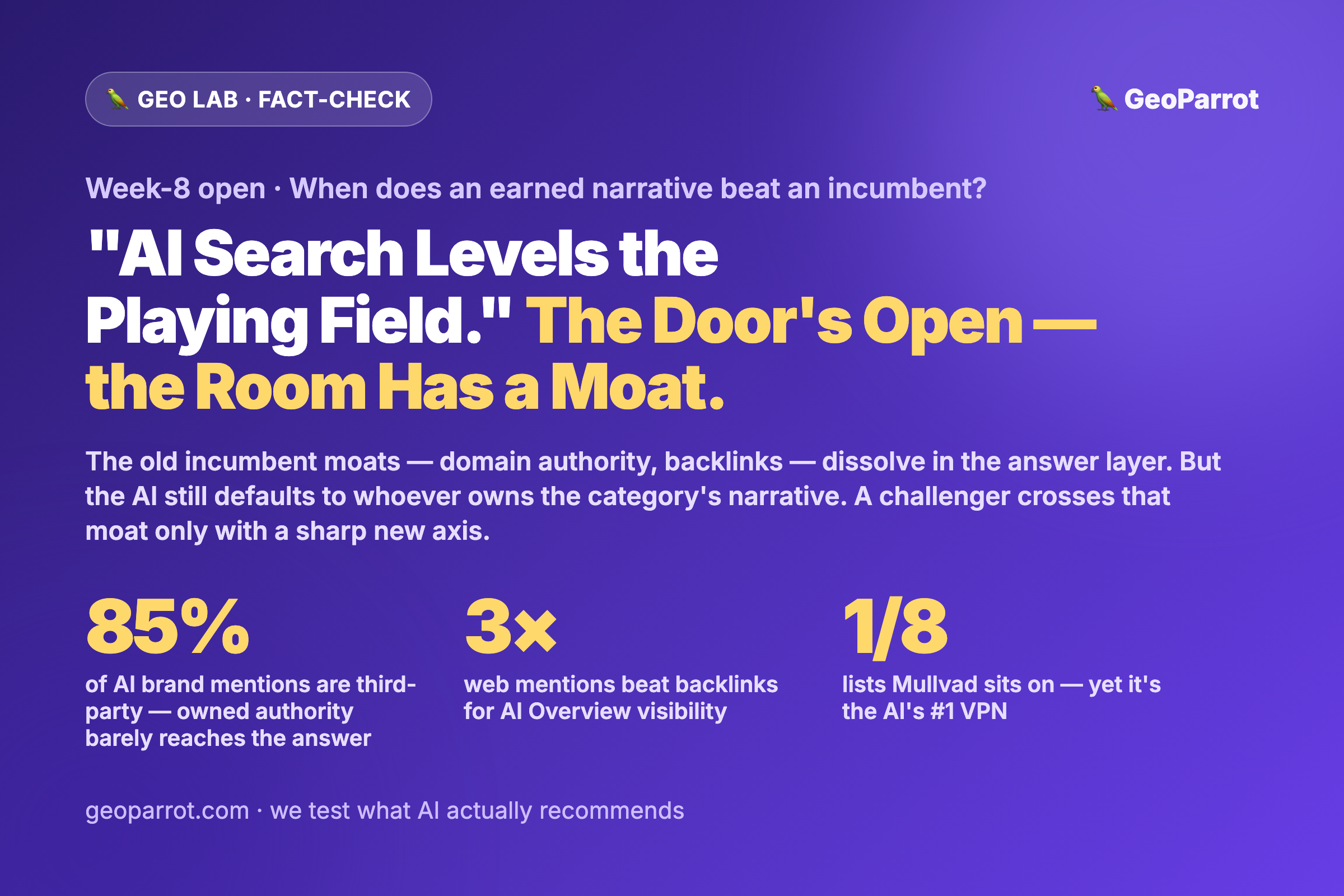
Quick answer: Half true — and the true half is genuinely new. AI search does dissolve the two moats that locked challengers out of classic SEO: because roughly 85% of AI brand mentions come from third-party pages (brands are ~6.5x more likely to be cited via third-party sources than their own site) and web mentions correlate about 3x more strongly with AI Overview visibility than backlinks do, an incumbent can no longer wall off a category with domain authority or a backlink hoard. That door is open to challengers for the first time. But the door isn’t the room. Fewer than 1 in 5 brands earn both frequent mentions and consistent citations — being in the third-party text doesn’t make you the pick. On our first-party data the AI’s #1 recommendation tracks who owns the category’s defining narrative, not who has the most coverage, and a brand that is the category default keeps a moat that survives the shift. A challenger crosses that moat only when it can own a sharp new attribute axis — the way Mullvad owns “private, no-logs, audited” and is the AI’s #1 VPN on just 1 of 8 best-of lists. So the honest verdict isn’t “the field is level”; it’s “there’s an incumbency moat, and earned narrative crosses it only sometimes.” Where the threshold sits is this week’s experiment.
This is Monday’s fact-check, and it opens this week’s GEO Lab question: when does an earned narrative beat an incumbent — and when does the incumbency moat hold? Last week we pushed narrative ownership from correlation toward causation and found it’s earnable, not locked in category history — a challenger can deliberately author the language of a category. But “earnable” and “enough to win” are different claims, and the gap between them is exactly where the optimism in this month’s headlines runs ahead of the data. So this week we test the threshold: how strong does an incumbent’s default have to be before an earned narrative can’t cross it?
What is the market actually claiming this month?
The dominant optimistic story in GEO right now is that AI search hands challengers a fair fight. It’s stated plainly and everywhere: AI search is “a huge opportunity for challenger brands and smaller agencies,” generative engine optimization is “the next competitive advantage,” and — the implicit promise under all of it — the giants can’t buy their way to the top of an answer the way they bought their way to the top of a SERP. The adoption numbers say the market believes it: 56% of marketing leaders reported high or significant GEO investment in 2025 and 94% plan to spend more in 2026, with AI Overviews now triggering on about 25% of Google searches (Conductor’s read of 21.9M queries). The behavior follows the belief — budgets are moving on the assumption that the field is level.
We’re not here to sneer at that. Half of it is the most important structural change GEO has produced. But the market compresses “the old moats are gone” into “there are no moats,” and that second step is where challengers get pointed at the wrong target.
Is the “open door” part real? (Yes — two incumbent moats genuinely dissolved.)
Take the optimistic case at full strength first, because it’s correct. In classic search, an incumbent defended a category two ways: a high-authority domain that outranked everyone, and a backlink hoard competitors couldn’t match. Both of those transfer poorly to the answer layer.
- Owned authority barely reaches the answer. About 85% of AI brand mentions come from third-party pages, and brands are roughly 6.5x more likely to be cited through third-party sources than through their own site. The incumbent’s giant website — its whole domain-authority advantage — mostly sits in the layer engines don’t quote.
- Backlinks stopped being the deciding signal. Brand web mentions correlate about 3x more strongly with AI Overview visibility than backlinks do. The moat an incumbent spent a decade building — a link profile no challenger could replicate — is not the thing that decides the citation.
- The citation lives in text the incumbent doesn’t own. We’ve found the same thing from the other side: engines cite almost entirely different source URLs and converge on a pick anyway. If the deciding material is independent third-party prose, an incumbent can’t wall it off — and a challenger can, in principle, get into it.
That’s the real, new opportunity, and it’s why the “level playing field” story caught. For the first time a small brand isn’t structurally locked out of the category’s answer. The door is open. The question the headlines skip is what’s on the other side of it.
So why do challengers still lose? (The one moat that survived.)
Here’s the number the optimism leaves out: fewer than 1 in 5 brands achieve both frequent mentions and consistent citations. Getting into the third-party text — walking through the open door — is not the same as being the answer. Most brands that clear the first bar never clear the second.
The moat that survived the shift isn’t domain authority or backlinks. It’s being the category’s default narrative. When someone asks an engine for “the best help desk” or “accounting software for a small business,” the model reaches for the brand that independent writers use as the category’s shorthand — and for a dominant incumbent, that shorthand is its name. This is the moat that doesn’t dissolve, because it lives in exactly the third-party prose the challenger was told to go win. On our first-party data the AI’s #1 pick tracks who owns that defining language, not who has the most coverage — narrative ownership out-predicted raw mention volume 4-to-1. So the incumbent’s advantage moved from its domain to its narrative, and the market’s “just earn more mentions” advice runs a challenger straight into it.
What actually crosses the moat — and what doesn’t?
Not volume. The cleanest proof in our data is a category where the incumbency moat fails: the AI’s #1 “best VPN” pick is Mullvad — 176 reviews, on just 1 of 8 independent best-of lists (the lowest breadth in the study), beating a runner-up with ~28,000 reviews on 7 of 8 lists. Every coverage count says Mullvad should lose. It wins because privacy writers converged on it as the shorthand for “no-logs, anonymous, audited.” It didn’t out-mention the incumbent; it owned a sharp attribute the incumbent didn’t.
That’s the pattern that separates the categories where a challenger crosses the moat from the ones where it doesn’t. When we look at our frozen roster, the split lines up on one thing — whether the challenger owns a distinct attribute axis or is fighting the incumbent for the diffuse default:
| Category | Challenger’s narrative axis | AI’s #1 pick | Moat crossed? |
|---|---|---|---|
| VPN | Mullvad owns “privacy / no-logs / audited” — a sharp new axis | Mullvad (the challenger) | ✅ Crossed |
| CRM / marketing | HubSpot authored “inbound marketing” as its own category | HubSpot (the challenger) | ✅ Crossed |
| Help desk | Freshdesk owns “omnichannel value” — but overlaps the default | Zendesk (the incumbent default) | ❌ Moat held |
| SMB accounting | Xero owns “cloud-native for SMBs” — adjacent to the default | QuickBooks (the incumbent default) | ❌ Moat held |
Read the four rows as one rule of thumb: a challenger crosses the incumbency moat when it owns an attribute the incumbent can’t also claim — a new axis (privacy) or a category it authored (inbound). When the challenger’s narrative is a better version of the incumbent’s own attribute (cheaper, more omnichannel, more cloud-native), the engine still defaults to the incumbent, because the incumbent already owns that axis in the prose. Earned narrative is the lever — but it only moves the pick when it’s pointed at ground the incumbent doesn’t already hold. This is exactly the pattern we detail in this week’s experiment; treat the table as the hypothesis, not the verdict.
Then what’s the real question for a challenger?
It isn’t the market’s “can I win?” — which the headlines answer too generously — and it isn’t the cynic’s “the giants always win,” which the Mullvad and HubSpot cases refute. It’s a threshold question: how strong is the incumbent’s hold on the category’s default narrative, and can I earn a distinct-enough narrative to cross it? That reframes the whole budget. If you’re in a category where the incumbent’s default is diffuse or contested, earned narrative can take the pick and you should spend on owning an attribute. If the incumbent is the category’s shorthand, out-mentioning it is wasted money — your play is to define a new axis you can own outright, the way Mullvad made “privacy” its own contest instead of fighting for “best VPN” in general.
So this week we measure the moat. Tuesday we pre-register a method to tell “crossed” categories from “held” ones on our frozen roster — what distinguishes an incumbent whose default an earned narrative overturned from one it couldn’t. Midweek we run it; Thursday we publish the results; Friday we rule and turn it into a per-engine playbook. The stakes for a challenger are concrete: the field is open enough to be worth playing, and structured enough that spending against the wrong incumbent is a real way to lose. Knowing which category you’re in is the whole game.
FAQ
Does AI search really favor small brands over big ones?
Partly. AI search removes two moats that locked challengers out of classic search: owned-domain authority barely reaches the answer layer (about 85% of AI brand mentions are third-party) and backlinks stopped being the deciding signal (web mentions correlate ~3x more strongly with AI Overview visibility). So a small brand is no longer structurally shut out. But it doesn’t guarantee a win — fewer than 1 in 5 brands earn both frequent mentions and consistent citations, and the AI’s pick still tracks who owns the category’s defining narrative.
What is an “incumbency moat” in GEO?
It’s the advantage an incumbent keeps after domain authority and backlinks stop mattering: being the brand independent writers use as the category’s shorthand. When a model answers “best help desk,” it reaches for the name that means help desk in the prose it read. That narrative default is the moat that survives the shift to AI answers — and the one a challenger has to cross.
Can a challenger actually outrank an incumbent in ChatGPT or Perplexity?
Yes, but conditionally. On our data the AI’s #1 VPN is Mullvad — a brand on just 1 of 8 best-of lists with 176 reviews — because it owns the “privacy” narrative outright. Challengers cross the incumbency moat when they own a sharp attribute the incumbent can’t also claim. When they merely offer a better version of the incumbent’s own attribute, the engine still defaults to the incumbent.
Do backlinks still matter for AI search?
Far less than they did for SEO. Brand web mentions correlate about 3x more strongly with AI Overview visibility than backlinks do, which is a big part of why the incumbent’s backlink moat doesn’t transfer. Getting mentioned in independent third-party text is the thing that maps to citations — but volume of mentions isn’t what decides the pick.
Is winning “share of voice” enough to beat an incumbent?
No. In our tests, raw mention volume — the thing Share-of-Voice tools count — predicted the AI’s actual #1 pick far less well than narrative ownership did (4-to-1). A challenger can out-mention an incumbent and still lose the recommendation if the incumbent owns the category’s defining language.
Sources
- Ad Age — Why generative engine optimization is the next competitive advantage for brands (AI search as a “huge opportunity for challenger brands”)
- Conductor — 2026 AEO / GEO Benchmarks Report (25.11% of 21.9M Google searches triggered an AI Overview; GEO investment share)
- Instant Press — AEO & GEO Statistics for 2026 (~85% of AI brand mentions are third-party; ~6.5x more likely cited via third-party than owned; web mentions ~3x backlinks; fewer than 1 in 5 brands earn both mentions and citations)
- GeoParrot GEO Lab — first-party data: narrative ownership out-predicts Share of Voice, the 4-to-1 result and the Mullvad case, and whether narrative ownership is earnable or locked in category history
Leave a Reply