
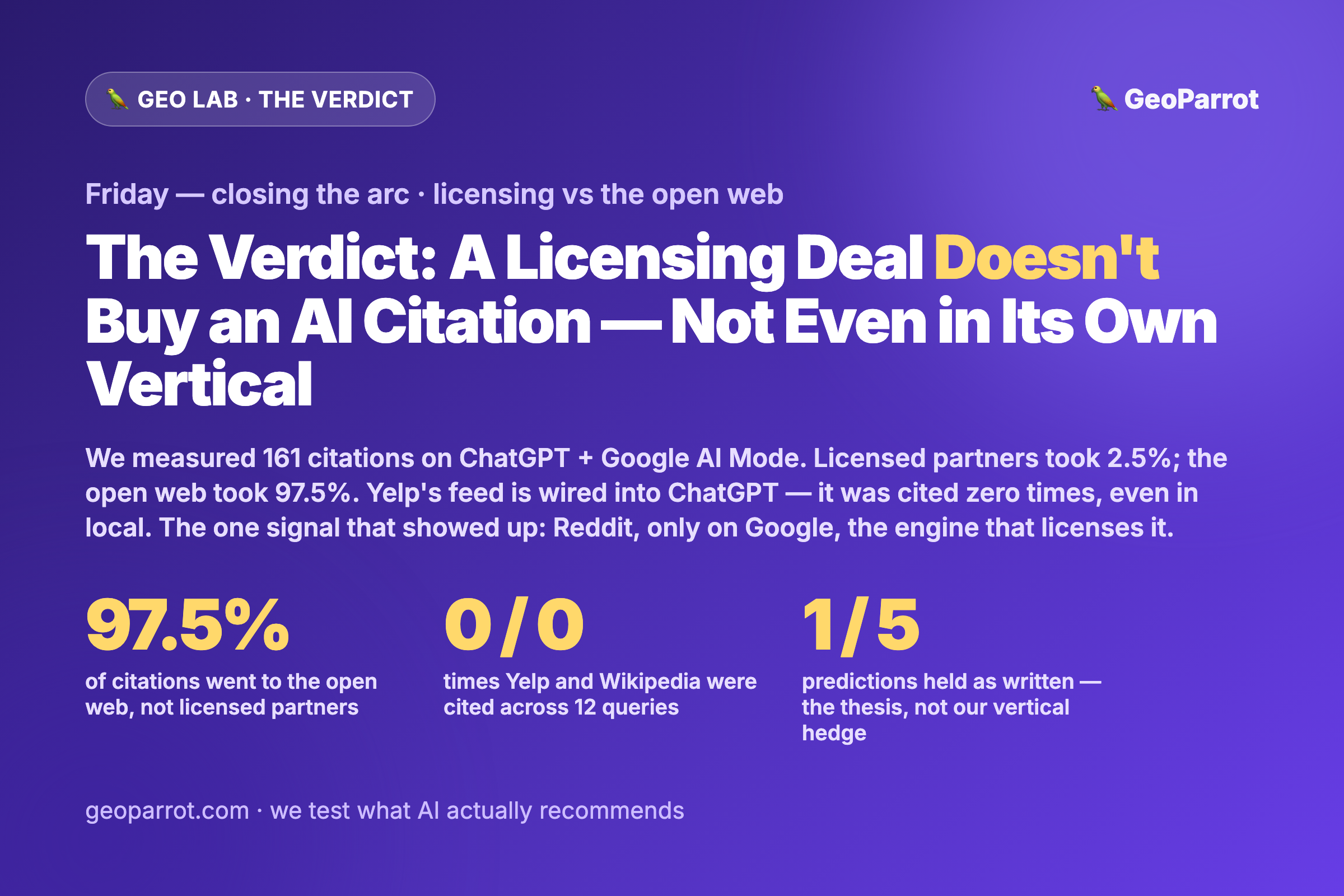
The verdict: Monday’s claim — “a licensing deal doesn’t decide who gets cited” — is ✅ confirmed, and the data made it stronger than we argued. Across 161 citations on ChatGPT and Google AI Mode, licensed/ingested partners took 2.5% and the open web took 97.5%. But here’s the honest twist: we also hedged that licensing might still work inside “fed verticals” like local and shopping — and that hedge was wrong too. Yelp’s review feed is wired into ChatGPT and it was cited zero times, even in local; Wikipedia, the most-ingested domain on the web, got zero everywhere. Of our five pre-registered predictions, only one held as written (the open web wins). The single licensing signal that appeared — Reddit, only on Google — wasn’t a vertical feed at all; it was a search-index deal. Below: the full scorecard, what we got wrong, and the per-engine action list.
Friday verdict — published September 11, 2026, closing this week’s GEO Lab arc. This scores the five predictions we locked on Tuesday against Thursday’s results, marks our own misses in the same ink as our hits, and turns the finding into an action checklist. Nothing here was reverse-fitted to the data.
So what’s the verdict on “a licensing deal decides who gets cited”?
Confirmed — and by a wider margin than the hot take deserved. The narrative we set out to test was that in 2026, with AI companies buying data at scale (Yelp’s 330M reviews into ChatGPT, OpenAI’s two dozen publisher deals, Reddit licensed to Google), a signed contract had become the new ranking factor. Our own queries say it isn’t. When we pulled the distinct domains ChatGPT and Google AI Mode actually cited across 12 buyer-intent questions, licensed and heavily-ingested partners — Yelp, Reddit, Wikipedia — accounted for 4 of 161 citations (2.5%). The open web took the other 157 (97.5%). A licensing deal governs whether a model may train on or retrieve your archive; it does nothing to make your page the one an engine reaches for at answer-time. That’s not a subtle margin you could argue with — it’s the shape of the result.
How did our five locked predictions actually score?
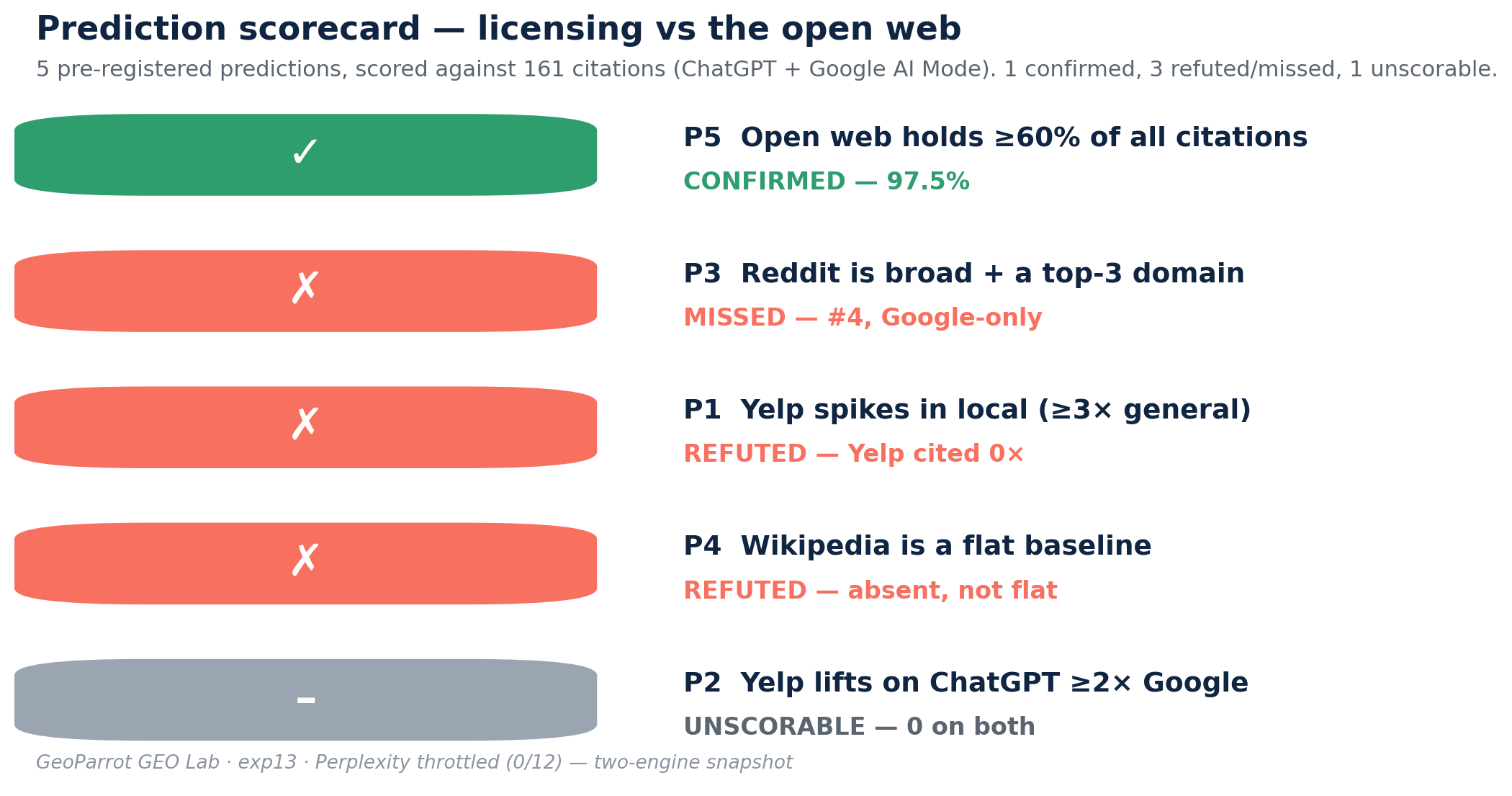
We pre-registered five falsifiable predictions before collecting a single citation. Scored against the data, one was confirmed, three were refuted or missed, and one was unscorable — because the thing it depended on (Yelp appearing at all) never happened.
| Prediction (locked Tuesday) | Result | Score |
|---|---|---|
| P5 — Open web holds ≥60% of all citations | Open web took 97.5% (157/161) | ✅ Confirmed |
| P3 — Reddit is broad and lands in the top-3 domains | Cited 4×, all on Google, ranked #4 (behind YouTube, RTINGS, TechRadar) | ❌ Missed |
| P1 — Yelp’s local share is ≥3× its general share | Yelp cited 0× in every bucket — no lift to be local | ❌ Refuted |
| P4 — Wikipedia is a flat, ambient baseline across buckets | Wikipedia cited 0× — absent, not flat | ❌ Refuted |
| P2 — Yelp lifts ≥2× more on ChatGPT than Google | Yelp was 0 on both engines | ⚠️ Unscorable |
We were wrong too — where did our own hedge fail?
This is the part a fact-check that only ever confirms itself would skip. On Monday and Tuesday we didn’t just say “licensing doesn’t drive general citations” — we carved out an exception and bet on it: licensing might still crowd the open web inside fed verticals, where an engine wires a clean structured feed straight into the answer. Yelp’s local feed was our headline example. So we built a whole local bucket (“best coffee shop in Austin,” “best dentist in Seattle,” “best plumber in Denver,” “best gym in Chicago”) to catch exactly that lift.
It caught nothing. ChatGPT cited 52 distinct domains across those four local queries and not one was yelp.com — it pulled from directories (brewatlas.co, restaurantji.com, birdeye.com), city media (theinfatuation.com, seattlemet.com, timeout.com), and individual business sites instead. Wikipedia, which we’d penciled in as a reliable ambient baseline, didn’t appear once across all 12 questions. Our “narrow but real” vertical-feed exception turned out to be narrower than that: for citations, it was nonexistent. The honest read is that we were directionally right about the big claim and too generous in the escape hatch we left for it — a good reminder that the metric you measure has to be the metric that matters: a licensed feed can power the interface (a map card, an inline widget) while the cited sources underneath still come entirely from the open web.
Then when does licensing actually move a citation?
Exactly once in our data, and it wasn’t a feed. Reddit was cited 4 times — every single one on Google AI Mode, zero on ChatGPT. That maps cleanly to reality: Google holds a content-licensing arrangement with Reddit and OpenAI does not. So the useful distinction the verdict leaves you with isn’t “licensed vs open web” — it’s two different kinds of licensing:
- Feed licensing (Yelp → ChatGPT): data piped in to render an interface element. It makes you eligible to appear in the answer’s plumbing — and, in our test, does not earn your domain a citation. Yelp: 0.
- Search-index licensing (Reddit → Google): your content enters the index the engine cites from. That can produce a real, visible citation lift — but it’s engine-specific, showing up only on the engine that holds the deal, and even then Reddit didn’t crack the top three most-cited domains.
This is the cleanest per-engine signal we’ve logged, and it’s more evidence that there is no universal GEO strategy — the same licensing relationship helps on one engine and is invisible on another. It also rhymes with the live Reddit-citation divergence we tracked earlier, where ChatGPT cut Reddit while other engines leaned in. Whatever moved was the index deal, not the feed.
What’s your per-engine, per-vertical action checklist?
The verdict collapses a month of licensing headlines into a short, boring, durable to-do list. Do this instead of chasing a contract you’ll never be offered.
- Everyone — stay readable at answer-time. The fastest way to guarantee 0% citations is to paywall or block the crawlers the answer engines use. That’s the trap the licensed paywalled publishers fell into (FT signed with OpenAI and still got cited 0%). Being crawlable beats being contracted.
- Everyone — be the cleanest source in your category. The top of our citation distribution was independent testing and review sites: YouTube (8/12 queries), RTINGS (6), TechRadar (5), PCMag (4). What they share is testable, first-party, answer-first content — the thing an engine can lift a passage from without ambiguity. Build that, not a licensing pitch deck.
- Local businesses — win the eligibility layer, not the “get licensed” fantasy. You will never sign Yelp’s deal, and Yelp’s deal didn’t earn Yelp a citation anyway. What surfaced in local was directories and individual business sites with accurate, structured listings. Keep your NAP, hours, reviews, and business data clean so any feed — or any crawler — can use them.
- E-commerce — same lesson from the shopping bucket. Product answers were led by rtings.com, techradar.com, and pcmag.com, not by any fed catalog. Get your product feed and structured data right for eligibility, but earn the citation with genuine testing/spec content a reviewer would cite.
- Per engine — measure separately. On Google AI Mode, a Reddit/community presence can help because of the index deal; on ChatGPT, it won’t — so don’t copy one engine’s playbook to the other. Track citations in your own logs per engine, the way our per-engine checklist lays out.
- Don’t buy a “licensing visibility score.” Ingestion, interface presence, and citation are three different layers. Anything that collapses them into one vanity number is the licensing cousin of the share-of-voice trap. The signals that actually move citations are earned — brand demand and mentions, not contracts.
What are we testing next?
This week kept pointing at the same short list of winners: RTINGS, TechRadar, PCMag — independent testing sites that out-cite platforms with licensing deals. So next week’s arc flips the question from “can you buy your way in?” to “what makes a testing site the default citation?” We’ll take the “best X” buyer-intent queries and reverse-engineer why these review domains are the ones AI reaches for — is it first-party test data, page structure, brand demand, or freshness? — and whether a smaller, focused site can earn the same treatment. If licensing is the lever that doesn’t work, we want to isolate the one that does. Monday’s fact-check kicks it off.
Bottom line: a licensing deal buys ingestion rights, legal cover, and sometimes a feed that renders inside the interface — but not a citation, not even in the vertical the feed was built for. Yelp: 0. Wikipedia: 0. The open web: 97.5%. The one thing that moved a citation was a search-index deal on the one engine that holds it. For everyone who can’t sign those deals — which is almost everyone — the job is unchanged: stay crawlable, publish first-party data, and be the cleanest, most-testable source in your category. That’s the lever that was available to you all along.
Frequently asked questions
What’s the final verdict — does a licensing deal get you cited by AI?
No. Across 161 distinct domain citations on ChatGPT and Google AI Mode, licensed and heavily-ingested partners (Yelp, Reddit, Wikipedia) took just 2.5% while the open web took 97.5%. A licensing deal governs ingestion, retrieval rights, and legal cover — it does not make your page the source an engine cites when it builds a live answer. The claim that “licensing is the new ranking factor” is not supported by the citations.
Yelp’s feed is licensed into ChatGPT — why did it get cited zero times, even in local?
Because a licensed feed powers an interface element, not a cited source. Yelp’s review data can appear inside a ChatGPT local answer as a map card or widget, while the domains the answer actually credits come from the open web — directories, city media, and individual business sites. Across four local queries ChatGPT cited 52 distinct domains and none was yelp.com. Being ingested is being part of the plumbing; it is not the same as being the domain the engine cites.
Did any licensing deal move a citation at all?
One did, and it was a search-index deal, not a feed. Reddit was cited four times, every one on Google AI Mode and none on ChatGPT — matching the fact that Google licenses Reddit’s content into its index and OpenAI does not. That’s a real but engine-specific lift, and even so Reddit ranked only #4 among cited domains. The lesson: index licensing can help on the engine that holds it; feed licensing (like Yelp’s) did not earn a citation anywhere.
You said you were wrong too — about what?
We pre-registered that licensing might still lift citations inside “fed verticals” like local (via Yelp) and predicted a measurable Yelp spike there. It never appeared — Yelp was cited zero times in every bucket, so the local-spike prediction (P1) and the engine-split prediction (P2) both failed, and our Wikipedia-baseline prediction (P4) failed because Wikipedia was absent, not flat. Only one of five predictions held as written (the open web winning). We were right about the headline and too generous with the exception we carved out for it.
If I can’t sign a licensing deal, what should I actually do?
Be the cleanest, most-crawlable, most-testable source in your category — that’s what the citations rewarded. The winners were independent testing and review sites (RTINGS, TechRadar, PCMag) plus well-structured directories and business pages for local. Stay readable at answer-time, publish first-party data, structure content so a passage lifts cleanly, and measure per engine. Licensing deals are enterprise transactions for a handful of brand-name platforms; earned, verifiable reputation is the lever a typical site can actually pull.
Sources
- AI Is Buying Its Sources. Does a Licensing Deal Decide Who Gets Cited? — Monday’s fact-check (0% paywalled partners vs 91.3% open web).
- Does a Licensing Deal Actually Buy a Citation? Our Pre-Registered Test — Tuesday’s locked design and five predictions.
- We Measured It — Yelp Got Zero — Thursday’s results (2.5% partner vs 97.5% open web across 161 citations).
- Cross-engine citation results — the top ~15 domains account for roughly 68% of AI citations.
- Reddit’s citation divergence across engines — the community-licensing playbook this run tested.
- There is no universal GEO strategy, the share-of-voice vanity trap, and the per-engine checklist.
- GeoParrot GEO Lab — exp13: 12 queries × ChatGPT (web search) + Google AI Mode, logged-out single snapshot; Perplexity throttled (0/12); 161 distinct domain citations after noise and self-citation removal.
Leave a Reply