
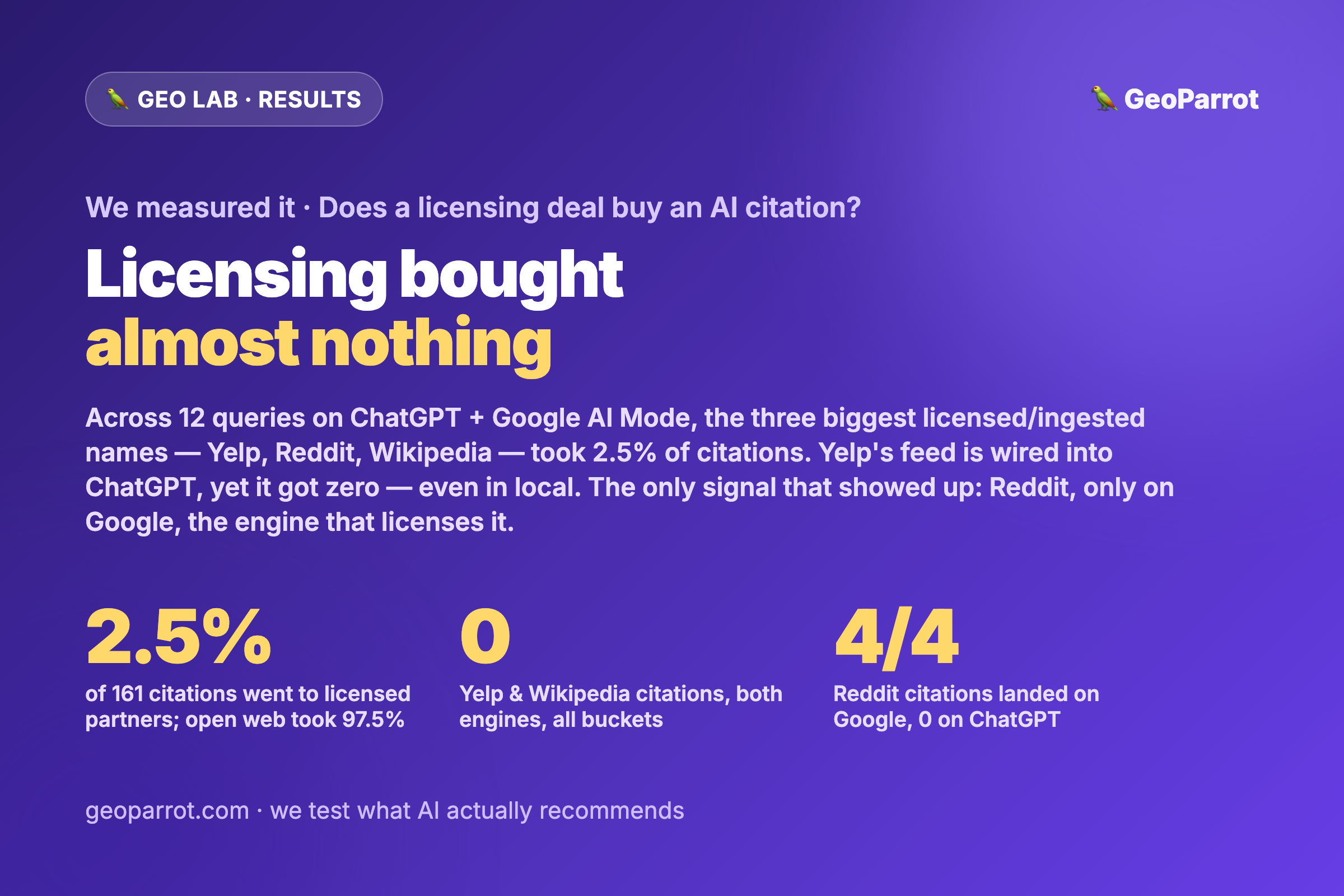
Quick answer: A licensing deal did not buy a citation. Across 12 buyer-intent queries on ChatGPT and Google AI Mode, the three biggest licensed or heavily-ingested names — Yelp, Reddit, and Wikipedia — took just 2.5% of the 161 distinct domain citations (4 of 161). The open web took the other 97.5%. Yelp got zero — even in the local queries its ChatGPT-licensed review feed is supposed to power. Wikipedia got zero. The only licensing signal that appeared was Reddit — cited 4 times, all on Google AI Mode (the engine that licenses Reddit), and never on ChatGPT. This is the results post for Monday’s pre-registered design; Friday’s verdict scores each of the five locked predictions and turns it into an action list.
Experiment results — published September 10, 2026, in the GEO Lab. We locked the query set and five falsifiable predictions on Tuesday, collected Wednesday, and are opening the counts now. Nothing below was changed after the data came in.
What did the citations actually show?
We ran all 12 queries logged-out on ChatGPT (web search) and Google AI Mode, pulled the distinct domains each answer cited, stripped noise (a Korean-footer regex artifact and map-tile infrastructure), and excluded each engine’s self-citations. That left 161 distinct domain citations. We then classified each as a licensed/ingested partner (Yelp, Reddit, Wikipedia) or open web.
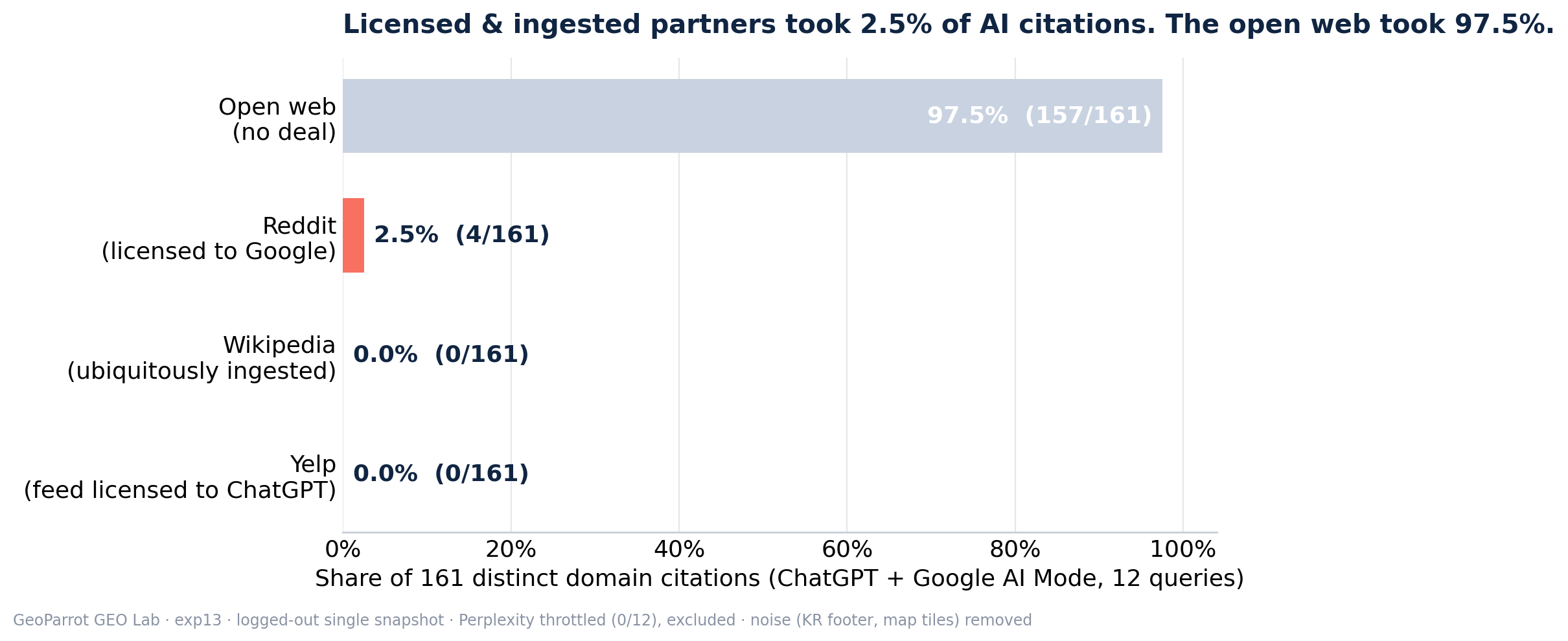
That is not a subtle margin. If a licensing deal were a general citation lever, the partner domains would crowd the board. Instead they were nearly invisible: a single partner (Reddit) accounted for every partner citation, and it landed on exactly one engine. This is the strong version of what Monday’s fact-check argued — a contract governs ingestion and legal cover; it does not make your page the one an engine cites when it assembles a live answer.
Did the one licensed feed show up where it should — in local?
No. This was the sharpest result. Yelp’s review feed — 330M reviews — is licensed directly into ChatGPT, and our whole local bucket (“best coffee shop in Austin,” “best dentist in Seattle,” “best plumber in Denver,” “best gym in Chicago”) was designed to catch exactly that. ChatGPT cited 52 distinct domains across those four local queries. Not one was yelp.com. It cited local directories (brewatlas.co, restaurantji.com, birdeye.com), city media (theinfatuation.com, seattlemet.com, timeout.com), and dozens of individual business sites — but never the platform whose data it licensed.
The explanation matters for anyone chasing “get on a licensed platform” as a tactic: a licensed feed powers an interface, not a citation. Yelp’s data can surface inside ChatGPT as a map card or an inline widget while the cited sources underneath come from the open web. Being ingested makes you part of the answer’s plumbing; it does not make you the domain the engine credits. That distinction is the entire finding — and it generalizes to product feeds in shopping answers too, where our shopping bucket was led by rtings.com, techradar.com, and pcmag.com, not by any fed catalog.
Why was Reddit the only partner that appeared — and only on Google?
Because the one licensing relationship that visibly moved citations is the one that actually exists as a search-index deal: Google licenses Reddit’s content. Reddit was cited in 4 of 12 queries — three general (best CRM, best email platform, best VPN) and one shopping (best running shoes) — and every single one was on Google AI Mode. On ChatGPT, Reddit’s citation count was zero.
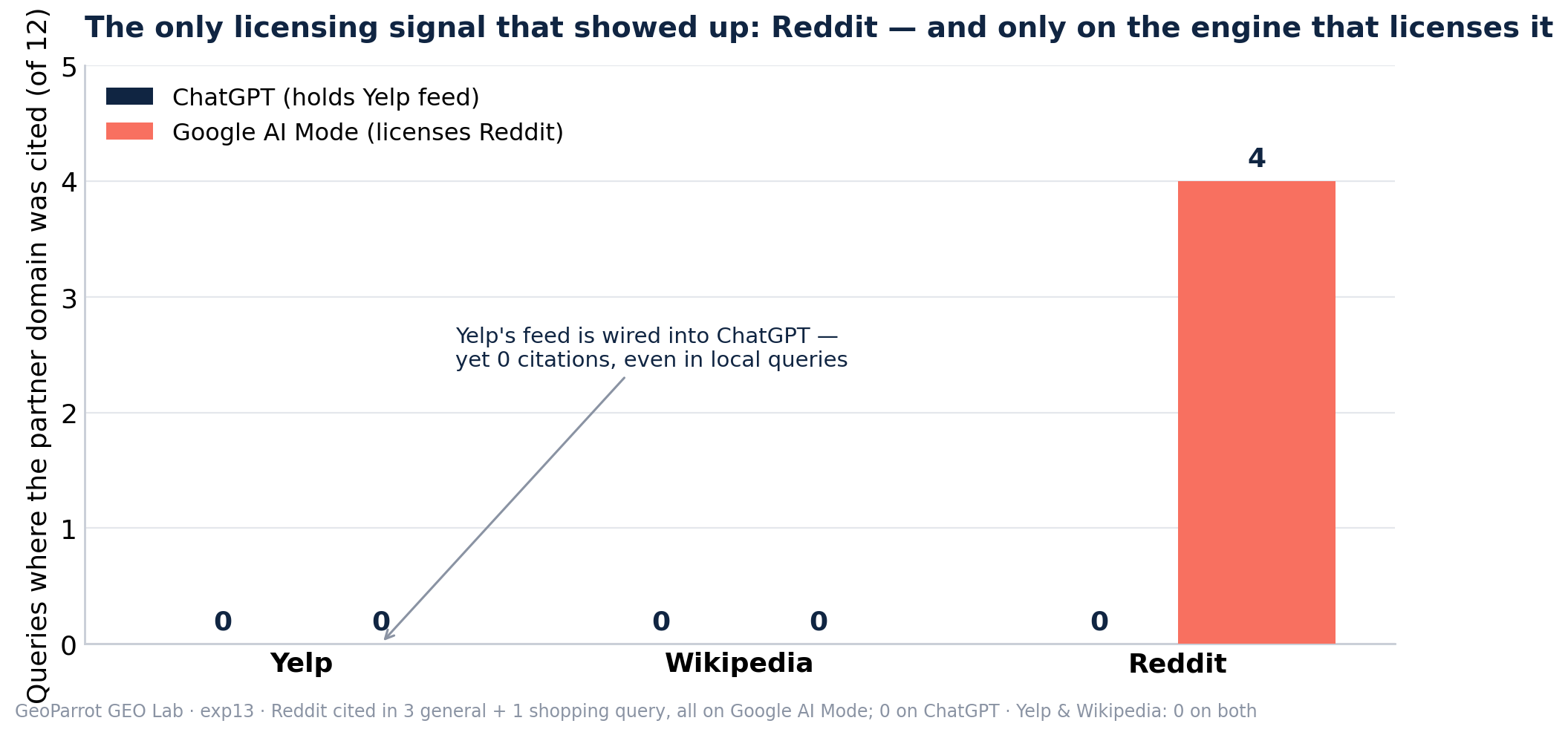
This is the cleanest per-engine signal we’ve logged: the licensing effect isn’t uniform, it’s engine-specific and maps to who holds the deal. It lines up with our running finding that there is no universal GEO strategy — and with the live Reddit-citation divergence we tracked earlier, where ChatGPT cut Reddit while other engines leaned in. Note the honest ceiling, though: even Reddit didn’t crack the top three most-cited domains overall (YouTube, RTINGS, and TechRadar did). A licensed community source generalizes further than a vertical feed, but it still isn’t dominating the answer.
Where did Wikipedia — the most-ingested source on the web — go?
Nowhere, in these queries. Wikipedia is ingested into essentially every model’s training data, so the intuition “it’s everywhere, it must get cited” is strong. But across all 12 buyer-intent “best X” questions on both engines, Wikipedia earned zero citations. The reason is the same one that sinks the licensing thesis: ingestion is not citation. Wikipedia is a reference for what a robot vacuum is, not a source for which one to buy. Commercial recommendation queries pull from testing sites and directories, not encyclopedias — so the most-ingested domain on the internet can still be absent from the answers that carry purchase intent. This is exactly why we keep warning that a self-counted “AI share of voice” is the wrong metric: presence-in-model and presence-in-citation are different layers.
So who actually got cited?
The open web — specifically independent testing publishers, niche directories, and individual business sites. Here are the most-cited domains across both engines, by number of queries they appeared in:
| Domain | Queries cited (of 12) | Type |
|---|---|---|
| youtube.com | 8 | Open web (video) |
| rtings.com | 6 | Open web (independent testing) |
| techradar.com | 5 | Open web (reviews) |
| reddit.com | 4 | Partner (Google-licensed) |
| pcmag.com | 4 | Open web (reviews) |
The practical read for most sites: the lever isn’t a deal you can’t get, it’s being the cleanest, most-crawlable, most-testable source in your category — the thing RTINGS and TechRadar are. That’s consistent with what we found when we looked at whether AI search leans on backlinks and whether brand mentions beat them: earned, verifiable reputation travels; contracts don’t.
What are the limits of this snapshot?
Named plainly, because a clean result deserves clean caveats. One: Perplexity throttled anonymous queries during collection (“sign up and repeat your request”), so we got 0 of 12 from it — this is a two-engine snapshot, ChatGPT + Google AI Mode, not three. We report that rather than paper over it. Two: it’s a single logged-out snapshot; AI citations drift week to week, so read this as a photograph, not a constant. Three: citation share depends on how many domains an answer happens to cite, which is why we report raw counts (4/161) alongside the percentage. Four: local queries are US-city-specific and vary by inferred location. None of these soften the headline: a partner floor of 2.5%, with Yelp and Wikipedia at exactly zero, is not a measurement artifact — it’s the shape of the result. Friday’s verdict judges each locked prediction against these numbers.
Frequently asked questions
Did a licensing deal buy an AI citation in this test?
No. Licensed and heavily-ingested partners (Yelp, Reddit, Wikipedia) took 2.5% of citations (4 of 161) across 12 queries on ChatGPT and Google AI Mode; the open web took 97.5%. Yelp and Wikipedia were cited zero times. The only partner citations were Reddit’s, all on Google — the engine that licenses Reddit — and none on ChatGPT.
Yelp’s feed is licensed into ChatGPT — why did it get zero citations?
Because a licensed feed powers an interface element (like a map card or inline widget), not a cited source. Yelp’s data can appear inside a ChatGPT local answer while the domains the answer actually credits come from the open web — directories, city media, and individual business sites. Being ingested is being part of the plumbing; it is not the same as being the domain the engine cites.
Why did Reddit show up only on Google and not on ChatGPT?
Google has a content-licensing arrangement with Reddit and ChatGPT does not, and the citations tracked that exactly: Reddit was cited in four queries, all on Google AI Mode, zero on ChatGPT. It’s the one place in the data where a real licensing relationship lines up with a visible citation lift — and it’s engine-specific, not universal.
If I can’t get a licensing deal, what actually gets me cited?
Be the cleanest, most-crawlable, most-testable source in your category. The top of our citation distribution was independent testing and review sites (RTINGS, TechRadar, PCMag) and, for local, well-structured directories and individual business pages. Licensing deals are enterprise transactions for a handful of brand-name platforms; earned, verifiable reputation is what a typical site can build — and it’s what the citations rewarded.
Why is Perplexity missing from the results?
Perplexity rate-limited our logged-out queries during collection and returned no answers or sources (0 of 12), so this is a two-engine snapshot: ChatGPT web search and Google AI Mode. We disclose it rather than backfill it. A future run with a signed-in session can add the third engine.
Sources
- Does a Licensing Deal Actually Buy a Citation? Our Pre-Registered Test — this week’s locked design, query set, and five predictions (published before collection).
- AI Is Buying Its Sources. Does a Licensing Deal Decide Who Gets Cited? — Monday’s fact-check (0% paywalled partners vs 91.3% open web).
- Cross-engine citation results — the top ~15 domains account for roughly 68% of AI citations.
- Reddit’s citation divergence across engines — the community-licensing playbook this run tests.
- There is no universal GEO strategy, the share-of-voice vanity trap, and the per-engine checklist.
- GeoParrot GEO Lab — exp13: 12 queries × ChatGPT (web search) + Google AI Mode, logged-out single snapshot, Perplexity throttled (0/12); 161 distinct domain citations after noise and self-citation removal.
Leave a Reply