
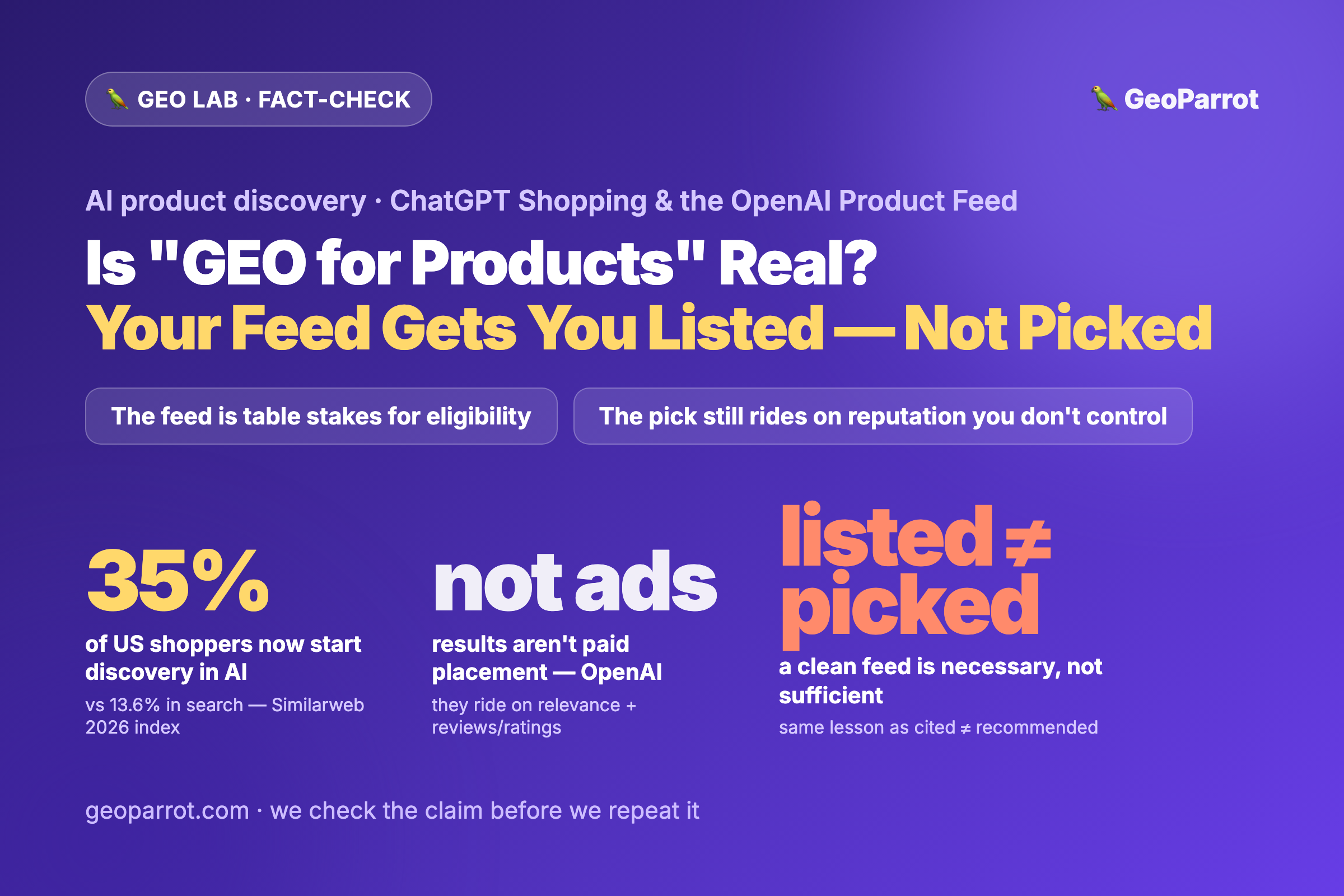
Quick answer: Product discovery is moving into AI — Similarweb’s 2026 Generative AI Brand Visibility Index puts 35% of US consumers using AI at the product-discovery stage versus 13.6% using search. That’s real, and it has real plumbing: the OpenAI Product Feed, the Agentic Commerce Protocol, ChatGPT Shopping, Shopify Catalog. But “GEO for products” advice is running ahead of the evidence. A clean, accurate feed is table stakes — it makes you eligible to appear. It does not buy you the recommendation. OpenAI says product results “are not ads and are not influenced by paid placement” — they lean on relevance and trust signals like reviews and ratings, which are third-party reputation you don’t control through a feed. That’s the same wall we’ve already measured in AI answers: listed is not picked, cited is not recommended. Fix your feed, then spend your real effort on reputation.
Trend watch — published September 1, 2026. This is a fact-check post: we report what’s actually shipping in AI commerce, separate it from the “optimize your feed and win” hype, flag what’s still an untested hypothesis, and connect it to the first-party data we keep gathering in the GEO Lab.
What actually changed in AI product discovery?
Two things happened at once. First, behavior moved: shoppers increasingly ask an AI “what’s the best cordless vacuum under $300?” instead of typing keywords and scanning ten blue links. Similarweb’s 2026 index has AI ahead of search at the discovery stage by more than 2-to-1. Second, the engines built the pipes to answer commercially. The OpenAI Product Feed lets a merchant push a structured catalog — titles, prices, stock, media, logistics — over an encrypted HTTPS endpoint (not a crawl), in CSV, TSV, XML, or JSON, refreshable as often as every 15 minutes. That feed becomes the “single source of truth” ChatGPT Shopping draws on. Around it sits the Agentic Commerce Protocol and Instant Checkout, with a growing merchant roster — Target, Sephora, Nordstrom, Best Buy, Lowe’s, and others — plus Shopify storefronts piped in through Shopify Catalog.
So the surface is genuinely new. This is not the citation layer we usually write about — nobody is “getting cited” for a toaster. It’s a merchandising surface with its own submission mechanics. And that’s exactly why a fresh crop of “GEO for products” playbooks has appeared, most of them promising that if you optimize your feed, the AI will recommend you. That’s the claim worth checking.
Does optimizing your feed actually win the pick?
Here’s the honest version, straight from OpenAI’s own description of how selection works. Product results in ChatGPT “are not ads and are not influenced by paid placement.” They rely on feed quality, product relevance, and user context — and among the signals that decide which eligible products surface are trust indicators like reviews and ratings. Read that carefully. Your feed controls the accuracy and completeness half: correct title, live price, in-stock status, clean images, structured attributes. That gets you into the candidate set. But the half that decides which candidate gets named — relevance to intent plus third-party trust — is largely reputation you earn off-feed, not a field you fill in.
We’ve measured this exact split on the content side, and it transfers cleanly. In our self-ranking experiment, publishing your own “best X” listicle almost never bought the top recommendation — cited is not the same as recommended, and self-declaration doesn’t move the pick. When we reverse-engineered why brands become the AI’s default choice, the lever wasn’t a count you can pad — it was category reputation the engine already trusts. Products are the same shape: a flawless feed is necessary, not sufficient. The feed makes you listed; reviews, ratings, and independent reputation make you picked. Treat “optimize the feed and you’ll be recommended” as a hypothesis to test in your own data, not a settled tactic — because OpenAI’s documentation describes eligibility and relevance, not a formula that rewards feed-tuning with placement.
Is this the same thing as GEO — or something different?
It’s adjacent, not identical, and conflating them is where advice goes wrong. Classic GEO is about getting your content retrieved, trusted, and cited in a generated answer (the whole subject of what “AI SEO” really means). Product discovery is a structured-data merchandising problem: you submit a catalog and compete inside a shopping module. It’s also a different layer from the action surface we covered last week — ChatGPT’s WebMCP “Site tools” help an agent operate your store once it’s chosen a product, but they don’t decide which product the agent surfaces. Discovery gets you into the consideration set; action closes the transaction. Optimizing one does nothing for the other.
The through-line across all three — content citation, product picks, agent actions — is that the engine’s trust decision sits upstream of every mechanism you can submit. A feed, a schema, a tool registration: each is a way to be eligible. None of them is a way to be preferred.
Why is there no universal “product GEO”?
Because every engine sources products differently. ChatGPT pulls from its pushed Product Feed and ACP partners. Google’s shopping experience runs on Merchant Center feeds and its own AI surfaces. Perplexity has its own shopping integrations. The formats, the eligibility rules, and the trust signals are not the same across them — a feed tuned for one is not automatically visible in another. This is the recurring GEO lesson, not an exception to it: there is no universal strategy that wins every engine at once. And it’s a reason to be skeptical of any single “AI product visibility score.” A one-number dashboard collapses several incompatible surfaces into a vanity metric, the same trap we flagged with AI share-of-voice. Measure per surface, on the engines your buyers actually use.
What should a merchant actually do this week?
- Get the feed clean first — it’s the eligibility gate. Accurate titles, live prices, real-time stock, complete attributes, good images. If ChatGPT Shopping or Shopify Catalog applies to you, submit and keep it fresh (the feed supports 15-minute updates for a reason). This is necessary work; just don’t mistake it for the finish line.
- Invest the real effort in reputation, because that’s what moves the pick. Reviews and ratings are named trust signals. Independent “best of” coverage, third-party review volume and recency, and being the shorthand answer in your category are what tip an eligible product into the recommended one — the exact pattern our consensus-pick experiment found.
- Don’t buy the “optimize your feed to win” pitch wholesale. Feed quality gets you in the room. No public data shows feed-tuning alone earns the recommendation. Ask any vendor for evidence that their optimization changed picks, not just listings.
- Pick your engines deliberately. There’s no universal product-GEO. Decide which surfaces your customers use — ChatGPT, Google, Perplexity — and optimize for each on its own terms instead of assuming one feed generalizes.
- Instrument before you conclude. Track whether your products actually appear and get recommended in real AI answers over time. Don’t infer impact from a vendor dashboard or a changelog — verify it in the surface itself, the same discipline we apply to every trend here.
Bottom line: AI product discovery is real and worth preparing for — the behavior shift is measured, and the pipes (OpenAI Product Feed, Agentic Commerce, ChatGPT Shopping) are shipping. But “GEO for products” is being oversold as a feed-optimization game. A clean feed makes you eligible; reputation makes you picked. That’s not a new rule — it’s the same one we keep measuring on the content side, now pointed at your catalog. Fix the feed, then go earn the trust signals no feed field can fake.
Frequently asked questions
What is the OpenAI Product Feed and how do merchants submit it?
It’s a structured catalog merchants push to OpenAI to power product results in ChatGPT Shopping. You send it over an encrypted HTTPS endpoint (a push model, not a crawl) in CSV, TSV, XML, or JSON, and can refresh it as often as every 15 minutes to keep prices and stock accurate. The feed acts as the single source of truth for your product data — titles, prices, availability, media, and logistics.
Are ChatGPT product results ads or paid placements?
OpenAI states that product results in ChatGPT are not ads and are not influenced by paid placement. Selection relies on feed quality, product relevance, and user context, along with trust indicators like reviews and ratings. Note that OpenAI does run separate shopping ad formats; the organic product results in the shopping experience are the ones described as unpaid.
Will optimizing my product feed get my products recommended?
A clean, complete, accurate feed makes your products eligible to appear — that’s necessary. But it doesn’t guarantee the recommendation. The signals that decide which eligible product gets named include relevance and third-party trust (reviews, ratings, reputation) you don’t set through a feed. Treat “optimize the feed and win the pick” as an unverified hypothesis and test it in real AI answers rather than assuming it.
Is there one product-GEO strategy that works across all AI engines?
No. ChatGPT, Google, and Perplexity source products through different feeds, formats, and eligibility rules, and their trust signals differ. A feed tuned for one isn’t automatically visible in another, and a single “AI product visibility score” tends to collapse incompatible surfaces into a vanity metric. Optimize per engine, on the surfaces your buyers actually use, and measure each separately.
How is AI product discovery different from GEO and from WebMCP?
They’re three different layers. GEO is about getting your content retrieved and cited in a generated answer. AI product discovery is a merchandising problem — submitting a catalog to compete in a shopping module. WebMCP “Site tools” are an action layer that lets an agent operate your site once a product is chosen. Discovery gets you into the consideration set, action closes the sale, and citation is a separate content game. Optimizing one does not improve the others.
Leave a Reply