
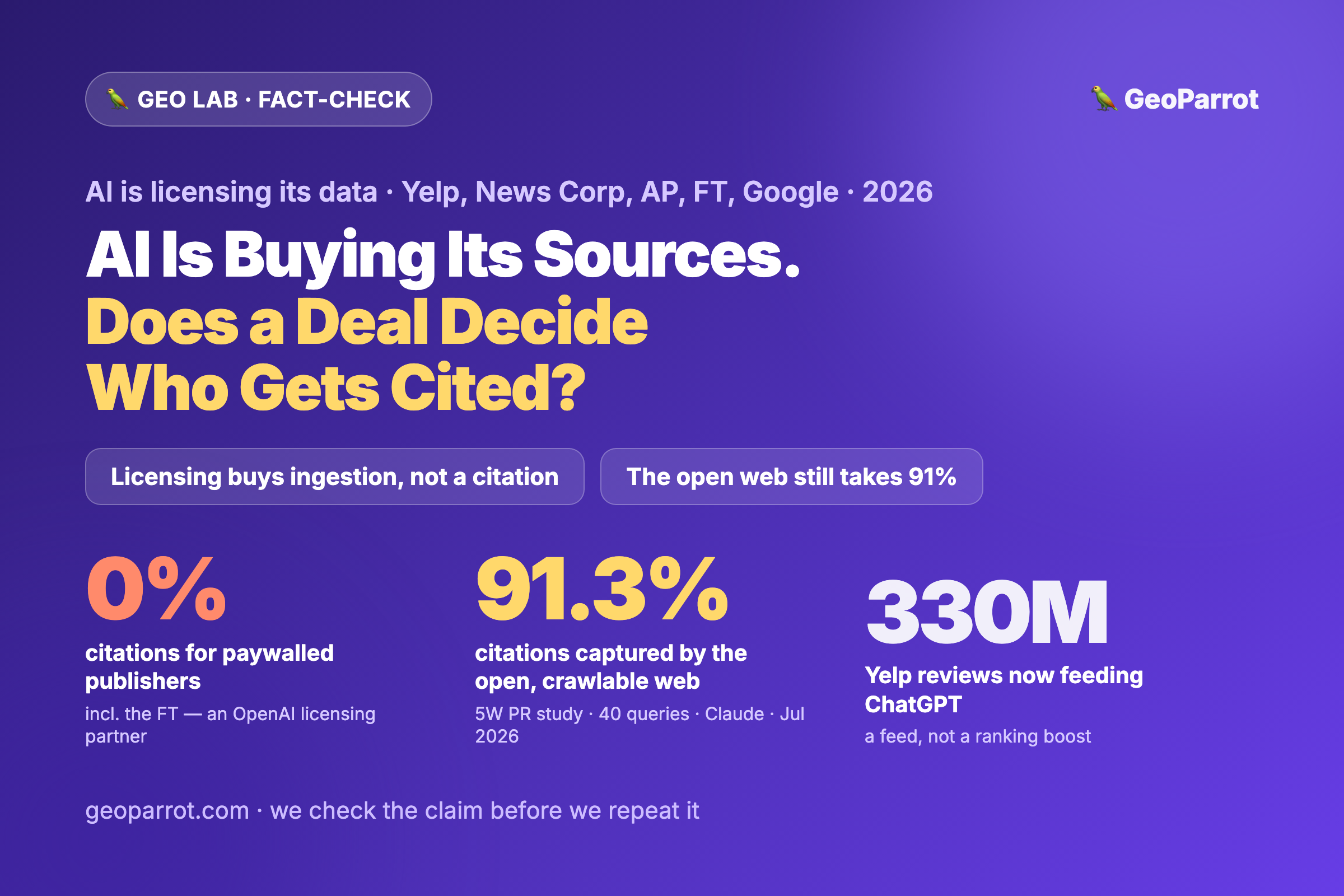
Quick answer: No — not the way the headlines imply. AI companies really are licensing data at scale in 2026 (Yelp’s 330 million reviews now feed ChatGPT; OpenAI has signed roughly two dozen publisher deals). But a licensing deal buys ingestion rights and, in some verticals, distribution — not a live citation. The proof is blunt: a July 2026 study found paywalled publishers earned 0% of AI citations — including the Financial Times, which is one of OpenAI’s own licensing partners — while the open, crawlable web captured 91.3%. If an engine can’t read your page in the answer, a signed contract doesn’t get you cited. For anyone outside the brand-name corpus, “go get a licensing deal” isn’t a strategy; being crawlable, structured, and trusted on the open web still is.
Trend watch — published September 7, 2026. This is a fact-check post: we report what the 2026 licensing deals actually do, separate the milestone from the hype, flag what’s still an untested hope, and connect it to the first-party thesis we keep testing in the GEO Lab. It also opens this week’s theme — we’ll run an experiment to test whether licensed-partner domains actually out-cite comparable open-web sources in our own queries.
What’s actually happening: the 2026 licensing wave
The data behind AI answers is quietly being bought. The clearest single example is local: Yelp signed a deal to license its 330 million cumulative reviews and more than 8 million business listings to OpenAI, so ChatGPT can answer “best ramen near me” style questions with real ratings, photos, and business details. Yelp first disclosed the agreement in its February 2026 results; the operational scope was reported this summer. It’s non-exclusive — Yelp is free to sign the same deal with other AI companies — and a “Request a Quote” handoff is coming, which turns an AI answer into a lead.
On the publisher side, OpenAI has signed roughly two dozen content and data deals — the largest reported at $250 million over five years with News Corp, plus the Associated Press, Axel Springer, the Financial Times, and Le Monde. In August 2026, Google began offering UK publishers two-year packages that bundle the right to train on content with the right to summarize it. And Reddit — the single most-cited domain across AI engines — is running the aggressive version of the same playbook: it licenses its data to Google while suing companies it says scraped it. The narrative writes itself: the open web is being fenced, licensed, and metered, so surely the way to get cited now is to be on the right side of a contract.
So does a licensing deal actually get you cited?
The citation data says no. A July 2026 study by 5W Public Relations tested 40 queries across six categories on Claude and looked at which publishers actually showed up as sources. Hard-paywalled publishers — the Wall Street Journal, Financial Times, and Bloomberg — received 0% of citations. Metered publishers, including the New York Times and Washington Post, also got 0%. Open-web publishers captured 91.3% of every citation. It’s one study on one engine (n=40, Claude), so treat the exact number as directional — but the direction is unambiguous and it echoes the larger picture: Reddit, Wikipedia, YouTube, and a short list of open editorial sources dominate, with the top ~15 domains accounting for roughly 68% of all AI citations.
Here’s the part that should end the “licensing = ranking factor” take: the Financial Times signed a licensing deal with OpenAI and still got 0% of the citations in that study. Why? Because a licensing deal governs whether a model may train on or retrieve your archive — it does nothing to make your live pages readable when the engine assembles an answer for a user. FT’s content stays behind a paywall, so at answer-time it’s invisible, contract or no contract. If an engine can’t read your content, it can’t cite you — that constraint doesn’t care what your legal team negotiated.
Then what is a licensing deal actually buying?
Two real things — neither of which is “a higher chance of being cited in an organic answer.” First, ingestion and legal cover: the right for a model to train on your corpus and, in some deals, to retrieve it, plus indemnity against the lawsuits Reddit and others are filing. That’s genuinely valuable to the AI company and to a publisher who’d rather be paid than scraped — but it’s an enterprise transaction, not a visibility lever for your marketing team.
Second, in specific verticals, distribution through a structured feed. The Yelp deal isn’t “Yelp pages now rank better in ChatGPT” — it’s Yelp’s reviews and ratings wired directly into ChatGPT’s local answers as a data source, the same way product feeds wire catalog data into shopping answers. That’s a feed integration for one category (local businesses), where the AI needs fresh, structured, licensed data it can’t reliably crawl. It does not generalize to “publish an article and get cited because you have a contract.” The feed makes the data eligible to appear; it doesn’t make your individual page the chosen citation.
Why “get a licensing deal” isn’t a strategy for almost anyone
Even if licensing did boost citations — and the FT case says it doesn’t — the market is structurally closed to you. Every serious 2026 analysis of the licensing economy reaches the same conclusion: the deals pay only the brand-name corpus with real negotiating leverage — News Corp, AP, Reddit, Yelp — while the long tail of small and mid-size sites will see no meaningful revenue and no deal at all. Licensing is happening at the level of mergers-and-acquisitions and antitrust-adjacent negotiation, not content strategy. You cannot “do GEO” by signing a contract you’ll never be offered.
This is the same category error we keep flagging: mistaking a signal you can buy for one you have to earn. It’s the licensing cousin of the share-of-voice vanity trap — a headline-driven proxy that feels like progress and changes nothing about whether an engine actually reaches for your page. The signals that do move citations are earned: being crawlable, answer-first, structured, and carrying enough brand demand and earned mentions that engines treat you as a source worth pulling from.
The honest caveat: where this could flip
We’re fact-checking a hot take, not declaring licensing irrelevant forever. There’s a real scenario where it starts to matter for visibility: vertical feed integrations. In categories where the AI wires a licensed feed straight into the answer — local (Yelp), shopping (product catalogs), maybe travel and reviews next — a licensed partner’s data can crowd out the open web for those specific queries, because the engine prefers the clean, fresh, structured feed over crawling a dozen sites. That’s narrow and vertical-specific today. But it’s exactly the kind of claim that should be measured, not assumed — which is why it’s this week’s experiment: we’ll test whether licensed-partner domains (Yelp, Reddit, Wikipedia) actually out-cite comparable open-web sources across a controlled set of queries, and whether the effect is general or confined to fed verticals. Because the engines behave differently, expect the answer to be per-engine, not universal.
What to actually do this week
Ignore the licensing headlines as a to-do list and do the boring, durable work instead. Stay readable: don’t paywall, gate, or block the crawlers the search-and-answer engines use — the fastest way to guarantee 0% citations is to make your best content unreadable at answer-time, which is precisely the trap the paywalled publishers fell into. Be the cleanest source in your category: answer-first structure, first-party data and statistics, and clear entity signals so an engine can lift a passage without ambiguity. If you’re in a fed vertical (local, e-commerce), get your structured data right — accurate listings, reviews, and product feeds — because that’s the eligibility layer that a feed can surface. And measure per engine in your own analytics rather than trusting any single “AI visibility score,” since AI SEO is still governed by retrieval and trust, not by contracts.
Bottom line: AI is absolutely buying its sources in 2026, and that’s a real shift worth watching. But licensing buys ingestion rights and, in a few verticals, feed distribution — not a citation. The Financial Times signed with OpenAI and still gets cited 0% of the time because it stays paywalled, while the open web takes 91%+. Don’t chase a contract you’ll never be offered. Be crawlable, be the best answer, earn the trust — and let us test the one place licensing might actually move the needle before you believe it does.
Frequently asked questions
Does an AI licensing deal help my content get cited by ChatGPT?
Not on its own. A licensing deal governs whether a model may train on or retrieve your archive, plus legal cover — it does not make your live pages the source an engine reaches for when it builds an answer. The clearest evidence: in a July 2026 study, the Financial Times — an OpenAI licensing partner — received 0% of AI citations because its content stays paywalled and unreadable at answer-time, while open, crawlable publishers captured 91.3%. Being citable is still governed by retrieval and trust, not by a contract.
Why do paywalled publishers get almost no AI citations even with licensing deals?
Because a licensing deal and answer-time readability are two different things. When an AI assembles an answer, it cites sources it can actually read and quote at that moment. Paywalled and metered content is blocked to the crawler in the answer path, so it’s effectively invisible — regardless of any training or retrieval rights negotiated separately. If an engine can’t read your content, it can’t cite you.
What is the Yelp–OpenAI deal, and does it mean local businesses should “optimize for the feed”?
Yelp licensed roughly 330 million reviews and 8 million-plus business listings to OpenAI so ChatGPT can answer local questions with real ratings, photos, and details. It’s a feed integration for one vertical, not a general citation boost. For local businesses it means the eligibility layer matters: keep your listings, reviews, and business data accurate and structured, because that’s the data a licensed feed can surface. It does not mean a licensing deal is available to, or needed by, your website.
If licensing doesn’t drive citations, what does?
Earned, on-page signals. Across 2026 studies the sources that dominate AI citations are open and crawlable (Reddit, Wikipedia, YouTube, and a short list of editorial outlets), and the strongest correlates of getting cited are brand demand, earned mentions, and being answer-first and structured — not backlinks or contracts. The practical levers are: stay readable, publish first-party data, structure content so a passage can be lifted cleanly, and build enough category authority that engines treat you as a go-to source.
Could licensing start to matter for visibility later?
Yes, in a narrow way. Where an engine wires a licensed feed directly into answers — local via Yelp, shopping via product catalogs, possibly travel and reviews next — a licensed partner’s data can crowd out the open web for those specific query types. That’s vertical-specific, not a general rule, and it should be measured rather than assumed. It’s exactly what we’re testing this week: whether licensed-partner domains actually out-cite comparable open-web sources, and whether any effect is general or confined to fed verticals. Expect the answer to differ by engine.
Leave a Reply