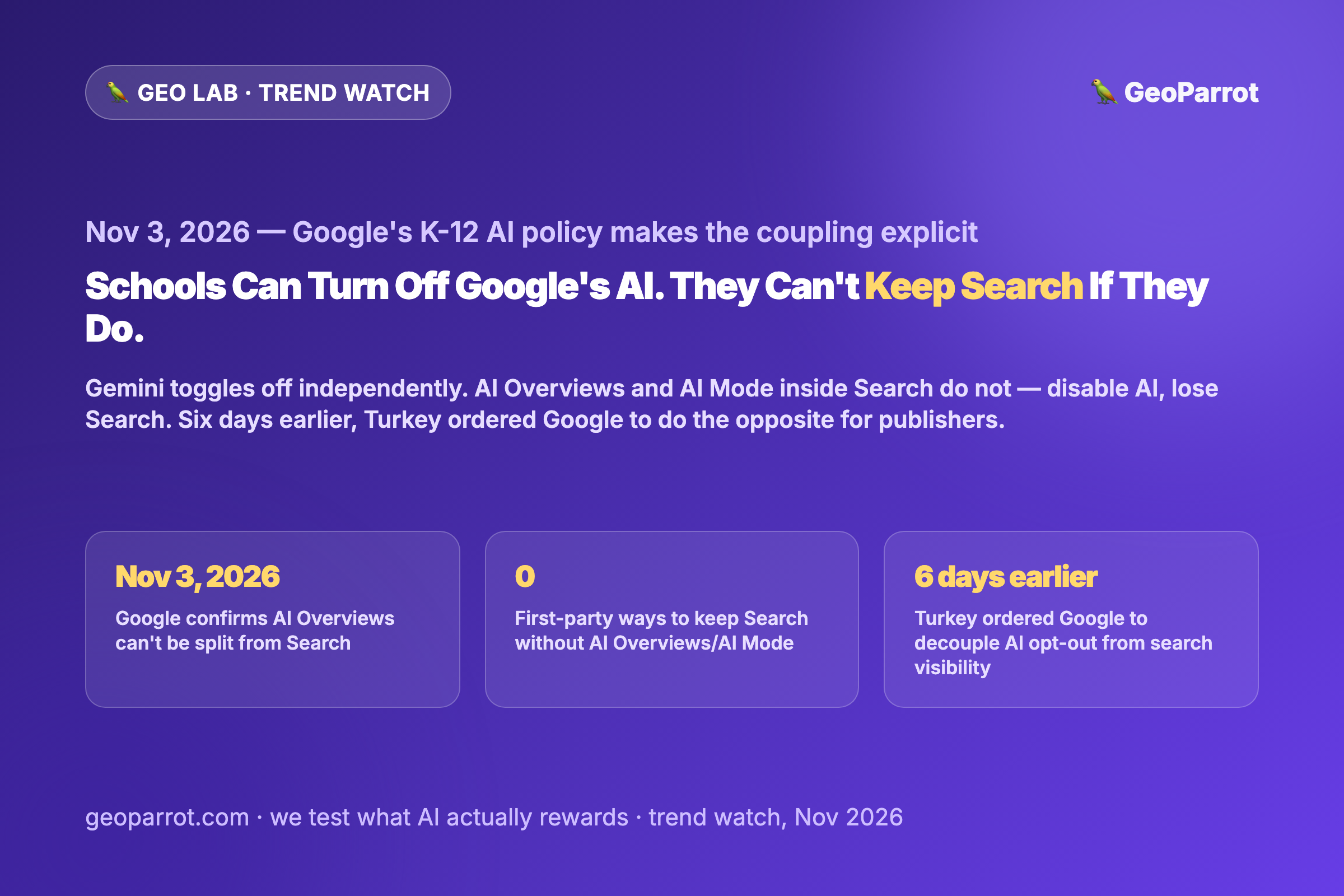
Quick answer: On November 3, 2026, Google announced that Gemini, Gemini Notebook, and Gemini in Classroom will be off by default for K-12 school accounts starting early 2027, with administrators able to turn each one on separately. After backlash over reporting that disabling AI would also disable Search, Google said on X that “schools are in control,” but its own VP for education, Chris Phillips, told the New York Times the quiet part directly: “Search and AI are deeply integrated.” In practice, a school that wants Google Search without AI Overviews and AI Mode cannot get it — disable AI entirely and Search goes dark too, with students shown an unavailable message. A third-party vendor, Lightspeed Systems, claims a workaround shipped November 2, but it is unverified, costs extra, and is not Google’s own control. This is the same coupling we have tracked from the publisher side all quarter, now showing up on the searcher side, in the one context (K-12 schools, under political pressure) with the most leverage to ask Google for a real split — and not getting one.
Trend watch — published November 9, 2026, in the GEO Lab. We test our own citation data most days; this one is about who gets to say no to AI Overviews, and who doesn’t.
What did Google actually announce on November 3?
Starting early 2027, Google will turn Gemini, Gemini Notebook, and Gemini in Classroom off by default for school-managed K-12 accounts, with district administrators able to switch each one on independently. The announcement landed alongside Guided Learning, an AI tutoring mode rolling into Google Classroom and, as a pilot, into Search itself for select US student accounts later this month. The part that triggered the backlash was a separate detail the New York Times reported the same day: schools that choose to disable AI altogether — not just the Gemini apps, but AI inside Search — lose Google Search for their students entirely. Politicians and school-technology commentators read that as coercive, and Google spent November 3 and 4 responding to the criticism rather than walking it back.
Why can schools turn off Gemini but not AI Overviews inside Search?
Because Google drew the line between two different things it calls AI, and only one of them is a separate product. Gemini the chatbot, Gemini Notebook, and Gemini in Classroom are standalone apps sitting next to Search — turning them off removes an app, nothing else. AI Overviews and AI Mode are not sitting next to Search. Per Phillips’s own framing, they are Search now. Google’s X response to the backlash said “schools are in control” and that Gemini, Gemini Notebook, and search are each toggleable — true, as far as it goes, but it answers a question nobody asked. The actual ask, confirmed in the reporting and unchanged by Google’s clarification, was narrower: can a school keep ordinary Google Search results while turning off just AI Overviews and AI Mode within it? As of November 3, the answer is still no. Disable AI as a category and the student sees a message that Search itself is unavailable. A third-party education-tech vendor, Lightspeed Systems, announced on November 2 that its Google Search AI Controls feature can bypass AI Overviews and block AI Mode for districts already using its Lightspeed Filter product — a real claim, but an unverified, paid, third-party patch over a gap Google itself chose not to close.
Isn’t this the exact opposite of what a regulator ordered six days earlier?
Yes, and the contrast is the most useful part of this story. On November 2, Turkey’s Competition Board (Rekabet Kurulu) ordered Google, as an interim measure inside an abuse-of-dominance case, to keep a publisher’s AI-opt-out decision separate from that publisher’s visibility in standard search results. One day later, in a completely different arena, Google told US schools that the equivalent separation — keep Search, lose just the AI layer inside it — does not exist as an option, for anyone, built by Google. The difference isn’t technical; both cases are the same underlying architecture (AI Overviews woven into core Search, not a layer on top of it). The difference is leverage. A national competition regulator with the power to issue a binding, immediately-effective order got a decoupling. A segment of Google’s own user base with maximum institutional standing — school districts, parents, sitting politicians, three days of national press coverage — got a clarifying tweet and a third-party workaround that “still needs independent evaluation,” as one school-technology newsletter put it. We’ve logged this same entanglement three other times this quarter from the publisher side: the shared robots.txt AI-training opt-out token that, on Google, also removes a site from Gemini citation eligibility unless a separate rule is added; and AI Overviews structurally absorbing legacy SERP real estate without an opt-out at all, in the brand-search Knowledge Panel replacement and the News Box displacement. This is the first time we’ve seen the identical pattern surface on the searcher side instead of the publisher side, and the first time we’ve seen it survive a public, political backlash unchanged.
Party asking for AI/Search decoupling
Leverage
Outcome by Nov 4, 2026
Publishers, via Turkey’s Rekabet Kurulu
Binding regulatory order, legal authority
Decoupling ordered, effective immediately
US K-12 schools, parents, politicians
Public backlash, national press, no binding authority
Clarifying statement only; AI Overviews/AI Mode still bundled into Search
Individual publishers, via robots.txt
Self-service technical control
Training opt-out and citation eligibility bundled by default on Google; separate rule required to split them
Compiled from Rekabet Kurulu’s November 2, 2026 order, TechCrunch and CNBC reporting on Google’s November 3-4, 2026 statements, and the robots.txt AI-training token behavior documented in our November 1 piece.
What should a GEO or content team actually do with this?
Stop planning for an “AI Overviews-free” audience segment on Google. If K-12 schools — an audience with regulatory backing, press coverage, and political pressure on their side — could not get Google to split Search from AI Overviews, no publisher-side request or user preference will either. Treat AI Overviews presence as the default state of Google Search for every query class, not an exception some users escape.
Don’t count on third-party AI-blocking tools as a stable baseline. Lightspeed Systems’ claim is specific to its own Filter product, unverified by independent testing, and adds cost and technical setup. If you’re measuring how content performs for users who “don’t see AI Overviews,” that population is now vendor-dependent and shrinking, not a reliable control group.
Separate regulatory leverage from public pressure when you forecast Google policy changes. This week showed the two don’t move the same lever. If you’re waiting on a Google architecture change (opt-outs, citation controls, display changes), weight an active binding regulatory order far more heavily than news-cycle backlash, even loud backlash, when estimating how soon it ships.
Read Google’s wording for what it actually commits to, not what it sounds like. “Schools are in control” and “Search and AI are deeply integrated” came from the same company on the same day. The second sentence is the one that describes the actual product behavior; the first describes the controls that exist around it.
Frequently asked questions
Can schools really turn off Google’s AI tools?
Partially. Starting early 2027, K-12 school accounts will have Gemini, Gemini Notebook, and Gemini in Classroom off by default, and administrators can turn each on separately. What schools cannot do is keep ordinary Google Search while disabling just AI Overviews and AI Mode inside it — Google’s own VP for education said Search and AI are deeply integrated, and disabling AI as a category disables Search for students too, per the New York Times reporting that triggered this story.
Is there a way to keep Google Search without AI Overviews or AI Mode?
Not from Google directly, as of this writing. A third-party vendor, Lightspeed Systems, announced on November 2, 2026 a feature called Google Search AI Controls that claims to bypass AI Overviews and block AI Mode for school districts already using its Lightspeed Filter product. That claim has not been independently verified, requires an existing paid relationship with the vendor, and is not a control Google itself offers.
How is this different from Turkey ordering Google to decouple AI opt-out from search visibility?
Turkey’s Competition Board acted on the publisher side, ordering Google to keep a publisher’s AI-content opt-out separate from that publisher’s visibility in standard search results, as a binding interim measure with legal force. The schools situation is on the searcher side: it’s about whether a user of Search can turn off the AI layer within results, not whether a publisher’s content appears in them. Both cases involve the same underlying coupling of AI and core Search, but only the publisher-facing case has, so far, produced an enforceable order requiring Google to split the two apart.
Does this mean AI Overviews can never be turned off by anyone?
Not globally, no — some regulators and some individual search engines (reporting on this story notes DuckDuckGo as an example) do let users or jurisdictions limit AI features while keeping search. What this week confirmed is narrower: inside Google’s own product, for its own K-12 accounts, in the one case this quarter where users had the most political leverage to demand that split, Google did not build it as a first-party option. Treat any specific opt-out claim, including Lightspeed’s, as unverified until tested rather than assuming it generalizes.
Should this change how I plan GEO or SEO content strategy?
It should remove one assumption: that a meaningful share of your audience browses Google Search without encountering AI Overviews or AI Mode, and that Google is likely to formalize an opt-out for them soon absent regulatory force. This week is evidence against both halves of that assumption. It doesn’t change the mechanics of citation-focused content work itself.

Leave a Reply