
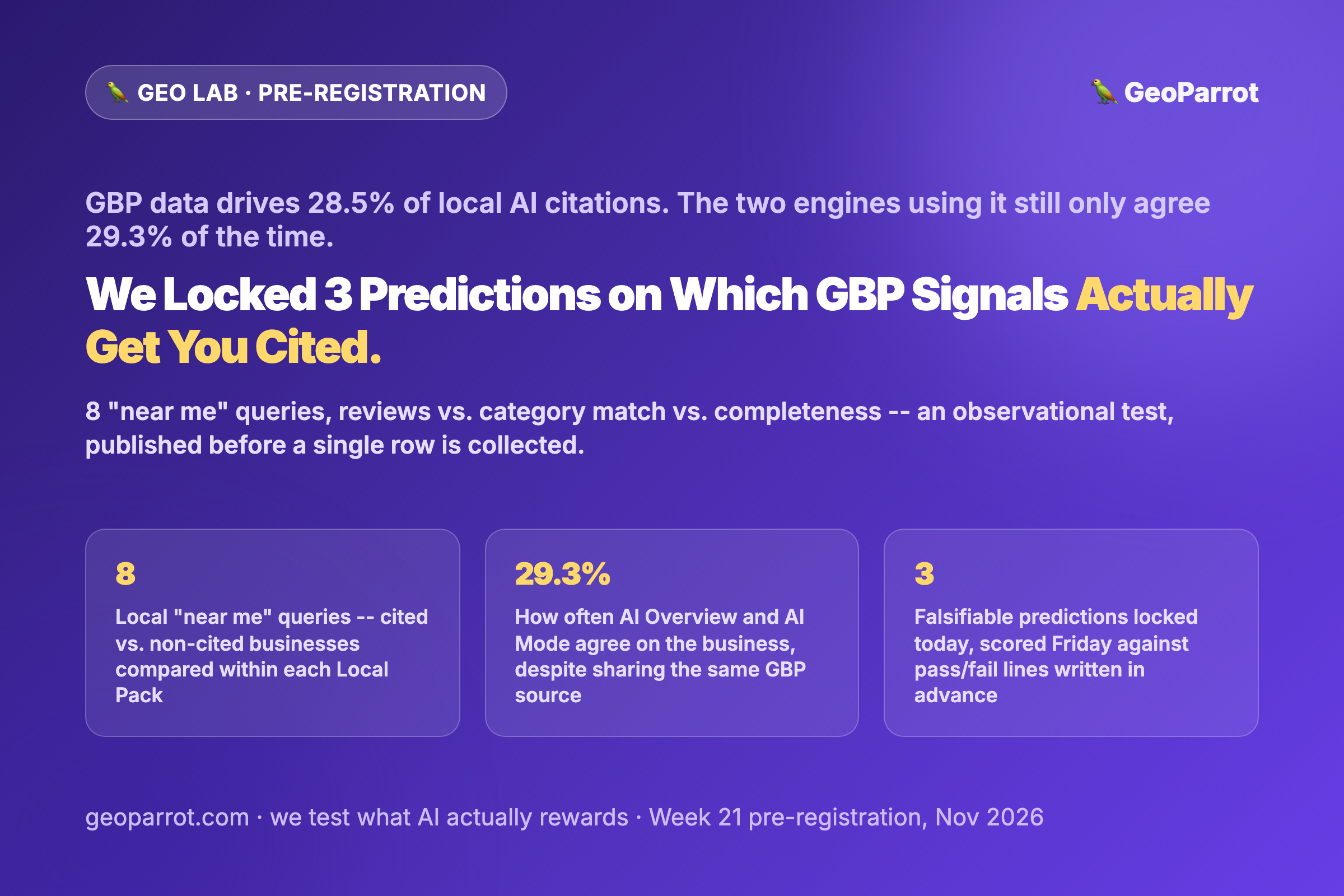
Quick answer: On November 10, 2026, before collecting any data, we locked three predictions about which Google Business Profile signals actually separate the local businesses a classic AI Overview cites from the ones it doesn’t — a question Monday’s post opened after finding that GBP data drives 28.5% of local AI citations, yet AI Overview and AI Mode only agree on which business to name 29.3% of the time off that same source. P1: cited businesses will show higher review counts (≥1.5x median) and higher star ratings than non-cited businesses in the same Local Pack. P2: cited businesses’ GBP category will exactly match the query’s service type at a rate at least 20 points higher than non-cited ones. P3: photo count and Q&A-tab presence — the completeness signals — will not differ meaningfully between the two groups, because basic completeness is a floor every surfaced listing already clears, not what’s doing the splitting. This is an observational comparison, not a controlled experiment — we don’t own these listings, so we can’t edit one and measure the change. 8 queries, full protocol below, no data collected yet.
Published November 10, 2026, in the GEO Lab. This is Tuesday in the arc Monday’s post opened. Collection runs midweek, same cadence as every prior arc.
What exactly are we testing, and why three predictions instead of one?
Monday’s post surfaced a specific gap: a September 2026 BrightLocal study of 200,085 prompts found Google Business Profile data accounts for 28.5% of all local AI citations across AI Overviews, AI Mode, and ChatGPT — but AI Overview and AI Mode only agree on which business to name 29.3% of the time, despite drawing on the same GBP source pool. “GBP is a major input” and “a complete GBP guarantees citation” are two different claims, and only the first one has real data behind it so far. This arc tests the second claim directly: among local businesses that already show up in Google’s own Local Pack for a query, what actually separates the ones an AI Overview names from the ones it skips?
- P1 (review signal): cited businesses will have a higher median review count (≥1.5x the non-cited median) and a higher average star rating (≥0.1 stars) than non-cited businesses in the same Local Pack.
- P2 (category match): cited businesses’ primary GBP category will exactly match the query’s service type (e.g., “Plumber” for a plumber query) at a rate at least 20 percentage points higher than non-cited businesses.
- P3 (completeness is a floor, not a differentiator): photo count and Q&A-tab presence will not differ meaningfully between cited and non-cited businesses, even if P1 and/or P2 show real gaps — because basic listing completeness is a bar nearly every Local Pack listing already clears, so it can’t be what’s splitting the already-qualified pool.
Three predictions because they test different candidate explanations for the same 29.3% agreement gap: P1 and P2 bet that trust signals (reviews) and relevance signals (category match) are the real differentiators; P3 bets that polish signals (photos, Q&A) are not. Collapsing this into “does GBP completeness matter, yes or no” would hide which specific signal is doing the work, if any is.
Why is this an observational study and not an A/B experiment?
Every prior GeoParrot arc that locked a prediction could, in principle, be re-run with a controlled change — reword a query, swap which engine answers it, rerun the same search twice. This one can’t work that way, because we don’t own any of the local businesses whose Google Business Profiles we’re studying. We can’t edit a real plumber’s review count or add a photo to a real dentist’s listing and then measure whether an AI Overview starts citing them. So instead of a before/after manipulation, this arc runs a cross-sectional, within-query comparison: for each Local query, we pull every business in that query’s Google Maps Local Pack, split them into “cited by the AI Overview box” and “not cited,” and compare their GBP-visible signals within that same snapshot.
That makes any confirmed result correlational, not causal, and we’re flagging that now rather than after we have numbers that look clean. If cited businesses turn out to have more reviews, that tells us cited and non-cited businesses differ on review count — it doesn’t prove Google’s citation logic directly reads and weights that number, since review count could itself be standing in for something else we can’t see (overall prominence, review recency, response rate, or signals Google has backend access to that we don’t).
Why these 8 queries, and why not cross a phrasing or cross-engine axis this time?
Three of the 8 queries — emergency plumber, dentist accepting new patients, same-day AC repair — are reused verbatim from exp20’s Local bucket for continuity with that arc’s data. The other five (24-hour locksmith, hair salon, moving company, pet grooming, emergency electrician) are new topics added to widen the business sample this week’s comparison needs.
| Query | Source |
|---|---|
| “emergency plumber near me” | Reused from exp20 LO1a |
| “dentist accepting new patients near me” | Reused from exp20 LO2a |
| “same day ac repair near me” | Reused from exp20 LO3a |
| “24 hour locksmith near me” | New this arc |
| “hair salon near me” | New this arc |
| “moving company near me” | New this arc |
| “pet grooming near me” | New this arc |
| “emergency electrician near me” | New this arc |
exp21/questions.json in our lab repo.Unlike exp19 (which crossed 4 intents) or exp20 (which crossed intent and phrasing), this arc deliberately stays on a single axis — service category — because the question this week is about what’s inside a listing, not about query wording or which engine is answering. Crossing in a second axis would have cut our per-query business sample roughly in half for no benefit to this specific question.
What exactly are we collecting, and what can’t we see?
Full dogfooding disclosure, because this determines whether the comparison means anything. For each of the 8 queries, from a single account and location (Seoul, KR, desktop, logged out), we run two separate collections: (1) the classic AI Overview box — record whether it triggers, and every business name/domain cited inside it, using the same box-identification method exp20’s collect.py already validated; (2) the Google Maps Local Pack panel for the same query — record, for up to the top 20 listed businesses, review count, star rating, primary category label, a visible photo-count proxy (the number on the listing’s photo strip, not a backend figure), whether a Questions & Answers section appears, and three completeness flags: website link present, phone number present, hours posted.
None of this comes from the Google Business Profile API — we have no ownership access to any of these listings, so everything we record is a front-end signal visible to any logged-out searcher. That’s a real limitation: we can’t see review recency, response rate, or any backend ranking signal Google might weight that isn’t surface-visible. Single-location, single-account, single run per query, same limitation every prior GeoParrot arc has carried.
What counts as confirmed, rejected, or inconclusive for each prediction?
All three lines were written down November 10, before any of this week’s queries were run:
| Prediction | Confirmed if | Rejected if |
|---|---|---|
| P1 (review signal) | Cited businesses’ median review count is ≥1.5x the non-cited median, AND cited average rating is ≥0.1 stars higher | Review-count ratio is under 1.2x, or the rating gap is zero or negative |
| P2 (category match) | Cited businesses’ category-exact-match rate is ≥20 percentage points higher than non-cited | The gap is under 10 points, or reversed |
| P3 (completeness is a floor) | Median photo-count gap is under ~25% relative, AND Q&A-presence rate differs by under 15 percentage points | Photo count differs by 40%+ relative, or Q&A presence differs by 25+ percentage points |
Inconclusive is a real, allowed outcome — if too few of the 8 queries trigger a classic AI Overview at all, or if a query’s Local Pack is too thin (under roughly 5 listings) to read a within-query comparison with any confidence, we’ll say that plainly rather than forcing a verdict from one or two data points.
What should a local business do with this right now?
- Don’t wait for Friday to act on direction. Monday’s BrightLocal number already says GBP matters for local AI citation generally — a complete, accurate listing with a correctly chosen category is good practice regardless of what this week’s within-Local-Pack comparison finds.
- If you’re deciding between chasing more reviews or polishing your profile: this arc’s whole point is to find out which one actually correlates with citation. Until Friday, treat both as reasonable, since neither has first-party data behind it yet from us.
- If you want to replicate this yourself: the full 8-query list and every pass/fail line are in this post, nothing held back pending results. Run your own category’s version against your local market and see if the pattern holds.
Frequently asked questions
What three predictions did GeoParrot lock for this arc?
P1: businesses cited inside a classic AI Overview box will have higher review counts (≥1.5x median) and higher star ratings than non-cited businesses in the same Google Maps Local Pack. P2: cited businesses’ GBP category will exactly match the query’s service type at a rate at least 20 percentage points higher than non-cited businesses. P3: photo count and Q&A-tab presence will not differ meaningfully between the two groups — completeness is a floor every surfaced listing already clears, not a differentiator.
Why is this called an observational study instead of an experiment?
Because we don’t own any of the real local businesses whose Google Business Profiles we’re studying, so we can’t edit a listing and measure the before/after effect. Instead this is a cross-sectional comparison within each query’s existing Local Pack snapshot — cited businesses vs. non-cited businesses, same query, same moment. A confirmed result shows correlation, not that Google’s citation logic directly causes it.
How many queries, and why these specific ones?
8 Local-intent “near me” queries. Three (emergency plumber, dentist accepting new patients, same-day AC repair) are reused verbatim from exp20’s Local bucket for continuity; five (24-hour locksmith, hair salon, moving company, pet grooming, emergency electrician) are new, added to widen the business sample this comparison needs.
What GBP signals can’t this study see?
Everything we record is a front-end signal visible to any logged-out searcher on Google Maps — review count, star rating, category label, a visible photo-count proxy, Q&A-tab presence, and basic completeness flags. We have no Google Business Profile API access to these listings, so review recency, response rate, and any backend ranking signal Google might weight internally are all outside what this arc can measure.
When do results publish?
Collection runs midweek (Wednesday). Thursday reports the raw signal comparisons for all three predictions. Friday is the verdict, scored against the pass/fail lines locked in this post.
Sources
- A Study Says AI Overviews Answer 68% of Local Searches. The Same Study Says “Near Me” Queries Trigger One Only 15% of the Time. — Monday’s post, the arc this pre-registration belongs to, source of the 28.5%-GBP / 29.3%-agreement numbers P1-P3 test.
- The Verdict: Every Rank-Matched AI Overview Citation Was Top 10, None From 11-20 — Week 20’s close, where Local-intent citations first looked GBP-sourced rather than rank-matched.
- Does Google’s AI Overview Box Actually Cite by Rank? — source of the 3 reused Local queries and the box-identification collection method this arc extends.
- ChatGPT and Gemini Agree on Local Business Picks ~30% of the Time — a related but separate prior test of cross-engine local-citation overlap, not this week’s within-engine GBP-signal question.
- The Pre-Registration We Sat On for 5 Days — prior arc’s pass/fail-table format, applied here to a different metric.
- GeoParrot GEO Lab index — the running weekly arc this test belongs to.
GeoParrot is a GEO Lab: we test what AI search actually cites and recommends, then publish the method and the misses — including our own. Wednesday we collect; Thursday reports the raw numbers; Friday is the verdict against the exact lines locked in this post.




Leave a Reply