
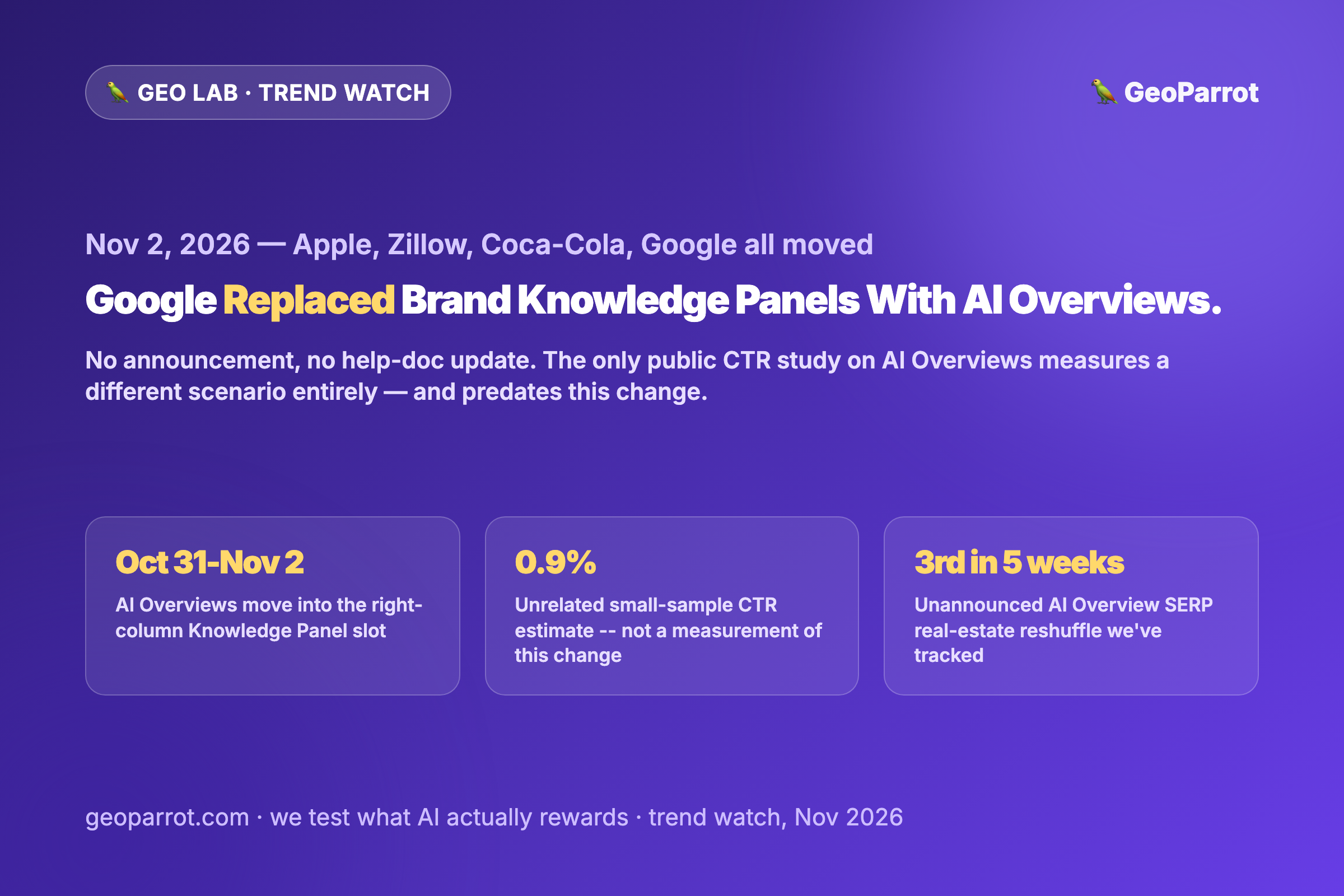
Quick answer: Starting around October 31, 2026 and confirmed by Search Engine Roundtable on November 2, Google began showing AI Overviews for many brand-name searches — Apple, Zillow, Coca-Cola, Google, Search Engine Roundtable itself — in the right-hand desktop column instead of the top or middle of the main results. That column is where Knowledge Panels have lived since 2012. Barry Schwartz called it plainly: Google is “essentially replacing brand knowledge panels with AI Overviews.” There’s no Google announcement, no help-doc update, and — this is the part worth sitting with — no click data on this specific change. The one CTR study anyone has for AI Overviews and AI Mode right now measures a different scenario and shouldn’t be stretched to cover this one.
Trend watch — published November 4, 2026, in the GEO Lab. We test our own citation data most days; this one is about where on the page that data even shows up.
What exactly moved, and when?
David McSweeney first flagged it on October 31, 2026, noting that AI Overviews for branded searches were generally appearing in a right-side panel on desktop rather than the main column. Chris Long and Barry Schwartz at Search Engine Roundtable corroborated it on November 2 with their own screenshots: queries for Apple, Zillow, Coca-Cola, Google, and Search Engine Roundtable’s own brand name all pulled an AI-generated summary into the right column — blended with the structured business data, commerce details, and Follow buttons a Knowledge Panel normally carries. Schwartz’s read: “I think this works much better than having it in the main results, but at the same time, it is not great to trust that AI will do a good enough job writing about your brand than your own website would.” No Google spokesperson has commented, and nothing in Google’s Search Help documentation reflects the change as of this writing. Ahrefs had already measured AI Overviews appearing on 63 of 100 major brand-name queries by late September 2026 — so the summaries themselves aren’t new. What’s new is where Google decided to put them.
Why move it instead of just leaving it where it was?
The simplest explanation is also the one the reporting leans on: a dense AI summary sitting on top of ten blue links pushes everything else down and reads as clutter, while the same content fits naturally into a sidebar format readers already associate with “facts about this entity.” Schwartz said as much — the right column suits the format better. That’s a design rationale, not a ranking or citation rationale, and it’s worth keeping those separate. Nothing about this reporting suggests which sources get cited inside the brand AI Overview changed, how often a brand’s own site appears in it, or whether being relegated to a sidebar changes how much attention the summary gets relative to when it sat at the top. Position changed. We don’t yet know if anything underneath the position changed with it.
Do we actually have click data on this?
No — and it’s worth being precise about why, because there’s a study circulating that sounds like it answers this and doesn’t. In October 2026, SEO consultant Cyrus Shepard published a small case study where he used Google’s AI Overview and AI Mode opt-out controls to block his own site from those features, then compared his site’s performance before, during, and after. He estimated AI impressions carried roughly a 0.9% click-through rate, calculated by subtracting known AI impressions from overall CTR — “a super limited study based on a small sample size,” in his own words. The more interesting finding was a side effect: his regular organic clicks also dropped when he disabled AI features, which he and Greg Sterling both read as a possible “halo effect” — appearing in more places on the page may lift clicks elsewhere on the page, not just steal them. That’s a genuinely useful data point about AI Overviews in general. It is not a measurement of brand searches specifically, and it predates the right-column move by weeks. Search Console still reports impressions for AI features without clicks or query-level detail, so until someone runs a before/after specifically on brand queries that just got relocated, “did this help or hurt brand page clicks” stays an open question — not an answered one borrowed from an unrelated study.
Is this part of a pattern, or a one-off?
Pattern. This is the third time in four days we’ve tracked Google quietly reassigning SERP real estate without an announcement. On November 2, we covered AI Overviews structurally outranking the News Box for breaking-news queries — a different mechanism (Top Stories placement, not brand-entity data) but the identical shape: Google’s AI layer absorbing a legacy SERP module’s real estate, unannounced, unmeasured. Before that, on October 4, we fact-checked DemandSphere and Ahrefs data showing AI Overviews on 82-83% of brand-name searches — establishing that brand AIOs were already near-universal well before this week’s layout change. None of these three events share a cause. What they share is Google restructuring how brand and news information gets surfaced, each time without a changelog entry, each time leaving third parties to reverse-engineer what happened from screenshots. Duane Forrester’s “counted vs. inferred” framing — which we wrote about in September — applies directly here: nobody outside Google can count how many brand queries moved, only infer it from spot-checks.
| Event | Date reported | What moved | Click/citation data available? |
|---|---|---|---|
| Brand AIO saturation | Oct 4, 2026 | Nothing moved — AI Overviews simply appeared on 82-83% of brand-name queries | Presence counted (DemandSphere, Ahrefs); citation and clicks not measured |
| News Box displacement | Nov 2, 2026 | AI Overviews began outranking Top Stories boxes on breaking-news queries | No publisher click data published |
| Knowledge Panel replacement | Nov 2-3, 2026 | Brand-query AI Overviews moved from main column to the right-side Knowledge Panel slot | No data on this change; nearest proxy (Shepard, Oct 2026) measures a different scenario |
What should you actually check this week?
- Search your own brand name, logged out, on desktop. Check whether your AI Overview now sits in the right column instead of the main results — Schwartz’s examples were household names, and smaller-brand rollout timing is unconfirmed.
- Read what the summary says about you, not just whether it’s there. We already found in our own brand self-audit that presence and accurate representation are separate questions; a right-column AI Overview is still a Google-written paraphrase of your brand, not your copy.
- Don’t borrow the 0.9% CTR figure as your baseline. It’s a single-site, small-sample study of general AI Overview opt-out, not a measurement of brand-query right-column placement. If you want a real number, you’ll need your own before/after on the queries that actually moved.
- Watch your Search Console brand-query impressions over the next two weeks, same way we recommended after the branded-saturation data in October — impressions-only data is still the most-checkable signal Google gives you, even without a click breakdown.
Frequently asked questions
Has Google confirmed it moved AI Overviews for brand searches into the Knowledge Panel column?
No. This is based on third-party observation and screenshots from David McSweeney, Chris Long, and Barry Schwartz of Search Engine Roundtable, reported October 31 through November 2, 2026. Google has not announced the change or updated its Search Help documentation to reflect it.
Does this mean AI Overviews are literally replacing Knowledge Panels everywhere?
Not confirmed at that scale. The examples reported so far are large, well-known brands (Apple, Zillow, Coca-Cola, Google). Whether this extends to smaller brands, non-brand entity queries, or mobile layouts hasn’t been documented yet.
Is the 0.9% CTR figure from Cyrus Shepard’s study a measurement of this specific change?
No. Shepard’s study measured click-through rate on AI Overview and AI Mode impressions generally, using his own site’s opt-out data from October 2026 — before this right-column shift was reported. It’s the closest public data point on AI Overview clicks, but it doesn’t measure brand-query placement specifically, and he himself described it as a small-sample, limited study.
Should I change anything about my brand page content because of this?
Not based on this alone. There’s no evidence yet that the layout change altered which sources get cited inside the brand AI Overview or how brand pages are evaluated. The actionable step right now is checking what the summary currently says about your brand and tracking your own Search Console impressions, not rewriting content in response to a UI reshuffle.
Leave a Reply