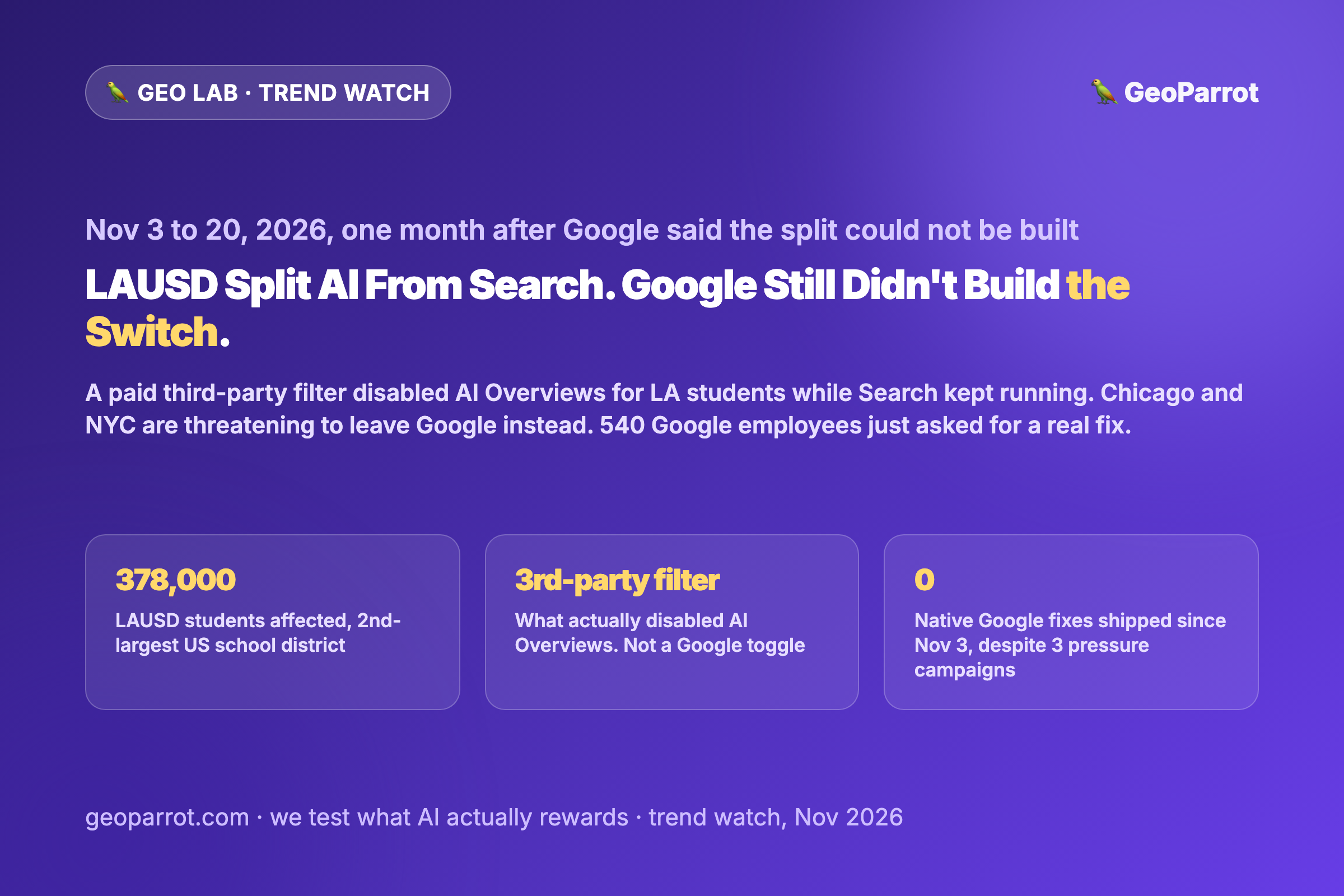
Quick answer: On November 18, 2026, Los Angeles Unified School District confirmed it had disabled AI Overviews and AI Mode for students while Google Search kept working normally. The district did not use a Google-built control to do it. A spokesperson credited “multiple layers of controls, including third-party filtering tools.” That is the same category of fix we flagged on November 9 as unverified: a paid vendor patch sitting on top of Search, not a toggle Google itself offers. One month after Google said on November 3 that Search and AI Overviews cannot be split, Google still has not built that split. The second-largest school district in the country got it anyway, by paying someone else for it. Chicago and New York, which have not announced an equivalent workaround, are instead threatening to leave Google Search for DuckDuckGo or Bing, both of which already let users turn off AI answers natively. And on November 20, 540 Google employees petitioned their own leadership to build the native fix, with no written response from Google at the time of that reporting.
Trend watch, published November 22, 2026, in the GEO Lab. This is a direct follow-up to our November 9 piece on Google bundling AI Overviews into K-12 Search, with new facts from three districts and Google’s own workforce.
What did LAUSD actually confirm, and how?
On Wednesday, November 18, 2026, Los Angeles Unified officials said they had disabled Google’s AI Overviews for students, on top of an AI Mode block already in place since September as part of the district’s broader generative AI moratorium. Google Search itself kept running for students throughout. A district spokesperson described the mechanism only in general terms, pointing to “multiple layers of controls, including third-party filtering tools,” without naming a specific vendor or confirming whether Google’s own admin console played any role. LAUSD Chief Information Officer Jack Kelanic, speaking at a board AI committee meeting, added that the district could switch its default search engine entirely “literally overnight” if it chose to. LAUSD enrolls roughly 378,000 students, making it the second-largest school district in the US after New York City.
Does this contradict what Google told us on November 3?
No, and that is the part worth being precise about. Google’s claim, reported the same week by the New York Times and detailed in our November 9 piece, was about Google’s own controls: disable AI as a category inside Google’s native settings and Search goes dark too. LAUSD did not use Google’s native settings to get around that. It used “third-party filtering tools,” the same category of fix we identified on November 9 when a vendor, Lightspeed Systems, claimed its own Google Search AI Controls feature could bypass AI Overviews for districts already paying for its Lightspeed Filter product. At the time, we called that claim unverified, paid, and not Google’s own control. LAUSD’s confirmation does not verify Lightspeed specifically, since the district did not name its vendor, but it is the first large-scale, on-record confirmation that the workaround category itself works in production, for a district serving hundreds of thousands of students. What has not changed in the eleven days since is Google shipping anything first-party. The switch LAUSD used came from somewhere else.
Why are NYC and Chicago threatening to leave instead of just filtering?
Because a paid filtering layer is a workaround, not a policy win, and two of the three largest districts in the country are explicitly refusing to settle for one. Chicago Public Schools told families around November 12 to 13 that it wants ordinary Search without AI bundled in, and that “if such an arrangement cannot be reached with Google, CPS will look to other search solutions.” New York City schools chancellor Kamar H. Samuels went further, telling reporters, “We refuse to accept the false binary Google has laid out,” and “If Google doesn’t reconsider their position, we will explore other search options.” Both districts are naming the same two alternatives: DuckDuckGo and Bing, which already let any user, student or not, turn off AI-generated answers while keeping ordinary search, as a native setting rather than a paid add-on. That is the actual leverage point. LAUSD solved its immediate problem with a vendor; NYC and Chicago are signaling they would rather change search engines entirely than normalize paying a third party to do what the platform itself won’t build in.
Did Google’s own employees move the needle?
Not yet, as far as the public record shows. On November 20, 2026, 540 Google employees signed an Alphabet Workers Union petition asking leadership to “let schools disable AI in Search without losing Search,” arguing that forcing the choice would likely push districts to abandon Google products altogether rather than accept bundled AI. Mother Jones reported the signature count the same day. Google’s leadership had acknowledged receiving the letter by the time of that reporting, with no written response to the union’s specific demand. That makes three separate groups now asking for the same first-party fix inside of three weeks: school administrators in public statements, a national press cycle, and Google’s own workforce. None of the three has produced a native toggle. The only entity that has produced the functional outcome, AI off with Search still on, is a school district paying a filtering vendor to build around the product rather than inside it.
Date
Event
Does it split AI from Search natively?
Nov 2, 2026
Lightspeed Systems claims a Google Search AI Controls feature for its filter customers
No, paid vendor claim, unverified at the time
Nov 3, 2026
Google confirms Gemini apps can be toggled off, AI Overviews and AI Mode cannot be split from Search
No
Nov 12-13, 2026
Chicago Public Schools tells families it wants Search without AI, or it will switch providers
No, a position statement
Nov 18, 2026
LAUSD confirms AI Overviews and AI Mode disabled for students via third-party filtering tools, Search unaffected
No, achieved through a paid vendor layer
Nov 20, 2026
540 Google employees petition leadership for a native fix
No, Google has only acknowledged the letter
Compiled from Lightspeed Systems’ November 2 announcement, Google’s November 3 statements reported by the New York Times, Chicago Public Schools and LAUSD statements reported November 18 by Digital Trends and NBC Los Angeles, and Mother Jones’ November 20 report on the Alphabet Workers Union petition.
What should a GEO or IT team actually do with this?
Don’t cite “a district disabled AI Overviews” as evidence Google shipped a native control. Check the mechanism first. LAUSD’s fix runs through a paid filtering layer sitting on top of Search traffic, not a setting inside Google’s own admin console.
If you’re tracking a “no-AI-Overviews” search population for benchmarking, that population is vendor-defined, not platform-defined. It will track filtering-tool adoption among institutions, not a Google policy choice, until Google ships something itself.
Know which engines already offer this natively. DuckDuckGo and Bing both let users disable AI-generated answers while keeping ordinary search results, which is the specific control Google has not built for Search.
Watch for Google’s actual response to its own employees, not just to press or district statements. An internal petition with 540 signatures is a different kind of pressure than a news cycle, and a written response to it, if one comes, would be the first concrete signal Google is reconsidering the bundle rather than just managing the story.
Frequently asked questions
Did LAUSD get Google to let schools keep Search without AI Overviews?
No. LAUSD disabled AI Overviews and AI Mode for students using “multiple layers of controls, including third-party filtering tools,” according to a district spokesperson, not a setting Google itself provides. Google’s own position, stated on November 3, 2026, is still that AI Overviews and AI Mode cannot be split out of Search through its native controls.
How did LAUSD disable AI Overviews if Google doesn’t offer that control?
Through third-party filtering tools layered on top of student Search traffic, as described generally by a district spokesperson. The district did not name a specific vendor or confirm the exact technical method, and it is a different mechanism from the Google Workspace for Education admin settings that govern the Gemini apps.
Are other large school districts doing the same thing?
Not with the same outcome. Chicago Public Schools and New York City schools have both said publicly they want ordinary Search without AI Overviews bundled in, and that they will look at switching to DuckDuckGo or Bing if Google does not change its position, rather than announcing a filtering workaround of their own.
Did Google respond to its own employees’ petition?
As of Mother Jones’ November 20, 2026 report, Google’s leadership had acknowledged the Alphabet Workers Union petition but had not issued a written response to its specific demand that schools be allowed to disable AI in Search without losing Search access.
Does this change the conclusion from the November 9 piece?
No, it reinforces it. The November 9 conclusion was that no segment of users, however loud, gets a first-party AI Overviews opt-out from Google by asking. One month and three separate pressure campaigns later, that is still true. The only entity that has produced the functional split did it by paying a vendor to build around Google’s product, not by getting Google to change it.






Leave a Reply