Evidence-first case study · sports brand SEO + GEO series, part 12 of 20
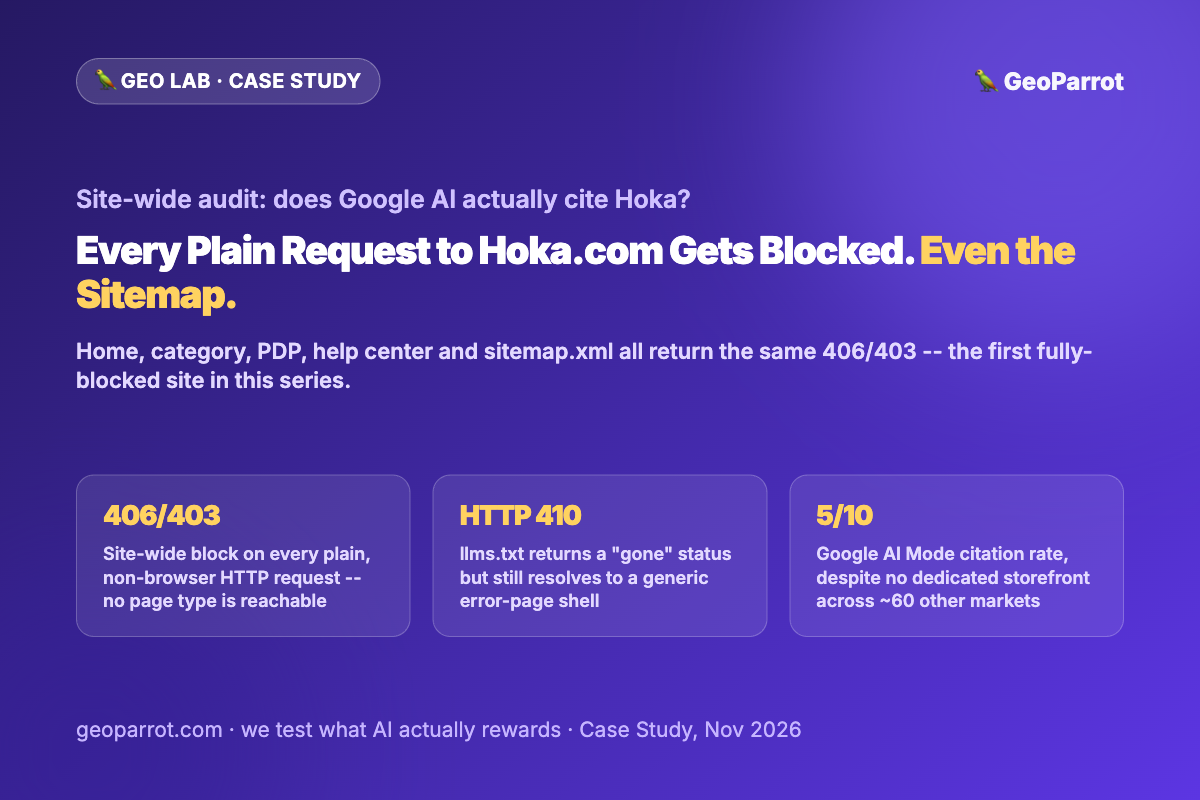
Hoka blocks every plain, non-browser HTTP request we sent it — home, category, product page, help center and even its own sitemap all return an identical “Access Denied” page — yet Google AI Mode still cited hoka.com in 5 of our 10 test queries. The brand’s llms.txt returns HTTP 410 Gone, but the body isn’t a clean error: it’s the site’s generic 676KB error-page shell, branded “Sites-HOKA-US-Site,” not any purpose-built AI policy document. And despite running dedicated storefronts for roughly 60 countries according to its own robots.txt — the US, Japan, and dozens of European and Middle Eastern markets among them — Hoka has no dedicated Korean-language site at all: requesting a Korea-region product URL just redirects back to the exact same US page, byte-for-byte identical in one case.
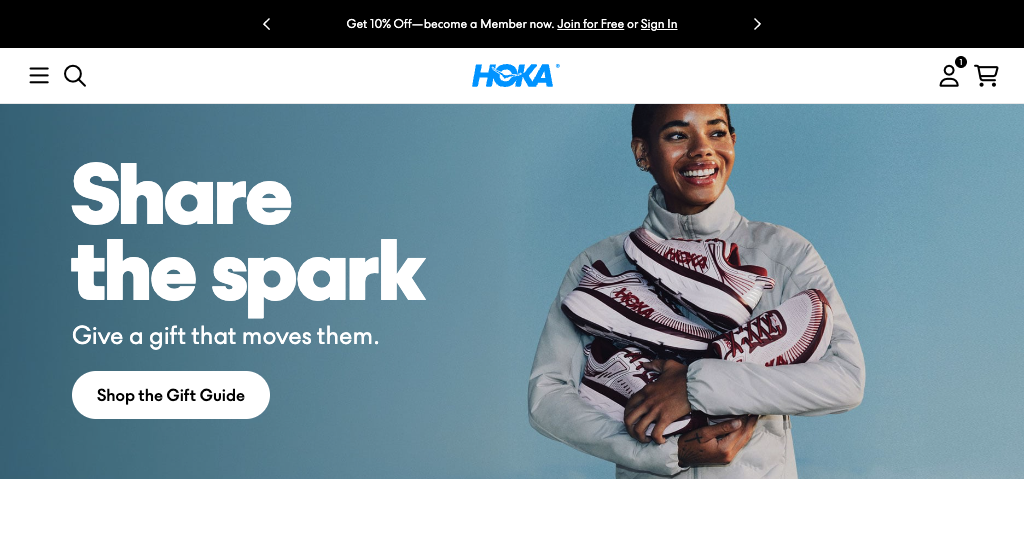
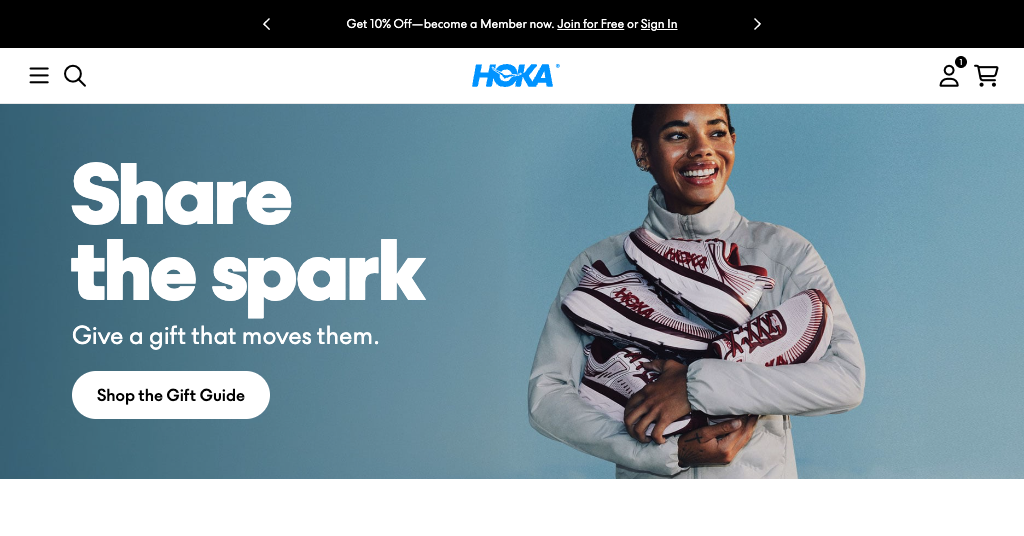
Actual public homepage captured during this audit, November 2026.
What is Hoka trying to do — and why audit it twelfth?
This is part 12 of GeoParrot’s sports-brand series, running the same evidence-first method we used on On Running, Converse, Reebok and nine other major brands. Hoka (styled HOKA) is a California-founded maximalist-cushion running shoe brand, now owned by Deckers Brands (which also owns UGG), best known for the oversized-midsole look it popularized and for shoes like the Bondi and Clifton lines. It’s a useful twelfth name because it’s the first brand in this series where every single page we requested, across the entire domain, returned an identical bot-block response to a plain HTTP fetch — not a partial block on one page type, the whole site.
Brand category Maximalist-cushion running shoe and apparel company, founded 2009 in France, now headquartered in Goleta, California under parent Deckers Brands.
Primary user job Find the right Bondi or Clifton-line running shoe for daily training, backed by sizing guidance (Hoka explicitly sells Regular, Wide and X-Wide width options) and clear return-policy information.
SEO + GEO challenge A site-wide bot wall that blocks every non-browser HTTP request, an llms.txt that resolves to a generic error-page shell instead of a real AI policy document, and the complete absence of a dedicated Korean storefront despite extensive global localization elsewhere.
The product we tracked: Bondi 9
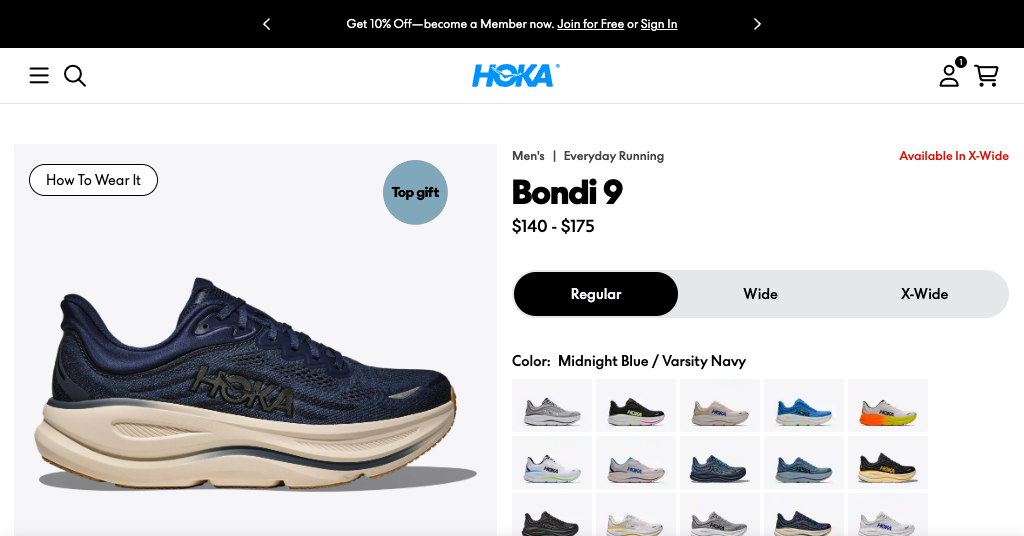
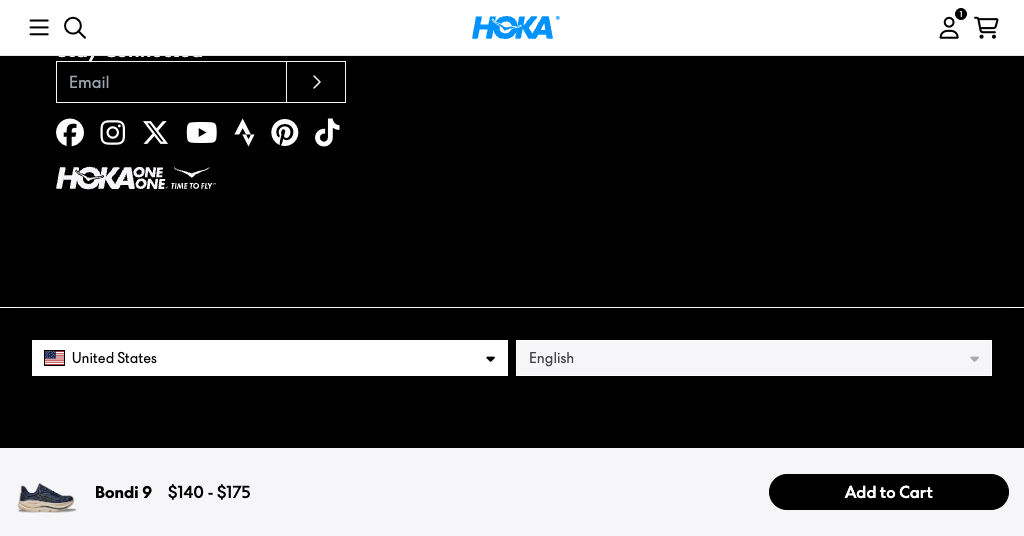
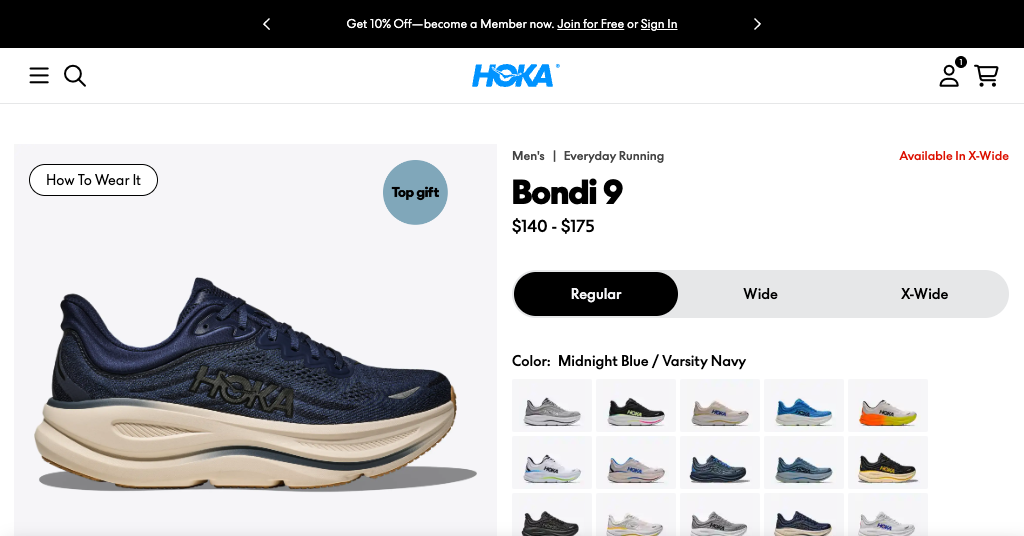
US product page: Midnight Blue / Varsity Navy, $140-$175, marked Available In X-Wide — no star rating or review count visible above the fold.Scrolled to the footer: a United States / English locale selector and sticky Add to Cart bar — still no review signal anywhere on the page.
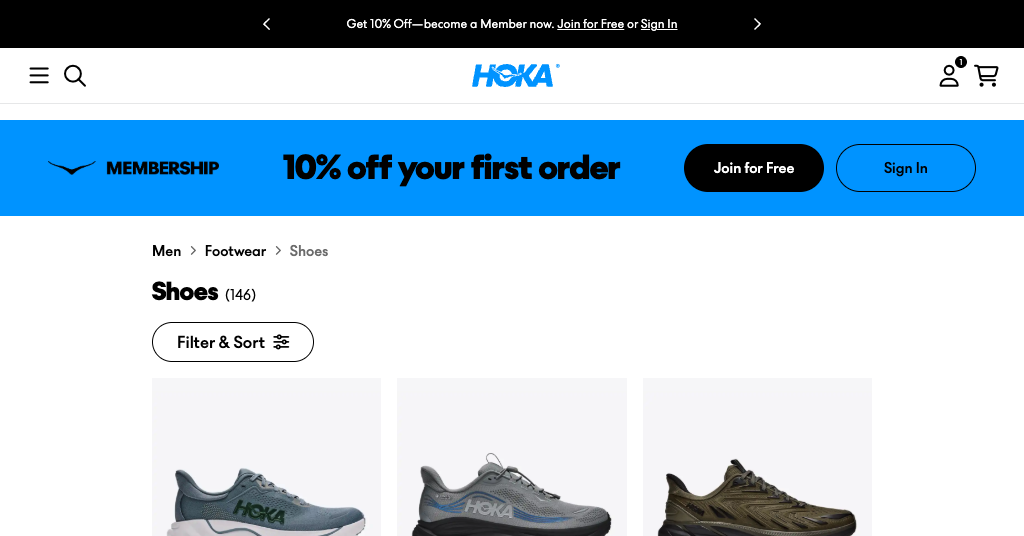
The category layer: “Shoes” (Men’s) at 146 results — one of the larger single-category counts in this series.
AI citation snapshot: 10 real queries, Google AI Mode
We sent 10 verbatim queries to Google AI Mode (udm=50) and checked direct a[href] links, counting a citation only when the exact registrable domain is hoka.com.
Query
hoka.com cited?
Who else showed up
best hoka running shoes for beginners
✅ Yes
runrepeat.com, tistory.com — hoka.com cited alongside a third-party review aggregator and a Korean blog
hoka bondi 9 review
❌ No
runrepeat.com, alastairrunning.com, run4it.com, doctorsofrunning.com, northernrunner.com, meta-endurance.com — continuing this series’ pattern of “[brand] [product] review” queries rarely citing the brand’s own domain
hoka vs on running
❌ No
runrepeat.com, alastairrunning.com, kream.co.kr, tistory.com, marathongo.co.kr, runtothefinish.com, poizon.com — neither brand’s own domain appeared; third-party comparison and resale sites dominated
hoka shoes return policy
✅ Yes
hoka.com was the only domain surfaced — the cleanest single-citation result in this run
are hoka shoes good for plantar fasciitis
✅ Yes
michiganfootdoctors.com, shape.com, runrepeat.com, vdbshoes.com, powerstep.com, forbes.com and others — hoka.com cited among a crowded field of medical and buying-guide sources
hoka bondi vs clifton
❌ No
alastairrunning.com, runningshoesguru.com, run4it.com, reddit.com, runtothefinish.com, findmyfootwear.com, marathonhandbook.com — Hoka’s own line-comparison content, if it exists, did not surface
best hoka shoes for wide feet
✅ Yes
ctrunco.com, theathletesfoot.com.au, runrepeat.com, northernrunner.com, widefitshoes.de — cited alongside third-party retailers, a query where Hoka’s own Regular/Wide/X-Wide sizing content is directly relevant
who owns hoka shoes
❌ No
wikipedia.org, worseonpurpose.com — the correct answer (Deckers Brands) is publicly verifiable, but neither hoka.com nor deckers.com surfaced here
hoka vs brooks running shoes
❌ No
No external links surfaced in the rendered results at all for this query — an empty-citation result rather than a competitor win
how to clean hoka shoes
✅ Yes
reddit.com, forbes.com, instagram.com — hoka.com’s own care guidance cited directly alongside social and media sources
Result: hoka.com cited in 5/10 queries (Nike 5/10, Adidas 4/10, Puma 5/10, Under Armour 8/10, New Balance 6/10, ASICS 7/10, Skechers 4/10, Lululemon 8/10, Reebok 7/10, Converse 7/10, On Running 6/10) — tied with Nike and Puma, lower-middle of the series. As with nearly every brand audited so far, both named-product and head-to-head comparison queries (“bondi 9 review,” “bondi vs clifton,” “vs on running,” “vs brooks”) failed to surface hoka.com even once — that’s 0 of 4 comparison-style queries, continuing a pattern now confirmed across the whole series. The brand’s own domain only appeared for care, policy, fit and medical-adjacent queries, not for product reviews or competitor comparisons.
G-score audit: the 8-pillar hygiene checklist
We scored six representative Hoka URLs with the same 8-pillar static-HTML checklist (JSON-LD present, FAQ content, visible date, author byline, concrete data points, table/list structure, 3+ subheadings, a 30-500 character early answer) used in our Week 17 quality-score experiment and on all eleven prior brands. Hoka is a first for this series in one specific way: a plain, non-browser urllib fetch to every single page we targeted — home, category, product page, help center, alike — returned an identical HTTP 406 “Access Denied” response (an 11.7KB block page), regardless of URL. Every page here had to be scored from a real browser-rendered DOM; there was no plain-fetch page to fall back on anywhere in this audit.
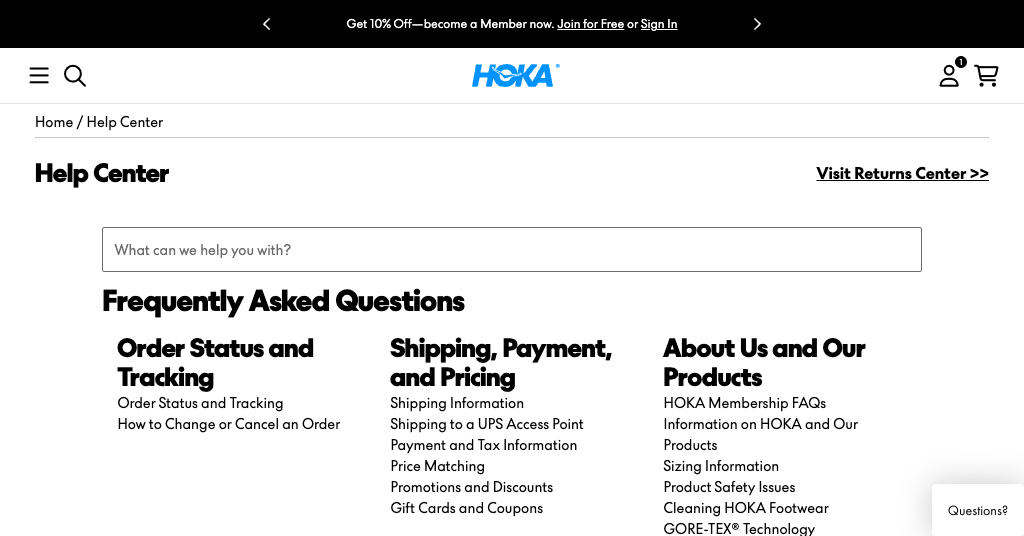
The Help Center: a three-column FAQ directory (Order Status, Shipping/Payment, About Us and Products) — no JSON-LD on this page even after browser rendering, despite the clear topical structure.
Page
Fetch method
G-score
Notable pillars
US homepage
Browser-rendered (plain fetch = HTTP 406)
0.625
1 JSON-LD block; has a visible date and data points; no FAQ, no author
Men’s Shoes category (US)
Browser-rendered (plain fetch = HTTP 406)
0.5
0 JSON-LD blocks even after rendering
Bondi 9 PDP (US)
Browser-rendered (plain fetch = HTTP 406)
0.625
1 JSON-LD block present; fails early-answer and FAQ pillars
Help Center (US)
Browser-rendered (plain fetch = HTTP 406)
0.625
0 JSON-LD blocks, but passes early-answer and has clear topic subheadings
/kr/ko/ Bondi 9 URL
Browser-rendered (plain fetch = HTTP 406)
0.625
Redirects to, and scores identically to, the US Bondi 9 PDP — this is not a distinct Korea page
/en/kr/ Bondi 9 URL
Browser-rendered — unmeasurable
n/a
Redirected to the US homepage in both attempts, but the rendered DOM captured only an 8-character text extraction on repeat runs — flagged unmeasurable rather than scored as 0, and excluded from the average
Five-page average: 0.6 (Nike: 0.4375, Puma: 0.354, Under Armour: 0.5208, New Balance: 0.5833, Adidas: 0.6458, ASICS: 0.4583, Reebok: 0.5417, Converse: 0.5208, On Running: 0.4583) — the third-highest full-page average in this series so far, behind only Adidas and Lululemon’s partial measurement. None of the five measurable pages scored below 0.5, and none scored above 0.625 — a narrow, consistently mid-to-upper band rather than one standout page carrying the average.
A site-wide plain-HTTP wall, and an llms.txt that resolves to an error shell
robots.txt — A long, standard Disallow list (checkout, cart, account forms, search-result grids, dynamic filter/color/size parameters) applied to User-agent: * with no per-bot rules. No AI crawler (GPTBot, ClaudeBot, PerplexityBot, Google-Extended) is named anywhere, positive or negative. The file also lists roughly 60 separate locale-specific hreflang sitemaps — the US, Canada, the UK, Australia, New Zealand, Japan, and dozens of European, Middle Eastern and North African markets. Korea is not among them.
Every plain HTTP request is blocked, site-wide — A bare curl request to the homepage, the Men’s Shoes category, the Bondi 9 PDP and the Help Center all returned the exact same HTTP 406 response: an 11,732-byte “Access Denied” page. This isn’t a single misconfigured page — it’s a uniform block applied across every URL pattern we tried, meaning any crawler that can’t execute JavaScript (or pass whatever bot-detection check is gating these requests) sees nothing at all, anywhere on the site.
sitemap.xml and sitemap_index_all.xml are also blocked — Both returned HTTP 403, with a response body served by captcha-delivery.com (DataDome’s bot-detection service) rather than any XML content. A crawler attempting to discover Hoka’s URL list the standard way hits the same wall as a crawler attempting to read a page.
llms.txt returns HTTP 410 — but the body is a generic error page — The status code itself (410 Gone, rather than a plain 404) is more deliberate than most “we never made one” cases in this series. But the actual response body is not a purpose-built AI policy page: it’s a 676KB page titled “Sites-HOKA-US-Site” in the page source, structurally identical to what a broken product URL on this same Salesforce Commerce Cloud platform would return. There is no llms.txt content here, just the platform’s generic not-found template wearing a 410 status code.
No dedicated Korean storefront — Requesting /en/kr/ for the Bondi 9 product redirected to the exact same URL and rendered content as the US homepage — the screenshot we captured is byte-for-byte (MD5) identical to our separate US homepage screenshot. Requesting /kr/ko/ for the same product redirected back to the English-language US Bondi 9 page. Both paths that would normally signal a Korea-region storefront simply bounce back to the US experience.
/en/kr/ Bondi 9 URL: redirects all the way back to the US homepage — same “Share the spark” campaign banner, same English copy, no Korea-region storefront./kr/ko/ Bondi 9 URL: redirected to the same US-site destination in our screenshots — in a later spot-check it landed on the equivalent English-language US Bondi 9 page instead of the homepage, an inconsistency we flag rather than paper over.
What works / What to verify
WHAT WORKS
Consistent mid-to-upper G-scores across every page type we checked (0.5-0.625, no catastrophic outliers), a clear Regular/Wide/X-Wide sizing signal on the PDP that’s directly relevant to one of the ten test queries, and a 410 status on llms.txt that is at least more deliberate than a silent 404.
WHAT TO VERIFY
Whether the site-wide 406/403 block on plain HTTP requests is an intentional anti-scraping measure or an overly broad bot-detection rule that also catches legitimate AI crawlers without a browser engine, whether Hoka genuinely has no Korea-region storefront or one exists at a URL pattern we didn’t try, and why the llms.txt path resolves to a generic error shell instead of either a real file or a clean 404.
Target query check — reported honestly, not inflated
We have not re-measured “hoka seo” or “hoka geo audit” query volume this session. Per the pattern already confirmed across eleven earlier subjects in this series on October 20, 2026 (Keyword Planner, US) — the large majority showed no measurable search volume at all for “[brand] SEO/GEO audit” phrasing — we’re not claiming this title drives ranking-based traffic. The distribution case for this series rests on internal links, our own index, and readers already following the GEO Lab arc, not on search demand for “[brand] SEO audit” as a query.
Frequently asked questions
Does hoka.com block automated requests to all of its pages, or just certain ones?
All of them, based on what we tested. A plain, non-browser HTTP request to the homepage, the Men’s Shoes category page, the Bondi 9 product page and the Help Center all returned an identical HTTP 406 Access Denied response. We can’t rule out an unblocked page existing elsewhere on the site, but every page we included in this audit’s scope was blocked the same way.
Does Hoka have a dedicated Korean-language online store?
Not based on what we found. Requesting the /en/kr/ product URL redirected to the exact same US homepage we already had on file, byte-for-byte identical in our screenshot comparison, and the /kr/ko/ path redirected back to the same English-language US product page. Hoka’s own robots.txt lists locale-specific sitemaps for roughly 60 countries, including Japan, but Korea is not one of them.
What is at hoka.com/llms.txt?
An HTTP 410 Gone response, but the response body is not a clean error page — it is the site’s generic, 676KB error-page template (titled Sites-HOKA-US-Site in its source), the same kind of page the site likely returns for any broken product URL on this platform. There is no AI-specific policy document served at this address.
Does a mid-pack AI citation rate of 5/10 mean Hoka’s site-wide bot-blocking isn’t hurting its AI visibility?
Not reliably — this audit is itself a data point against that conclusion, consistent with eleven prior brands in this series. Our Week 17 experiment found hygiene and technical-structure scores were not a dependable predictor of AI citation, and here Hoka blocks every plain HTTP request on the entire site yet still lands at a tied-for-middle 5/10 citation rate with one of the higher G-scores measured so far. A likely explanation is that Google’s own crawler and retrieval infrastructure are not subject to the same bot-detection challenge that blocks a plain curl request — but our 10-query snapshot measures the domain family, not individual URL citation, so we can’t confirm that specific mechanism from this data alone.
Audit evidence, scope and limits
Inspected: November 2026, public logged-out access from a Korea-based IP (real browser session used for screenshots, G-score rendering and citation testing; plain HTTP fetches used urllib with a standard desktop user agent). Screens: US homepage, Men’s Shoes category (146 results), the Bondi 9 product page (top and footer/locale-selector), US Help Center, and the /en/kr/ and /kr/ko/ Bondi 9 URLs — plus robots.txt, llms.txt, sitemap.xml/sitemap_index_all.xml checks, a 10-query Google AI Mode citation snapshot, and an 8-pillar G-score scored on six target pages (all six required browser rendering; plain fetch returned HTTP 406 on every page we tried).
Not measured: rankings, Search Console performance, analytics, conversion, signed-in/member flows, ChatGPT citations (not attempted, given the composer failures flagged on earlier audits in this series), the exact bot-detection vendor or rule set behind the 406/403 responses, whether a legitimate Korea storefront exists at some other undiscovered URL pattern, or the complete product/locale catalogue beyond the one shoe line and six URLs sampled here. This is a public-signal snapshot, not a performance claim or a full-catalogue crawl.
This is part 12 of a daily series. Every day, GeoParrot runs this same evidence-first method — real screenshots, a 10-query AI citation snapshot, an 8-pillar G-score audit, and an honest target-query check — against one more major sports and athletic-wear brand. Next: Vans.



Leave a Reply