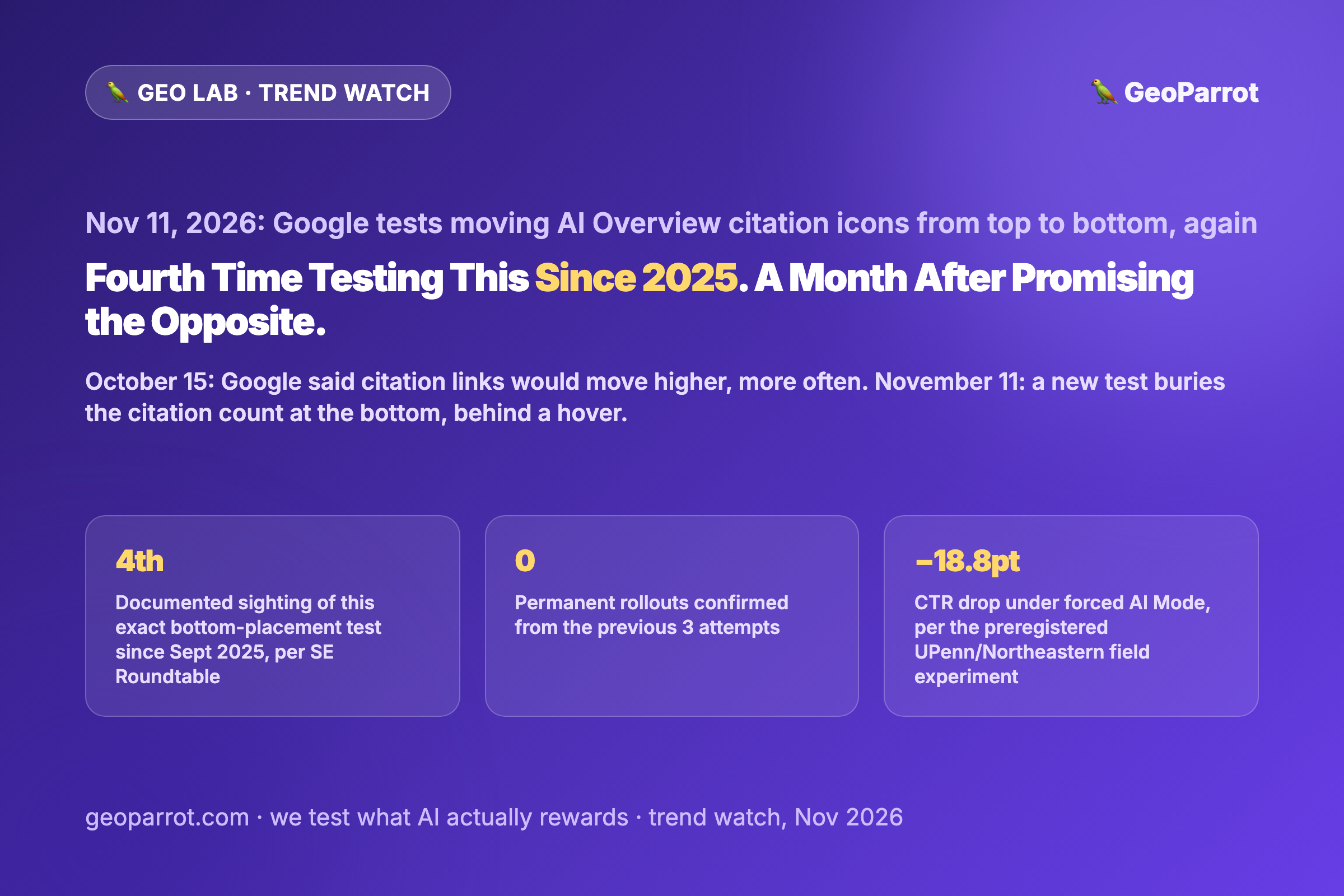
Quick answer: On November 11, 2026, SEO analyst Brodie Clark (via SERP Alert) found Google testing a layout where the AI Overview citation count moves from directly above the answer to a small hover-only element at the bottom. Barry Schwartz immediately asked why Google would reduce source visibility when lower placement usually means fewer clicks. It’s a fair question, and not a new one. Search Engine Roundtable’s own coverage shows this identical bottom-placement test running in September 2025, March 2026, and again September 29, 2026, with no permanent rollout any time. This is the fourth sighting in roughly 14 months, and it lands one month after Google’s October 15 promise to push citation links “higher up in responses more frequently,” a claim we already found was backed by a feature-adoption number, not a click number. Google hasn’t commented on this specific test.
Trend watch, published November 13, 2026, in the GEO Lab. We read every AI-search interface change the same way: what’s actually shipped, what’s a test, and whether it squares with what the company said last time.
What exactly did Brodie Clark find on November 11?
Clark, an independent SEO consultant who tracks SERP layout changes, posted screenshots and video showing a new AI Overview design on desktop. In the current, common layout, a small row of source icons sits directly above the generated answer, visible the moment the box renders. In the test he found, that row is gone from the top; a citation marker appears at the bottom instead, and the full source list only shows on hover. Search Engine Roundtable, which broke the story the same day, calls it an active test, not a confirmed change, and Google has made no statement on it.
Why does “bottom” matter a month after Google promised “higher”?
Because the direction is the opposite of what Google said it was doing. On October 15, 2026, Google’s Search blog announced changes meant to make AI Mode and AI Overview links more visible: inline links placed “higher up in responses more frequently.” We covered that announcement and found its one supporting number, Preferred Sources adoption “up more than 7x,” measured setting adoption, not clicks. A citation row moving from the top of the answer to a hover-only element at the bottom is, on its face, a visibility decrease for the same kind of link that announcement said it was elevating. Nothing proves the two efforts are connected, or that one team at Google knows what another is testing. But it’s a clean reminder not to treat any single UI announcement as a durable commitment: Google runs many simultaneous, often contradictory layout experiments, and what one user sees on one day says little about company-wide direction.
Hasn’t Google tried this exact test before?
Yes, repeatedly. Search Engine Roundtable’s own archive documents this same idea (moving citation cards or icons to the bottom of the AI Overview) surfacing in September 2025, March 2026, and again September 29, 2026, where the outlet itself called it “the third iteration.” November 11 makes a fourth sighting in roughly fourteen months. None of the three prior instances got a stated permanent rollout; each generated a round of SEO-press coverage, then the conversation moved on with no confirmation from Google either way. That pattern, more than any single sighting, is the real story: a layout Google keeps testing and keeps not committing to.
Date
What was reported
Shipped permanently?
September 2025
Citation cards tested at bottom of AI Overview
No
March 2026
Same bottom-placement idea retested
No
September 29, 2026
Citation cards at bottom, desktop, called the third iteration
No
November 11, 2026
Citation icon count moved to bottom, full list on hover only (Brodie Clark)
Unconfirmed, test-stage
Compiled from Search Engine Roundtable’s coverage, most recently its November 11, 2026 report citing Brodie Clark’s findings.
What does our own click data say about citation placement?
We don’t have a controlled test of this exact element, since it isn’t shipped broadly enough to measure. But the broader link between AI-answer visibility and clicks is already measured, and the direction is consistent: less-prominent source links mean fewer clicks. A preregistered, randomized field experiment from UPenn and Northeastern (N=1,100 real Google users) found forced AI Mode cut click-through to external sites by 18.8 percentage points. Ahrefs’ 963-domain panel found AI Overviews cut CTR by a median of 5.7%, rising to 23.1% for the most AI-exposed sites. Glenn Gabe’s own GSC case study, cited in a different trend piece this week, showed one site’s daily clicks fall from roughly 750 to roughly 400 once AI Overviews simply started appearing more, with no hover-gated citation list involved. A list that requires a deliberate second action most users never take is a plausible way to push that number lower still, but nobody has a before/after test of this specific change yet.
What should you actually do about this?
Don’t change anything based on a test-stage screenshot. Three prior versions of this exact test never shipped broadly.
Keep optimizing for citation, not the citation UI. Our own locked-prediction test found every rank-matched citation we tracked came from the top 10 organic positions, a mechanism unaffected by where the icon sits.
Segment your Search Console AI-surface clicks now, so you have a clean before number if this ships broadly later.
Wait for a Google statement, not more screenshots. This moves from rumor to fact only with a confirmed scope or permanent decision, which three previous rounds of coverage never got.
Frequently asked questions
Has Google confirmed it’s moving AI Overview citations to the bottom permanently?
No. The evidence is Brodie Clark’s November 11, 2026 screenshots and video, reported by Search Engine Roundtable the same day as an active experiment, not a confirmed rollout. Google has made no public statement on it.
Is this the first time Google has tested this?
No. Search Engine Roundtable’s own coverage documents this same bottom-placement idea in September 2025, March 2026, and September 29, 2026 (which it called the “third iteration”), making November 11 at least the fourth sighting in roughly fourteen months. None of the prior three got a stated permanent rollout.
Doesn’t this contradict Google’s October 15 announcement about making links more visible?
Directionally, yes. We have no evidence the two efforts are connected; large companies run many simultaneous, uncoordinated UI experiments. It’s a reason to discount both as settled facts, not to conclude Google is deliberately inconsistent.
Do we have click data on this specific citation placement?
Not for this exact UI element. The closest evidence is broader research tying AI-answer prominence to lower click-through: a preregistered UPenn/Northeastern field experiment found an 18.8-point CTR drop under forced AI Mode, and Ahrefs’ French domain panel found a median 5.7% CTR decline from AI Overviews generally.
Should I change my GEO strategy because of this test?
No. Citation position inside the AI Overview box doesn’t change what gets your site cited in the first place, which our own testing continues to tie to organic rank. Watch Search Console if this ships broadly, but don’t act on a fourth unconfirmed screenshot of a test that hasn’t shipped three times before.


Leave a Reply