

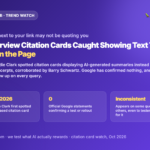
Quick answer: On November 11, 2026, SEO consultant Brodie Clark found Google testing an AI Overview layout that moved the citation count from above the answer to a hover-only element at the bottom, a visibility decrease we covered the same week. On November 17, Clark spotted the opposite change: a new default showing three citation cards directly under the answer with no fade effect, making the third citation as visible as the first (previously, only the first citation displayed clearly and the rest faded out). SEO consultant Sachin Patel is calling it “sticky AI Overview” citations. Google has not confirmed either test, and nothing ties the two together beyond the six-day gap and the fact that both touch the same UI element. That gap is the story: the part of AI Overviews that every citation-tracking study treats as a fixed, measurable surface changed direction twice in under a week.
Published November 18, 2026, in the GEO Lab. This week’s arc opened by comparing four 2026 studies that measured AI Overview citation volatility and got four different numbers, then found a second confound when Google hid which Gemini model answers a given query. This is a third: the citation display container itself is not stable either.
What did Brodie Clark actually find on November 17?
Clark posted screenshots on X showing a new default state for AI Overview citation cards on desktop. In the layout most people see, the first citation card renders clearly and the ones below it fade progressively, so only the top source reads as fully legible without extra effort. In the change Clark found, three citation cards sit beneath the answer with no fade applied to any of them, so the second and third sources are exactly as readable as the first. Search Engine Roundtable, which has tracked this exact UI element across more than half a dozen tests since September 2025, reported the find the same day. No percentage of users or query types has been disclosed, and Google has made no statement confirming or explaining the change.
Why does this matter six days after the opposite test?
Because the two tests move citation visibility in opposite directions, inside the same six-day window. On November 11, the tested change buried the citation count behind a hover interaction at the bottom of the answer, a design that reduces how many people notice sources exist at all. On November 17, the tested change does the reverse: it removes a visual cue (the fade) that was already quietly discouraging people from reading past the first source. Neither test has a stated rollout percentage, a stated goal, or a stated end date. Taken together they say less about where Google is heading on citation visibility than about how often the underlying layout is in flux at any given moment, which is the detail a single screenshot, taken on a single day, cannot capture.
| Date spotted | What changed | Effect on source visibility | Who found it |
|---|---|---|---|
| Nov 11, 2026 | Citation icon row moved from above the answer to a hover-only element at the bottom | Decrease; sources no longer visible by default | Brodie Clark, via SERP Alert |
| Nov 17, 2026 | Three citation cards shown with no fade, up from one clear card plus fade on the rest | Increase; third citation now as legible as the first | Brodie Clark; also flagged by Sachin Patel as “sticky AI Overview” |
Does this connect to the citation-volatility numbers from Monday?
Only as a reminder of what those numbers can’t see, not as a correction to them. Monday’s post compared four studies that measured how often AI Overview’s cited pages change, from SISTRIX’s 5% weekly churn-in to GetMentions’ pooled 69% daily turnover. None of those four studies logged, or could have logged, which rendering of the citation UI was shown to which user on which day, because that variable wasn’t something Search Engine Roundtable had reported on at the time most of that data was collected. A tracker scraping AI Overview output doesn’t see fade states or hover interactions; it sees whichever domains got cited. So the unfaded-cards test doesn’t change any of the four numbers from Monday. It adds a separate, compounding reason to be careful with all of them: the measuring instrument’s own display layer is being actively tested in both directions, in the same week the underlying citation set is also shifting.
Checklist: what to do with a citation UI that flips direction in a week
- Don’t screenshot once and call it the current state. The same citation element changed twice in six days. A screenshot from November 10 and one from November 18 would show two different layouts for the same feature.
- Separate “is my page cited” from “would a user notice.” These two tests changed how visible a citation is, not which pages get cited. A brand can be cited and still be effectively invisible if it lands in a faded third slot, or newly visible if the fade test rolls back.
- Don’t treat either test as a signal about Google’s long-term direction. Four prior bottom-placement tests since September 2025 never got a stated permanent rollout, per our November 13 coverage. Treat this one the same way until Google says otherwise.
- If you’re running or reading a citation-tracking study, ask what UI state it was collected under. None of the four studies compared this week disclosed that detail, and now there’s a concrete reason it could matter.
Frequently asked questions
Is Google officially rolling out unfaded AI Overview citations?
Not confirmed as of November 18, 2026. It is a test spotted by SEO consultant Brodie Clark and reported by Search Engine Roundtable, with no stated rollout percentage, timeline, or goal from Google.
Didn’t Google just test hiding citations at the bottom?
Yes, on November 11, 2026, six days before this one. That test moved the citation count to a hover-only element at the bottom of the answer, which we covered as the fourth sighting of that specific pattern since September 2025. The two tests move in opposite directions on source visibility and are not confirmed to be related.
What is “sticky AI Overview” citations?
It’s the term SEO consultant Sachin Patel used to describe the same November 17 change Brodie Clark reported: citation cards that stay fully visible and legible rather than fading after the first one.
Does this affect which pages AI Overview cites?
No. Both tests change how citations are displayed, not which domains get selected as sources. A page’s odds of being cited are a separate question from how visible that citation is once it’s shown.
Should I change anything based on this test?
No immediate action is justified by an unconfirmed test that could revert within days, as the November 11 test and its three predecessors did. The more durable takeaway is methodological: when you evaluate your own AI Overview visibility, note the date and the layout you saw, because both can change out from under you.
GeoParrot is a GEO Lab: we run experiments to test what AI search engines actually reward, and we track interface changes the same way, what’s confirmed, what’s a test, and whether it squares with what the company said last time. See the running scoreboard at our 2026 GEO benchmark. Related: the November 11 bottom-placement test, and this week’s four-study citation volatility comparison.



Leave a Reply