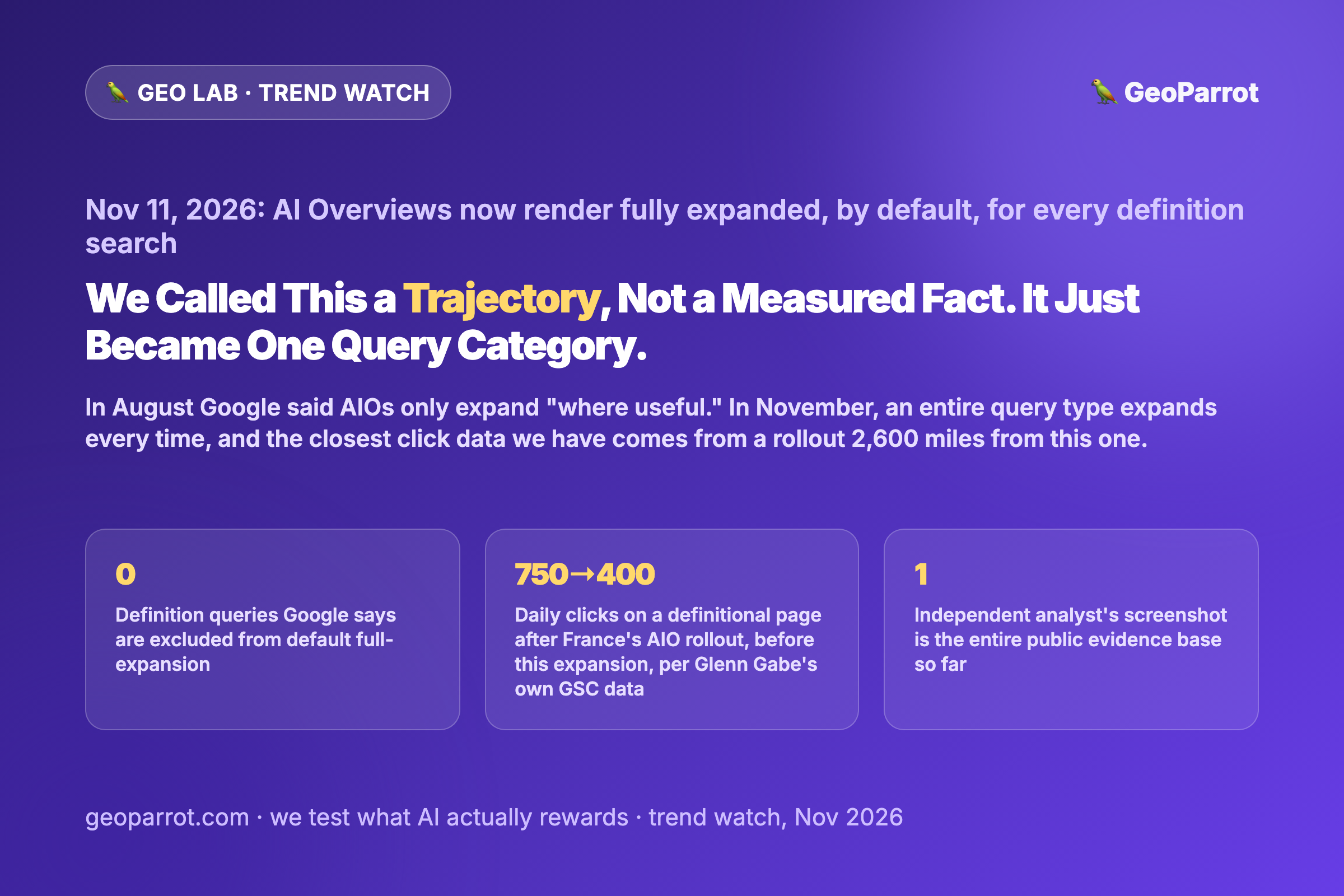
Quick answer: On November 11, 2026, SEO analyst Glenn Gabe found that Google’s AI Overview for definition-style searches (e.g. “define expandable”) now renders fully expanded on load, with no “Show more” click needed, pushing organic blue links below the first screen. Google has not issued a statement on this specific change; the only prior Google quote on record is from August, describing expansion as happening only “for topics where our systems determine it to be most useful,” which we read at the time as a trajectory Google hadn’t disclosed the scope of. Three months later, an entire query category appears to get full expansion every time, with no stated exception. We don’t have click data for definition queries specifically. Gabe’s own first-party case study of a different rollout (AI Overviews arriving in France) is the closest proxy, and it showed one site’s daily clicks fall from roughly 750 to roughly 400, with CTR dropping from about 2% to about 1.1%, before any default full-expansion was involved. If full-screen AIO dominance has that effect on ordinary informational queries, definition queries, already the most completely answerable in a single paragraph, have little room left to hold a click.
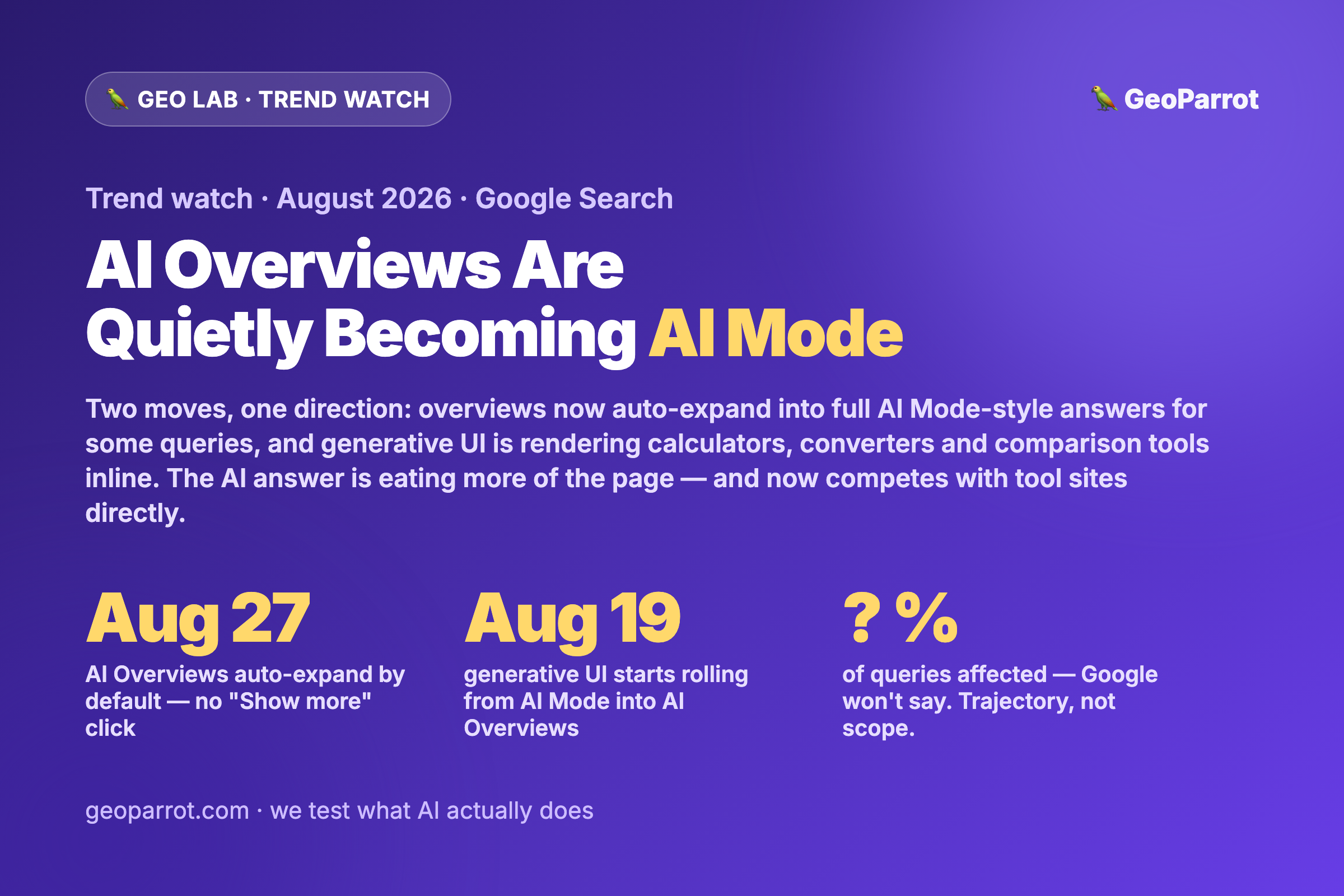
Trend watch, published November 12, 2026, in the GEO Lab. In August we wrote about Google’s default auto-expansion mechanism and said explicitly that Google never disclosed what share of queries it covered, so “AI Mode is becoming the default” was a direction, not a measured fact. This is the first concrete instance we’ve seen of that direction landing on a whole query type.
What exactly changed on November 11?
Glenn Gabe, an independent SEO consultant who tracks Google algorithm and SERP changes closely, posted screenshots showing that searches like “define expandable” now return an AI Overview that is already fully expanded on page load. Previously, and still the default behavior for most other query types, a shortened AI Overview appears with a “Show more” link, and the user has to click to see the full synthesized answer. For this query category, that click is gone: the full answer renders immediately, and because it’s long enough to fill the visible viewport, the organic web results sit below the fold without scrolling. Multiple independent write-ups (Search Engine Roundtable, PPC Land, The King of Search) picked up and corroborated the same screenshot evidence within hours, which is more independent confirmation than most AI Overview UI changes get, but it’s still screenshot-level corroboration of one observer’s queries, not a disclosed rollout percentage from Google.
Why connect this to something we flagged in August?
Because the mechanism isn’t new, the scope is. On August 27, 2026, Google confirmed to reporters that “some queries” dynamically expand AI Overviews by default, attributed to a statement from Google’s Robby Stein: “AI Overviews only dynamically expand for topics where our systems determine it to be most useful.” At the time, we wrote that this framing (dynamic, selective, query-by-query) meant nobody outside Google could say how common full expansion actually was, and that calling it “AI Mode becoming the default” got ahead of the evidence. Three months on, Gabe’s find is the first time we’ve seen that mechanism apply to an entire, nameable query category rather than scattered individual queries. That’s a meaningfully different claim: “this type of search always gets the full answer” is testable and falsifiable in a way “some queries sometimes expand” never was. It’s also still not Google confirming a percentage, a query-type list, or a permanent commitment. It’s one analyst’s queries, independently reproduced by a few other writers, with Google silent on this specific instance.
What does the click data actually say?
Nothing specific to definition queries exists yet, as far as we could find. But Gabe has published his own first-party Search Console data from a related event, the July 22, 2026 AI Overviews rollout in France, and it’s the best proxy available for what happens when an AIO takes over more of the first screen. For one site, daily clicks fell from about 750 to about 400 after the rollout (CTR from roughly 2% to roughly 1.1%). A smaller site in the same dataset dropped from about 80 clicks a day to about 25. A third case showed CTR falling from about 1.2% to about 0.4%. None of those numbers are about definition queries or about default full-expansion specifically; they measure what simply having an AI Overview appear did to clicks, not what happens when that AI Overview additionally skips the “Show more” step. The honest reading is that full default expansion is a plausible amplifier of an effect we already have real numbers for, not something we have numbers for directly yet.
Source
What it measures
Specific to definition queries?
Confirmed by Google?
Glenn Gabe, Nov 11 screenshots
AI Overview renders fully expanded on load for “define X” searches
Yes, the entire finding
No official statement on this instance
Google / Robby Stein, Aug 27
General statement that some queries dynamically expand AIOs
No query-type list given
Yes, but no scope or percentage disclosed
Gabe’s France GSC case study, Jul 22 rollout
Click/CTR drop after AI Overviews simply appeared (no full-expansion variable)
No, mixed query types, one country
First-party GSC data, not Google-confirmed causally
GeoParrot AI Overview rank test
Which organic positions get cited inside classic AI Overview answers
Compiled from Glenn Gabe’s November 11 screenshots (via Search Engine Roundtable, PPC Land, and The King of Search), Google’s August 27 statement to reporters, Gabe’s own GSC case study of the French AI Overview rollout, and our own rank-citation test.
What should you actually do if you publish definitional content?
Segment your Search Console data by query intent before reacting. Filter for “define,” “what is,” and “meaning of” queries specifically. A blended CTR trend can hide a steep decline on exactly this slice while looking flat overall.
Don’t rewrite glossary pages into longer answers hoping to “win” the AI Overview. A fuller page doesn’t make Google show less of its own synthesized answer; it’s still Google deciding whether and how to expand, not you.
Shift the goal from being ranked to being the cited source inside the box. Our own locked-prediction test found that for Google’s classic AI Overview, 100% of rank-matched citations we tracked came from the top 10. Rank still matters, just as a gate to citation rather than a path to a click.
Treat this as Google-scoped, not universal. Our cross-engine citation test found almost no overlap in what ChatGPT, Perplexity, Gemini, and Google’s own AI Overview cite. A UI change in Google’s AIO box says nothing about how ChatGPT or Perplexity handle the same definition query, so don’t let this one change rewrite your whole GEO strategy.
Watch for the actual confirmation, not just the screenshot. If Google publishes a scope, or if Search Console’s Gen-AI performance report starts breaking out definition-style queries, that’s the point this moves from direction to measured fact.
Frequently asked questions
Has Google officially confirmed AI Overviews now auto-expand for all definition searches?
No. The evidence is Glenn Gabe’s November 11 screenshots, independently reproduced by a handful of other SEO writers within the same day. Google’s only public statement on the broader auto-expansion mechanism is from August and describes it as happening for “topics where our systems determine it to be most useful,” without naming definition queries or giving a percentage of affected searches.
Is this the same thing GeoParrot wrote about in August?
It’s the same underlying mechanism, applied more specifically. Our August post covered Google’s general confirmation that some AI Overviews dynamically expand by default, and we flagged at the time that the scope was undisclosed. This is the first concrete sighting of that mechanism covering an entire, nameable query category rather than scattered individual queries.
Do we have real click data showing what this does to definition-page traffic?
Not for definitions specifically. The closest available data is Glenn Gabe’s own Search Console case study of a different event: AI Overviews arriving in France in July 2026, where one site’s daily clicks fell from about 750 to about 400 after AI Overviews simply started appearing, before any default full-expansion was part of the picture. It’s a reasonable proxy for direction, not direct proof for this specific change.
Should I stop publishing glossary or definition content?
No, but set expectations correctly. If Google’s AI Overview answers the query completely on the results page, a click was never guaranteed for that query type. The more durable goal is being the source the AI Overview actually cites, which still appears tied to organic rank in our own testing, rather than the click itself.
Does this apply to ChatGPT, Perplexity, or other AI search tools too?
No evidence of that. This is a Google AI Overview UI behavior specifically. Our own cross-engine testing found almost no overlap in what different AI engines cite or how they render answers, so a change to Google’s box shouldn’t be assumed to apply anywhere else.



Leave a Reply