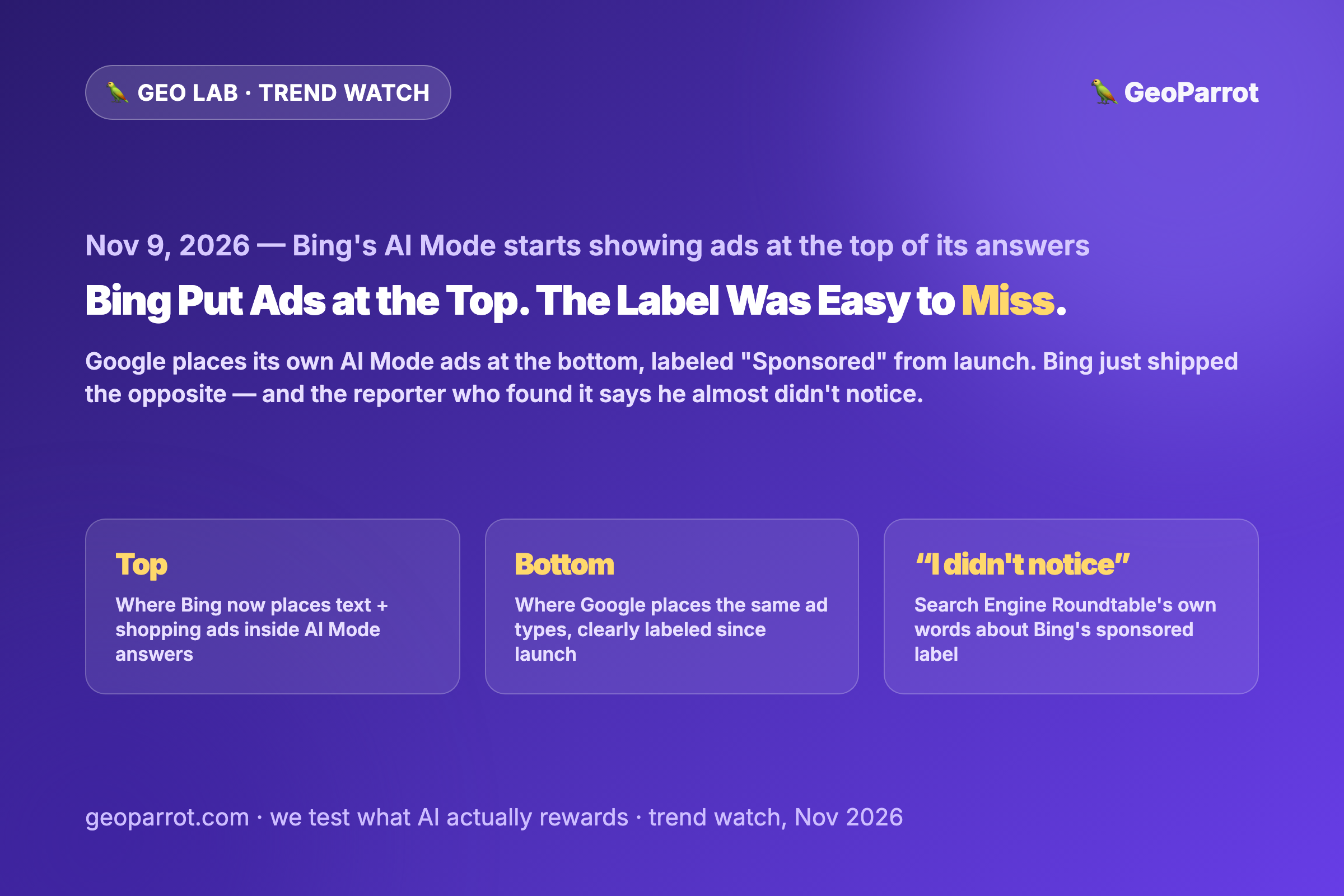
Quick answer: On November 9, 2026, Barry Schwartz at Search Engine Roundtable reported that Bing’s AI Mode is now showing both regular search ads and shopping ads at the top of its AI-generated answers, based on screenshots Sachin Patel posted on X and on Search Engine Watch. Schwartz’s own line about the label: “the ‘sponsored’ labels on the Bing results are so muted, at first I didn’t notice they were ads.” That is the opposite of how Google built AI Mode ads — Google placed them at the bottom of the response from launch, labeled them “Sponsored” from day one, and has spent the past few weeks testing even clearer “Sponsored” vs. “All products” headers to keep paid and organic results apart. Microsoft has made no public comment on the placement or the label design. Nothing here is an FTC enforcement action against Microsoft — it’s a case study in two companies solving the same problem (ads inside a conversational answer) in opposite order: Bing shipped the riskier position before the clearer label, Google shipped the clearer label before testing the riskier position.
Trend watch — published November 10, 2026, in the GEO Lab. We test our own citation data most days; this one is about what sits next to those citations once an engine starts selling the space around them.
What exactly did Bing change, and when?
On November 9, 2026, Schwartz reported that Bing’s AI Mode (the successor branding to Copilot Search) is showing ads at the top of its AI-generated answers, not interspersed within the generated text and not appended below it. Both formats now appear there: ordinary text search ads and a shopping ad carousel. The evidence is screenshots, not an official Microsoft announcement — Sachin Patel first spotted and posted the examples, Schwartz verified and wrote them up. The same week, Microsoft Advertising’s own newsletter (dated November 9) described a batch of changes rolling out from an October 28 announcement — AI-written-ad guidelines, AI-assisted campaign creation, a Conversions API, new Performance Max controls — with no mention of this specific placement or label change. That gap matters: it means the top-of-answer placement shipped without the kind of product messaging Microsoft usually puts around a monetization change, which is why outside reporters are the only source for how it actually looks.
How does this compare with where Google put its own AI Mode ads?
Oppositely, on both axes that matter. When Brodie Clark first documented Google testing ads inside AI Mode, he noted the placement was at the bottom of the response, after the generated answer finished, carrying an explicit “Sponsored” label from the first screenshot. Google has since expanded that ad format to ten more countries and added multiturn ads that persist into follow-up questions, but the bottom-of-answer position and the plain “Sponsored” tag held. More recently, Google went further and started testing separate “Sponsored” and “All products” headings inside AI Mode shopping results specifically to keep paid and organic listings visually apart — a company that already labels ads clearly, working to label them even more clearly. Bing’s rollout inverts both choices: the more valuable position (top, where a reader’s eye lands first) combined with the less noticeable label. Position and clarity don’t have to move in opposite directions, but in this case they did.
Platform
Ad placement in AI answer
Label clarity (as reported)
Trend this year
Google AI Mode
Bottom of response
Explicit “Sponsored” from launch; testing even clearer sponsored/organic headers
Expanding countries and multiturn ads, keeping label design stable or clearer
Bing AI Mode
Top of response
“So muted” the reporter covering it said he missed it at first
New as of Nov 9, 2026; no Microsoft comment on label design yet
Compiled from Brodie Clark’s original Google AI Mode ad documentation, Search Engine Land’s reporting on Google’s clearer-label testing, and Barry Schwartz’s November 9, 2026 Search Engine Roundtable report on Bing.
Does a muted label actually break a disclosure rule?
We’re not aware of any regulator opening a case over this specific Bing change, and we want to be precise about that rather than imply one exists. What we can say is that the FTC’s long-standing “clear and conspicuous” disclosure guidance — used for everything from native advertising to influencer posts — asks that a sponsorship label be hard to miss: high enough contrast, large enough text, positioned where a reader actually looks, not technically present but practically invisible. A professional search-industry reporter saying, in his own write-up, that he didn’t notice the label on first look is a real-world failure of exactly that standard, independent of whether any agency acts on it. It’s also a predictable failure: AI-generated answers already blur the line between “the model said this” and “someone paid for this to appear,” which is precisely why Google’s own shopping-ads team is moving toward more separation, not less, even without a prompting case against it.
Why should a GEO practitioner who doesn’t run Bing ads care?
Because this isn’t really an ads story for us — it’s a measurement story. If you track how AI answer monetization affects the surfaces your content gets cited on, “ads in AI Mode” stopped being one thing the day Bing and Google diverged on where those ads sit and how visible they are. A citation that lands below an unlabeled-feeling ad at the top of a Bing answer is a different piece of real estate than a citation sitting above a clearly-labeled ad at the bottom of a Google one, even though both would get reported identically in most rank-tracking tools as “cited in AI Mode.” We’ve written before about what ads inside AI answers mean for GEO and about Bing’s own AI-citation tooling shipping with caveats attached — this is the same pattern again: a platform ships a monetization or visibility feature, and the fine print on how it actually behaves lags the feature itself by days or weeks, and only outside reporters close that gap in the meantime.
What should you actually do with this?
Audit ad placement and label visibility per engine, not once for “AI search.” Google AI Mode and Bing AI Mode now place ads in opposite positions with different label clarity. Any assumption about where a citation sits relative to paid content has to be re-checked engine by engine, not generalized from whichever one you tested first.
Don’t wait for a regulator to treat a faint label as a real problem. Google is already tightening its own sponsored/organic separation in AI Mode shopping results without any enforcement action forcing it to. Treat visible, unambiguous disclosure as a competitive signal platforms correct toward on their own, and expect Bing to patch the label design after press coverage rather than before.
Re-baseline any CTR or trust assumptions you’ve made about AI answer surfaces. A reader who can’t immediately tell an ad from the rest of the answer behaves differently than one who can — and that behavior difference is now platform-specific, not a general property of “AI search.”
If you track citation position as a KPI, add “relative to nearest ad” as a column, not just “cited: yes/no.” Position next to an ad is now a variable that differs by engine and changes without notice, which means a single cross-engine citation-rate number can hide very different user experiences underneath it.
Frequently asked questions
What exactly changed with Bing’s AI Mode ads?
As reported by Search Engine Roundtable on November 9, 2026, Bing’s AI Mode began showing both ordinary text search ads and a shopping ad carousel at the top of its AI-generated answers, based on screenshots from Sachin Patel. The change has not been confirmed or explained in an official Microsoft announcement; the same week’s Microsoft Advertising newsletter described other changes from an October 28 rollout without mentioning this one.
How is this different from how Google places ads in AI Mode?
Google’s AI Mode ads have appeared at the bottom of the generated response since Brodie Clark first documented them, carrying an explicit “Sponsored” label, and Google has recently tested even clearer separate headers for sponsored versus organic shopping results. Bing’s new placement is at the top of the answer, with a label the reporter covering it described as so muted he initially missed it — the opposite choice on both position and clarity.
Is this confirmed to violate an FTC rule?
No. We are not aware of any regulatory action against Microsoft over this specific change, and we are not claiming one exists. We’re pointing to the FTC’s established “clear and conspicuous” disclosure standard as a reference point for evaluating label visibility, not reporting an investigation or enforcement action.
I don’t run ads on Bing. Why does this matter for my content strategy?
Because it changes what a citation inside an AI answer actually means. If your content is cited in Bing’s AI Mode, it may now sit near an ad that’s harder for the reader to identify as paid than the equivalent ad would be on Google. That changes reader trust and attention dynamics around your citation even though the citation itself didn’t change, and it means cross-engine citation-rate comparisons without this context can be misleading.
Has Microsoft responded to this report?
Not as of this writing. Microsoft Advertising published a newsletter on November 9, 2026 describing several other recent changes, but it did not address the top-of-answer ad placement or the label design that Search Engine Roundtable reported the same day.

Leave a Reply