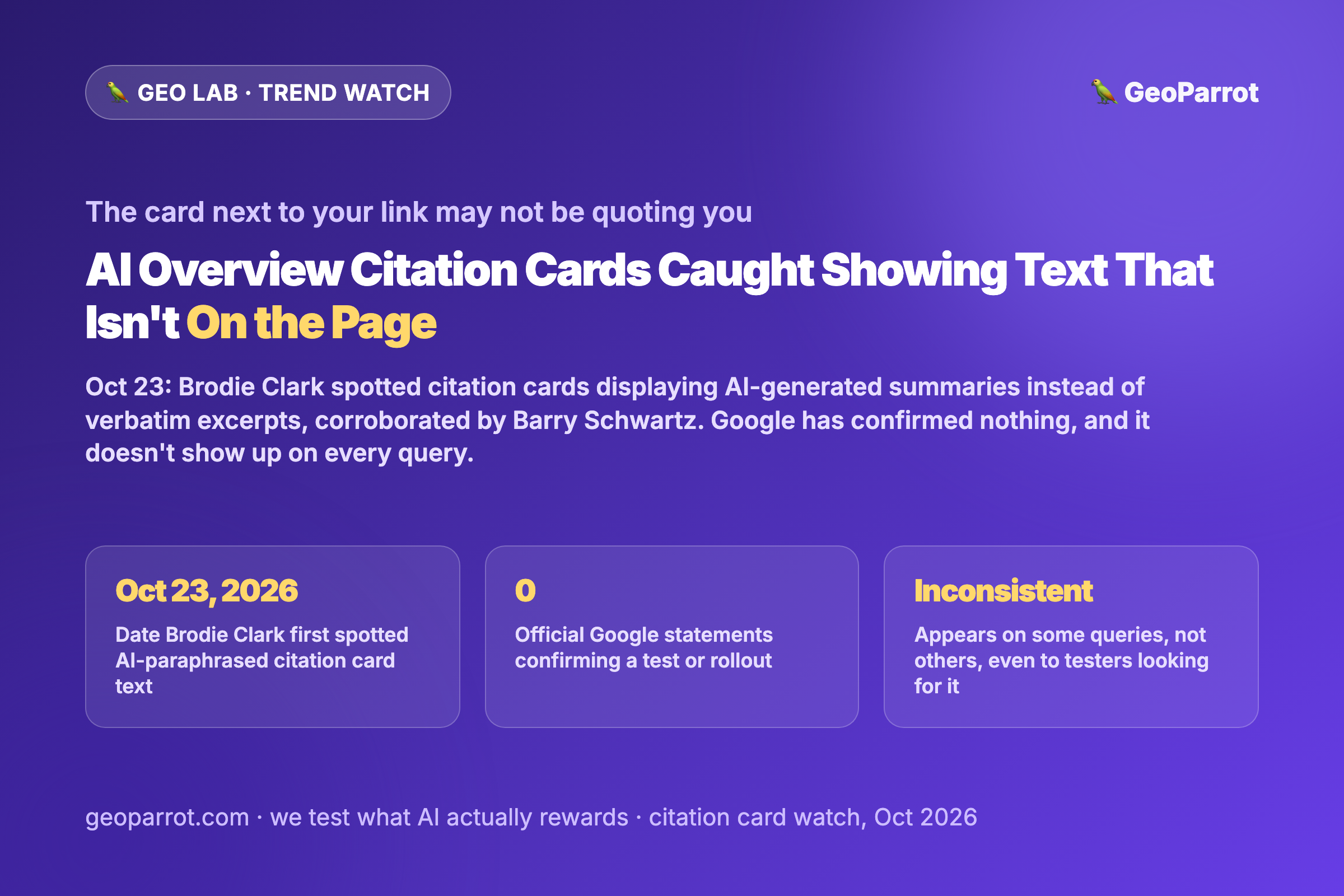
Quick answer: On October 23, 2026, SEO consultant Brodie Clark posted screenshots showing Google AI Overview citation cards — the small source cards that sit beside an AI Overview answer — displaying summary text that doesn’t appear anywhere on the cited page. Clark’s own framing: “The text doesn’t appear exactly like this on the page – it is being summarised based on the information that Google thinks is most relevant to the query.” Barry Schwartz at Search Engine Roundtable confirmed seeing it in his own test queries, but noted it isn’t showing up consistently, and Google has said nothing about whether this is a test or a rollout. The part worth separating from the hype: this doesn’t change whether your page gets chosen as a cited source — it changes what text sits next to your brand’s name when it is, and that text is now something Google wrote, not something you did.
Trend watch — published October 24, 2026, in the GEO Lab. We’ve spent most of this year measuring what “cited” actually means across engines — from which metrics are counted versus inferred to paragraph-level citation tracing. This finding adds a new wrinkle to that pile: the UI element whose entire job is “here’s what this source says” turns out to not always say what the source says.
What did Brodie Clark actually find, and has Google confirmed it?
Clark posted the screenshots on X on October 23, showing an AI Overview citation card with summary text that didn’t match the wording on the linked page. His explanation, quoted directly: the card text “is being summarised based on the information that Google thinks is most relevant to the query” — a per-query, AI-generated rewrite, not a copy-paste excerpt. Barry Schwartz ran his own searches and corroborated the behavior, but added that it “doesn’t appear consistently across all searches.” That’s the full state of confirmation: one credible spotter, one independent corroboration, zero statements from Google, inconsistent even to people looking for it. Treat it the way we’ve treated every other single-screenshot AI-surface sighting this year — a real, verifiable observation, not a confirmed feature.
Don’t AI engines already paraphrase citations? Why does this specific change matter?
Yes — and it’s worth being precise about which part of the system was already known to paraphrase, because it isn’t the part that changed here. The 116,000-citation study we covered a few weeks ago explicitly tracked citations down to the paragraph an engine appeared to “quote or paraphrase” — paraphrasing inside the main AI Overview answer has been part of the baseline assumption all year, including in our own work. What’s different about Clark’s find is the location: the citation card, the small element next to the link whose specific job is to represent that one source accurately, is now also running through the same generative rewrite. The main answer paragraph synthesizing across multiple sources is one thing; a card labeled as pointing to a single, specific source showing words that source never wrote is a narrower and more pointed claim about accuracy.
Does this mean “write a quotable 50-word answer” advice is dead?
No, and this is the distinction most reaction posts to this story are likely to blur. The Geeky Tech data we cited above still holds: a self-contained ~50-word passage, positioned high on the page, remained the strongest predictor of a page getting pulled into a citation at all — up to 48% of citations in that study traced back to passages shaped exactly that way. That’s a finding about selection: does the engine treat your page as a usable source. Clark’s citation-card finding is about representation: once selected, is the text attributed to you actually your text. Those are two separate questions, and the second one has no clean fix on the publisher side — you can’t phrase your way into guaranteeing Google quotes you verbatim in a UI element it generates per query.
Question
What this story changes
Does my page still need to be chosen as a cited source?
Does the main AI Overview answer paragraph quote me verbatim?
Unchanged — it has synthesized across sources all year, this isn’t new
Does the small citation card next to my link show my exact words?
New claim (unconfirmed, inconsistent) — Clark’s find says sometimes it shows an AI paraphrase instead
Is there a way to check or correct a wrong paraphrase?
No public mechanism either spotter identified — Google has said nothing
Selection and the main-answer synthesis are the parts GEO advice already accounts for. The citation card’s own accuracy is the part this story newly puts in question.
What did our own brand-citation check miss, and what should you check now?
Worth being honest about a gap this surfaces in our own work. When we ran five brand-name queries through Google and logged which of our own pages got cited, we checked which pages got pulled in and whether any external sites mentioned us — we did not check whether the citation card text next to our own links matched our actual page copy. That’s an oversight this story just exposed. We’re adding a thirty-second diff step to the next pass of that same audit: pull up the citation card, pull up the actual page, compare by hand. It’s the only way to know, for your own brand, whether this is happening to you right now.
There’s also a connection to the citation-quality work we did last week. Our hygiene-score experiment found that polishing on-page signals was, if anything, a weak-to-negative predictor of getting cited at all — a 0.22 odds ratio, backwards from the vendor claim we tested. If citation-card text gets regenerated per query regardless of your phrasing, that’s one more reason the real lever is being a reliable, extractable source of facts — not hand-tuning sentence-level wording for a display an AI may rewrite anyway.
What to actually do about this right now
Run your own brand and top-topic queries, and diff the citation card text against your actual page. This is the only way to know if you’re affected — Clark and Schwartz both found it inconsistent, so a single search that doesn’t show it proves nothing either way.
Don’t over-invest in crafting the “perfect quotable sentence” specifically for the citation card. If Google can regenerate that text per query, no amount of on-page phrasing guarantees it survives verbatim. Spend that effort on unambiguous, hard-to-misparaphrase factual claims instead — defined terms, numbers with units, clear subject-verb-object statements that are difficult to distort even when summarized.
Treat a misrepresenting paraphrase as a brand-monitoring issue, not just a GEO issue. Neither spotter identified a Google feedback channel for a wrong AI-generated summary attributed to your page. Screenshot and document any mismatch you find; there’s currently no confirmed way to report or correct it.
Keep the two questions separate going forward. “Did I get selected as a source” and “does the card text represent me accurately” are different failure modes with different fixes — don’t let one experiment or one audit answer both at once.
Frequently asked questions
Has Google confirmed it changed how AI Overview citation cards display text?
No. This comes from screenshots posted by SEO consultant Brodie Clark on October 23, 2026, corroborated independently by Barry Schwartz at Search Engine Roundtable. Google has made no public statement, and both spotters note the behavior doesn’t appear on every search.
Is this the same thing as AI Overviews paraphrasing answers in general?
No. The main AI Overview answer synthesizing across multiple sources has been a known baseline all year, including in citation-tracing research we’ve covered. This finding is narrower: it’s the small citation card tied to one specific source — the element meant to represent that source’s own words — showing AI-generated text instead.
Does this affect whether my page gets chosen as a cited source in the first place?
Not based on anything in this report. Selection still appears to favor short, self-contained, high-position passages, consistent with prior citation-tracing research. This story is about what text shows up once you’re already selected, not about selection itself.
What should I do if the AI-generated summary misrepresents my page?
Document it with a screenshot and the exact query used. Neither Clark nor Schwartz identified a confirmed Google feedback mechanism for this specifically, so treat it as a brand-monitoring record for now rather than something you can expect to get corrected on request.
Should I change my content strategy because of this?
Not based on a single, inconsistent, unconfirmed sighting. The practical move is to start checking your own brand’s citation cards periodically and to keep writing clear, factually unambiguous claims — which helps regardless of whether Google quotes or paraphrases you.


Leave a Reply