
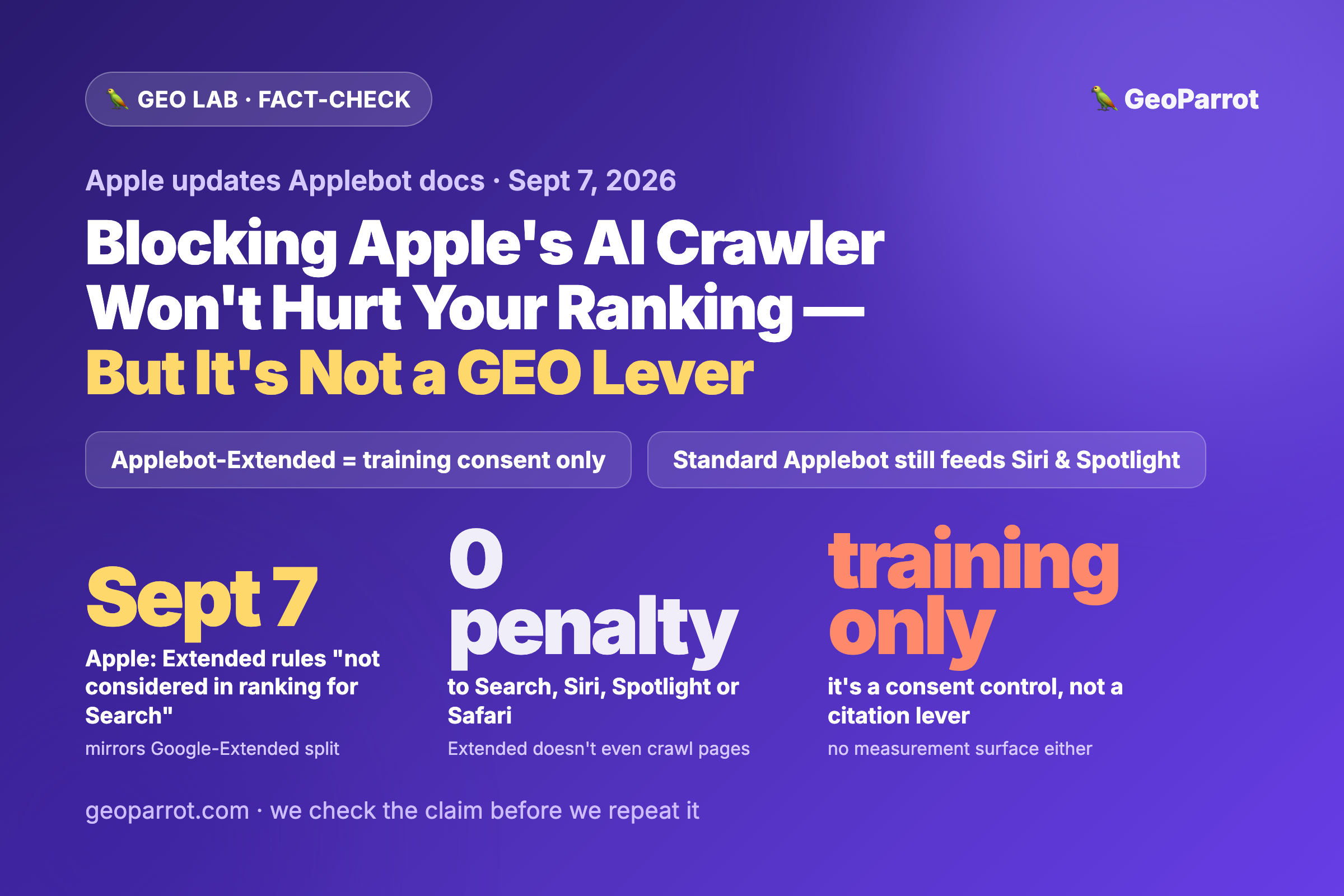
Quick answer: Over the weekend of September 7, 2026, Apple updated its Applebot documentation with one clarifying line: site rules for Applebot-Extended are “not considered in ranking for Search.” Applebot-Extended is Apple’s AI-training opt-out — a robots.txt token that lets you say “don’t use my content to train Apple’s foundation models.” Apple now confirms it in plain terms: it doesn’t crawl pages, blocking it won’t hurt your Search ranking, and your content still stays discoverable through Spotlight, Siri, and Safari. Good, welcome clarity. But read it correctly. This is a consent control, not a visibility lever. The crawler that actually decides whether you appear in Apple’s answers is standard Applebot — which you don’t touch by editing Extended rules. So block Applebot-Extended if you want to opt out of training; just don’t file it under “GEO tactics.” It moves your rights, not your citations.
Trend watch — published September 8, 2026. This is a fact-check post: we report exactly what Apple changed, separate it from the “new AI crawler lever” reflex, flag what it does and doesn’t control, and connect it to the crawler-block and per-engine theses we keep testing in the GEO Lab.
What exactly did Apple change?
Apple runs two distinct crawlers. Applebot is the long-standing one: in Apple’s words, the data it crawls “is used to power various features, such as the search technology integrated into many user experiences in Apple’s ecosystem including Spotlight, Siri, and Safari.” Applebot-Extended is the newer, narrower control introduced alongside Apple Intelligence — it lets a site “opt out of their website content being used to train Apple’s general purpose foundation models powering generative AI features.” The opt-out is a two-line robots.txt directive: User-agent: Applebot-Extended then Disallow: /.
The September 7 edit, first flagged by Barry Schwartz at Search Engine Roundtable, added a sentence removing the last bit of ambiguity: “Site rules for Applebot-Extended are not considered in ranking for Search.” Apple’s doc goes further — “Applebot-Extended does not crawl webpages. Webpages that disallow Applebot-Extended can still be included in search results.” In other words, Extended is a data-use flag on content Applebot has already crawled, not a crawler you can starve. Blocking it changes one thing only: whether your pages help train Apple’s models. It mirrors, almost exactly, Google’s split of Google-Extended from Googlebot — a dedicated training token separate from the search crawler.
Does blocking Applebot-Extended hurt my visibility?
No — and that’s the point of the clarification. Apple is explicit that even if you disallow Applebot-Extended (and tag content with nosnippet on top of it), your content “will remain discoverable through Spotlight, Siri, and Safari.” No ranking penalty, no removal from search results, no loss of Siri surfacing. Apple decoupled the training opt-out from every visibility outcome.
Why does a documentation footnote deserve a post? Because it’s the clean version of a trap we’ve watched people fall into. When Cloudflare moved to block AI crawlers by default, we warned that multi-purpose crawlers — Googlebot, Bingbot, Applebot — carry search and AI in one user-agent, so a blunt “block AI” toggle can quietly delist you from the very index that AI answers cite. Applebot-Extended is the antidote to that mistake: a surgical, training-only, non-crawling token. You can pull the training lever without touching the search lever. The lesson from both stories is identical — use the dedicated token, never the blanket block. Blocking standard Applebot to “control Apple’s AI” would remove you from Search and Siri; blocking Applebot-Extended removes you from neither.
So is this a new GEO win?
Here’s the misread to avoid. A headline that says “Apple’s AI crawler won’t affect ranking” gets reflexively filed under GEO tactics — as if there’s now a knob to turn for more Apple visibility. There isn’t. Applebot-Extended is a consent and rights control: it governs whether your words become training data for future Apple models. That’s a real decision — a legal, brand, and licensing one — but it is not a citation lever. Nothing about allowing or blocking Extended changes whether Siri surfaces you tomorrow, because that’s decided upstream by standard Applebot’s crawl and Apple’s own retrieval-and-ranking stack, none of which this toggle touches.
This is the same shape as the llms.txt debate: a file (or flag) people want to be a ranking signal, that vendors have said plainly is not one. The honest framing is to keep the two questions apart. “Do I want my content training Apple’s models?” is a consent question — answer it on your own terms. “How do I get cited by Apple’s answers?” is a GEO question — and its answer has nothing to do with the Extended token. Don’t let a clarified consent control masquerade as a growth tactic.
What this means for the new Gemini-powered Siri
The timing matters. Last week we covered the rebuilt, Gemini-powered Siri shipping with iOS 27 — a brand-new AI answer surface that reads the live web inside Spotlight, on hundreds of millions of devices, with no citation reporting. This week’s doc update tells you which crawler feeds that surface: standard Applebot, the same one behind Spotlight and Safari. The training opt-out you can now block with confidence sits beside that pipeline, not inside it.
The practical takeaway compounds. Editing Extended rules won’t make Siri cite you more, and there’s still no Search Console equivalent to tell you whether Siri used your content — so the measurement gap we flagged for Siri is unchanged. What travels to a black-box surface isn’t a crawler toggle; it’s earned reputation and clear, answer-first content — the signals that generalize across engines because, as our cross-engine study showed, citation sets barely overlap and there is no universal GEO strategy to game. Instrument what you can see, per engine, and treat the rest as hypothesis.
What should you actually do this week?
- Decide the consent question on its own merits. If you don’t want your content training Apple’s models, add
User-agent: Applebot-Extended+Disallow: /to robots.txt. Apple now confirms this won’t cost you Search, Siri, Spotlight, or Safari visibility. If you’re fine being training data, do nothing. - Never blanket-block to “control AI.” Blocking standard Applebot removes you from Search and Siri. Use the dedicated Extended token — the same discipline (Google-Extended vs Googlebot) applies across vendors. This is the multi-purpose crawler trap we flagged with Cloudflare.
- Don’t file this under GEO tactics. Applebot-Extended is a rights lever, not a citation lever. It changes nothing about whether Siri surfaces you. Anyone selling “Applebot GEO optimization” is repackaging a consent flag as a growth hack.
- Keep instrumenting what you can see. There’s still no Siri citation report. Watch referrer logs for Apple/Siri/Spotlight traffic once iOS 27 ships and track AI referrals the way you can today; don’t buy an invented “Apple AI visibility score” (the inverse of the share-of-voice vanity metric).
- Invest where it travels. The highest-confidence work for any invisible ranking stack is earned reputation and answer-first content — then apply the per-engine checklist to the surfaces you can actually measure.
Bottom line: Apple’s September 7 clarification is genuinely useful — it removes the fear that opting out of AI training could hurt your Apple visibility. Take that reassurance and make the consent decision cleanly. Just don’t mistake a clarified rights control for a new GEO opportunity. Applebot-Extended moves whether your content trains Apple’s models; it does not move whether Siri cites you. The work that does move citations is the same everywhere: earn the reputation and write the answers that travel to surfaces you can’t yet see into. We check the claim before we repeat it — and here the honest claim is “safe to block, but not a lever to pull for growth.”
Frequently asked questions
Will blocking Applebot-Extended hurt my Apple Search ranking?
No. Apple’s documentation, updated September 7, 2026, states that “site rules for Applebot-Extended are not considered in ranking for Search.” Applebot-Extended doesn’t even crawl webpages, and pages that disallow it can still be included in search results and remain discoverable through Spotlight, Siri, and Safari. Blocking it only opts your content out of training Apple’s foundation models.
What is the difference between Applebot and Applebot-Extended?
Standard Applebot is the crawler whose data powers Apple’s search features across Spotlight, Siri, and Safari. Applebot-Extended is a separate, training-only control: it governs whether content Applebot already crawled may be used to train Apple’s general-purpose foundation models. It does not crawl pages itself. The split mirrors Google’s Google-Extended (training) versus Googlebot (search).
How do I opt out of Apple AI training?
Add two lines to your robots.txt: User-agent: Applebot-Extended followed by Disallow: /. This opts your content out of training Apple’s foundation models without affecting your Search ranking or your presence in Siri, Spotlight, and Safari. A separate nosnippet meta tag limits real-time snippet/retrieval context; even using both leaves your content discoverable.
Is optimizing Applebot-Extended a GEO tactic?
No. Applebot-Extended is a consent and rights control, not a visibility lever. Allowing or blocking it changes whether your content trains Apple’s models — it does not change whether Siri or Spotlight surface and cite you, which is decided upstream by standard Applebot and Apple’s own retrieval stack. Treat “should my content train Apple’s models?” and “how do I get cited by Apple’s answers?” as two separate questions.
Does this affect the new Gemini-powered Siri?
The Gemini-powered Siri arriving with iOS 27 reads the live web through standard Applebot — the same crawler behind Spotlight and Safari — not through Applebot-Extended. So editing Extended rules won’t change whether Siri cites you, and there’s still no citation report for Siri answers. The reliable work for a surface you can’t measure is earned reputation and answer-first content, not a crawler toggle.
Leave a Reply