
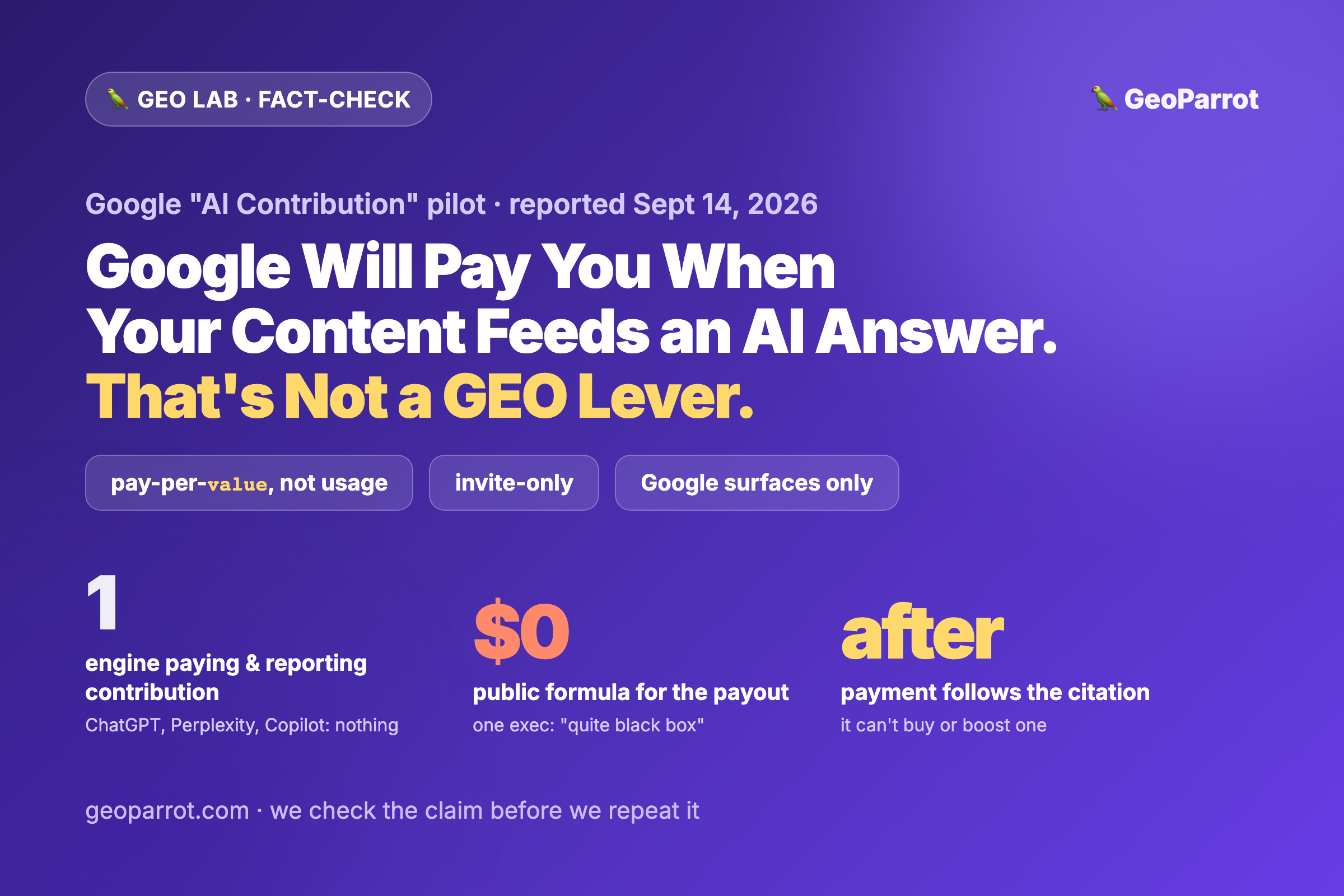
Quick answer: Google is running an invite-only pilot called AI Contribution that pays selected publishers when their content “significantly” contributes to an AI-generated answer in AI Overviews, AI Mode, or Gemini. Participants see a new earnings widget in Google Search Console showing a monthly dollar figure. It’s a genuine first — an engine putting a number on “your content materially fed this answer,” which is a step past the impressions-only reporting Google shipped in August. But three things make it a poor GEO target: you can’t opt in (invite-only), you can’t optimize the number (Google publishes no formula — one exec called it “quite black box”), and it covers only Google’s surfaces. Most importantly, the payment follows a citation you already earned — it doesn’t buy or boost one. Treat it as a directional signal if you’re invited, not a strategy or a KPI.
Trend watch — published September 15, 2026. This is a fact-check post: we report exactly what Google confirmed, separate the “Google is paying for AI content” headline from what it means for getting cited, and connect it to the eligibility-vs-pick and measurement theses we keep testing in the GEO Lab.
What did Google actually launch?
An “AI contribution” report was first spotted quietly inside Search Console back in April 2026, but its purpose stayed unclear until Digiday and Search Engine Land detailed the compensation side on September 14, 2026. Here’s the confirmed shape of it:
- It pays for contribution, not clicks. Google pays when a publisher’s content “significantly” contributes to an answer generated across AI Overviews, AI Mode, and Gemini. It is described as pay-per-value rather than raw pay-per-use: payment accrues only when Google judges the content meaningfully shaped the answer. Links or fact-checks appended after the answer is written don’t qualify.
- It shows up as a Search Console widget. Invited publishers get an AI-earnings widget displaying a monthly number with some history — and, per multiple reports, little else. There is no published breakdown of how a payout is calculated.
- It’s invite-only and low-commitment. At least dozens of publishers were approached, the pilot has expanded beyond news, and it reportedly appeals more to small and mid-sized publishers than to the majors. No upfront fee; participants can leave at any time.
- Google frames it as an experiment. Google confirmed it is “an early-stage learning pilot to test how best to reward high-quality content, on top of the traffic and tools it already provides.”
The publisher-side reaction is where the caveats live. One executive told Digiday the calculation is “quite black box,” another source described early returns as minimal next to advertising revenue, and skeptics called the whole thing a “legal fig leaf.” Yet publishers inside the pilot said they’d rather be in the tent testing direct payments and data-sharing than on the sidelines. Both things can be true — and both matter for how you read this as a GEO signal.
Is this the “licensing decides citations” story again?
No — and the difference is the whole point. When we fact-checked the AI data-licensing wave on September 6, the question was whether an upfront deal — buying rights to ingest a publisher’s catalog — buys you citations. The answer was no: licensing controls access, and our own arc measuring licensed vs open-web citation share found paywalled and licensed sources didn’t dominate the cited set.
AI Contribution is the inverse of a licensing deal. A license is a gate you pay to pass through before anything happens; AI Contribution is a payment that lands after your content already contributed, with no gate, no upfront fee, and an exit anytime. That inversion actually reinforces the September 6 conclusion: even when Google’s own money is on the table, it flows toward citations that were already earned. Payment is downstream of getting cited. It is a symptom of good GEO, not a cause of it — which is exactly why you can’t spend your way to a bigger check.
So is it a new way to measure GEO?
Partly, and this is the honest update to our own coverage. When Google rolled out the Generative AI performance report in Search Console on August 31, we flagged its ceiling: impressions only, no clicks, no per-source contribution signal — a page was either “shown in an AI feature” or it wasn’t. AI Contribution goes one rung deeper. To pay you, Google has to decide your specific page materially fed a specific answer. That means an engine now exposes a proxy for the exact thing GEO has struggled to measure: not “was I on the surface” but “did I actually feed the machine.”
The Lab takeaway underneath the headline: for months the open question was whether Google even holds a per-source contribution weight, or whether the answer is an unattributable blend. Monetizing “significant contribution” is Google implicitly confirming that weight exists and can be attributed to individual pages. That validates the premise of measuring contribution — the thing we’ve argued you should track. But Google isn’t handing over the formula, and a dollar figure with no methodology is a directional read at best. Do not turn it into a reported “GEO ROI” number; a black-box payout that’s minimal versus ads is precisely the kind of proxy that becomes a vanity metric if you let it.
Why the payout isn’t a lever you can pull
We keep finding the same shape across experiments: being on the list isn’t the same as being the pick. Our self-ranking listicle test showed listed ≠ picked; our consensus-pick teardown showed cited ≠ recommended. AI Contribution adds a fourth rung to that visibility ladder — contributed → paid — and it sits at the very end, downstream of everything you can influence:
- You can’t opt in. It’s invite-only, so no amount of on-page work puts the widget in your Search Console. The eligibility gate is Google’s, not yours.
- You can’t tune the number. With no published formula, “optimize for AI Contribution earnings” has nothing to optimize against. Chasing an opaque payout is guesswork dressed as strategy.
- The number reacts to the work; the work doesn’t chase the number. The payout moves when your content earns more contribution — which comes from the same fundamentals that earn any citation: answer-first structure, first-party data, and being the source an answer genuinely needs. Do that, and the money is a lagging indicator. Chase the money, and you have nothing to do.
One engine, not a scoreboard
AI Contribution reports and pays for Google’s surfaces only. ChatGPT, Perplexity, and Copilot neither pay you nor expose a contribution figure — so a rising number tells you nothing about your footprint on the engines that don’t overlap with Google. And they largely don’t: in our cross-engine citation study, just 2 of 395 unique cited domains were common to all four engines, and roughly 85% were unique to a single engine. A Google-only earnings widget is the definition of a partial view. Treating it as your GEO scoreboard would repeat the mistake we keep flagging: there is no universal GEO strategy, and no single-surface metric stands in for the whole. Cross-check everything with your own server logs and GA4, per engine.
What should you actually do?
- If you’re invited, join — it’s free and reversible. The data is worth having, and there’s no upfront cost. Just read the dollar figure as a directional contribution signal, not a target.
- Don’t wait for an invite. You can’t opt in, so don’t pause anything hoping to qualify. Keep earning contribution the only way that works: answer-first writing, original first-party data, and being the source an answer needs.
- Separate the money from the method. Payment ≠ recommendation ≠ citation across engines. Track your actual citation footprint in your own logs, per engine — don’t let one payout widget stand in for it.
- Don’t report the AI Contribution dollar as your “GEO ROI.” It’s Google-only, black-box, and reportedly minimal versus ads. As a headline KPI it’s a vanity number waiting to happen.
- Watch for two things. Whether Google publishes a payout formula, and whether it opens the pilot beyond invitation. Until then, gather it as a signal, not a strategy — and keep investing in the earned reputation that correlates with citations in the first place.
The reflex to read “Google is paying for AI content” as “GEO now has a price and a payout to optimize” is the trap. The pilot is real, and the contribution signal underneath it is genuinely interesting. But you earn the citation first; the check — if it comes at all — arrives after. Build for the citation, measure across engines, and let the widget be a footnote.
Frequently asked questions
What is Google’s AI Contribution pilot?
It’s an invite-only Google program, detailed publicly on September 14, 2026, that pays selected publishers when their content “significantly” contributes to an answer in AI Overviews, AI Mode, or Gemini. Participants see a monthly earnings figure in a new Search Console widget. Google calls it “an early-stage learning pilot to test how best to reward high-quality content.”
Can I sign up or optimize my content to earn more from it?
Not directly. The pilot is invite-only, so you can’t opt in, and Google publishes no payout formula — one executive called the calculation “quite black box” — so there’s nothing concrete to optimize against. The number moves when your content earns more contribution, which comes from the same fundamentals that earn any AI citation: answer-first structure, original data, and being the source an answer needs.
Is this the same as an AI licensing deal?
No — it’s almost the opposite. A licensing deal is an upfront gate you pay to pass before ingestion. AI Contribution is a usage-based payment that lands after your content already contributed, with no gate, no upfront fee, and an exit anytime. Payment follows the citation rather than buying it, which is why it reinforces the finding that licensing controls access, not who gets cited.
Does a higher payout mean my GEO is working across all AI engines?
No. AI Contribution reports and pays for Google’s surfaces only. ChatGPT, Perplexity, and Copilot don’t pay or report contribution, and cited sources overlap very little across engines — in our study, 2 of 395 cited domains were common to all four, and about 85% were unique to one. Treat the widget as a partial, Google-only view and cross-check with your own per-engine logs.
Should I report the earnings number as a GEO KPI?
Better not to. It’s a black-box figure covering one engine, and early returns are reportedly minimal versus advertising revenue. As a leading KPI it’s a vanity metric. Use it as a directional signal if you’re in the pilot, but base your GEO measurement on actual citation footprint tracked in your own analytics, engine by engine.
Leave a Reply