
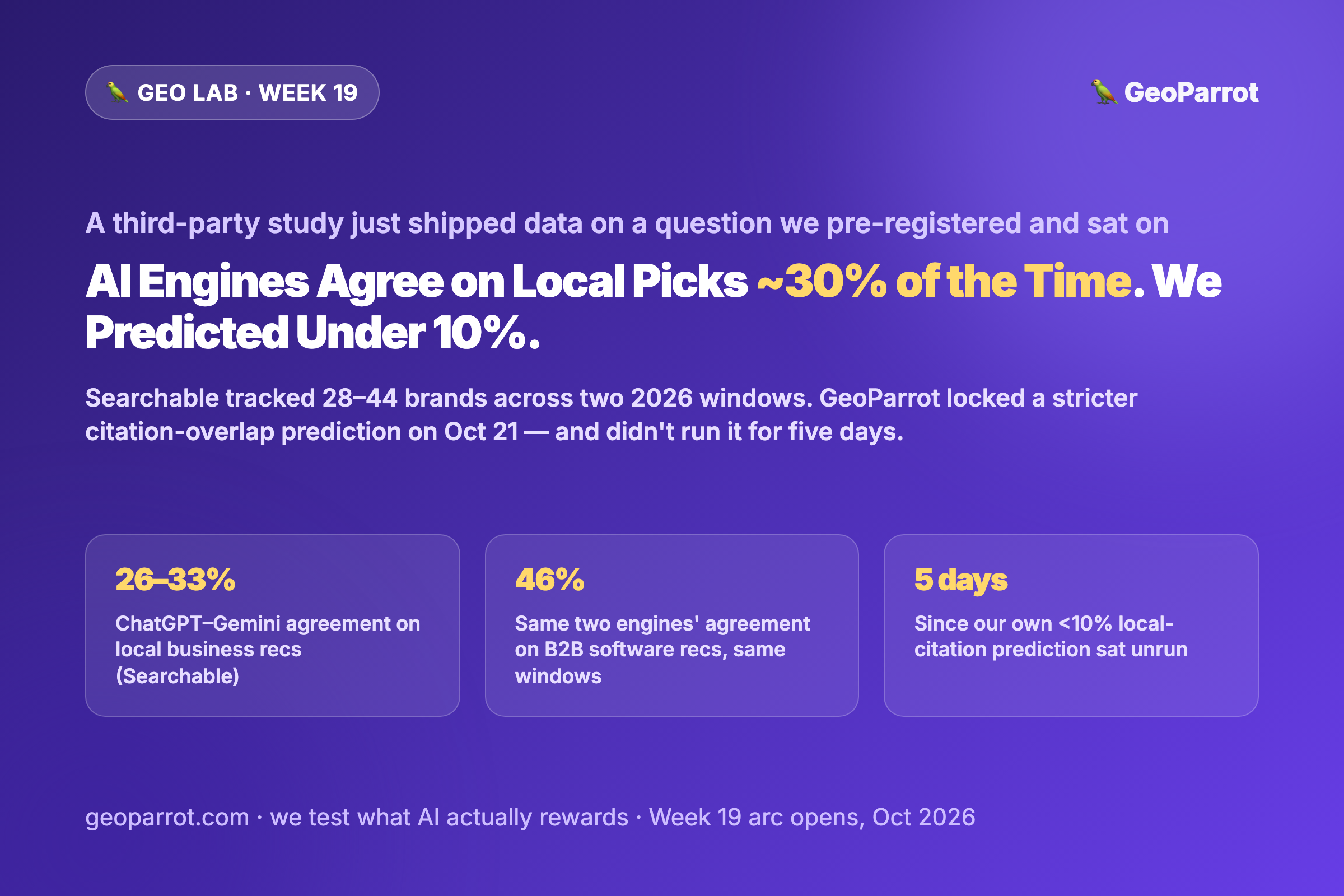
Quick answer: Searchable tracked ChatGPT and Gemini across two 2026 windows — 28 local-service and 44 B2B brands through September 15, then 29 local-service and 41 B2B brands through October 5 — and found the two engines agree on which local business to recommend only 26-33% of the time, versus a stable 46% for B2B software in both windows. Separately, on October 21, 2026, GeoParrot locked a prediction that cross-engine citation overlap for Local-intent queries specifically would fall under 10% — a stricter number, but for a related, not identical, question. We then didn’t run the test for five days. This week we do.
Published October 26, 2026, in the GEO Lab. This opens a new weekly arc. The pre-registration this week tests was written five days ago, on October 21, as part of a broader lab-methodology upgrade (engine × intent × domain-tier segmentation) — and then queued behind that upgrade’s other work instead of running in the same session. It never even ran as its own blog post. Reading this week’s trend scan and finding a third party had already shipped data on a cousin of the same question was the push to finally open the arc.
What does the Searchable study actually show about ChatGPT and Gemini?
Searchable’s methodology, as stated on its own blog: for each prompt, they compared the businesses each engine mentioned in at least half of its answers, averaged that overlap per brand, then took the median across brands. Run across two overlapping 10-week windows in 2026, the result split sharply by category. In the window ending September 15, local-service businesses (28 brands tracked) showed 33% median overlap between ChatGPT and Gemini recommendations; B2B software companies (44 brands) showed 46%. In the window ending October 5, with a slightly different brand set (29 local-service, 41 B2B), local overlap fell to 26% while B2B held at 46%. Read together: B2B agreement was stable across both windows: Local agreement was lower in both windows, and dropped further in the more recent one.
| Window | Local service (brands tracked) | B2B software (brands tracked) |
|---|---|---|
| 10 weeks to Sep 15, 2026 | 33% (n=28) | 46% (n=44) |
| 10 weeks to Oct 5, 2026 | 26% (n=29) | 46% (n=41) |
How does that compare to the test we pre-registered and never ran?
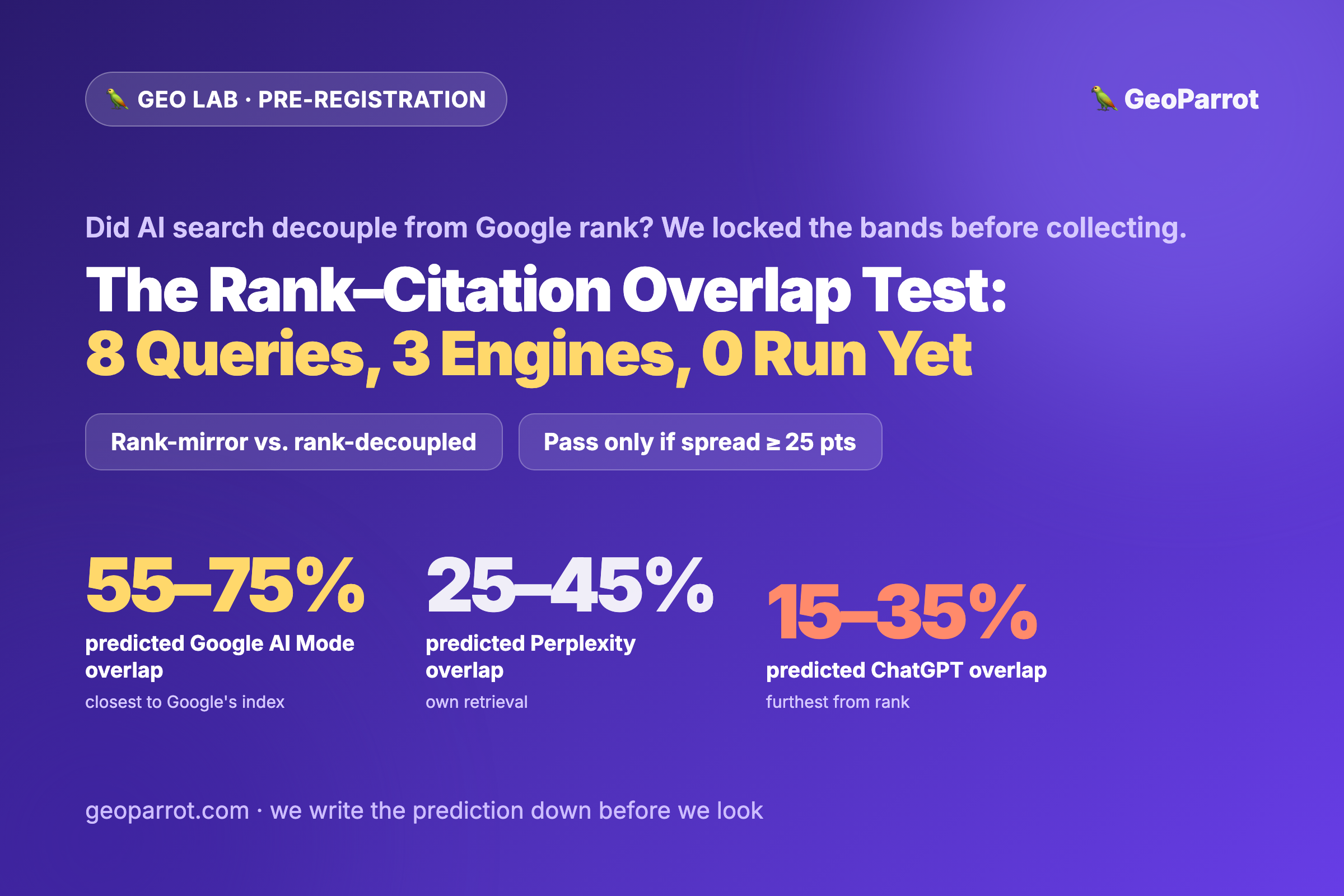
On October 21, 2026, while scoping a broader lab upgrade, we locked a 24-query pre-registration (6 Product, 6 Informational, 6 How-to, 6 Local — the first GeoParrot arc with a Local bucket large enough to analyze on its own) across three engines: ChatGPT, Perplexity, and Google AI Mode. Hypothesis H1, written down and timestamped before any data existed: Local-intent queries would show cross-engine citation overlap under 10%, far below the other three intent buckets, because local answers pull from a structurally different source pool (Google Business Profile, Yelp, Maps listings) than editorial web pages. That prediction is more extreme than anything Searchable published — their lowest local number is 26%, ours predicts under 10% — but it’s also answering a different question, which the next section doesn’t skip past.
For context on how our own prior numbers sit against both: a blind test we ran in early September found 34% blended cross-engine citation overlap across general commercial queries (not local-specific, not filtered by intent) — almost exactly between Searchable’s local and B2B figures. That’s the general baseline H1 is predicting a sharp drop below.
Is “which business gets recommended” the same question as “which sources get cited”?
No, and treating them as interchangeable would be the same mistake we flagged in last week’s Reddit comparison. Four things keep these two numbers from being the same statistic:
- Different unit. Searchable measures which business name each engine surfaces as a recommendation. Our H1 measures which source domain each engine cites as a reference — a business can be named without any source being cited, and a source can be cited without a specific business being named.
- Different comparison baseline. Searchable only compares local service businesses against B2B software companies — two categories, no within-arc comparison to Product/Informational/How-to intent. Our H1 compares Local against three other intent buckets inside the same 24-query set, collected the same week.
- Different engine pair. Searchable tests ChatGPT vs. Gemini specifically. Our pre-registration tests ChatGPT, Perplexity, and Google AI Mode — no Gemini, which doesn’t expose a citations feature we can audit the same way.
- Different sample scale. Searchable’s 28-44 brands, tracked over 10-week windows, is a far larger and more stable sample than our 24-query, one-week snapshot will be. Our number, whatever it comes out to, is a single-week read, not a trend line.
What the two studies share isn’t a statistic — it’s a direction. Two independent efforts, measuring two different things, both landed on “local intent is where cross-engine AI search agrees least.” That’s worth taking seriously precisely because neither study is just a rerun of the other.
On a Reachable / Methodology-disclosed / Stable check, does the Searchable number hold up?
| Criterion | Score | Why |
|---|---|---|
| R — Reachable | 1 | Published directly on Searchable’s own blog, no paywall, brand/category breakdowns included. |
| M — Methodology disclosed | 1 | States the exact comparison rule (businesses mentioned in at least half of each engine’s answers, averaged per brand, median across brands) and the brand counts per window. |
| S — Stable under re-citation | 0.5 | We found no independent third-party re-analysis of these specific figures at publication time — only the originating post. The number is well-documented but not yet cross-checked elsewhere. |
What does this open for this week’s GEO Lab arc?
Tuesday we publish the October 21 pre-registration properly — it never got its own post the first time, which is part of how it sat unrun for five days. Two hypotheses are locked and timestamped before any of this week’s data exists: H1, Local-intent queries show under 10% cross-engine citation overlap (ChatGPT, Perplexity, Google AI Mode) against the other three intent buckets in the same 24-query set. H2, last week’s hygiene-score reversal — cited pages scoring lower on our content-hygiene rubric than uncited ones, the opposite of a widely repeated “4.2x more citations” claim — gets checked for whether it’s specific to Google AI Mode or holds on ChatGPT and Perplexity too. Collection runs midweek; Thursday reports what the 24 queries actually returned, and Friday is the verdict against both locked predictions.
What should you do with this right now?
- If you run a local business or multi-location brand: don’t assume ranking well with one AI assistant means another one recommends you. Searchable’s data says the two biggest consumer assistants agree on local picks roughly a quarter to a third of the time — closer to a coin flip than to consensus.
- If you’re citing this stat elsewhere: say “business-recommendation overlap,” not “citation overlap” or “AI agreement” generically — the number is specific to which business gets named, measured a specific way, for two specific engines.
- If you’re waiting on our own number: it isn’t in yet. Treat <10% as a locked prediction, not a result, until Thursday.
Frequently asked questions
Do ChatGPT and Gemini really only agree on local business recommendations about 30% of the time?
According to Searchable’s tracking of 28-44 brands across two 2026 windows, yes — a median overlap of 33% in the window ending September 15, falling to 26% in the window ending October 5. B2B software recommendations agreed at a stable 46% in both windows.
Is that the same thing GeoParrot predicted in its October 21 pre-registration?
Related, not identical. Searchable measured which business each engine recommends by name. Our pre-registration measures which source domains get cited across engines for Local-intent queries specifically — a citation-overlap number, not a recommendation-overlap number. Both point toward local intent breaking cross-engine consistency, but they’re different statistics.
Why didn’t GeoParrot run its own test sooner?
The October 21 prediction was written as part of a broader lab-methodology upgrade and queued behind that upgrade’s other work. It was locked and timestamped the same day, but data collection didn’t happen in the same session, and the arc sat for five days before this week’s resumption.
What is GeoParrot testing this week?
Two hypotheses locked October 21: that Local-intent queries show under 10% cross-engine citation overlap across ChatGPT, Perplexity, and Google AI Mode, far below Product, Informational, and How-to queries in the same 24-query set; and that last week’s hygiene-score reversal (cited pages scoring lower on content hygiene than uncited ones) replicates across all three engines rather than being specific to Google AI Mode.
Sources
- AI Search Optimization for Local Businesses in 2026 — Searchable, 2026. Primary source for the ChatGPT–Gemini local vs. B2B overlap figures and methodology.
- Verdict: The Rank-to-AI-Citation Decoupling Passed Our Blind Test — source of our 34% blended cross-engine citation overlap baseline (general commercial queries, early September 2026).
- We Built the Missing Control Group. Hygiene Score Predicted Who AI Does NOT Cite. — last week’s hygiene-score reversal this arc’s H2 re-tests for engine-universality.
- The Verdict: A “4.2x More AI Citations” Quality-Score Claim Didn’t Just Overshoot. It Pointed Backwards. — the original claim the reversal responds to.
- ChatGPT’s Reddit Citations Collapsed 88% This Year. Our Own Google AI Mode Data Still Shows 21%. — the prior arc, and the same “different unit, don’t conflate it” distinction applied to a different cross-engine comparison.
- Counted vs. inferred GEO metrics — the broader framing behind why sample scale and definition matter before two percentages get compared.
GeoParrot is a GEO Lab: we test what AI search actually cites and recommends, then publish the method and the misses — including our own. This opens a new weekly arc. Tuesday we publish the pre-registration this arc runs on, five days later than we should have.
Leave a Reply