

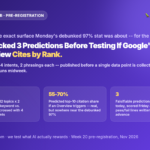
The short answer: the “68%” stat is real but stale, and it hides a number that cuts the other way. It traces to a Whitespark study of 540 queries published May 12, 2025 — now 18 months old — and at least five SEO blogs republished it between August and November 2026 as if it were fresh 2026 data. More importantly, that same study breaks its own average down by intent: local-intent “near me” service queries (plumber, dentist, lawyer) triggered a classic AI Overview just 15% of the time, with the Local Pack dominating at 93%. The 68% headline is driven almost entirely by informational (92%) and hybrid (97%) queries, not the “near me” searches most local businesses actually care about. That 15% number is also the opposite of what we measured five days ago: all 6 of our own local-intent queries triggered an AI Overview, a 100% rate. Below is the source check, the gap, and a fresher 200,000-prompt study on what’s actually driving local citations.
This opens Week 21 of our running GEO Lab arc. Last Friday we closed Week 20 by finding that our own Local-intent citations mostly weren’t attributable to any organic top-20 page at all — they looked like they were drawing from Google’s own Business Profile data instead (full verdict here). This week we test that directly. First, a stat check on how often local queries even see an AI Overview in the first place — because the number everyone’s citing doesn’t match what we just measured.
Where does the “68% of local searches get an AI Overview” number come from?
It traces to a Whitespark case study published May 12, 2025 — 540 manual queries across three US cities (Houston, Phoenix, Denver) and six local-business verticals (plumbers, personal injury lawyers, dentists, optometrists, medical clinics, real estate agents). The study’s own headline finding, quoted directly: “On average, AI Overviews are currently appearing in 68% of local business-type queries.” That part is accurate as a description of the study. The problem is what happens to that number once you open the methodology section, because Whitespark didn’t just report one average — it broke the 540 queries into three intent buckets, and the buckets disagree sharply with the headline.
| Query intent | AI Overview appearance rate | Local Pack appearance rate |
|---|---|---|
| Local-intent (“near me” service searches) | 15% | 93% |
| Informational (“how long does an eye exam take near me”) | 92% | 6% |
| Hybrid (“average cost of dental implants in Phoenix”) | 97% | 17% |
| Blended average (all 540 queries) | 68% | 39% |
The 68% is a real, correctly-calculated average of the full 540-query sample. It’s just an average dominated by informational and hybrid queries, which trigger AI Overviews at 92-97%. The query type most local businesses actually worry about losing visibility on — a straight “near me” service search — sits at 15%, with the Local Pack still doing most of the work. Citing “68%” without the breakdown tells a local plumber the opposite of what the data says about the search type they’re trying to win.
Is this 2026 news, or 18-month-old data being recycled?
Recycled. We found Search Engine Journal’s “AI Overviews Now Answer Most Local Searches” piece republishing the 68% figure roughly in August 2026 — more than a year after Whitespark’s original May 2025 publication date — and at least four other sites (Art of Strategy, First Call Visibility, Bushletter, hi-commerce) running “68% of local searches” as a headline stat as late as this past quarter, with no indication in most of them that the underlying data is from before Google’s AI Overviews looked anything like they do now. None of the republications we checked carried forward the intent breakdown; all of them led with the blended 68%.
This is the same pattern we caught last Monday with a fabricated 97%-from-top-20 citation stat (that fact-check is here) — except this time the number is real and sourced, it’s just old enough that treating it as a snapshot of “local search in 2026” is the actual error, not the arithmetic.
Why does our own data show the opposite of the 15% local-intent number?
Five days ago, as part of closing our Week 20 arc, we ran 6 local-intent queries (“which dentist near me is accepting new patients,” “emergency plumber near me,” and four others spanning the same kind of service search) against the classic AI Overview box. All 6 triggered an Overview — a 100% rate, not 15%.
| Measurement | Local-intent AI Overview trigger rate | Sample |
|---|---|---|
| Whitespark, May 2025 | 15% | ~180 local-intent queries (of 540 total), 3 US cities |
| GeoParrot, Nov 2026 | 100% (6 of 6) | 6 local-intent queries, single account, Seoul, KR |
We’re not claiming our 6-query sample overturns Whitespark’s 180-query one — ours is too small to generalize, same caveat we gave on Friday. But the gap is too large to wave away as noise, and there are real candidate explanations: an 18-month gap during which Google has visibly changed how often and where AI Overviews render (we’ve tracked several such changes in this arc alone), a geography difference (US metro queries vs. a single Seoul-based account), and the possibility that Google now triggers AI Overviews on local-intent queries far more consistently than it did when Whitespark collected its data. We can’t isolate which factor matters most from 6 queries. We can say the 15% figure currently being cited as a reason local-intent search is “mostly still Local Pack territory” doesn’t match what we just measured, and shouldn’t be trusted uncritically either.
What does a fresher, larger study say about what local AI Overviews actually cite?
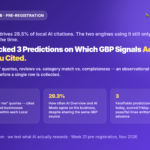
BrightLocal published a study on September 16, 2026 — four months old, not 18 — analyzing 200,085 localized prompts across 1,300 business locations on three platforms: Google AI Overviews, Google AI Mode, and ChatGPT. Two findings from it matter directly for this week’s question. First, Google Business Profile data accounted for 28.5% of all citations across the three platforms combined — a large single-source share, consistent with what we found Friday (our Local citations mostly traced to Google’s own business-listing data, not the open web). Second, and more interesting: AI Overview and AI Mode only agreed on which businesses to name 29.3% of the time, despite both drawing heavily on the same Google Business Profile source.
That second number is the one that sets up this week’s test. If GBP data is a major input for both surfaces but they still only agree on the named business 29.3% of the time, having a complete, well-signaled Business Profile apparently isn’t sufficient on its own to guarantee consistent AI citation — something else about a listing is doing the differentiating work. We don’t yet know what that something is.
What should a local business actually do with any of this?
- Don’t assume “near me” searches are safely AI Overview-free. The widely-cited 15% figure is 18 months old and contradicted by our own fresh (if small) measurement. Treat local-intent AI Overview exposure as unresolved, not settled at either extreme.
- Keep the Google Business Profile current regardless. Both this week’s BrightLocal data (28.5% of all citations) and our own Friday finding (most Local citations traced to Google’s own listing data, not the open web) point the same direction: GBP matters more for local queries than for Product or Informational ones.
- Don’t treat “GBP is a top citation source” as “a complete GBP guarantees citation.” AI Overview and AI Mode only agree on which business to name 29.3% of the time while pulling from the same source pool — something beyond profile completeness is deciding the split, and we’re testing what this week.
What’s this week’s question?
Friday’s Week 20 verdict found that local-intent AI Overview citations mostly weren’t traceable to organic rank — they looked GBP-sourced instead. Today’s check adds a second open question: even among businesses with a presence in Google’s own data, what separates the ones that get named from the ones that don’t, given that AI Overview and AI Mode only agree 29.3% of the time off the same source. This week’s GEO Lab arc pre-registers a test of which Google Business Profile signals — review volume, category match, photo count, Q&A presence, listing completeness — actually correlate with which businesses a local AI Overview names, rather than assuming “GBP matters” settles the question on its own.
Frequently asked questions
Do AI Overviews really answer 68% of local searches?
That figure is accurately calculated from a real study (Whitespark, 540 queries, published May 12, 2025), but it’s an 18-month-old blended average across informational, hybrid, and local-intent queries. For the local-intent subset specifically — “near me” service searches — the same study found just a 15% AI Overview trigger rate, with the Local Pack appearing 93% of the time.
Is the 68% stat current 2026 data?
No. It was published May 12, 2025. We found it republished as current by Search Engine Journal (roughly August 2026) and at least four other sites through November 2026, none of which flagged the age of the underlying study or carried forward its intent-level breakdown.
Why does GeoParrot’s own test show the opposite for “near me” queries?
Five days ago we ran 6 local-intent queries and got an AI Overview on all 6 (100%), versus Whitespark’s 15% from 18 months earlier. Our sample is too small to generalize on its own, but the gap is large enough that we don’t think the 15% figure should be treated as current either. Candidate explanations include the 18-month gap, a US-metro vs. single Seoul-account geography difference, and real platform change in how often local-intent queries trigger an Overview.
Does Google Business Profile data explain local AI Overview citations?
Partly. A September 2026 BrightLocal study of 200,085 prompts found GBP data accounted for 28.5% of all citations across Google AI Overviews, AI Mode, and ChatGPT — consistent with our own Friday finding that Local citations mostly traced to Google’s own listing data rather than the open web. But AI Overview and AI Mode only agreed on which business to name 29.3% of the time despite sharing that source, so GBP presence alone doesn’t explain which specific business gets cited.
What’s the next GEO Lab test?
Which Google Business Profile signals — review volume, category match, photo count, Q&A presence, listing completeness — actually correlate with which businesses a local AI Overview names, since this week’s check found that GBP being a major source doesn’t mean AI Overview and AI Mode agree on the result.
Sources
- The Verdict: Every Rank-Matched AI Overview Citation Was Top 10, None From 11-20 — Friday’s Week 20 close, where Local-intent citations first showed up as GBP-sourced rather than rank-matched.
- Does Google’s AI Overview Box Actually Cite by Rank? — Tuesday’s pre-registered method this arc built on.
- A “97% From Top 20” AI Overview Stat Is Not in the Study It Cites — last Monday’s stat fact-check, same source-checking pattern applied here.
- ChatGPT and Gemini Agree on Local Business Picks ~30% of the Time — our prior cross-engine local-citation overlap test, a related but separate question from this week’s GBP-signal focus.
- GeoParrot GEO Lab index — the running weekly arc this test belongs to.
GeoParrot is a GEO Lab: we test what AI search actually cites and recommends, then publish the method and the misses — including our own. This opens Week 21. Tuesday: a pre-registered test of which Google Business Profile signals actually correlate with local AI Overview citation.



Leave a Reply