
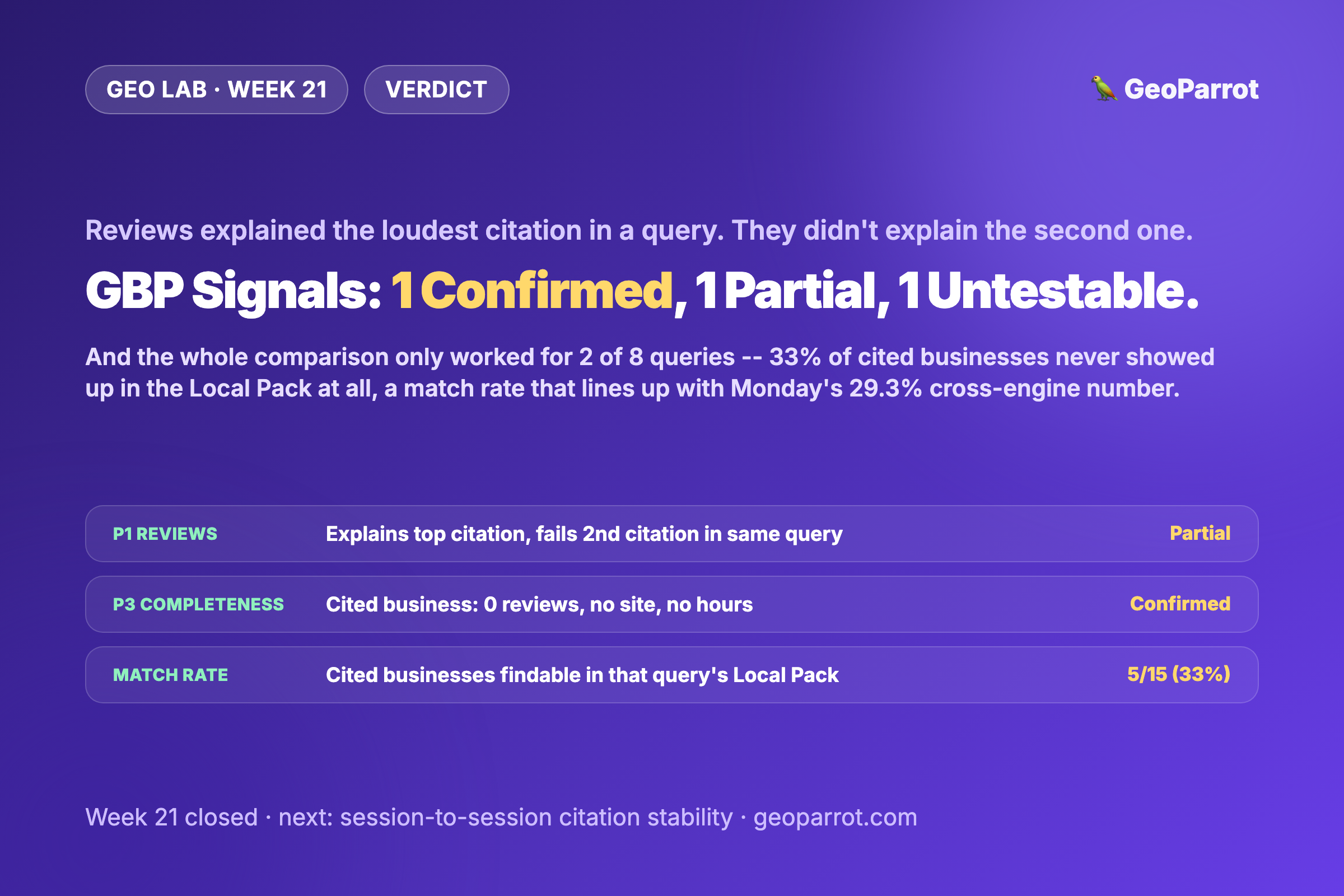
The verdict: 1 of 3 predictions confirmed, 1 partial, 1 untestable, and the comparison itself only worked for 2 of 8 queries. Tuesday we pre-registered three bets on whether Google Business Profile signals explain which business a local AI Overview cites. Wednesday’s collection found that only 5 of 15 cited businesses (33%) could even be matched by name into the same query’s Google Maps Local Pack, so the within-pack comparison the pre-registration designed could only run on the dentist and locksmith queries. On those two: review count (P1) cleanly explains the single loudest citation in each query but fails to explain a quieter second citation that’s statistically tied with, or worse-provisioned than, non-cited competitors. Category match (P2) couldn’t be tested at all: zero variance in either matchable pack. Completeness-as-a-floor (P3) held, confirmed by a cited business with zero reviews, no website, and no posted hours. Full scoring and what it means for next steps below.
Friday verdict, closing this week’s GEO Lab arc. Monday we fact-checked the “68% of local searches get an AI Overview” stat and surfaced a BrightLocal number showing AI Overview and AI Mode only agree on which business to name 29.3% of the time off the same GBP source. Tuesday we pre-registered three predictions to test whether GBP signals themselves (reviews, category match, listing completeness) explain local citation. Wednesday’s collection found the comparison mostly couldn’t run as designed. This post scores the three predictions against the data that did come in, and takes seriously what it means that most of the data didn’t.
What’s the final verdict on each of the three locked predictions?
Three predictions went out Tuesday with pass/fail lines written before a single query ran. Here’s how each one scored against the 2 of 8 queries (dentist, locksmith) where a within-pack comparison was even possible.
| Prediction | Verdict | What the data showed |
|---|---|---|
| P1 (review signal): cited businesses carry meaningfully higher review counts than non-cited peers in the same pack | ⚠ Partially confirmed | Holds for the single loudest citation in both testable queries: Wooriwell Dental (115 reviews vs. a pack median of 2, a 57x gap) and 24hr Locksmith Co. (23 reviews vs. a pack median of 0). Fails for the quieter second citation in each query: Seoul Korea Dental (2 reviews, 5.0 stars) was statistically tied with four non-cited competitors at the identical figure, and Myeongseong Locksmith (0 reviews, no rating) was cited despite being less provisioned than most of its own pack. |
| P2 (category match): cited businesses carry a more exact service-category label than non-cited peers | ❓ Untestable | Both matchable packs (dentist, locksmith) had zero category variance: every one of the 20 dentist listings and all 19 locksmith listings already carried the relevant single category. With no mismatched-category competitor present in either pack, there was nothing for a citation decision to route around. Not rejected; there was no sample that could have rejected it. |
| P3 (completeness is a floor, not a differentiator): website/phone/hours presence doesn’t predict citation once a listing clears a basic bar | ✅ Confirmed | Myeongseong Locksmith was cited by the AI Overview while failing 2 of 3 completeness checks (no website, no posted hours), worse-provisioned on paper than several non-cited competitors in the same pack. A pure completeness-gates-citation model would not have named this business at all. |
Net score on the testable sample: one prediction confirmed, one partially confirmed in a way that cuts against a simple “more reviews wins” story, one with no sample to test at all. That’s not a clean record even before you get to the bigger problem: this scorecard only covers a quarter of the week’s cited businesses.
Why does review count explain the loudest citation but not the second one?
We predicted cited businesses would carry meaningfully higher review counts than their non-cited peers. For the single most-prominent business the Overview named in each testable query, that’s exactly what happened, and it wasn’t close: a 57x gap in the dentist query, an effectively infinite gap (23 vs. zero) in the locksmith query. If the prediction only had to explain one citation per query, it would score as confirmed, full stop.
It breaks on the second name each Overview included. In the dentist query, Seoul Korea Dental, the Overview’s second citation, had 2 reviews and a 5.0 rating. Four other listings in that same 20-business pack (투엠치과의원, 서울엘치과의원, 연세안치과의원, 단아치과의원) carried the identical 2-reviews-5.0-stars figure and weren’t cited. Review count alone has no way to explain why this specific tied listing got named over the other four. In the locksmith query, the problem is sharper: Myeongseong Locksmith, the Overview’s third citation, had zero reviews and no star rating at all, worse than the review floor the prediction itself was built to detect clearing. A signal that explains the headline citation and fails the supporting cast isn’t wrong, but it’s a much weaker finding than “GBP review count predicts AI Overview citation” would suggest on its own.
Why was the category-match prediction impossible to test, not just rejected?
P2 bet that cited businesses would carry a more exact category label than businesses the Overview skipped. Testing that requires a pack with at least some category disagreement in it, say a locksmith pack with a stray hardware store in it. Neither of the two packs we could test had any: all 20 dentist listings were already dentist-family (치과의사 / 치과 진료소 and close variants), and all 19 locksmith listings carried the single label 열쇠공. Google’s own Local Pack ranking had already filtered out anything off-category before the Overview ever saw the list. That’s a real finding, just not the one P2 was built to find. It says something about how tightly Maps pre-filters by category, and it means this week’s data can’t speak to whether category precision matters once you’re inside a pack that’s already category-pure. A future test would need a query where the pack itself contains a category mismatch, which neither of our two usable queries happened to produce.
Why does one counter-example count as confirming P3?
P3’s bet was narrower than it sounds: not “completeness never matters,” but “completeness functions as a floor nearly every surfaced listing clears, rather than a differentiator that explains who gets named.” A single clean violation of the opposite claim (a cited business that’s demonstrably less complete than multiple non-cited peers) is enough to confirm a floor hypothesis, because the floor hypothesis predicts exactly that completeness won’t reliably gate citation. Myeongseong Locksmith is that violation: no website, no posted hours, zero reviews, cited anyway, while several non-cited locksmiths in the same pack had all three. If completeness were a hard gate, this business wouldn’t have been eligible to be named. It was.
So does GBP explain local AI Overview citation, or not?
Conditionally, and only for a fraction of what gets cited. Where a comparison was possible at all, review count correctly flagged the single most-prominent business the Overview named, a real, large, repeatable-looking gap in both of our two testable queries. But it couldn’t explain the second name in either query, category match had no variance to test against, and completeness turned out to be the opposite of a differentiator. That’s the honest ceiling of what this week’s design could answer.
The bigger finding sits above all three predictions: only 5 of 15 cited businesses (33%) across this week’s 5 triggered “near me” queries could even be matched by name into the same query’s Local Pack listing. Three of five triggered queries had zero overlap at all between what the Overview cited and what Maps listed for the identical search. That 33% match rate lines up, structurally, with a number from Monday’s own fact-check: BrightLocal’s finding that AI Overview and AI Mode agree on which business to name only 29.3% of the time off the same underlying GBP data. Monday’s number was cross-engine (two different AI surfaces disagreeing). This week’s number is same-engine, cross-surface (one AI Overview box and the Google Maps page it sits next to, for the identical query, disagreeing on names). Those are two different mechanisms producing roughly the same ~30% agreement band. We don’t have enough data across enough weeks to call that a law, but it’s now shown up twice in two different comparisons, and that’s worth tracking as its own pattern rather than filing away as noise in either arc.
One honest limitation, carried over from Tuesday: this is a single-location (Seoul, KR), single-account, logged-out, one-round snapshot across 8 queries. We have no backend business ID, so a “non-match” could mean a genuinely different business, or the same business under a different display string in the Overview’s generated prose versus its own Maps card. We can’t rule either reading out, and anyone repeating this test with API-level access to Google’s own entity matching could settle it more cleanly than a front-end comparison like ours ever will.
What should you actually do with this, surface by surface?
If you run Google Business Profile for a local-service business
- Review count is still worth pursuing, but as a necessary floor, not a guarantee. The businesses with the largest review gaps in our sample were also the headline citation in their query. That’s a real pattern, even on a two-query sample.
- Don’t assume a thin listing disqualifies you from citation. One of our cited businesses had zero reviews, no website, and no posted hours. Completeness looked like something almost every listing clears or doesn’t need, not something that predicts who gets named.
- Don’t over-invest in category precision beyond what’s already required to appear in the pack. By the time a listing is being compared at all, it’s usually already in the right category. We found zero cases where category label explained a citation decision, because there was no mismatched competitor left to compare against.
If you’re pitching “optimize your GBP for AI citation” as a service
- Be honest about what a GBP signal can and can’t buy. In our data, the strongest review signal explained the loudest name in a citation list, not the full list. If a client gets named second or third, GBP completeness work may have had little to do with it.
- Expect roughly a third of citations to be unexplainable by Local Pack comparison at all. A client whose business doesn’t even surface by name in the Local Pack for a query where they’re AI Overview-cited isn’t a measurement failure on your end. It may reflect how loosely these two Google surfaces are coupled for that query, full stop.
Reading any “GBP signal X predicts AI citation” claim from here on
- Ask what share of cited entities the study could even locate inside its comparison universe. Ours was 33%. A study that reports a clean correlation without disclosing its match rate may be quietly excluding the two-thirds that don’t fit the story.
- Ask whether the claim was tested against a second citation in the same result, not just the first. Our review-count signal looked airtight until we checked who else the same Overview named.
- Treat “no category variance” results as untested, not as evidence category doesn’t matter. A pack that’s already category-pure can’t tell you anything about category-based citation decisions either way.
What’s next week’s question?
Two numbers, a 33% same-engine citation-to-pack match rate from this week and a 29.3% cross-engine naming-agreement rate from Monday’s fact-check, now sit in roughly the same ~30% band from two completely different comparisons. Before treating that as a real “AI local citation only agrees with its own source data about 30% of the time” pattern, the obvious next check is whether the AI Overview box even agrees with itself: if we re-run this week’s same 8 queries from the same account a few days later, how much of the citation list stays the same? If the box can’t reproduce its own citation list session to session, that instability would explain a chunk of this week’s low match rate before GBP signals ever enter the picture, and it’s a cleaner, cheaper test to run first.
That closes the loop Monday’s fact-check opened and Tuesday’s pre-registration ran all the way through: one prediction confirmed, one partially confirmed in a way that undercuts the simple version of itself, and one left untestable by a sample with no variance to measure against.
Frequently asked questions
Do Google Business Profile signals explain which local business an AI Overview cites?
Partially, and only for a minority of citations. Review count correctly flagged the single most-prominent cited business in both of our testable queries (a 57x and an effectively infinite gap over the pack median), but failed to explain a second cited business in each query that was tied with, or less provisioned than, non-cited competitors. Category match couldn’t be tested, and listing completeness turned out to be the opposite of a differentiator: one cited business had zero reviews, no website, and no posted hours.
Why could only 2 of 8 queries actually be tested?
Wednesday’s collection found that only 5 of 15 AI Overview-cited businesses across 5 triggered queries could be matched by name into the same query’s Google Maps Local Pack. That left a comparison sample in only the dentist and locksmith queries; the other three triggered queries had zero overlap between what the Overview cited and what the Pack listed.
Why wasn’t the category-match prediction rejected instead of marked untestable?
Rejecting it would require a pack with at least one category-mismatched listing that got cited over a better-matched one, or vice versa. Both testable packs (dentist, locksmith) had zero category variance: every listing already carried the correct category before the Overview saw the list. With no mismatch present, there was nothing to confirm or reject.
What’s the connection to Monday’s 29.3% figure?
Monday’s fact-check cited a BrightLocal finding that AI Overview and AI Mode only agree on which business to name 29.3% of the time off the same GBP source, a cross-engine disagreement. This week’s 33% citation-to-Local-Pack match rate is a different, same-engine comparison (one AI Overview box vs. the Maps page next to it, same query). Both land in roughly the same ~30% band, which is worth watching as a possible pattern across two unrelated comparisons, though two data points isn’t enough to call it a rule.
What’s the next GEO Lab test?
Whether the classic AI Overview box’s local citation list is even stable session to session for the identical query, before attributing this week’s low match rate to GBP signals at all.
Sources
- Monday’s claim check: the 68% local-search stat and the BrightLocal 29.3% cross-engine naming-agreement figure this week’s arc grew out of.
- Tuesday’s pre-registration: the locked query set, GBP signals, and three predictions scored above.
- Wednesday’s results: the raw collection, including the 33% match rate and the review-count data this verdict scores.
- Local AI citation overlap: claim check: Week 18’s related finding on cross-engine (not within-Local-Pack) local citation agreement.
- GeoParrot GEO Lab index: the running weekly arc this test belongs to.
GeoParrot is a GEO Lab: we test what AI search actually cites and recommends, then publish the method and the misses, including our own. This closes Week 21 of a running weekly arc. Next week: is the classic AI Overview box’s local citation list even stable from one session to the next?



Leave a Reply