
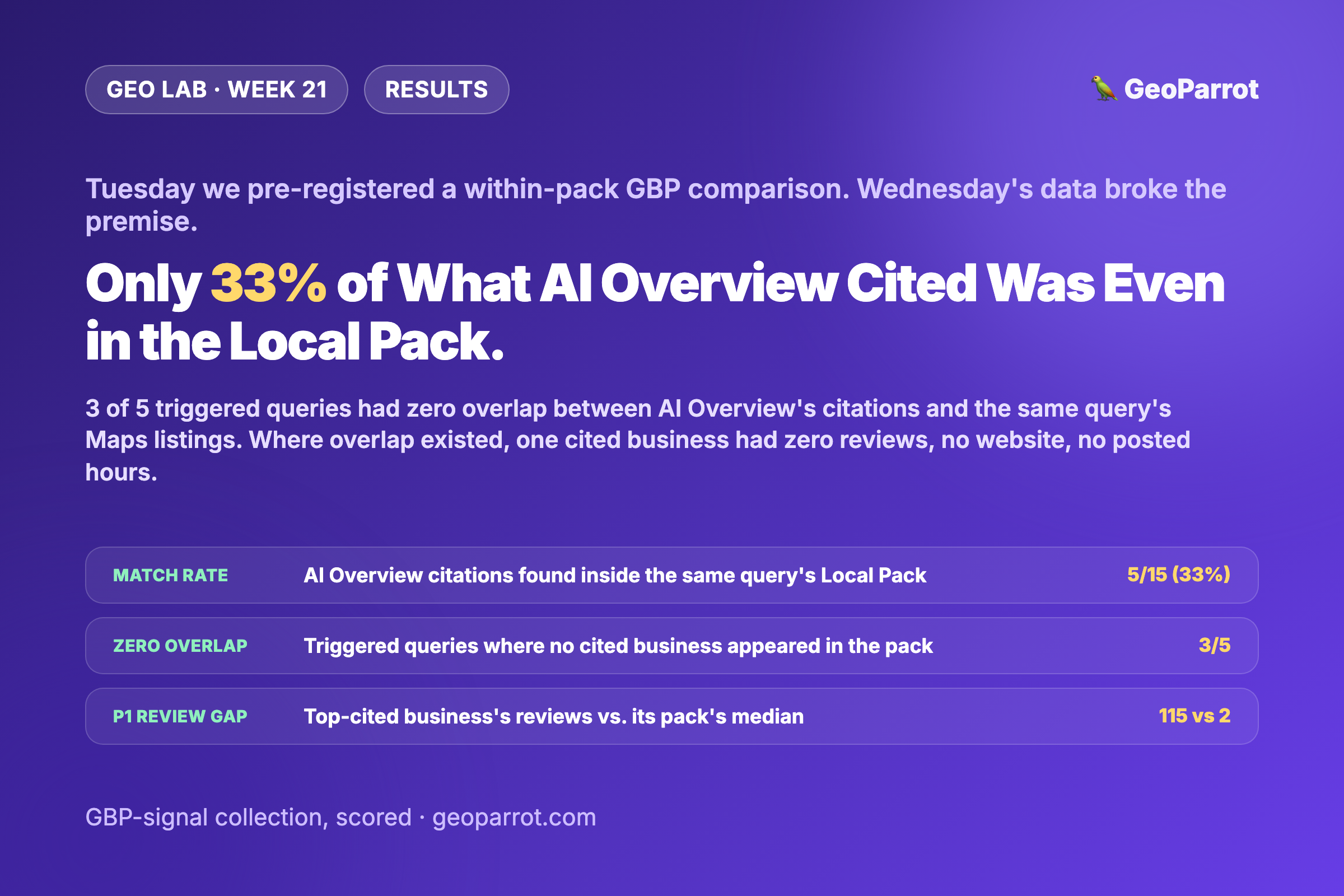
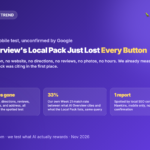
Quick answer: Tuesday we pre-registered a within-query comparison: for 8 Local “near me” queries, compare the GBP-visible signals of businesses an AI Overview box cites against the businesses in the same query’s Google Maps Local Pack it doesn’t cite. Wednesday’s collection ran into a problem the pre-registration didn’t anticipate — most cited businesses weren’t in the Local Pack list at all. Across the 5 queries that triggered a classic AI Overview box, we could name 15 distinct cited businesses. Only 5 of those 15 (33%) showed up by name in the same query’s top-20 Maps listing. Three of five queries had zero overlap. Only two queries (dentist, locksmith) had any cited business locatable inside the pack at all, and even there the signal was mixed: one cited business crushed the field on reviews (115 vs. a pack median of 2), and another cited business had zero reviews, no rating, no website, and no posted hours — the least complete listing option in a field of mostly-empty ones. Full breakdown below; Friday’s post judges what this means for all three pre-registered predictions.
Results — published November 12, 2026, in the GEO Lab. Collected Wednesday via browser automation (classic AI Overview box + Google Maps Local Pack, single account, Seoul, logged out), per Tuesday’s pre-registration. No queries, predictions, or pass/fail lines changed after Tuesday — what changed is that the comparison the pre-registration described could only run on 2 of 8 queries, and that limit is itself the finding this post reports first.
How much of what AI Overview cited was even sitting in the Local Pack?
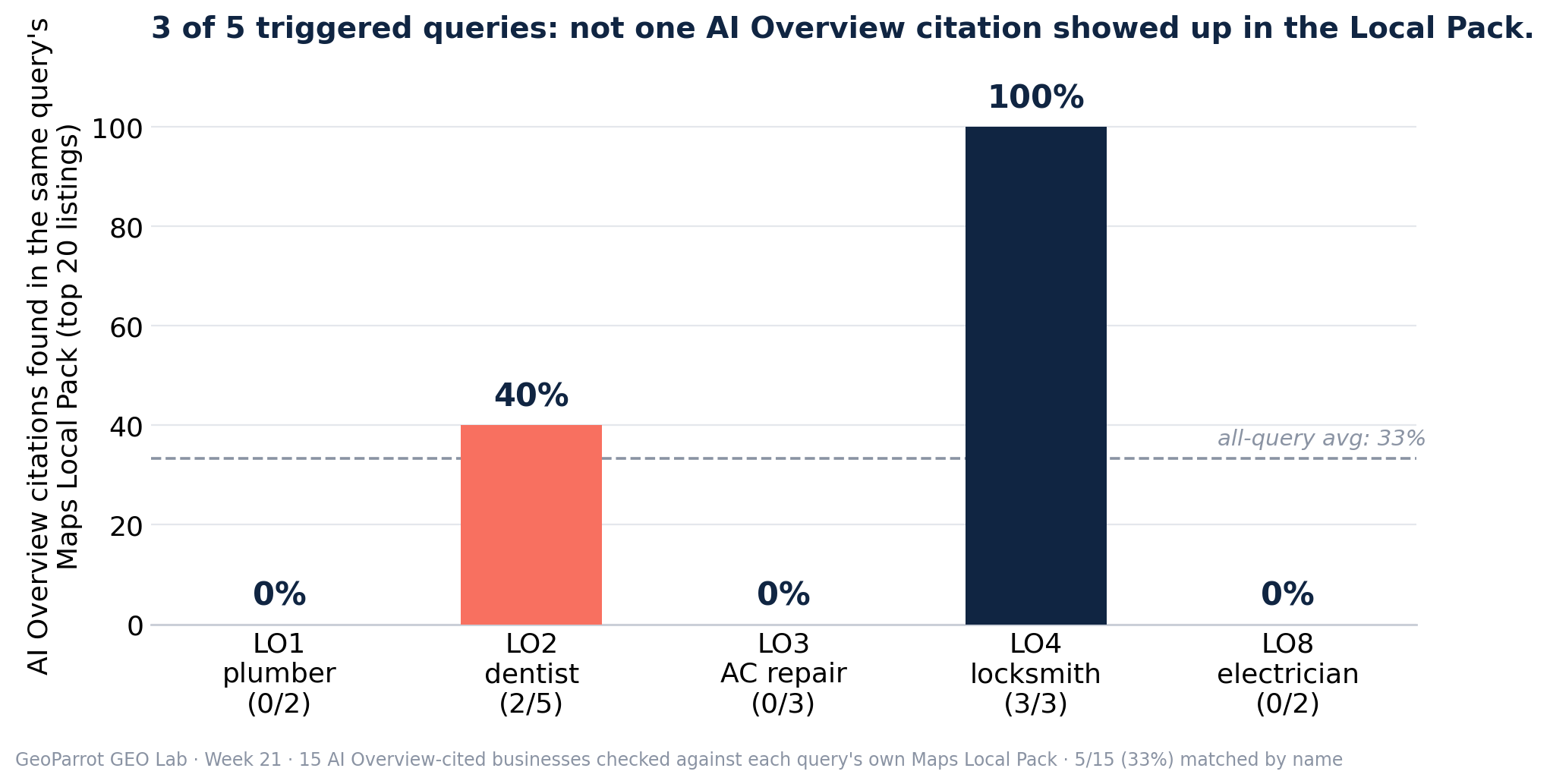
5 of 8 queries triggered a classic AI Overview box (plumber, dentist, AC repair, locksmith, electrician). Those 5 boxes named 15 distinct local businesses between them. Separately, for every one of the 8 queries we also pulled the Google Maps Local Pack and recorded up to 20 listed businesses’ visible signals — 122 business records total. The pre-registration’s plan was to find each cited business inside its query’s Local Pack and compare its signals to the businesses the Overview skipped. That only worked for a third of the cited businesses we had.
| Query | AI Overview triggered? | Cited businesses named | Found in that query’s Local Pack | Match rate |
|---|---|---|---|---|
| LO1 · emergency plumber | Yes | 2 | 0 | 0% |
| LO2 · dentist accepting new patients | Yes | 5 | 2 | 40% |
| LO3 · same-day AC repair | Yes | 3 | 0 | 0% |
| LO4 · 24-hour locksmith | Yes | 3 | 3 | 100% |
| LO5 · hair salon | No (not triggered) | — | — | — |
| LO6 · moving company | No (not triggered) | — | — | — |
| LO7 · pet grooming | No (not triggered) | — | — | — |
| LO8 · emergency electrician | Yes | 2 | 0 | 0% |
For LO8 (electrician), the Overview named “전기친구들” (5.0 stars, 6 reviews, in its own text) and “거성종합전기” — neither string appears anywhere among the 20 businesses our Maps pull returned for the identical query text. For LO3 (AC repair), the Overview named three businesses by brand (바로쿨에어, 에어컨해결사, 미소); the Local Pack for that query returned only two listings total, neither of them a match. We’re not claiming these are necessarily different real-world businesses — a business can legitimately show up under a different display string in the Overview’s generated prose than on its own Maps card, and we have no backend ID to confirm or rule that out. What we can say is that matching by the visible business name — the only signal a logged-out searcher like us has access to — failed two-thirds of the time, which on its own says something about how loosely coupled these two Google surfaces are for the identical query.
Where the comparison did work, what did the GBP signals actually show?
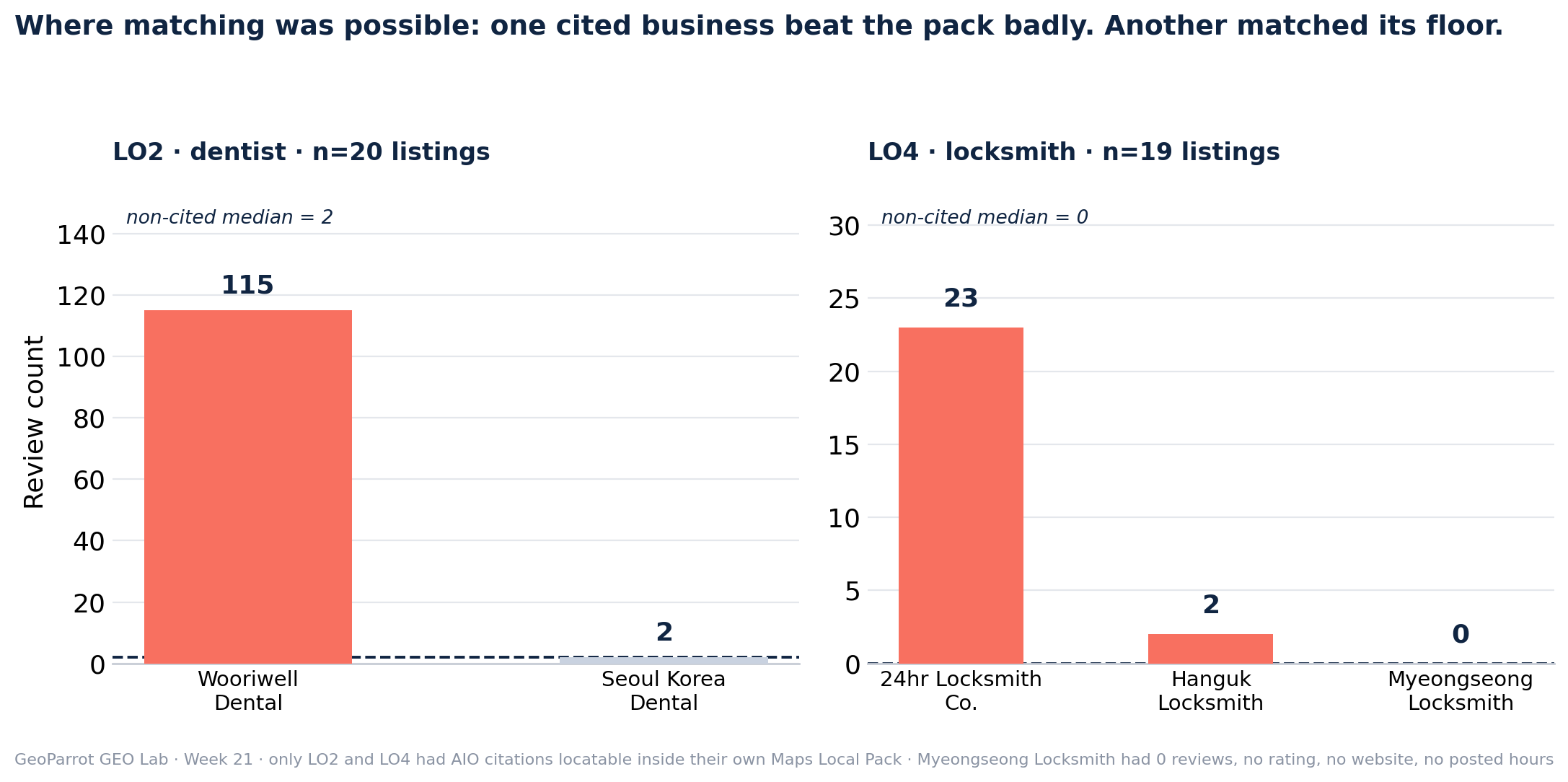
Only the dentist query (LO2) and the locksmith query (LO4) had enough matched citations to say anything about P1 (review signal). The result is a genuine split, not a clean confirmation.
LO2 — dentist, 20 Local Pack listings. The top-cited business, Wooriwell Dental, had 115 reviews against a Local Pack median of 2 — a 57x gap, the single clearest review-signal result in the entire dataset. The Overview’s second cited business, Seoul Korea Dental, had exactly 2 reviews and a 5.0 rating — tied on both figures with four other listings in the same pack (투엠치과의원, 서울엘치과의원, 연세안치과의원, 단아치과의원) that were not cited. Review count alone cannot explain why this specific 2-review, 5.0-star listing got named and the other four, statistically identical ones didn’t.
LO4 — locksmith, 19 Local Pack listings. The top-cited business (24hr Locksmith Co.) had 23 reviews at a 5.0 rating against a pack median of 0 — comfortably confirming the review-gap direction. The second cited business (Hanguk Locksmith) had 2 reviews at 4.0 stars, again above the zero-review floor most of the pack sits at. But the third cited business, Myeongseong Locksmith, had 0 reviews, no star rating, no website link, and no posted hours — on every completeness and trust signal we could measure, it was indistinguishable from more than half the 19-listing pack, and worse-provisioned than several non-cited competitors that at least had a posted schedule.
Why couldn’t P2 (category match) be tested at all?
The pre-registration’s P2 bet that cited businesses would carry a more exact category label than non-cited ones in the same pack. That comparison needs variance in category labels to exist within a pack, and in both queries where matching worked, it didn’t: all 20 LO2 listings carry a dentist-family category (치과의사 / 치과 진료소 / specialist variants), and all 19 LO4 listings carry the single label 열쇠공 (locksmith). Every business Maps chose to surface for these two queries had already cleared the category-relevance bar before the Overview ever saw the list — so there was no mismatched-category listing in either pack for a citation decision to avoid. P2 isn’t rejected; it’s untestable with the data this arc could collect, which is a different and more honest outcome than forcing a verdict from a sample with zero within-group variance.
What about P3 — is completeness just a floor, not a differentiator?
Wednesday’s collection already confirmed photo-count and Q&A-tab presence don’t exist as measurable signals in the current Google Maps UI (documented in the pre-registration‘s planned substitution), so P3 runs on three completeness booleans instead: website link present, phone number present, hours posted. Myeongseong Locksmith — cited by the Overview in LO4 — failed two of those three (no website, no posted hours) while several non-cited listings in the same pack passed all three. That’s the opposite of what a pure completeness-gates-citation story would predict, and it’s consistent with the pre-registration’s own P3 bet: completeness looks like a floor nearly every surfaced listing already clears or doesn’t need, not something that’s differentiating who gets named inside the box.
So what’s the state of all three predictions heading into Friday?
| Prediction | Testable sample | What the data shows |
|---|---|---|
| P1 — review signal | 2 of 8 queries (LO2, LO4) | Mixed: holds cleanly for the top-cited business in both queries (57x and ∞x the pack median); fails to explain a second cited business in each query that was statistically tied with, or worse than, multiple uncited peers. |
| P2 — category match | 0 of 8 queries | Untestable — both matchable packs had zero category variance among surfaced listings, so there was no mismatched competitor for a citation decision to route around. |
| P3 — completeness is a floor | 2 of 8 queries (LO2, LO4) | Supported on the one clear counter-example available: a cited business failed 2 of 3 completeness checks while non-cited peers passed all three. |
Frequently asked questions
What did this week’s collection actually find?
Of 15 businesses an AI Overview box cited across 5 triggered “near me” queries, only 5 (33%) could be located by name inside the same query’s Google Maps Local Pack. 3 of 5 triggered queries had zero overlap between what the Overview cited and what the Local Pack listed.
Does this mean AI Overview is citing businesses that don’t exist on Google Maps?
No — it means we couldn’t match the business name as written in the Overview’s generated prose to a business name as written on a Maps listing card, using only front-end signals visible to a logged-out searcher. The businesses may be the same entity under a different display string, or the Overview may be drawing from a broader or differently-filtered pool than the visual Local Pack for that query. We don’t have backend access to confirm either way, and we say so directly rather than guessing.
Did review count predict which businesses got cited?
Partially. In both queries where matching worked, the single most-cited business had a dramatically higher review count than the Local Pack median. But a second cited business in each of those same two queries was statistically tied with, or worse-provisioned than, multiple non-cited competitors — including one cited locksmith listing with zero reviews, no rating, no website, and no posted hours.
Why couldn’t the category-match prediction (P2) be tested?
Both queries with a matchable cited business (dentist, locksmith) had zero category variance across their entire Local Pack — every surfaced listing already carried the relevant service category. With no mismatched-category competitor present in either pack, there was nothing for a citation decision to route around.
When does the formal verdict publish?
Friday. This results post reports what Wednesday’s collection shows against each of the three pre-registered predictions; Friday’s post judges what the low match rate and the mixed P1 result mean for whether GBP signals are a reliable explanation for local AI citation at all.
Sources
- Tuesday’s pre-registration — the locked query set, GBP signals, and three predictions scored above.
- Monday’s claim check — the BrightLocal 29.3% cross-engine naming-agreement figure that opened this week’s question.
- Local AI citation overlap: claim check — Week 18’s related finding on cross-engine (not within-Local-Pack) local citation agreement, a different angle on the same underlying gap.
- Local AI citation overlap: method — Week 18’s pre-registration for that related arc.
- GeoParrot GEO Lab — Week 21 GBP-signal collection, raw data gathered November 11, 2026. Formal verdict on all three predictions publishes Friday.
GeoParrot is a GEO Lab: we test what AI search actually cites and recommends, then publish the method and the misses — including our own. This is Thursday’s results in a four-part weekly arc — Monday set the hypothesis, Tuesday locked the method, today is the full collection against all three predictions, and Friday delivers the verdict.




Leave a Reply