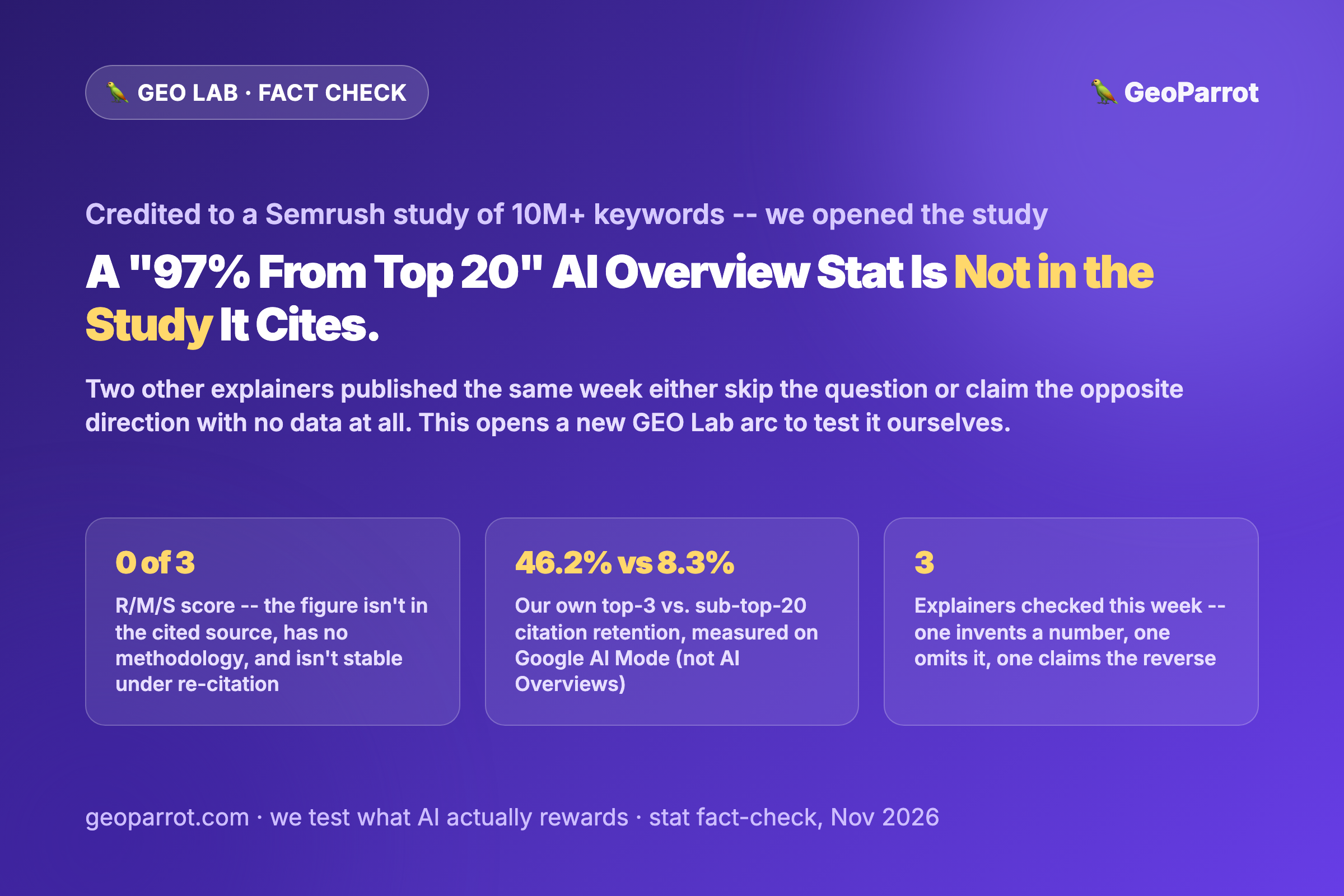
Quick answer: A stat circulating across SEO blogs in late October 2026 claims “roughly 97% of AI Overview citations come from pages already sitting in the top 20 organic results,” with position-one pages “pulled into an Overview more than half the time it appears” — credited to a Semrush analysis of 10M+ keywords. We fetched that Semrush study directly. It discusses AI Overview prevalence, zero-click rates, and SERP feature overlap from 10M+ keywords collected January-November 2025 — but contains no citation-position-correlation data at all. Two other SEO blogs covering the same topic in October 2026 either omit the stat entirely or assert the opposite direction with no numbers attached. This opens a new GEO Lab arc testing the underlying claim ourselves, directly.
Published November 2, 2026, in the GEO Lab. This opens a new weekly arc. We went looking for this week’s trend anchor and instead found a citation that doesn’t check out — which became the anchor.
Where did the “97% from top 20” stat come from?
Scanning this week’s AI Overview coverage, one article (a 2026 “citation rules” roundup) states: “According to Semrush’s analysis of more than 10 million keywords, roughly 97% of AI Overview citations come from pages already sitting in the top 20 organic results,” adding that “pages ranking in position one are pulled into an Overview more than half the time it appears.” It links directly to Semrush’s own AI Overviews study as the source. That’s a clean, specific, falsifiable claim with a named source and a link — the kind of citation that’s easy to just repeat. So we opened the link.
What does the Semrush study the stat is credited to actually say?
We fetched Semrush’s AI Overviews study directly. Publish date: December 15, 2025, refreshed from an original March 2025 version. Data collection window: January through November 2025. Sample: “10M+ keywords from the Semrush database,” plus a partnership with Datos examining over 200,000 keywords specifically for zero-click behavior. The study’s actual content covers AI Overview prevalence by query type and industry, zero-click rates, and SERP feature overlap. The closest thing to a ranking-related finding in the entire study is “keywords that trigger AI Overviews tend to be longer and more specific” — a statement about query length, not about which organic rank position gets cited. No percentage anywhere in the study ties citation source to organic rank position. The 97%-from-top-20 and position-one-over-50%-of-the-time figures are not in the document they’re credited to.
What the article claims Semrush found
What Semrush’s study actually contains
97% of AI Overview citations come from top-20 organic pages
Not present — no citation-to-rank correlation data anywhere in the study
Position-one pages cited >50% of the time an Overview appears
Not present — same gap
(implied) ranking position drives citation
Only rank-adjacent finding: AI-Overview-triggering keywords “tend to be longer and more specific” (about query phrasing, not citation source)
Side-by-side: the claim as repeated, versus the study’s actual contents, checked directly against Semrush’s December 2025 (refreshed from March 2025) AI Overviews report, 10M+ keywords, data collected Jan-Nov 2025.
Is this just one bad citation, or does the pattern hold elsewhere?
We checked two more AI Overview explainers published in the same window. One, published October 26, 2026, covers which domains get cited most often (Reddit, LinkedIn, Wikipedia lead its list) but doesn’t quantify rank position at all — no 97%, no position-one figure, no number of any kind tying citation to where a page ranks organically. The other asserts the opposite direction, under a section it calls the “Position 11-30 Extraction Advantage”: that pages ranking between positions 11 and 30 “regularly capture AI Overview citations over the #1 organic ranking URL.” No sample size, no percentage, no methodology — just the claim. So across three explainers published within roughly a week of each other, covering the same question: one invents a specific-sounding statistic and misattributes it, one says nothing quantitative, and one asserts the reverse direction with zero evidence attached. None of the three actually measured anything themselves.
On a Reachable / Methodology-disclosed / Stable check, does the 97% stat hold up?
Criterion
Score
Why
R — Reachable
0
The cited source is reachable, but the specific figure is not in it — a broken chain of custody, not a paywall or dead link.
M — Methodology disclosed
0
No methodology exists for this specific figure, because the figure itself was not produced by the study it’s credited to.
S — Stable under re-citation
0
One competing explainer states the opposite direction with no data; another omits the question. Nothing stabilizes it.
0 of 3 — our lowest R/M/S score logged this quarter. Not a stale number or a measurement bug; a fabricated attribution.
What do we actually know about rank and AI citation, from our own data?
We have real numbers here, just not for the exact claim above. None of our prior arcs measured the classic Google AI Overview box specifically — they measured Google AI Mode, ChatGPT, and Perplexity citations, which is a related but different surface. Still, worth laying out what we know before testing the gap directly: on Google AI Mode, citation retention was 46.2% for top-3-ranked pages versus 8.3% for pages outside the top 20 — directionally consistent with “rank matters,” but a 5.6x gap, not a 97%-concentration claim. Across a blind cross-engine test, blended rank-to-citation overlap came out to 34%, with a 40-point spread between engines — “under 20%” turned out to be a ChatGPT-specific number, not a universal law. And when we reworded the same queries without changing intent, AI Mode swapped roughly 86% of its cited sources — evidence that citation sets are considerably less stable than a clean “it’s just rank” story implies.
What are we testing this week?
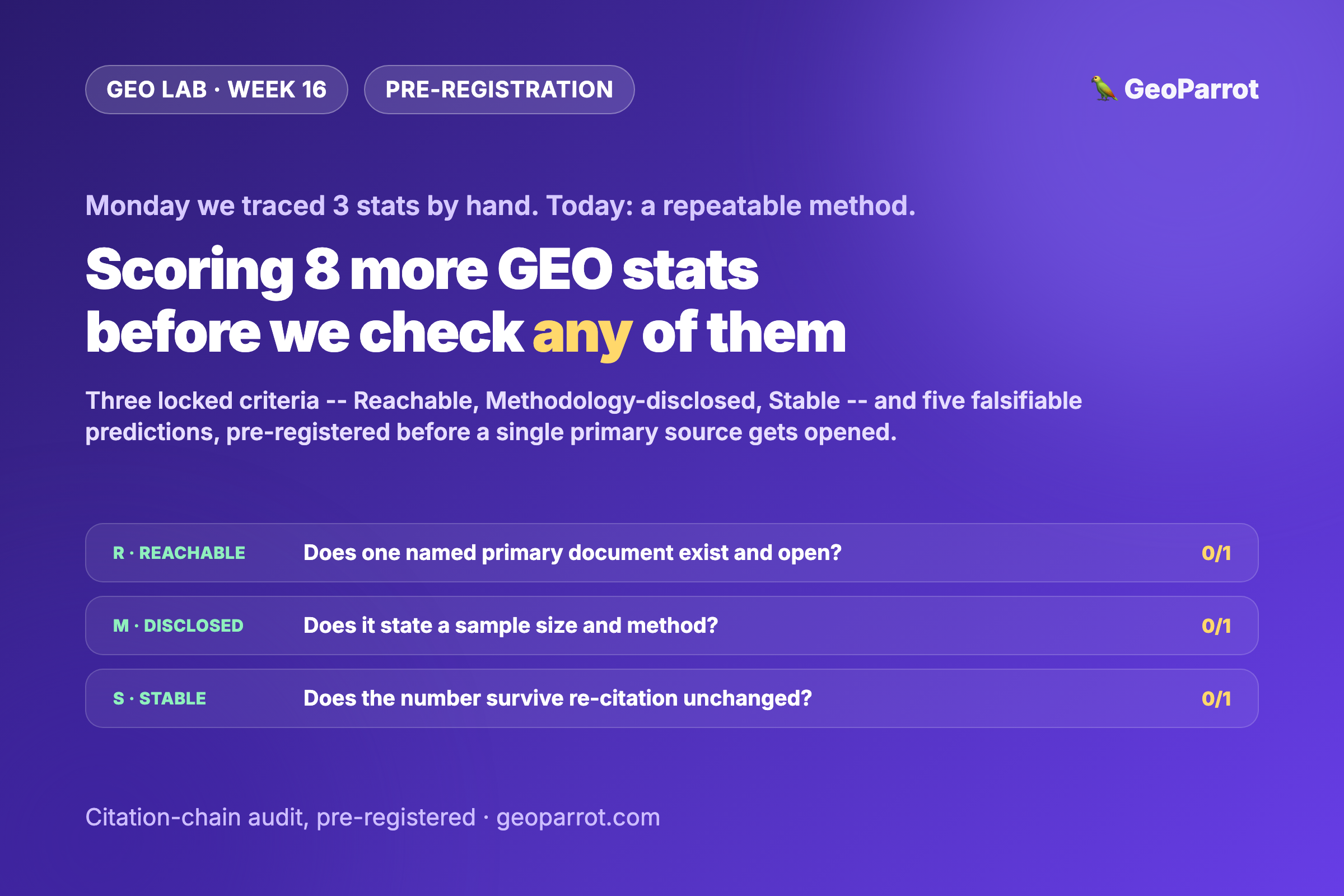
Tuesday we lock and publish a pre-registration that tests the actual claim this stat makes, aimed specifically at the classic AI Overview box rather than AI Mode or chat assistants: does a query’s AI Overview cite a source that is already ranking near the top of that same query’s organic results, and does that relationship hold across different query intents (product, informational, how-to, local) and phrasings (short keyword vs. full question)? Collection runs midweek. Thursday reports what actually triggered an Overview and what got cited when it did; Friday is the verdict against whatever we lock Tuesday — including an honest check on whether our own number lands anywhere close to 97%, or closer to the 34-46% range our adjacent experiments have already found.
What should you do with this right now?
If you’ve seen the 97% figure cited anywhere: it traces back to an article that links to Semrush as its source, but the number is not in Semrush’s study. Treat it as unverified until someone produces the actual measurement.
If you’re deciding how much to invest in rank versus other citation signals: don’t anchor on 97% either way. Our own measurements across AI Mode, ChatGPT, and Perplexity put rank-citation correlation in the 34-46% range, with real variance by engine and query phrasing — strong enough to matter, nowhere near total.
If you’re citing a stat in your own content: open the link before you repeat the number. This one had a working link and a named, credible-sounding source. That wasn’t enough.
Frequently asked questions
Is it true that 97% of AI Overview citations come from top-20 organic pages?
We can’t confirm it, and the study it’s credited to — a Semrush AI Overviews analysis of 10M+ keywords, published December 2025 — does not contain that figure. No other source we checked produced or confirmed the number either.
Did Semrush publish a different, correct version of this stat somewhere else?
Not that we found. We checked the exact study the claim links to directly; its actual content covers AI Overview trigger rates, zero-click behavior, and SERP feature overlap from January-November 2025 data, with no citation-to-rank-position breakdown.
Does GeoParrot have its own data on rank and AI citation?
Yes, but not for the classic AI Overview box specifically. Our existing numbers cover Google AI Mode, ChatGPT, and Perplexity: 46.2% vs. 8.3% citation retention for top-3 vs. sub-top-20 pages on AI Mode, 34% blended cross-engine rank-citation overlap, and an 86% source swap rate when queries are reworded. This week’s experiment tests the AI Overview box directly for the first time.
What is GeoParrot testing this week?
Whether a query’s classic AI Overview citation tracks that query’s own top organic ranks, across four intent types (product, informational, how-to, local) and two phrasing styles (short keyword vs. full question). The pre-registration locks Tuesday, data collection runs midweek, and Thursday/Friday report results and verdict.
Sources
Semrush AI Overviews Study — Semrush, published December 15, 2025 (refreshed from March 2025), 10M+ keywords, data collected January-November 2025. The study the 97% figure is credited to; checked directly, the figure is not in it.
GeoParrot is a GEO Lab: we test what AI search actually cites and recommends, then publish the method and the misses — including our own. This opens a new weekly arc. Tuesday we publish the pre-registration for this week’s direct test of AI Overview citation versus rank.



Leave a Reply