
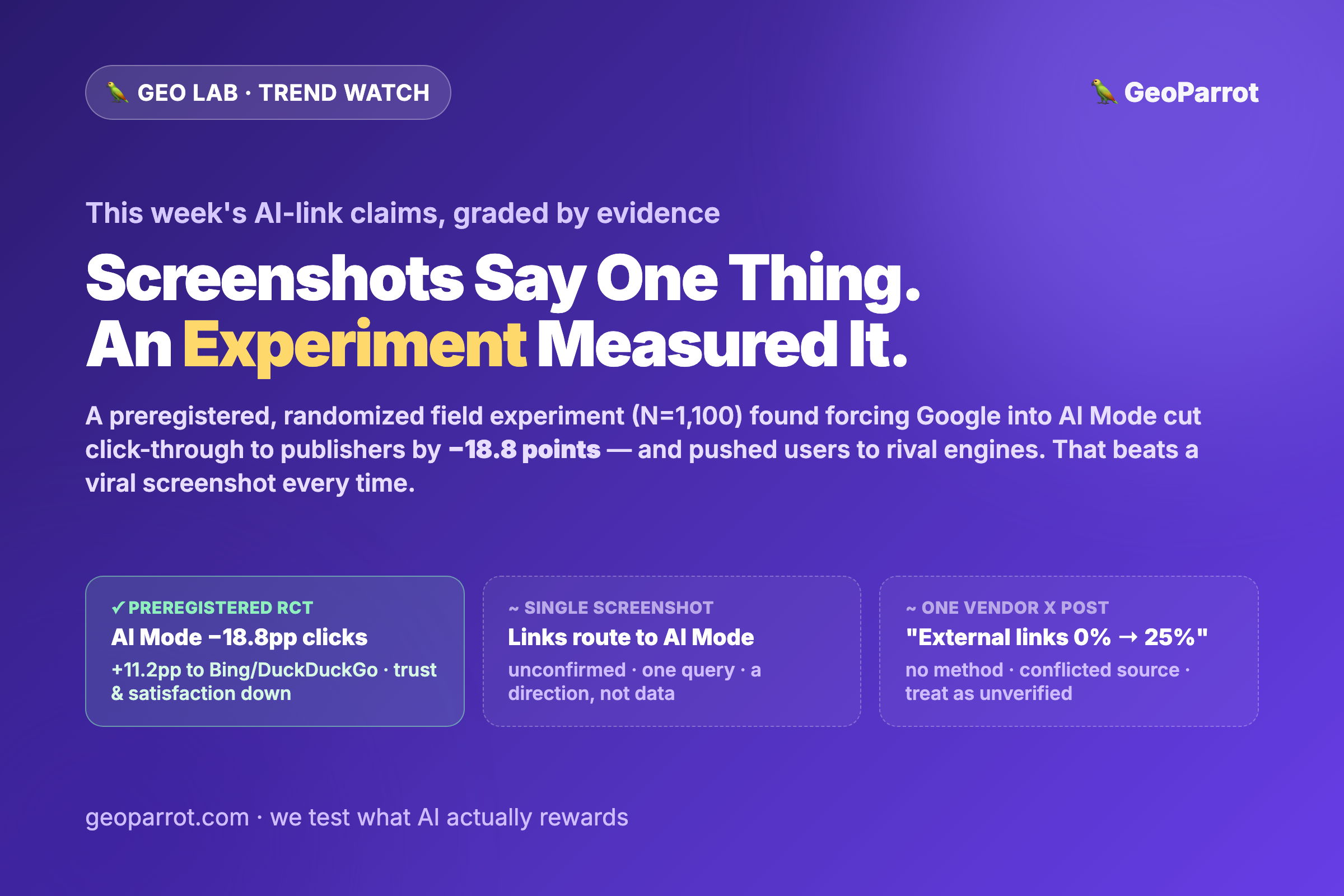
Quick answer: A preregistered, randomized field experiment from the University of Pennsylvania and Northeastern (N=1,100, surfaced in the trade press on September 21) found that forcing Google Search into AI Mode cut click-through to external websites by 18.8 percentage points [95% CI −22.2, −15.3] and increased the share of users who defected to a rival engine — Bing, DuckDuckGo or Yahoo — by 11.2 points, while lowering trust and satisfaction. It’s the strongest evidence yet that Google’s AI answers shrink the click. It also landed the same week as two much noisier claims about the same topic — a single screenshot of AI Overview links routing into AI Mode, and one vendor’s X post claiming external links jumped “0% to 25%.” The GEO takeaway is the contrast: a randomized experiment outranks a viral screenshot, and it upgrades our year-long “cited ≠ clicked” refrain from a correlation to a causal fact. Value citations as presence; stop pricing them as guaranteed traffic.
Trend watch — published September 24, 2026. Three signals about the same question — does being in Google’s AI answer earn you a click? — hit within a few days of each other, at three very different evidence grades. The GEO Lab reads them the way we read any claim: grade the evidence first, then check the mechanism against data you can actually count.
What did the experiment actually measure?
This is the part that matters most, because it’s what separates this study from the usual dashboard stat. The paper — “AI in Search Reduces Publisher Referrals Without Improving User Experience: Experimental Evidence,” by Stephanie T. Wang and Danaé Metaxa (UPenn) with Jeffrey Gleason, Yakov Bart and Christo Wilson (Northeastern) — is a preregistered, randomized field experiment, not an observational scrape. Roughly 1,100 US Google users installed a browser extension that recorded their real searches, clicks, and which AI features appeared, and they were randomly assigned to one of three conditions: normal Google, a version with AI features removed, and a forced-AI-Mode experience. Randomization is what lets the authors claim cause, not just correlation — the groups differ only in the search experience they were handed.
That design is exactly what we mean by the GEO Lab standard. Most “AI kills traffic” numbers are inferred from panels and correlations; this one is measured under a controlled manipulation with confidence intervals attached. When you’re deciding how much to trust a finding, the method is the headline.
What did it find?
The core result is blunt. In the authors’ words, “assignment to AI Mode Search significantly reduced click-through rate by −18.8 percentage points [95% CI: −22.2pp, −15.3pp].” In the other direction, “exposure to No AI Search increased click-through rate by 8.8pp” — take the AI answers away and people click out to sites more. AI Mode didn’t just keep users on Google, either: it “significantly increased the fraction of users searching on a competitor engine (Bing, DuckDuckGo, or Yahoo) by 11.2pp.” And it made the experience worse — AI Mode “significantly decreased trust (−0.34 points on a 7-point scale), perceived usefulness (−0.59 sd), satisfaction (−0.73 sd), and agency (−0.66 sd).”
Read those together and the picture is coherent: the AI answer absorbs the click, and the people it does send somewhere are more likely to bounce to a rival than to a publisher. That is the causal version of a thing we’ve only been able to show by correlation until now.
Why does this matter for GEO specifically?
Because it settles an argument we’ve been having with our own readers all year. The entire GEO business case rests on an unstated chain: you get cited, the citation earns a click, the click becomes traffic. We’ve repeatedly warned that the middle link is weak — that pages get cited without ranking and that the click was never the guaranteed prize. But our evidence for the shrinking click was observational: an Ahrefs study on France’s AI Overviews CTR drop, Google’s test of a thinner citation panel, and the reported spread on AI traffic conversion running from −13% to 23x on tiny denominators. Correlation, all of it.
This experiment upgrades that to a causal claim: in a randomized setting, AI Mode caused an 18.8-point drop in click-through. So the practical instruction hardens. Do not price a GEO strategy on the click. Price it on presence — being the source that frames the answer, the brand the model recalls, the recommendation the user walks away with. That value survives even when the click doesn’t, and this study is now the reason to say so with a straight face.
How does this compare to the week’s other AI-link claims?
Here’s where GEO Lab discipline earns its keep, because two other claims about Google’s AI links went around this same week — and both are far weaker. On September 22, a widely shared screenshot showed Google testing anchor links at the bottom of AI Overviews that drop you into AI Mode instead of a webpage. Interesting direction — but unconfirmed, spotted on a single query, and easy to over-read. On September 23, a vendor (Peec AI’s Malte Landwehr) posted that external links in AI Overviews had jumped from “close to 0% to over 25%.” No sample size, no dates, no methodology — and even Barry Schwartz, reporting it, said it “doesn’t ‘feel’ right” and disclosed that he has an investment in the company.
Notice these three signals point in different directions: one says Google is hiding the click (the experiment), one says Google is adding its own links (the screenshot), one says Google is adding more publisher links (the X post). When trade coverage contradicts itself in a single week, recency is a terrible tiebreaker. Evidence grade is the right one. A preregistered randomized experiment with confidence intervals beats a single screenshot beats one conflicted, unmethodologied post — every time. That’s not cynicism about the two weaker claims; the screenshot may well be a real test and the link-count claim may even be true. It’s that you don’t rebuild a strategy on evidence you can’t check, and you weight your beliefs by how the number was produced. That’s the same counted-versus-inferred rule we apply to vendor “AI visibility” dashboards.
What are the honest limits of the study?
Grading evidence cuts both ways, so we hold the strong study to the standard too. Three caveats. First, the cleanest number is the AI Mode arm; the authors report that their attempt to reliably remove AI Overviews degraded as Google changed its HTML — “the success rate declined to 0% as the experiment progressed,” landing at only 51.1% overall — so the AI-Overviews-removal estimate is noisier than the AI Mode one. Don’t stretch the 18.8-point figure to cover all of AI search. Second, “forced AI Mode” is an experimental manipulation, not most people’s default reality yet; it isolates the effect of the surface, but it isn’t a forecast of your traffic. Third, it’s one population and window — US Chrome users, about 1,100 of them, over a week — a real experiment, not a universal law.
And the scope is Google. ChatGPT, Perplexity and Gemini source and render citations their own way — in our own cross-engine test the four major engines shared just 2 of 395 cited domains, with about 85% unique to a single engine. A click-behavior finding on Google AI Mode tells you nothing about whether Perplexity sends the click through on the same question. There’s no universal GEO move hiding in this result; verify click-through per engine.
How do you measure this on your own site?
On first-party infrastructure, because that’s the only evidence grade you fully control. Google’s Generative AI performance report is impressions-only — it has no click data, so if AI Mode is quietly absorbing your citation clicks, that report will keep looking healthy while your actual traffic erodes. The fingerprint to watch is flat or rising AI-feature impressions paired with falling GA4 AI-referred sessions — cited, but the click stayed inside Google. Counted numbers on your side beat inferred numbers an interface implies. Run that comparison quarterly and you’ll know whether the experiment’s population-level effect is showing up in your own funnel.
The practitioner takeaway
- Grade evidence before you act on it. A preregistered randomized experiment outranks a screenshot outranks a single unmethodologied post. Weight your beliefs — and your roadmap — by how the number was produced, not by how loudly it circulated.
- Treat “cited ≠ clicked” as settled now, not speculative. The click loss is causal, not just correlated. Price GEO on presence — framing, recall, recommendation — and stop reporting citations as guaranteed traffic.
- Don’t rebuild for the two weak claims. The AI-Mode-links screenshot and the “0% → 25%” post are unverified. Note the directions; wait for method before you reorganize anything.
- Watch clicks first-party. GSC’s AI report has no click data. Pair impressions with GA4 AI-referred sessions; flat impressions plus falling clicks is your early-warning fingerprint.
- Hold the scope on Google. This is a Google AI Mode result. Verify click-through behavior on ChatGPT, Perplexity and Gemini separately — their sources barely overlap.
- Optimize the asset, not the affordance. You can’t control whether Google keeps the click. You can control whether your page is the one worth citing — so keep earning the citation.
Bottom line: This week handed practitioners three claims about Google’s AI links pointing in three directions. Only one — a preregistered, randomized field experiment — is built on evidence you can actually check, and it says AI Mode causally cut publisher click-through by 18.8 points while nudging users to rivals and making the experience worse. That doesn’t mean GEO is dying; our data has always said the click was never the guaranteed prize. It means the discipline that wins is boring and durable: grade the evidence, price citations as presence, and measure the clicks on infrastructure you own.
Frequently asked questions
What did the UPenn and Northeastern experiment find about Google AI Mode?
In a preregistered, randomized field experiment with about 1,100 US Google users, forcing the search experience into AI Mode reduced click-through to external websites by 18.8 percentage points (95% CI −22.2 to −15.3) and increased the share of users who searched on a competitor engine (Bing, DuckDuckGo or Yahoo) by 11.2 points. It also lowered trust, perceived usefulness, satisfaction and users’ sense of agency. Removing AI features instead increased click-through by 8.8 points.
Why is a preregistered experiment stronger evidence than the other AI-link claims this week?
Because it establishes cause, not just correlation. Randomly assigning users to different search experiences means the groups differ only in the surface they were shown, so the click-through gap can be attributed to AI Mode rather than to who happened to use it. Preregistration and confidence intervals add further credibility. A single screenshot of a test on one query, or one vendor’s post claiming a number with no methodology, can’t support that kind of causal claim — they’re directions to watch, not facts to act on.
Does this mean being cited in AI search is worthless?
No. It means the click is a shrinking and unreliable part of a citation’s value, not the whole of it. The durable value is presence — being the source that frames the answer, the brand the model recalls, the option it recommends — which persists even when the user never clicks through. The practical shift is to price and report GEO as presence rather than as guaranteed traffic, and to measure any click-through separately using your own analytics.
Does the study apply to ChatGPT and Perplexity?
No. The experiment measured Google’s AI Mode specifically. ChatGPT, Perplexity and Gemini pull from largely different source sets and render citations differently — in our cross-engine test the four major engines shared only 2 of 395 cited domains, with about 85% unique to a single engine. A click-behavior finding on Google tells you nothing about how another engine handles the click, so verify each engine on its own.
How can I tell if AI Mode is costing my site clicks?
Compare first-party signals. Google Search Console’s Generative AI performance report shows impressions but no click data, so it won’t reveal it directly. Track your AI-feature impressions in GSC against your GA4 AI-referred sessions over time. If impressions stay flat or rise while AI-referred clicks fall, that’s a fingerprint consistent with the answer box keeping clicks inside Google rather than passing them to you.
Leave a Reply