
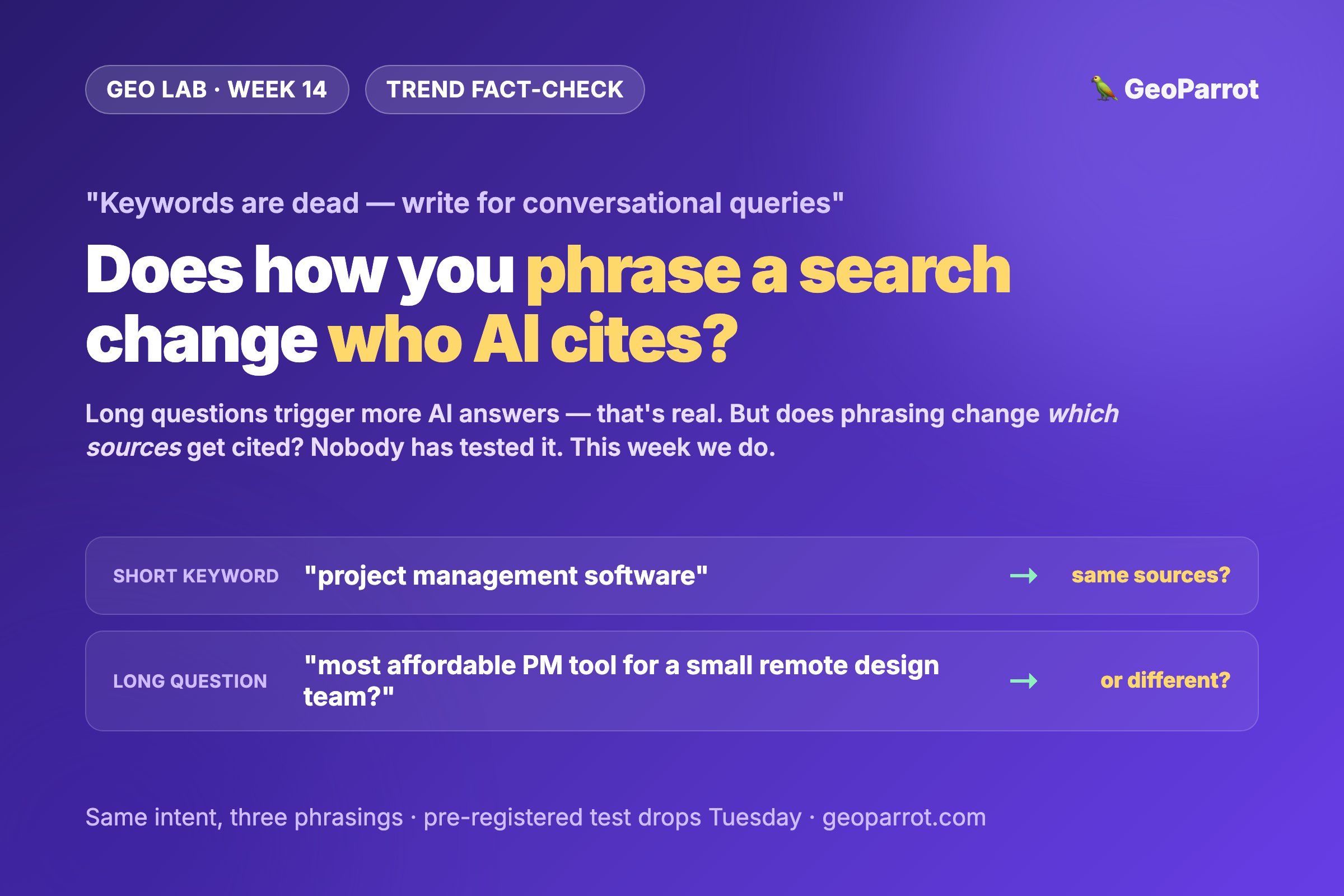
Quick answer: The 2026 advice you keep hearing — “keywords are dead, write for long conversational questions” — is half-verified and half-assumed. The verified half: long, natural-language questions (8+ words) do trigger AI answers far more often than short keywords, and roughly 80% of search is drifting toward conversational phrasing. The assumed half is the one that actually decides your traffic: that phrasing your target queries conversationally will get your source cited more. Nobody has separated “did an AI answer appear?” (trigger) from “did it cite me?” (selection). Our own data says selection is governed by things that have nothing to do with phrasing — engines share only 2 of 395 cited domains, rank predicts citation at just 34.4%, and for commercial queries the top 15 domains capture only 23%. So this week the GEO Lab runs the missing test: hold the intent fixed, change only the phrasing (short keyword → medium → long conversational question), and see whether the set of cited domains actually moves. If it does, phrasing is a real lever. If it doesn’t, “conversational optimization” mostly changes whether an answer shows up — not who wins it.
Trend watch — published September 21, 2026, and the opening move of this week’s GEO Lab arc. This month the “from keywords to conversations” narrative hit peak volume across the SEO and GEO world — Clearscope, Search Engine Land and a dozen agency blogs all telling you to stop chasing short keywords and start writing for the questions people actually type into ChatGPT and AI Mode. Most of it is directionally right and quietly incomplete. We took the trend and asked the question the advice skips: does changing how a search is phrased change which sources the AI pulls into its answer? The rest of the week is a pre-registered experiment to find out.
What are people actually claiming when they say “keywords are dead”?
Strip the slogans away and the 2026 conversational-search advice bundles three separate claims that usually get treated as one:
- Behavior: people are searching in longer, more natural sentences — roughly 80% of search is shifting toward conversational, question-shaped input as ChatGPT, Perplexity and AI Mode field billions of natural-language queries.
- Trigger: long-tail question queries (8+ words) fire an AI Overview or AI answer far more often than short head terms. Write “what’s the best CRM for a 5-person agency” and you get an answer engine; type “crm” and you often get a plain results page.
- Selection (the leap): therefore, if you write and optimize for those conversational questions, you will get cited more often.
The first two are measurable and largely true. The third is where the advice quietly changes subject. Getting an AI answer to appear is not the same as getting the AI to cite you inside it. Trigger is about the query; selection is about the sources. And almost every “optimize for conversational search” post assumes that winning the first automatically wins the second. That assumption is exactly what has never been isolated — and it’s what this week is about.
Is the “conversational queries trigger more AI answers” part actually true?
Yes — and we’re not going to pretend otherwise. This is the well-supported half of the trend. Longer, question-format queries reliably surface AI Overviews and AI Mode responses more than short keywords do, because a full question gives the model something to answer, while a bare keyword is ambiguous intent the engine often resolves with a classic SERP. That’s consistent with what Google itself keeps saying — that AI experiences reward content that directly answers specific questions — and it’s the same logic behind writing pages that lead with the answer. We’ve argued for answer-first, question-headed content for exactly this reason: it matches how AI systems chunk and quote text.
So if your problem is “AI answers never appear for my topic,” phrasing and structure genuinely help. But notice what that fixes: coverage — the odds that an answer engine engages at all. It says nothing about whether the answer that appears reaches for your page or for Reddit, a comparison site, and a competitor. The trend has thoroughly documented the doorway. It has barely looked at who walks through it.
But does phrasing change which sources get cited?
This is the real question, and honestly, nobody has published a clean answer. Here’s the hypothesis worth taking seriously: because AI engines expand and rewrite your query before retrieving, a long conversational question (“what’s the most affordable project management tool for a small remote design team”) may pull in a different, more niche set of sources than the head term (“project management tool”) — comparison articles, category-specific media, forum threads — while the short keyword leans on the broad, high-authority domains. If that’s true, phrasing isn’t just a trigger; it’s a lever that decides which kind of source gets the citation, and small, specific publishers would win disproportionately on the long-tail phrasings.
The counter-hypothesis is just as plausible: the engine normalizes both phrasings to the same underlying intent, retrieves the same candidate pool, and cites roughly the same domains either way — meaning “conversational optimization” changes whether an answer fires, not who’s in it. Both stories are believable, and the entire GEO industry has been giving advice as if the first were settled fact. It isn’t. That gap is the point of the experiment.
What our first-party data already says about how citations get chosen
We come into this week with a strong prior, and it’s a skeptical one: the things that actually decide AI citations, in every test we’ve run, have had nothing to do with how the user phrased the query. Three findings set the baseline:
- Engines barely agree on sources at all. Across our four-engine test, the major engines shared only 2 of 395 cited domains, with ~85% unique to a single engine — which is why there is no universal GEO strategy. Whatever phrasing does, it operates on top of engines that already diverge wildly.
- Rank is a weak, uneven predictor. The overlap between an engine’s cited domains and Google’s top-10 was 34.4% blended — 53.6% on AI Mode, 13.3% on ChatGPT. Rank buys the ticket, not the seat.
- For commercial queries, the citation economy is a long tail. When we re-ran the industry’s concentration study on buyer-intent queries, the top 15 domains captured just 23%, with 77% of cited domains appearing only once. The “Reddit and Wikipedia own everything” picture is a general-knowledge artifact.
On the content side, what moves selection has been reputation and structure, not query wording: brand mentions correlate with citation at 0.664 versus 0.218 for backlinks, and independent experiments we replicated found earned third-party mentions dwarf owned content. None of that is about whether the searcher typed a keyword or a sentence. So our honest prior is that phrasing will move trigger a lot and selection a little — but “a little” is not “nothing,” and a real experiment beats a strong opinion. That’s why we’re measuring it instead of asserting it.
How the GEO Lab will test this, this week
Tuesday’s post pre-registers the design in full; here’s the shape so you know what’s coming. We take a set of commercial, buyer-intent topics and, for each, write three phrasings of the same intent:
- Short keyword — e.g. “project management software.”
- Medium — e.g. “best project management software for small teams.”
- Long conversational question — e.g. “what’s the most affordable project management tool for a small remote design team just getting started?”
We run each phrasing through the AI engines, capture the distinct domains cited in each answer, and compare across the three variants for the same intent. The primary measure is simple: how much does the cited-domain set change when only the phrasing changes? We’ll report overlap between phrasings, whether long phrasings surface more niche or long-tail domains (measured with the same concentration math as our 15-domains study), and whether the effect is consistent across engines or — as we’d bet — heavily engine-dependent. Predictions get written down before collection, so the results can actually falsify the hypothesis instead of flattering it. As always we’ll pair it with the honest caveats: sample size, query selection, and the fact that a citation set is a snapshot, not a guarantee.
What should you do with “conversational optimization” today?
- Use conversational phrasing to win coverage — that part is real. Writing answer-first content around full, natural questions genuinely raises the odds an AI answer appears for your topic. Keep doing it.
- Don’t assume it decides who gets cited. Triggering an answer and being the cited source are different games. Until this week’s data lands, treat “phrase it conversationally and you’ll be cited” as an untested claim, not a strategy.
- Fix selection with what we know moves it. Earned brand mentions, structured citable passages, and comparison-shaped content have measurable pull on citations; query wording, so far, has not.
- Measure per engine, not on a blended average. If phrasing does anything, it’ll almost certainly do different things on AI Mode versus ChatGPT — see the per-engine GEO checklist.
- Watch outcomes on your own instruments. Coverage and citation health show up in your GA4 setup for AI-referred traffic, not in a slogan. Let your own counted data settle whether conversational content actually earns you anything.
Bottom line: “Keywords are dead, write for conversational queries” is good advice pointed at the wrong outcome. The evidence for it — longer questions trigger more AI answers — is about whether the door opens, not who gets invited in. Whether phrasing actually changes the set of sources an AI cites is the untested claim underneath the whole trend, and our prior data says selection is driven by fragmentation, reputation and structure rather than wording. So this week we stop assuming and measure it: same intent, three phrasings, and a straight look at whether the cited domains move. Come back Tuesday for the pre-registered design — and by Friday we’ll have a verdict on whether “write for conversational queries” is a citation lever or just a louder doorbell.
Frequently asked questions
Are keywords really dead for AI search in 2026?
Not dead — repositioned. Short head keywords are worse at triggering AI answers than long, natural questions, and roughly 80% of search is drifting toward conversational phrasing, so writing for full questions genuinely improves your odds of an AI answer appearing. But “keywords are dead” overstates it: the intent behind a keyword still matters, and there’s no proof yet that conversational phrasing changes which sources get cited once an answer appears. Treat conversational optimization as a coverage tactic, not a guaranteed citation win.
Does phrasing a search as a question change which sources AI cites?
That’s the open question this week’s GEO Lab experiment is built to answer, and honestly nobody has published a clean test. The hypothesis is that a long conversational question pulls in more niche, long-tail sources than a short keyword, which retrieves broad high-authority domains. The counter-hypothesis is that engines normalize both phrasings to the same intent and cite roughly the same domains. Our prior data — engines sharing only 2 of 395 cited domains, rank predicting citation at 34.4% — suggests selection is driven by other factors, but we’re testing phrasing directly rather than assuming.
What’s the difference between triggering an AI answer and getting cited in it?
Triggering is whether an AI Overview or AI answer appears at all for a query — largely a function of how the query is phrased, with long questions firing answers far more often than short keywords. Getting cited is whether your specific page is among the sources the AI pulls into that answer — governed by things like brand mentions (0.664 correlation vs 0.218 for backlinks), content structure, and engine-specific retrieval. Most “conversational optimization” advice quietly conflates the two, treating a tactic that improves triggering as if it also guarantees selection.
Should I rewrite my content for long conversational queries?
Yes for coverage, cautiously for citations. Structuring content answer-first around full, natural questions is well-supported for raising the odds an AI answer appears on your topic, so it’s worth doing. But don’t rewrite everything expecting more citations specifically — until phrasing is shown to change the cited-source set, invest citation effort where the evidence already points: earned brand mentions, self-contained citable passages, and comparison-shaped content. Measure the outcome in your own GA4 AI-referred traffic rather than trusting the slogan.
Why does query phrasing affect AI answers differently across engines?
Because the engines retrieve differently. Google AI Mode and AI Overviews are generated over Google’s search index, so they stay closer to ranked results; ChatGPT and Perplexity run their own retrieval and query expansion, leaning on brand recall, reviews and forums. In our tests that produced huge divergence — the four major engines shared only 2 of 395 cited domains. Any effect of phrasing therefore rides on top of engines that already disagree about sources, which is why we expect phrasing to behave differently per engine and will report results per engine rather than as a single blended number.
Leave a Reply