
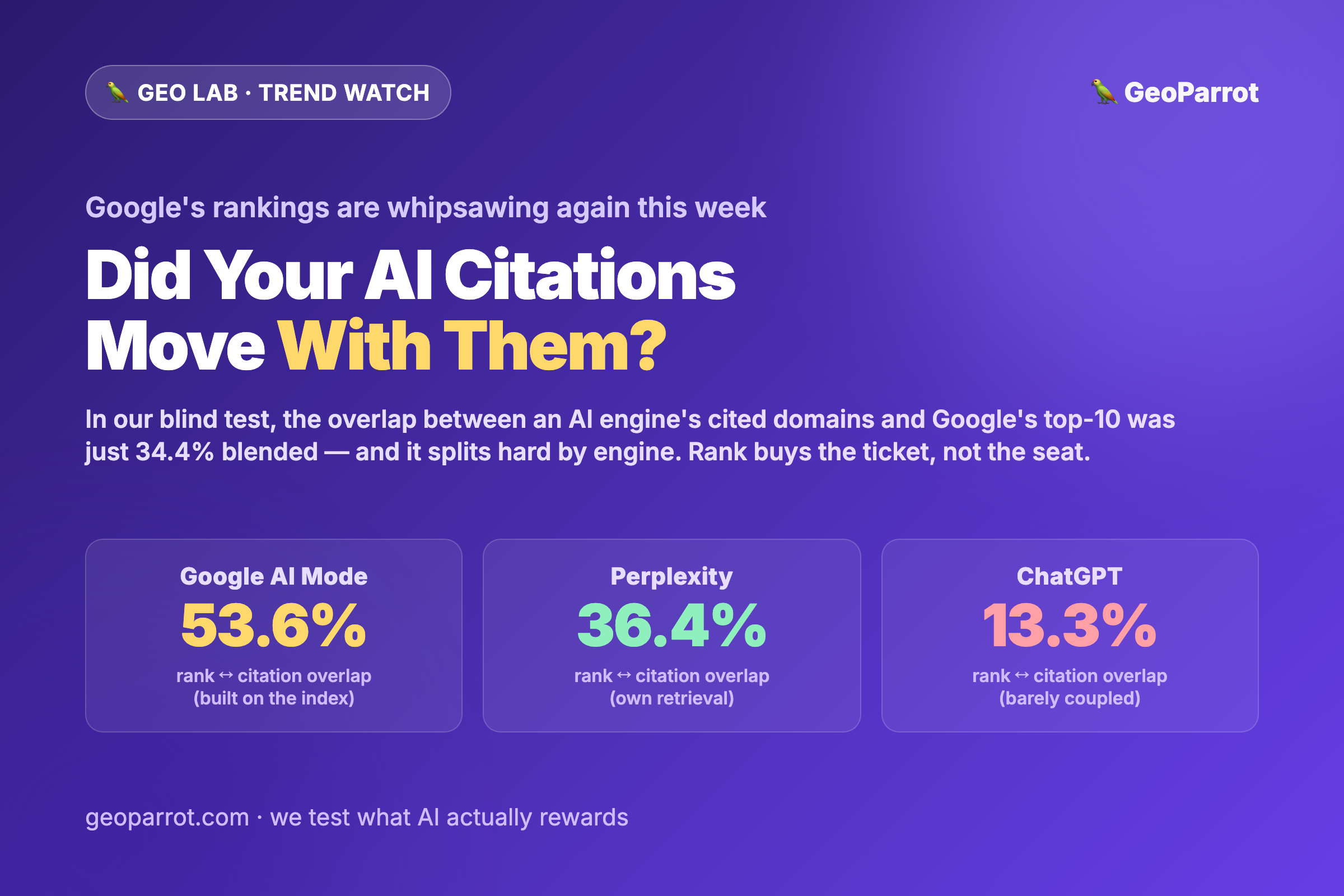
Quick answer: An unconfirmed Google update knocked rankings around on September 3–4, a chunk of it reversed on September 13, and trackers spiked again this week — Search Engine Roundtable called it “unusual” volatility and noted it “spike[d] up in a big way this week as well.” Natural next thought: my AI citations must be swinging too. Probably not — at least not in step. In our own blind test, the overlap between an AI engine’s cited domains and Google’s top-10 was 34.4% blended, split wildly by engine: 53.6% on Google AI Mode, 36.4% on Perplexity, 13.3% on ChatGPT. Rank buys the ticket, not the seat. So a normal ranking wobble is a weak, engine-dependent signal for your AI visibility — strongest on Google AI Mode (which is built on the index), nearly irrelevant on ChatGPT (which retrieves separately). Measure the two things separately before you touch anything.
Trend watch — published September 19, 2026. Search Engine Roundtable has been tracking an unconfirmed Google ranking update since early September; Barry Schwartz called the drop-then-reversal pattern “super weird,” and the September 18 recap noted volatility “spike[d] up in a big way this week.” We took the event and asked the question the SEO coverage skips: does a Google ranking swing move your AI citations at all? We answered it with our own pre-registered data — in the spirit of the GEO Lab.
What actually happened to Google’s rankings this week?
Short version: a lot of movement, none of it confirmed by Google. An unconfirmed update hit around September 3–4, 2026, and multiple large sites saw sharp ranking drops in both Search and Discover. Then, on September 13, a number of those same sites “completely surged back” — Barry Schwartz of Search Engine Roundtable called the drop-and-reversal pattern “super weird,” and stressed it wasn’t a tracking-tool artifact: the affected sites saw the drop and the recovery in their own first-party analytics. Volatility tools including Mozcast, Semrush, AccuRanker, Algoroo, Sistrix and DataForSEO all flagged the period as elevated, and the September 18 video recap reported it “spike[d] up in a big way this week as well — something is up.” Google has not announced a September core update.
That is the classic setup for a bad reflex. Rankings drop, panic sets in, and teams start rewriting pages, changing internal links, or — increasingly — worrying that their hard-won AI Overviews and ChatGPT citations are evaporating along with the rank. The GEO-specific question is whether those two things are even connected. If your AI citations don’t track your Google rank, then a ranking swing tells you almost nothing about your AI visibility, and reacting to one as if it were the other is how you break something that was fine.
Does a Google ranking swing move your AI citations?
This is exactly the question we ran a controlled test on — and the answer is “weakly, and it depends entirely on the engine.” We fact-checked the viral claim that rank-to-citation overlap collapsed from ~70% to under 20%, then refused to leave it at other people’s aggregates and pre-registered a blind test: 8 high-commercial-intent “best [category]” queries, predicted overlap bands written down before we collected anything. For each query we pulled Google’s top-10 organic domains and the distinct domains cited by Google AI Mode, Perplexity, and ChatGPT.
The measured overlap — the share of an engine’s cited domains that also rank in Google’s top-10:
- Google AI Mode — 53.6%. Built on top of Google’s own index, so it stays closest to the rankings. A #1 organic slot still lands you in AI Mode’s sources more than half the time — but ~47% of its citations come from outside the top-10.
- Perplexity — 36.4%. A third tracks Google’s rankings; two-thirds come from its own retrieval, heavy on review sites and community threads.
- ChatGPT — 13.3%. Rank barely predicted citation. For CRM it named vendors (Ecount, Freshworks, Pipedrive) that don’t sit in Google’s top-10 at all.
Blended, that’s 34.4% overlap with a 40.3-point spread across engines, on a correlation of roughly r ≈ 0.18. The one-line reading: rank buys the ticket, not the seat. A high ranking keeps you eligible to be cited, but on most engines it doesn’t decide who actually gets pulled into the answer. So when your rank oscillates in a volatility event, the mechanical link to your AI citations is loose — and on ChatGPT it’s almost nonexistent.
Why don’t AI citations track rank one-to-one?
Because the engines don’t all source the same way, and only one of them is really reading Google’s ranked results. ChatGPT and Perplexity run their own retrieval — Perplexity searches the web for nearly every query and leans on reviews and forums; ChatGPT skews toward brand-name recall over ranked-page fetching. Neither is looking up “what ranks #3 on Google right now,” so a Google ranking swing doesn’t propagate to them. Google AI Mode and AI Overviews are generated over Google’s index, which is why they show the highest coupling — but even there, the answer layer reaches past the top-10 to pull in vendor pages, comparison sites, and Reddit threads the organic ranking buries.
This is the same structural fact we keep hitting from other angles. The engines barely agree on who to cite in the first place: across our cross-engine test, the four major engines shared only 2 of 395 cited domains, with ~85% unique to a single engine — which is why there is no universal GEO strategy, and no universal reaction to a ranking event either. And the pages that get cited without ranking have their own signature — they tend to be more structured, more comparison-driven, more brand-named — which is exactly why a rank number can’t stand in for citation health.
When would ranking volatility actually hurt your AI citations?
Here’s the honest caveat, because “rank doesn’t matter for AI” would be the wrong lesson. On Google’s generative surfaces (AI Overviews, AI Mode), citations are drawn from the search index — so there is a floor of coupling, and a catastrophic, sustained drop is different from ordinary jitter. If a volatility event doesn’t just move you from position 3 to position 8 but pushes a page off the first few pages entirely (or de-indexes it), you can lose AI Mode eligibility for the queries where that page was the source. That’s a real risk worth watching.
But the September event, as reported, was position volatility with a partial reversal — sites dropped and many came back within days. That profile is very unlikely to flip your AI citations, especially on ChatGPT and Perplexity, which never saw the rank change at all. The distinction to hold: normal ranking volatility ≠ deindexing. The first is noise for GEO; only the second is a genuine AI-visibility threat, and even then it’s Google-surface-specific. One more scope note — this is us reasoning from our overlap data, not a live before/after measurement of citations during this specific update. We’re saying the mechanism is weak and engine-dependent, not that we A/B-tested this week’s swing.
How do you tell ranking volatility from citation volatility?
You measure them on separate instruments, which is the whole point. Rank volatility shows up in your rank tracker and Search Console’s classic Performance report. AI citation health is a different scoreboard: Google’s Search Console Generative AI report gives you impressions on Google’s AI surfaces (no clicks, Google-only), and your own GA4 setup for AI-referred traffic captures the sessions and conversions that actually reach your server from ChatGPT, Perplexity and the rest. If your rank tracker is red this week but your AI-referred sessions and AI-surface impressions are flat, you have ranking volatility, not citation volatility — and you should not “fix” the second by chasing the first.
Two guardrails while you read those dashboards. First, don’t over-read Google’s AI “position”: Google itself clarified that every link in an AI Overview shares the block’s position, not a rank, so a moving AI-position line during a volatility week is often layout, not your standing. Second, keep the counted-vs-inferred distinction in mind: your own AI-referred sessions are a counted event; a third-party “AI visibility score” jumping around this week is inferred and shouldn’t drive a reaction on its own.
The practitioner takeaway
- Don’t assume a ranking swing moved your AI citations. Overlap between rank and AI citation was 34.4% blended in our test — and just 13.3% on ChatGPT. The link is weak and engine-dependent.
- Watch rank and AI citation on separate instruments. Rank tracker + classic Search Console for rank; GSC Generative AI report + GA4 AI-referred traffic for citations.
- Separate volatility from deindexing. Position jitter with a reversal is GEO noise. A page falling off the index entirely can cost you AI Mode eligibility — that’s the one to watch.
- Hold steady during an unconfirmed update. The standard SEO advice (don’t make reactive changes) applies double for GEO — you’d be “fixing” a citation problem you can’t confirm exists.
- Act per engine, not on a blended number. Rank for Google AI Mode, get cited for ChatGPT, do both for Perplexity — see the per-engine GEO checklist.
Bottom line: Google’s rankings are having a genuinely weird week, and the SEO world is right to watch it. But a ranking swing is a poor proxy for your AI visibility — our data puts the rank-to-citation overlap at 34.4% blended, and near zero on ChatGPT. The engines that don’t read Google’s index never saw your rank change, and the one that does still pulls half its citations from outside the top-10. So track the two separately, reserve real concern for pages that actually leave the index, and don’t let a red rank tracker stampede you into rewriting content that your AI citations never noticed was ranked.
Frequently asked questions
Was there a Google algorithm update in September 2026?
There was significant ranking volatility, but no confirmed core update. An unconfirmed update hit around September 3–4, 2026, with sharp drops in Search and Discover for many large sites; a chunk of it reversed on September 13, and trackers flagged another spike in the following week. Google has not announced a September core update, so the movement remains officially unconfirmed.
If my Google rankings drop, will my AI citations drop too?
Not reliably. In our blind test across 8 buyer-intent queries, the overlap between AI-cited domains and Google’s top-10 was 53.6% on Google AI Mode, 36.4% on Perplexity, and 13.3% on ChatGPT — 34.4% blended. Rank keeps you eligible but doesn’t decide most citations, so a ranking swing is a weak, engine-dependent signal for AI visibility. The exception is a severe, sustained drop that removes a page from the index, which can cost you Google AI Mode eligibility.
Which AI engines are most affected by Google ranking changes?
Google AI Mode and AI Overviews are the most coupled, because they’re generated over Google’s search index (53.6% overlap with the top-10 in our test). Perplexity is moderately coupled (36.4%) since it runs its own retrieval. ChatGPT is barely coupled (13.3%) — it retrieves separately and leans on brand-name recall, so a Google ranking swing has almost no mechanical path to your ChatGPT citations.
How do I check whether my AI citations changed during a volatility event?
Use instruments built for AI visibility, not your rank tracker. Google’s Search Console Generative AI report shows impressions on Google’s AI surfaces (Google-only, no click data), and a GA4 setup for AI-referred traffic captures sessions and conversions arriving from ChatGPT, Perplexity, and other engines. If those are flat while your rank tracker is red, you have ranking volatility, not citation volatility.
Should I change my content in response to this ranking volatility?
Generally no, especially for an unconfirmed update with a partial reversal. The standard SEO guidance is to avoid reactive changes during unconfirmed volatility, and it applies even more to GEO: since rank predicts AI citation weakly, rewriting pages to “recover” your AI visibility is likely fixing a problem you can’t confirm exists. Hold steady, measure rank and AI citations separately, and act only on confirmed, sustained losses.
Leave a Reply