Evidence-first case study · sports brand SEO + GEO series, part 6 of 20
ASICS scored the highest AI citation rate we’ve measured in this series so far — 7 of 10 Google AI Mode queries cited asics.com or asics.co.kr — while its Korea site’s non-JS infrastructure is the most broken we’ve audited: /llms.txt and /sitemap.xml return the exact same near-empty ~4KB generic shell HTML as the homepage and every product page, and asics.com’s own /llms.txt and /sitemap.xml simply loop in an infinite redirect. High AI visibility and a technically threadbare machine-readable layer are coexisting on the same brand, which is itself a useful data point against treating AI citation as a reward for technical hygiene.
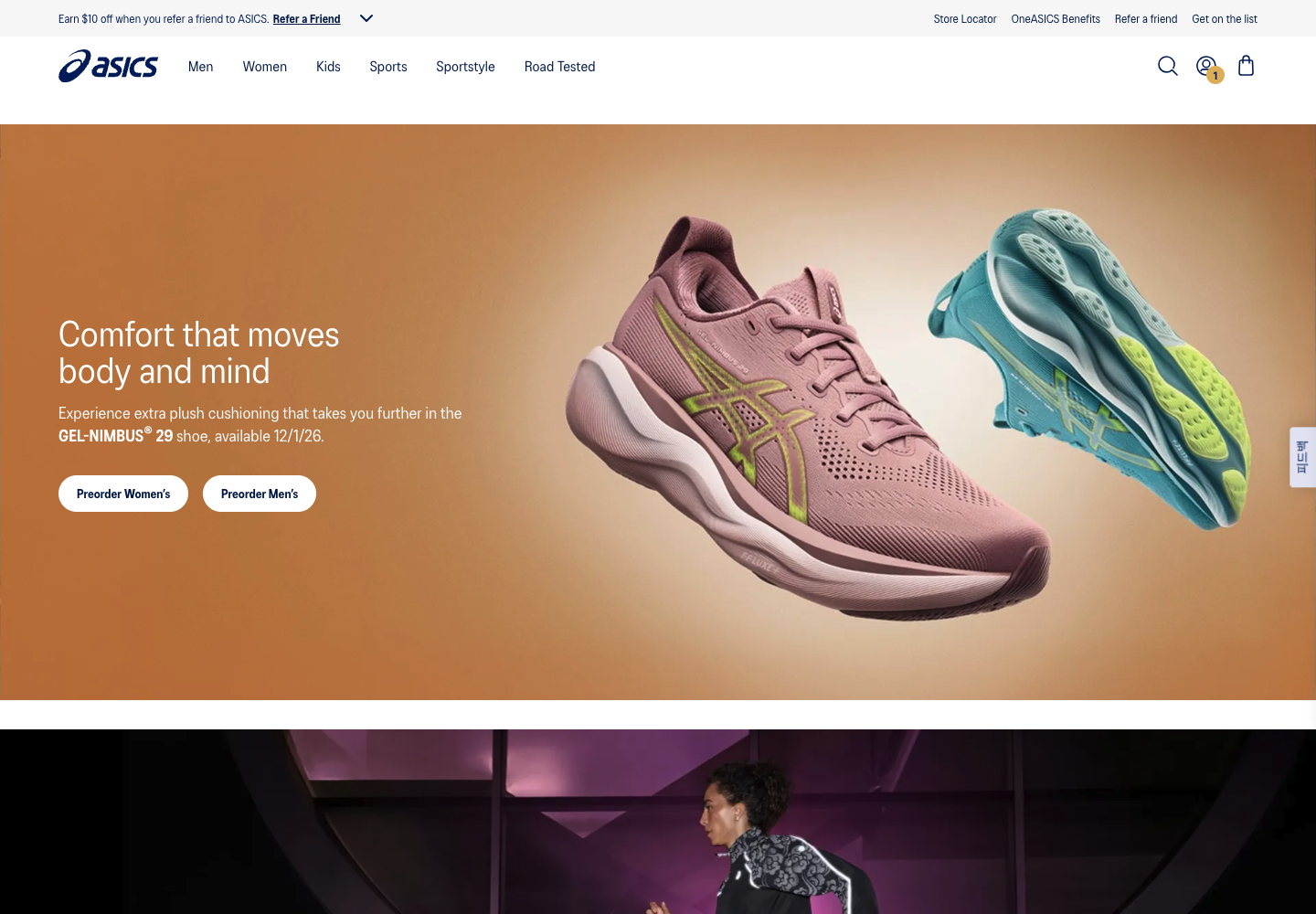
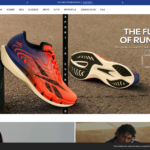
Actual public homepage captured during this audit, October 30-31, 2026.
What is ASICS.com trying to do — and why audit it sixth?
This is part 6 of GeoParrot’s sports-brand series, running the same evidence-first method we used on New Balance, Under Armour, Puma and Adidas. ASICS is a useful sixth name because, unlike New Balance’s licensee split, its Korea site (asics.co.kr) is clearly ASICS-branded and even carries an on-site warning about third-party sites impersonating it — yet the heritage running shoe we tracked, the GEL-KAYANO 33, was sold out in every colorway on that same Korea site during this audit.
Brand category Japanese performance running brand built on biomechanics research, with the GEL-KAYANO stability line as its longest-running heritage franchise (33rd edition at time of audit).
Primary user job Find the right GEL-KAYANO colorway and width, check fit/stability guidance, and get order or return help from a first-party support hub.
SEO + GEO challenge The highest AI-citation rate measured in this series so far is paired with the most structurally broken non-JS infrastructure we’ve found — redirect loops on the global site, a Korea site that serves identical near-empty content to any URL requested without JavaScript.
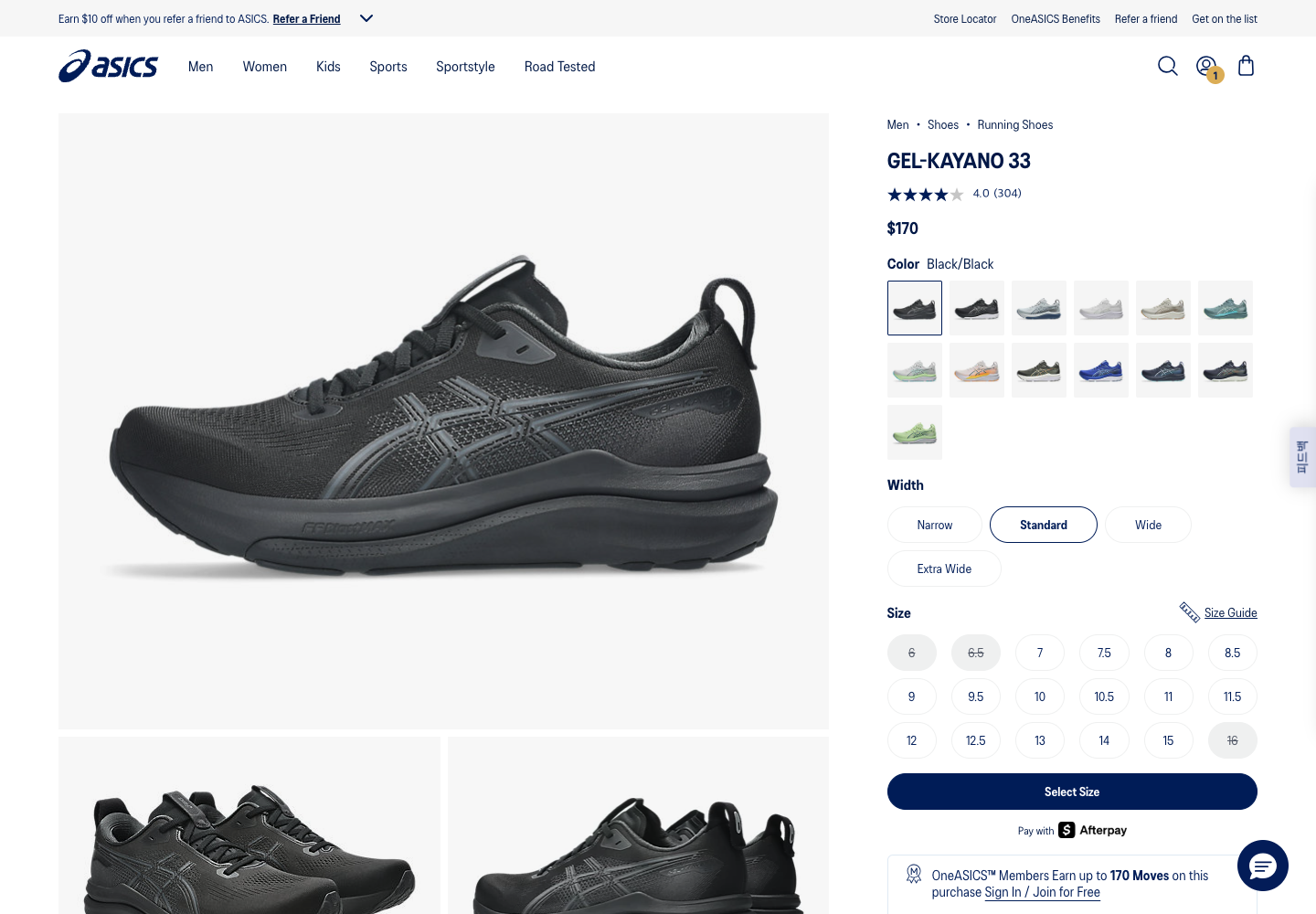
The product we tracked: GEL-KAYANO 33
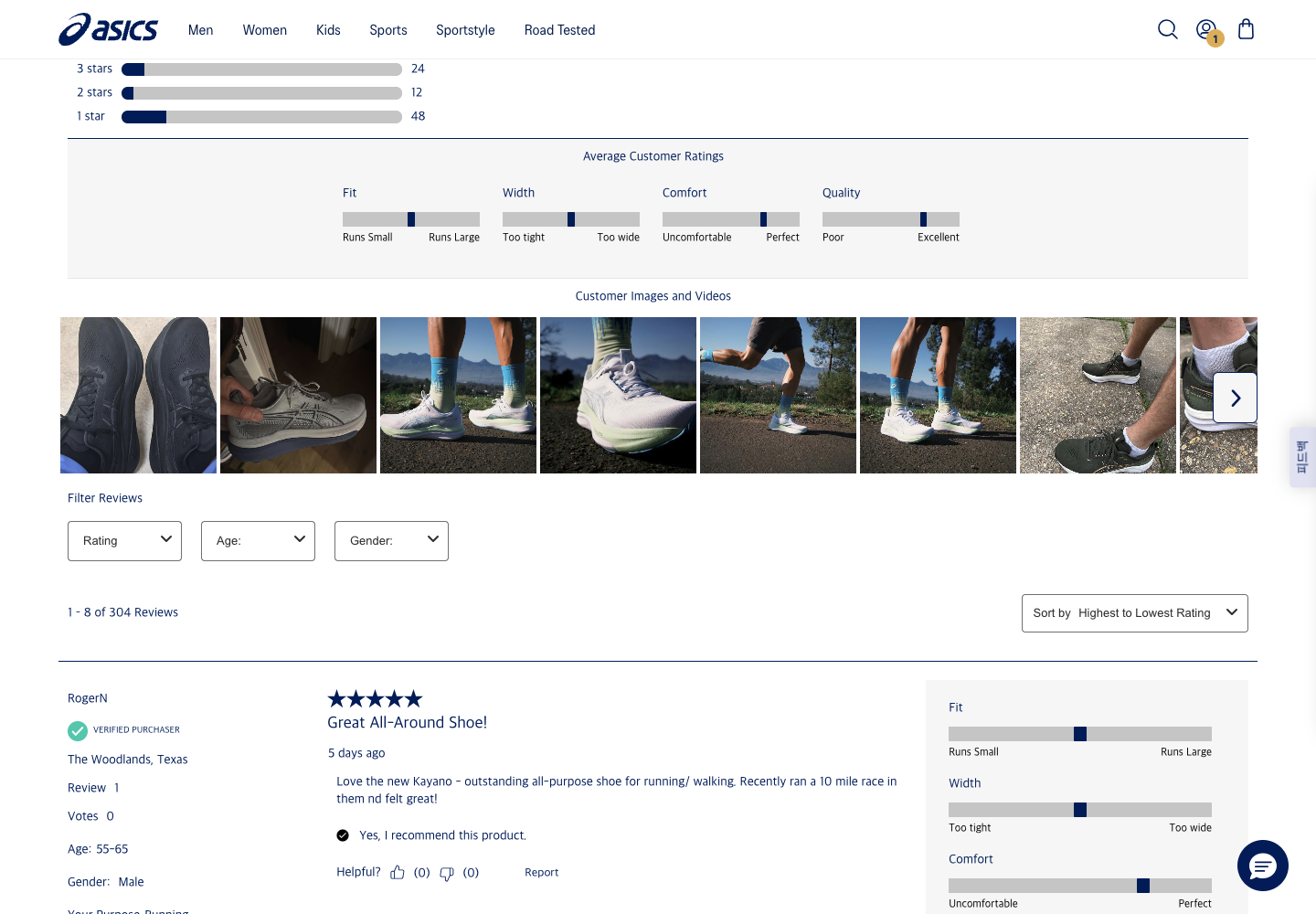
US product page: $170, a 4.0-star rating linking to 304 reviews, 13 colorways, narrow/standard/wide/extra-wide width options.Scrolling into the review section surfaces a visible star-distribution bar chart, customer photo/video carousel, and individually attributed reviews with age/gender/purpose metadata — the richest on-page review UI we’ve seen in this series, independent of whether it’s backed by schema (checked below).
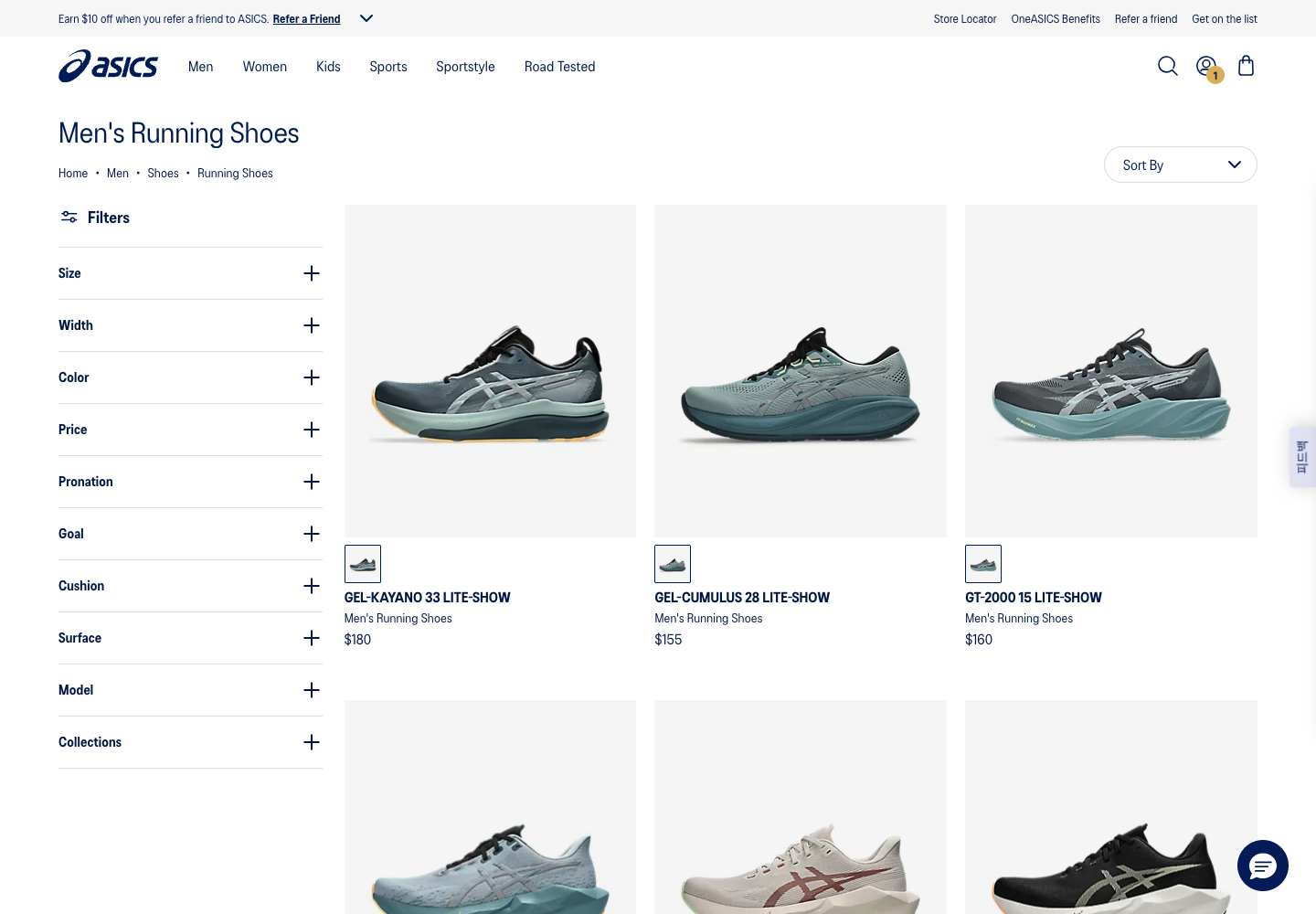
The category layer: “Men’s Running Shoes” with GEL-KAYANO 33 Lite-Show as the first featured tile, followed by GEL-CUMULUS 28 and GT-2000 15 — a clean, filterable grid (size, width, color, price, pronation, goal, cushion, surface, model, collections).
AI citation snapshot: 10 real queries, Google AI Mode
We sent 10 verbatim queries to Google AI Mode (udm=50) and checked both direct a[href] links and citation chip aria-labels for asics.com and asics.co.kr, including the Korean brand label “아식스.” Every citation below was verified against an actual captured URL or a chip label naming ASICS directly — no subreddit-name or substring false positives made it into the count (a failure mode we caught and corrected on Puma).
Query
ASICS domain cited?
Who else showed up
best asics gel-kayano colorways
✅ Yes
woovin.com, flightclub.com, thedropdate.com, eBay, StockX, ASOS — ASICS’ own UK regional PDP (asics.com/gb/en-gb) captured directly
asics gel-kayano 33 review
❌ No
Doctors of Running, RunRepeat, Running Magazine, Reddit, flawlessshoereviews.com — the sixth brand in a row where a third-party review site beat the brand’s own PDP on “[brand] [product] review”
asics vs brooks running shoes
❌ No
No usable hrefs or labelled chips captured at all — a measurement gap, not a confirmed non-citation
asics return policy
✅ Yes
ASICS-dominated result set — US return policy, Canada returns policy and the US warranty form page all captured directly
is asics true to size
✅ Yes
Reddit, RunRepeat, sneakerjagers.com, whentocop.com, size.co.uk — ASICS Australia’s own fit-guidance blog post captured directly
asics gel-nimbus vs gel-kayano
✅ Yes
RunRepeat, runningshoesguru.com, T3 — both asics.com (US blog + GEL-KAYANO category) and asics.co.kr (two URLs, including the mobile m.asics.co.kr subdomain) cited together
best asics running shoes 2026
❌ No
kicksown.com, Believe in the Run, RunRepeat, theruntesters.com, Run to the Finish, rtings.com, Fleet Feet — all third-party running-shoe review sites
oneasics rewards membership benefits
✅ Yes
rivo.io, loyaltyrewardco.com, Runkeeper — ASICS’ own OneASICS landing and discount-programs pages captured directly
is asics made in japan
✅ Yes
Wikipedia, Instagram, madeometer.com, Reddit — ASICS’ own corporate history page (corp.asics.com) captured directly
asics vs nike running shoes
✅ Yes
RunRepeat, Run to the Finish, Marathon Sports, nike.com — ASICS’ own UK running-shoe-finder tool captured directly, even on a head-to-head comparison query (unusual in this series)
Result: ASICS cited in 7/10 queries — the highest rate measured anywhere in this series so far (Nike 5/10, Adidas 4/10, Puma 5/10, Under Armour 8/10 under a looser regional-counting rule, New Balance 6/10). Two of the three misses were the same query types that have failed for every brand audited to date: the named-product review query and the “best [brand] shoes [year]” roundup query, both of which third-party editorial sites continue to dominate. The standout is “asics vs nike running shoes” — ASICS’ own tool was captured even on a direct head-to-head comparison, something most other brands in this series have not managed.
G-score audit: the 8-pillar hygiene checklist, six pages
We scored six representative ASICS URLs with the same 8-pillar static-HTML checklist (JSON-LD present, FAQ content, visible date, author byline, concrete data points, table/list structure, 3+ subheadings, a 30-500 character early answer) used in our Week 17 quality-score experiment and on the first five brands. asics.com sits behind an Akamai edge that returns a 403 to a plain HTTP fetch (the same pattern we hit on Adidas and New Balance), so the four US pages were scored from browser-rendered HTML instead. asics.co.kr fetched with a 200 status via plain HTTP for every page requested — but the HTML it returned was nearly empty regardless of URL (see the technical section below for why that matters more than the score itself).
Page
G-score
Passes
Fails
Men’s Running Shoes category (US)
0.75
JSON-LD, FAQ, data points, lists, subheadings, early answer
date, author
FAQ page (US)
0.75
JSON-LD, FAQ, data points, lists, subheadings, early answer
date, author
US homepage
0.625
JSON-LD, data points, lists, subheadings, early answer
FAQ, date, author
GEL-KAYANO 33 product page (US)
0.625
JSON-LD, data points, lists, subheadings, early answer
FAQ, date, author
Korea homepage (asics.co.kr)
0.0
none
all 8 pillars — fetched body contained effectively no extractable text
Korea GEL-KAYANO 33 product page
0.0
none
all 8 pillars — identical ~4.1-4.2KB shell to the homepage, not page-specific content
Average G-score across six pages: 0.4583 (Nike: 0.4375, Puma: 0.354, Under Armour: 0.5208, Adidas: 0.6458, New Balance: 0.5833) — middle of the series range. But the headline isn’t the average, it’s that the two Korea scores are a true zero: a plain-HTTP fetch of asics.co.kr’s homepage and of its GEL-KAYANO 33 product page returned nearly byte-identical ~4.1-4.2KB generic page shells (same meta tags, same GTM boilerplate, no product-specific text) — confirmed directly against the technical finding below.
robots.txt (asics.com) — A single blanket file covering every region under one User-agent: * block, with country-prefixed disallow rules for Japan, the US, Australia, Canada, the EU and New Zealand plus Salesforce Commerce Cloud boilerplate (login, checkout, account, wishlist paths). No AI crawler (GPTBot, ClaudeBot, PerplexityBot, Google-Extended) is named at all, positive or negative — matching Nike’s and Puma’s silence. No Sitemap: directive appears anywhere in the file.
llms.txt (asics.com) — broken — asics.com/llms.txt doesn’t return a 404 or a 200; it returns ERR_TOO_MANY_REDIRECTS, an infinite redirect loop that never resolves to any page. We confirmed this with a real browser session, not just curl. See our explainer on what llms.txt actually does before treating its presence or absence as a ranking factor — Google Search doesn’t read it regardless.
sitemap.xml (asics.com) — broken — Same failure mode as llms.txt: asics.com/sitemap.xml also loops in ERR_TOO_MANY_REDIRECTS rather than resolving. Combined with the missing Sitemap: line in robots.txt, we could not locate any working sitemap entry point for the global site during this audit.
robots.txt (Korea, asics.co.kr) — A short, generic file: disallows API, filter, search, account, order and admin paths, then an explicit Allow: /c/ and Allow: /p/ scoped specifically to Googlebot. No AI-crawler section at all, positive or negative.
llms.txt (Korea, asics.co.kr) — the headline finding — Returns a clean HTTP 200, so on a status-code check alone it looks like ASICS Korea has an llms.txt. It doesn’t: the response body is the site’s generic page-shell HTML (meta tags, Google Tag Manager script, a NetFunnel queueing widget) — the exact same markup, byte-for-byte near-identical, that the homepage and the product page also return to a non-JS request. There is no actual llms.txt content; the server appears to route any unmatched path to the same SPA shell rather than returning a true 404.
sitemap.xml (Korea, asics.co.kr) — also broken, differently — Here the status code is legitimate (200, Content-Type: application/xml, a last-modified header dated December 16, 2025) but the response body is zero bytes. A sitemap that reports itself as six-week-old XML while serving nothing is arguably worse than a missing one: it will pass an automated “sitemap exists” check while giving a crawler no URLs at all.
The pattern behind all three Korea failures — We fetched asics.co.kr’s homepage and its GEL-KAYANO 33 product page with plain HTTP (no JavaScript execution) and got back near-identical ~4.1-4.2KB generic shells regardless of which URL we requested. That’s consistent with a server that serves one static template to any non-browser request and defers all real content to client-side JavaScript. A browser-based crawler (like the one we used for screenshots) sees the full site; a text-only or non-JS-executing crawler — which is how several AI engines’ retrieval layers are documented to operate — would see the same near-empty shell whether it requested the homepage, a product page, or a file that doesn’t exist.
Product schema and reviews — US only testable — Because asics.co.kr’s non-JS response carries no markup to inspect, we could only check product schema on the US GEL-KAYANO 33 page: JSON-LD is present and the page passed our pillar check, but the visible review UI (4.0 stars, 304 reviews, a star-distribution bar chart, customer photos) sits in front of a rating curve worth noting on its own terms — 48 one-star votes outnumber both the 24 three-star and 12 two-star counts, a U-shaped rather than smoothly declining distribution, visible directly on the page regardless of what’s in its schema.
Locale and stock — a different kind of gap — Unlike New Balance’s licensee split or Under Armour’s separate ccTLD, asics.co.kr is clearly ASICS-branded — it even displays a banner warning shoppers about sites impersonating ASICS Korea. But the GEL-KAYANO 33 we tracked was marked 품절 (sold out) on its Korea product page, and every visible colorway (4 shown) on the Korea GEL-KAYANO 33 listing page was also sold out at the time of this audit, versus 13 in-stock colorways on the US site for the same model.
What works / What to verify
WHAT WORKS
The highest AI citation rate measured in this series (7/10), including a captured citation on a direct brand-vs-competitor query (“asics vs nike”) that most other brands here have not managed, plus a genuinely rich on-page review UI (distribution bars, photo/video carousel, attributed reviews) on the US product page.
WHAT TO VERIFY
Whether the redirect loops on asics.com’s /llms.txt and /sitemap.xml are a temporary misconfiguration or a long-standing gap; whether asics.co.kr’s near-empty non-JS response is intentional bot-gating or an unaddressed SPA-rendering limitation; and whether the GEL-KAYANO 33 stockout on the Korea site was a snapshot-in-time inventory gap or a longer pattern worth re-checking.
Target query check — reported honestly, not inflated
We have not re-measured “asics seo” or “asics geo audit” query volume this session. Per the pattern already confirmed across ten earlier subjects in this series on October 20, 2026 (Keyword Planner, US) — the large majority showed no measurable search volume at all for “[brand] SEO/GEO audit” phrasing — we’re not claiming this title drives ranking-based traffic. The distribution case for this series rests on internal links, our own index, and readers already following the GEO Lab arc, not on search demand for “[brand] SEO audit” as a query.
Frequently asked questions
Does ASICS’ 7/10 AI citation rate mean its SEO/GEO setup is in better shape than other brands in this series?
Not by our technical findings — the opposite pairing, in fact. ASICS has the highest citation count we’ve measured (7/10, versus New Balance 6/10, Under Armour 8/10 under a looser counting rule, and 4-5/10 for Nike, Adidas and Puma) while also having the most broken non-JS infrastructure in the series: redirect loops on two global-site files and a Korea site that serves identical near-empty shells regardless of URL. This audit is itself evidence against assuming citation rate tracks technical hygiene.
What does it mean that asics.co.kr’s llms.txt and sitemap.xml return a 200 status but no real content?
It means an automated check that only looks at HTTP status codes would wrongly report both files as present and healthy. The llms.txt request gets back the site’s generic page shell (not a true 404, not real llms.txt content); the sitemap.xml request gets back a 200 with correct XML headers and a recent last-modified date, but a literal zero-byte body. Status-code-only monitoring would miss both problems.
Why was the GEL-KAYANO 33 sold out on ASICS Korea but not on the US site?
We can only report what we observed at the time of this audit (October 30-31, 2026): all 4 visible colorways on the Korea GEL-KAYANO 33 listing page showed a 품절 (sold out) badge, and the specific colorway we tracked (Lite-Show, 209,000원) showed a disabled 품절 button on its product page, versus 13 in-stock colorways for the same model on asics.com/us. We did not investigate restocking schedules or regional allocation — this is a snapshot, not a trend claim.
Does a G-score of 0.0 on both Korea pages mean they have zero SEO value?
No — it means a non-JS text fetch of those specific URLs returned almost no extractable content at the moment we checked, which is what our 8-pillar checklist measures. A real browser session (what we used for the evidence screenshots) renders the full site correctly; Google’s own crawler executes JavaScript and would likely index the rendered content. The G-score here is a proxy for what a simpler, non-JS-executing bot or retrieval system would see, not a claim about how Google ranks the page.
Audit evidence, scope and limits
Inspected: October 30-31, 2026, public logged-out access from a Korea-based IP (real browser session used throughout for screenshots and citation testing). Screens: US homepage, Men’s Running Shoes category, GEL-KAYANO 33 product page (top and reviews), US FAQ page, Korea homepage, the Korea GEL-KAYANO listing, and the Korea GEL-KAYANO 33 Lite-Show PDP — plus robots.txt, sitemap.xml and llms.txt checks on both domains (browser-session fetches, since asics.com sits behind an Akamai edge that blocks plain curl with a 403), a 10-query Google AI Mode citation snapshot, and an 8-pillar G-score scored on six fetched pages.
Not measured: rankings, Search Console performance, analytics, conversion, signed-in/member flows, ChatGPT citations (not attempted, given the composer failures flagged on earlier audits in this series), or the complete product/locale catalogue beyond the one shoe and six URLs sampled here. This is a public-signal snapshot, not a performance claim or a full-catalogue crawl.
This is part 6 of a daily series. Every day, GeoParrot runs this same evidence-first method — real screenshots, a 10-query AI citation snapshot, an 8-pillar G-score audit, and an honest target-query check — against one more major sports and athletic-wear brand. Next: Lululemon.





Leave a Reply