
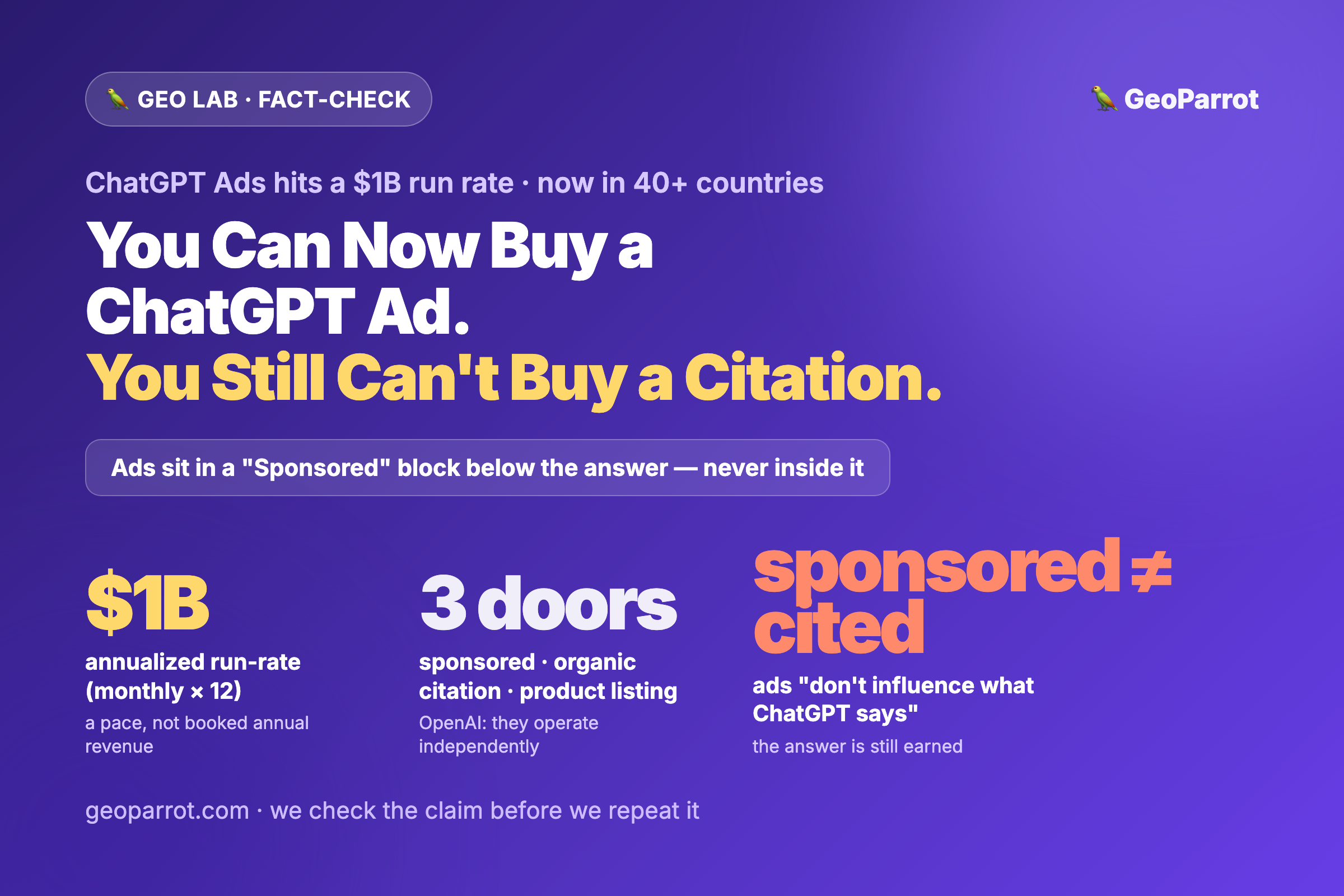
Quick answer: OpenAI says ChatGPT Ads has crossed a $1 billion annualized revenue run rate and is now buyable in 40+ countries, with self-serve Ads Manager opening the platform to small and mid-sized businesses. It’s a genuine structural shift in the answer engine most people optimize for — but it doesn’t change what GEO is chasing. By OpenAI’s own design, ads appear in a labeled “Sponsored” block below the answer, visually separated, and OpenAI states they don’t influence what ChatGPT says. So there are now three independent ways a brand shows up in ChatGPT — a sponsored placement, an organic citation inside the answer, and a product listing — and they operate independently. Translation: you can buy a slot, but you can’t buy your way into the generated answer. Sponsored ≠ cited. Don’t move your GEO budget into ads expecting citations, and don’t confuse an ad auction win with earning the recommendation.
Trend watch — published September 5, 2026. This is a fact-check post: we report what OpenAI actually announced, separate the milestone from the “ads are the new GEO” hype, flag what the “$1 billion” number does and doesn’t mean, and connect it to the citation thesis we keep testing in the GEO Lab.
What did OpenAI actually announce?
OpenAI said ChatGPT Ads has reached a $1 billion annualized revenue run rate and expanded where advertisers can buy: as of late August, advertisers in India, Europe, the Middle East, and North Africa can purchase directly through Ads Manager, and ads are now live across more than 40 countries. The self-serve Ads Manager, opened earlier this year, brought in small and mid-sized advertisers who OpenAI says now account for a “material share” of the business. OpenAI has publicly targeted roughly $2.5 billion in ad revenue this year, part of a company revenue picture tracking toward an annualized figure north of $40 billion.
That’s the news, and it’s real: advertising inside the world’s most-used AI assistant has gone from pilot to a billion-dollar-pace business in well under a year. The reflex in a lot of marketing feeds this week is “ads are the new GEO — buy your way in.” Before you reallocate a dollar, it’s worth reading OpenAI’s own description of how these ads actually work, because it draws a hard line that most of the hot takes skip over.
Does buying a ChatGPT ad get me cited in the answer?
No — and this is the assumption to kill first. By OpenAI’s design, an ad appears as a labeled “Sponsored” block below the response, visually separated, and it does not get woven into the generated text. OpenAI has been explicit that ads don’t influence what ChatGPT says in its answer. In practice that means a brand can show up in ChatGPT through three distinct doors — a sponsored placement, an organic citation inside the answer, or a product listing on commercial queries — and those doors operate independently of each other. Winning the ad auction opens door one. It does nothing for doors two and three.
This is the same wall we keep running into from the organic side, now confirmed from the paid side. Our experiments have shown repeatedly that being listed is not the same as being picked: when we tested whether brands could rank themselves into AI answers with their own “best-of” listicles, the self-ranking play mostly failed — engines cited the listicle and then recommended a competitor. And when we reverse-engineered what actually drives the pick, the lever was category reputation, not the countable signals you can manufacture. Now add a third axis: sponsored ≠ cited. A paid slot rents you attention next to the answer; it does not rent you the trust inside it.
How is this different from Google putting ads in AI answers?
It’s a good reminder that “AI ads” is not one thing. A few days ago we covered Google putting ads inside AI answers — its “Highlighted Answers” and Conversational ads sit above and are generated in an answer-like, explainer format that blends into the AI surface. ChatGPT, by contrast, keeps the sponsored unit in a separate block below the answer and states it never enters the generated text. Same category — “ads in AI search” — but a materially different placement, labeling, and relationship to the organic answer on each engine.
Which is exactly why there’s no universal GEO strategy. Our cross-engine citation study found four engines answering the same 15 questions shared only two common cited domains out of 395 — over 85% of cited sources were unique to a single engine. If organic citation behavior barely overlaps across engines, ad mechanics overlap even less. “Ads work like X on Google” tells you almost nothing about how they work on ChatGPT. Read each engine’s own documentation, then verify against your own data — don’t port a tactic across a headline.
What does the “$1 billion” number actually mean?
Here’s the fact-check part, because the number is being repeated loosely. A “$1 billion annualized run rate” is not $1 billion in revenue — it’s the current monthly ad revenue multiplied by twelve. It describes the pace of the business right now, not money booked over a full year. That’s a legitimate and impressive metric, but it’s a projection, and it will move up or down with monthly numbers. Treat the headline the way we treat any AI-search claim: note what’s measured (monthly pace, annualized), note what isn’t (booked annual revenue, how many answers actually carry an ad), and don’t repeat the loose version.
The same discipline applies to the “half of answers now have ads” style claims floating around aggregator posts — those are third-party estimates, not OpenAI disclosures, so don’t build a strategy on them. This is the inverse of the vanity-metric trap we’ve warned about, where people optimize a self-reported “share of voice” score that measures the wrong thing. The honest posture is the same in both directions: only act on numbers you can actually see and source.
What should you actually do this week?
- Don’t move GEO budget into ads expecting citations. Ads and organic citations are different doors. If your goal is to be the source ChatGPT recommends, ads don’t buy that. If your goal is bottom-of-answer visibility on commercial queries, ads may be worth a test — but budget them as ads, not as GEO.
- Keep the two programs separate — and measured separately. Track ad performance in Ads Manager; track organic citations and referral traffic on their own, per engine, using the same discipline in our AI-search traffic tracking guide. Don’t let an ad win flatter your organic reporting.
- Don’t assume ChatGPT ad mechanics port to other engines. Google’s ads-in-answers behave differently. Read each engine’s own rules; verify with your own data before you scale.
- Invest where it travels across every door. The signal that keeps predicting organic citation — earned brand mentions and category authority, not schema tweaks — is exactly what a sponsored block can’t buy you and what carries across engines. That’s the highest-confidence work.
- Use OpenAI’s numbers, not the loose ones. Run rate is a pace, not booked revenue, and “X% of answers have ads” is a third-party estimate. Cite what’s sourced; flag what isn’t.
Bottom line: A billion-dollar-pace ad business inside the biggest AI answer engine is a real shift, and if you sell on commercial queries, sponsored placements are now a channel worth evaluating. But it doesn’t change what GEO is for. OpenAI keeps ads in a separate, labeled block that doesn’t touch the answer, and says as much out loud: the citation inside the response is still earned, not bought. So run ads as ads, keep earning the reputation that gets you cited, measure the two apart — and, as always, check the claim before you repeat it.
Frequently asked questions
Can I pay to get cited in a ChatGPT answer?
No. ChatGPT ads appear in a labeled “Sponsored” block below the response, visually separated from the answer, and OpenAI states ads don’t influence what ChatGPT says. A brand can appear through a sponsored placement, an organic citation inside the answer, or a product listing — but these operate independently. Buying an ad gets you the sponsored block, not a citation inside the generated answer.
What is a “$1 billion annualized run rate”?
It’s the current monthly ad revenue multiplied by twelve — a measure of the pace of the business right now, not $1 billion in revenue actually booked over a full year. It’s a real milestone, but it’s a projection that moves with monthly numbers, so it shouldn’t be repeated as if it were annual revenue on the books.
Should I shift my GEO budget into ChatGPT ads?
Only if your goal matches what ads deliver. Ads buy a sponsored slot below the answer on commercial queries; they don’t buy the organic citation or recommendation inside the answer. If you want to be the source ChatGPT recommends, keep investing in earned reputation and category authority. If you want bottom-of-answer commercial visibility, test ads — but budget and measure them as advertising, not as GEO.
Are ChatGPT ads the same as Google’s ads in AI answers?
No. Google’s “Highlighted Answers” and Conversational ads sit above and are generated in an answer-like explainer format that blends into the AI surface, while ChatGPT keeps its sponsored unit in a separate block below the answer and states it never enters the generated text. Same category, different placement, labeling, and relationship to the organic answer — which is why ad tactics don’t port cleanly between engines.
Does a booming ad business mean fewer organic citations?
There’s no published data showing ads displace organic citations in ChatGPT — the sponsored block is separate from the answer by design. Treat “ads will crowd out citations” as a hypothesis to measure, not a fact: watch your own referral traffic and citation rate per engine over time. If you see a change, that data is the finding; don’t pre-emptively re-architect your program around a fear.
Leave a Reply